
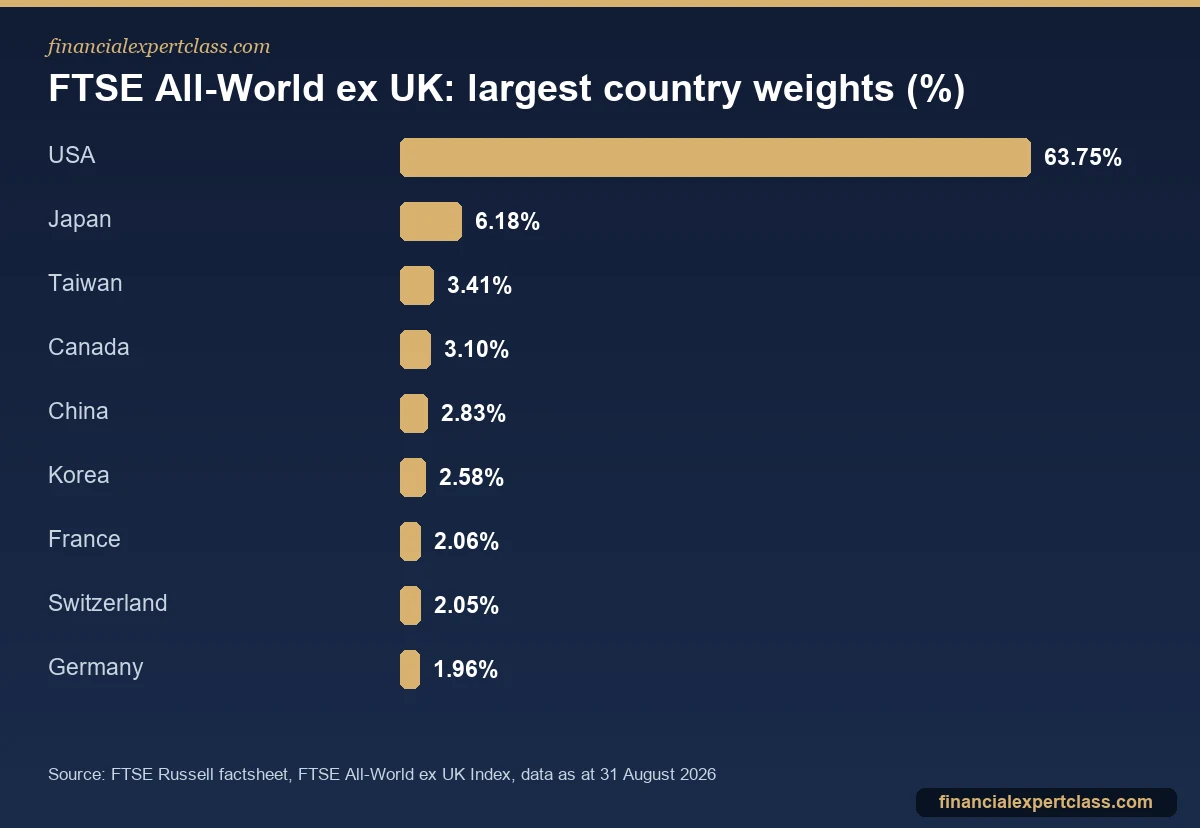
The FTSE All-World ex UK Index is the FTSE All-World with British companies taken out. At 31 August 2026 it held 4,171 large and mid-sized companies across developed and emerging markets, with the US at 63.75%. UK investors use it, or a close equivalent, when they want to hold their UK shares in a separate fund. That way they control that allocation themselves.
New to ETFs? Start with the free checklist.
The European ETF Starter Kit: what to check before you buy your first UCITS ETF — domicile, costs, tax and broker set-up.
What the index holds
FTSE Russell builds the All-World ex UK from its Global Equity Index Series. That is the same universe as the FTSE All-World Index. It is market-capitalisation weighted and uses free-float adjusted share counts. It also applies a liquidity screen, and FTSE Russell reviews it twice a year, in March and September. The only difference from the parent index is that it excludes UK-listed constituents.
Taking out the UK removes 93 companies. The All-World had 4,264 constituents at 31 August 2026, and the ex-UK version 4,171. Because the UK was 3.20% of the All-World, every other country’s weight rises slightly. For example, the US goes from 61.71% to 63.75%, and Japan from 5.98% to 6.18%. In addition, the ten largest companies (led by Nvidia, Apple and Microsoft) go from 23.73% to 24.51% of the index.
By sector, technology is the largest slice at 35.14% under the Industry Classification Benchmark (ICB) supersectors. Next come industrial goods and services at 11.04% and banks at 8.06%. The dividend yield was 1.52%, a little lower than the full All-World’s 1.57%. That is because the UK market pays relatively high dividends, so removing it lowers the average.
All-World ex UK vs All-World vs World ex UK
Three similar names cause most of the confusion. The table shows how they differ.

- FTSE All-World includes the UK and emerging markets. It is what one-fund trackers such as Vanguard’s FTSE All-World ETFs follow.
- All-World ex UK keeps the emerging markets but drops the UK. As a result, it is the natural partner for a separate UK fund.
- World ex UK covers developed and advanced emerging markets only. So it has far fewer stocks (2,391) and a heavier US weight (67.34%). Countries FTSE classes as secondary emerging markets, such as China and India, are outside it.
There is also the FTSE Developed ex UK index, which drops emerging markets altogether. That is the index behind one of the most widely held UK funds in this space, which we cover below.
Why UK investors choose an ex-UK index
The main reason is control over home bias. That means deliberately holding more of your own country’s shares than its share of world markets. In the All-World, the UK is only about 3%. Plenty of UK investors want more than that, because their future spending, pension and liabilities are in pounds. Others like the dividend income of UK large caps. However, if you add a UK fund on top of a full All-World tracker, you end up counting UK companies twice. Then the arithmetic gets messy.
Splitting the portfolio into “UK” and “world ex UK” makes the decision explicit. For example, you might hold 80% in an ex-UK global fund and 20% in a UK index fund. That UK fund could track the FTSE 100 or FTSE All-Share. You then rebalance between the two once a year. The split is a personal choice, since there is no official “correct” UK weight.
The currency question
Currency is the other consideration. Every company in an ex-UK index trades outside sterling, mostly in dollars, yen and euros. So the value of the fund in pounds moves with exchange rates as well as with share prices. When the pound weakens, overseas holdings are worth more in sterling. When it strengthens, they are worth less. A separate UK fund gives you a slice of the portfolio priced in pounds. Some investors find that reassuring when their bills are in pounds too. Currency-hedged share classes exist for some global funds. However, they add cost and complexity, and most long-term equity investors accept the currency swings.
The trade-off is complexity. Two funds need rebalancing. Also, a large UK overweight concentrates you in one market with its own sector mix (more banks, energy and consumer staples, less technology). If you have no strong view on home bias, a single global fund is simpler.
How to invest in the FTSE All-World ex UK
Fewer retail funds track this exact index than track the full All-World. So most UK investors build the same exposure from two pieces:
- A developed world ex-UK fund. The best-known is the Vanguard FTSE Developed World ex-U.K. Equity Index Fund, a UK OEIC that tracks the FTSE Developed ex-UK Index. Its factsheet showed an ongoing charges figure (OCF) of 0.14%, total assets of £32,753 million and 1,891 holdings at 31 August 2026. The US made up 71.1% and Japan 6.9%.
- An emerging markets fund for the part the developed fund leaves out. Our guide to the best emerging markets ETFs compares the main UCITS options.
If you want to replicate the index, weight the two roughly in line with it. In the ex-UK index, emerging markets such as China, Taiwan, India, Brazil and Saudi Arabia make up around a tenth of the total. However, the exact figure depends on the index provider’s country classifications. FTSE, for example, treats Korea as a developed market.
Before you buy, check the specific share class on your platform. Look at its OCF and whether it is accumulating (dividends reinvested) or income (dividends paid out). Also compare the platform’s own charges for funds versus ETFs. Our global ETF guide for UK investors compares the one-fund alternatives if you decide against splitting.
Pairing it with a UK fund: a worked example
Suppose you invest £20,000 a year into a stocks and shares ISA and want 20% in UK shares. You would put £16,000 into the ex-UK global fund and £4,000 into a UK index fund. After a year in which global shares outperform the UK, the split might drift to 83/17. At your annual review, you direct new money into the UK fund until you are back at 80/20. Alternatively, you sell a little of the global fund inside the ISA, where there is no capital gains tax.
Doing this inside an ISA or SIPP matters. In a general account, rebalancing can trigger capital gains tax once gains exceed the annual exempt amount. Our ISA, LISA and SIPP decision tree explains which wrapper to use first.
Frequently asked questions
What is the FTSE World ex UK index?
It is FTSE Russell’s index of large and mid caps from developed and advanced emerging markets, excluding the UK. It held 2,391 stocks at 31 August 2026, with the US at 67.34%. Unlike the All-World ex UK, it leaves out secondary emerging markets such as China and India.
How is the FTSE All-World ex UK different from the FTSE All-World?
It is the same index with UK companies removed. At 31 August 2026 that meant 4,171 stocks instead of 4,264, and a US weight of 63.75% instead of 61.71%. The UK had been 3.20% of the All-World.
Is there a Vanguard FTSE All-World ex UK fund?
Vanguard’s widely held ex-UK fund is the FTSE Developed World ex-U.K. Equity Index Fund, which tracks the FTSE Developed ex-UK Index. It leaves out emerging markets. So investors who want full coverage of the ex-UK index usually add a separate emerging markets fund.
Should a UK investor use an ex-UK global fund?
Only if you want to hold more UK shares than the roughly 3% a global index gives you, and manage that split yourself. If you are happy with the market weight, a single global fund is simpler and avoids double-counting UK companies.
Cited sources: FTSE Russell: FTSE All-World ex UK Index factsheet, FTSE Russell: FTSE All-World Index factsheet, FTSE Russell: FTSE World ex UK Index factsheet, and Vanguard FTSE Developed World ex-U.K. Equity Index Fund factsheet. Verify current fund figures before investing. Educational content, not financial advice.
Not personalised financial advice. Verify your situation with a qualified adviser. Operated by Aurum Digital Marketing LTD (UK), Companies House 15203665.
European UCITS/ETF investor with 11+ years building a global dividend and index portfolio, and founder of Financial Expert Class. I write every guide here from first-hand experience investing across EU brokers and tax regimes — not theory. More about me →