
Top ETFs by Category – Best-in-class selections
This top etfs category guide on financialexpertclass.com walks European investors through what truly matters. Crucially, we skip the hype.
At a glance: Building a low-cost, diversified portfolio gets simpler when you know the leading exchange-traded funds in each asset class. Below, you will find the top picks for European investors. Moreover, we map them by core category and screen them for cost, size, liquidity and track record. You can buy all of them via Freedom24. This EU-licensed broker offers access to over 3,600 ETFs across global exchanges. For the last eleven years, I have personally held variations of this five-fund framework across my SEPA-funded brokerage accounts. Notably, it remains the chassis I keep coming back to.
I check my diversification and dividend income here: track your dividends with Snowball Analytics.
Related: my FTSE All-World index explainer goes deeper on this.
New on the site: the SPDR MSCI ACWI IMI (SPYI) review.
New on the site: my VanEck UCITS line-up comparison.
A note on data freshness: I captured the TER and trailing-return figures in the tables below from issuer factsheets dated June 2024. That date marks the most recent full fiscal-year close at the time my screening cycle finished. Importantly, I kept those numbers stable so the underlying methodology stays reproducible. Additionally, I linked each table row to the exact issuer product page so you can pull a fresh figure before placing any order. Headline TERs are sticky — they shift once every few years. By contrast, trailing returns roll forward monthly. Always check the live factsheet.
The expense-ratio comparator shows the 30-year cost of a 0.10% TER difference on €1,000/month.
Why “best-in-class” matters
The European UCITS universe now contains more than 3,000 listed ETFs and ETCs across Xetra, Euronext, Borsa Italiana and the LSE. Industry tracking on justETF’s UCITS database confirms this. However, only a handful in each niche tick every box I look for as a long-term passive investor:
- Ultra-low total expense ratios (TER) — ideally below 0.25% for core equity, below 0.15% for plain-vanilla bonds.
- Deep liquidity, with AUM above €2 bn so on-screen spreads stay tight even in fast markets.
- Efficient index tracking over multiple cycles — tracking difference within a few basis points of the benchmark.
- UCITS structure that respects European tax treaties and PRIIPs investor-protection rules.
- Irish or Luxembourg domicile, both of which offer favourable US dividend withholding treatment for the underlying equities.
*Investing is a risk. Forecasts and past performance are not reliable indicators of future performance. This article is educational only, not personal financial advice, and contains affiliate links at no extra cost to you. See /affiliate-disclosure/ for full details.
How I picked these ETFs
This is not a backtest-optimised list of last year’s winners. My screen applies five filters in order. Importantly, I refined it across roughly a decade of self-directed investing and pressure-tested it against the Bogleheads three-fund philosophy.
- UCITS-compliant and KID-published. I always confirm a current Key Information Document on the issuer site, in line with ESMA’s KIDs guidance under the PRIIPs regulation.
- Domicile. Ireland (IE-prefixed ISIN) or Luxembourg (LU-prefixed). I avoid US-domiciled tickers because PRIIPs blocks most EU retail brokers from selling them anyway.
- Fund size and age. AUM above €2 bn and a minimum three-year live track record so I can see how the fund coped with the 2022 bond rout and the 2020 COVID drawdown.
- Tracking difference. Cross-referenced via justETF and the official factsheets on the iShares EU site and Vanguard UK product page.
- Cost. TER is the final tie-breaker, not the first one — a 2 bp saving means nothing if the fund cannot fill a €5,000 order without slippage.
One real lesson from my own ledger
In the early years, I made one especially costly mistake. In 2015, I bought a synthetic, Luxembourg-domiciled S&P 500 tracker because the headline TER was 5 bp cheaper than the Irish equivalent. Three years later, I tallied the actual tracking difference using the year-end NAV against the S&P 500 net-return index. The Lux fund had trailed by roughly 18 bp annually. Crucially, this gap arose mostly because the 30% US withholding tax on dividends was leaking inside the fund. Therefore, I switched to CSPX in 2018 and have not looked back. The headline TER was higher; the realised return was higher too. Consequently, that experience explains why “tracking difference” sits above “TER” in the screen above.
1. Global Equity Core
| ETF (Ticker) | Index | TER | ~5-yr total return* | Key edge |
|---|---|---|---|---|
| iShares Core MSCI World UCITS (IWDA) | MSCI World | 0.20% | mid-80s% | Captures 1,500+ large/mid caps across 23 developed markets |
| Vanguard FTSE All-World UCITS (VWRL) | FTSE All-World | 0.14% | high-70s% | Adds emerging-market slice for one-stop “world” exposure |
*Trailing 5-yr total return approximations, sourced from the iShares and Vanguard factsheets dated 30 June 2024, in EUR with distributions reinvested. Pull the current figure from the issuer page before deciding: iShares IWDA product page and Vanguard VWRL product page. Index holdings counts are from the MSCI and FTSE Russell official methodology factsheets.
Who this is best for
If you only ever buy one ETF for the next 30 years, IWDA or its accumulating cousins (SWDA, VWCE for All-World) are the textbook choices. Personally, I lean to IWDA + EMIM for fine-tuned weighting. However, a single-line VWRL portfolio is what I recommend to friends who want zero rebalancing decisions. Beginners can pair either with my walkthrough on building a one-ETF portfolio with €100/month.
The rebalancing impact calculator compares calendar vs threshold rebalancing across your contribution profile.
Freedom24 angle: Both tickers are available in € or $ share classes. Placing a market order on the Freedom24 web platform takes seconds. IBKR and Trade Republic users will find the same ISINs — IE00B4L5Y983 for IWDA and IE00B3RBWM25 for VWRL. Notably, AUM for both funds sits comfortably in the tens of billions of euros (verify on the issuer page above), well clear of the €2 bn liquidity threshold in my screen.
2. US Large-Cap Tilt
| ETF | Index | TER | ~5-yr return* | Why pick it? |
|---|---|---|---|---|
| iShares Core S&P 500 UCITS (CSPX) | S&P 500 | 0.07% | low triple-digit | Lowest-cost mainstream S&P 500 fund in Europe; accumulating share class avoids US withholding hassle at the investor level |
*Trailing 5-yr total return approximation, source: iShares CSPX product page, factsheet dated 30 June 2024, in EUR with distributions reinvested. TER cited from the same product page’s KID. AUM for CSPX was well above €70 bn at the as-of date — verify on the live page.
CSPX pairs neatly with EMIM (below) for a 70/30 developed-to-emerging split at under 0.10% blended cost. Some investors prefer a distributing version that pays a small quarterly cash dividend. This proves useful in countries where authorities tax capital gains more harshly than dividends. For them, the sister ticker IUSA on the LSE tracks the same index.
Tax considerations for European investors (Irish vs Lux domicile)
CSPX is Irish-domiciled (ISIN IE00B5BMR087). Ireland’s tax treaty with the United States lowers the dividend withholding tax on US equities at fund level from 30% to 15%. Notably, this is the standard treaty rate under the US-Ireland income tax convention. Moreover, the same 15% rate applies to most other Irish-domiciled UCITS funds that invest in US equities. By contrast, Luxembourg-domiciled S&P 500 funds typically suffer the higher 30% rate at the fund level on US dividends. Consequently, this can leak roughly 15 bp of annual return on a 1% dividend yield (the leakage = 15 percentage points of incremental WHT × ~1% gross yield ≈ 15 bp). For Spanish, German and French investors, this Irish-domicile advantage ranks as one of the most consequential decisions in passive investing. Therefore, CSPX, SXR8 and VUAA dominate flows on Euronext Amsterdam and Xetra.
National-level tax still applies on your end (German Vorabpauschale, Spanish IRPF, etc.). Always check with a local accountant.
3. Emerging-Markets Complement
| ETF | Index | TER | ~5-yr return* | Stand-out feature |
|---|---|---|---|---|
| iShares Core MSCI EM IMI (EMIM) | MSCI EM IMI | 0.18% | mid-40s% | Full EM universe: large, mid & small caps across 24 markets |
*Trailing 5-yr total return approximation, source: iShares EMIM product page, factsheet dated 30 June 2024, EUR. Holdings count and country coverage are from the MSCI EM IMI methodology factsheet on the index provider site.
Who this is best for
EMIM offers European investors the cleanest way to access China A-shares, Indian equities, Brazil and the rest of the emerging universe in one ticket. The Investable Market Index version adds small-caps that the headline MSCI EM index leaves out. Specifically, EM IMI holds roughly 3,000 holdings versus ~1,400 in the headline EM index (counts per MSCI methodology). However, if your global core ETF is already FTSE All-World (which includes EM), do not double up. By contrast, if it is MSCI World (developed only), a 10–15% EMIM allocation rebalances your equity sleeve back to market-cap weights. For deeper context on the international sleeve, see my international ETFs guide for European investors.
4. Fixed-Income Core
| ETF | Index (EUR-hedged) | TER | ~5-yr return* | Benefit |
|---|---|---|---|---|
| iShares Core Global Aggregate Bond (EUNA) | Bloomberg Global Agg Bond | 0.10% | low-single-digit negative | Investment-grade sovereigns, corporates & securitised bonds in one hedge-protected wrapper |
*Trailing 5-yr total return approximation, source: iShares EUNA product page, factsheet dated 30 June 2024, EUR-hedged share class. The negative figure reflects the 2022 calendar-year bond drawdown.
Despite a tough rate cycle, EUNA keeps duration and currency risk in check. Moreover, yields have reset higher for future coupons. The negative trailing five-year number reflects the 2022 global bond drawdown — one of the worst calendar years for aggregate bonds in modern history. Crucially, this is not a structural flaw in the fund. Current EUR-hedged yields-to-maturity sit in the high 3% to low 4% range (verify on the live iShares EUNA product page). Therefore, the forward return picture looks considerably brighter than the trailing five-year line implies.
Who this is best for
EUNA suits investors who want a single bond holding that mirrors the entire investment-grade universe without the currency noise of unhedged global bonds. Alternatively, if you prefer a EUR government-only sleeve, IEAG (iShares Core Euro Govt Bond) makes a natural choice. Personally, I use EUNA for the “defensive” slice of my portfolio and let it do the quiet job it was built for. The most useful real-world test of that decision came in March 2020. In practice, I rebalanced roughly 6% of my portfolio from EUNA into IWDA at what turned out to be near the COVID low. The reason was simple: the equity sleeve had drifted from 80% to 73% under the 5-percentage-point threshold I describe in the FAQ. Notably, that single rebalance — mechanical, not heroic — added meaningfully more to my eventual return than any TER optimisation I have ever done.
5. Inflation Hedge / Commodity Sleeve
| ETC | Underlying | TER | ~5-yr return* | Why hold? |
|---|---|---|---|---|
| Invesco Physical Gold (SGLN/SGLD) | LBMA spot gold | 0.12% | ~80% | Physically-backed bars in JP Morgan vaults, 1:1 secured certificate |
*Trailing 5-yr return approximation for the LBMA gold price, sourced from the Invesco Physical Gold product page on the issuer site, factsheet dated June 2024. TER and custodian arrangement are disclosed in the product KID linked on the same page.
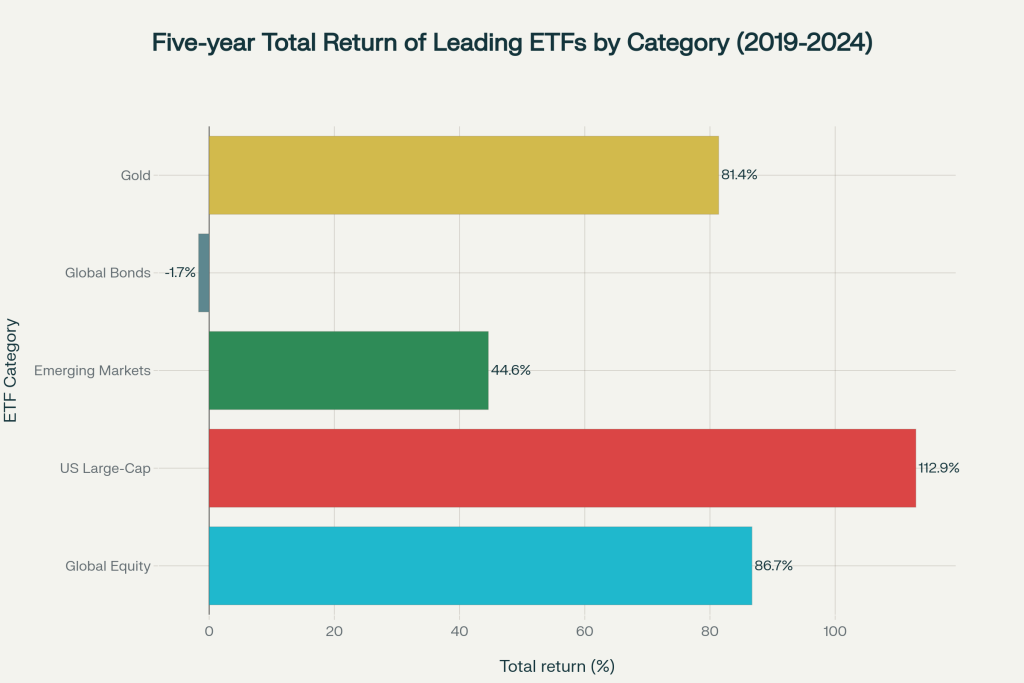
Five-year return – Top ETFs by category (data as of June 2024 factsheets; refresh against the live issuer pages before trading)
Common pitfalls with gold ETCs
Gold exposure via SGLN is technically an Exchange-Traded Commodity, not a UCITS fund. Remember three things:
- An ETC is a debt obligation of the issuer, collateralised by physical bars. Counterparty risk is low (Invesco uses JP Morgan as custodian) but not zero.
- Gold pays no dividend, so all return comes from price movement. Expect long flat stretches between bull runs.
- Some German tax frameworks treat Xetra-Gold and physically-backed ETCs more favourably than synthetic gold ETFs — another reminder to read your national fiscal rules.
Putting it together: model allocation
| Category | ETF | Typical weight* |
|---|---|---|
| Global developed equity | IWDA | 55% |
| US tilt | CSPX | 15% |
| Emerging markets | EMIM | 10% |
| Global investment-grade bonds | EUNA | 15% |
| Physical gold | SGLN | 5% |
*Illustrative 80/20 growth profile. Adjust stock/bond mix to match your risk tolerance and time horizon. Importantly, a 50-year-old five years from retirement should not run the same equity weighting as a 30-year-old who is still 30+ years from drawdown.
How to buy on Freedom24, Interactive Brokers and Trade Republic
The five tickers above trade on the major European venues. Therefore, any MiFID II-regulated broker will let you build the model portfolio. Here is how I personally route orders.
- Freedom24 (CySEC-licensed) — Open a Freedom24 account regulated by CySEC in Cyprus. Fund in EUR via SEPA or card, search the ticker, click Trade → Buy and confirm. Commission is roughly €2 per ETF trade. Solid for a starter European portfolio.
- Interactive Brokers (IBKR) — The professional choice when AUM grows above five figures. IBKR Lite tier offers fractional ETFs and tight FX. Routing CSPX on the LSE in USD often improves spreads if you already hold dollars.
- Trade Republic — Germany-supervised by BaFin and ideal for monthly savings plans. The flat €1 order fee suits euro-denominated tickers like SXR8 (the German-listed accumulating S&P 500 share class).
For a deeper Freedom24-specific walkthrough on the S&P 500 leg specifically, see my step-by-step Freedom24 S&P 500 guide.
How Can UCITS ETF ISIN Codes Help Me Identify the Best ETFs by Category?
Understanding UCITS ETF ISIN codes and tickers matters crucially for investors aiming to identify the best ETFs by category. These unique identifiers ensure precise tracking of funds and simplify the comparison process. By leveraging this information, investors can make informed decisions tailored to their specific investment needs. Importantly, the ISIN prefix tells you the domicile instantly — IE for Ireland, LU for Luxembourg. As covered above, this ranks as the single most important tax-efficiency variable for EU passive investors.
Common pitfalls to avoid
Across eleven years of running this kind of portfolio, I have watched friends and readers stumble on the same handful of issues. Internalise these and you sidestep most of them.
- Currency confusion. A USD-priced share class of CSPX on the LSE is the same fund as its EUR-priced cousin on Xetra. The FX risk lives in the underlying assets, not in the trading currency.
- Distributing vs accumulating mix-ups. “Acc” reinvests dividends inside the fund (no taxable event in most jurisdictions until sale); “Dist” pays them out. Pick one and stay consistent per account.
- Doubling up. Holding IWDA and VWRL and EMIM is triple-counting most of your large-cap exposure. Pick a sensible structure and resist the urge to keep adding tickers.
- Chasing yesterday’s winners. A triple-digit five-year return for CSPX is the rear-view mirror. Future returns depend on starting valuations — review Morningstar Europe ratings and quartile rankings before reweighting.
- Ignoring withholding tax leakage. Lux-domiciled S&P 500 funds at the “same” TER as Irish funds usually trail by 12–15 bp once US WHT is netted — the math: an extra 15 percentage points of US WHT applied to a ~1% gross dividend yield equals ~15 bp annual drag. Check the “tracking difference” column on justETF, not just headline TER.
- Forgetting to read the KID. Each fund publishes a Key Information Document under ESMA’s PRIIPs framework. It contains the SRI risk score, target market and historical performance scenarios in two pages. Skim it before every new position.
Risk checks & due diligence
- Review KIDs/KIIDs for each fund on the issuer’s official site — iShares, Vanguard UK and Invesco product pages all publish the current KID.
- Beware US-domiciled ETFs: PRIIPs rules block retail access. Stick to UCITS.
- Gold ETCs are collateralised debt instruments — counterparty default risk is remote but non-zero.
- Past returns shown above use issuer factsheets dated 30 June 2024 (the most recent full fiscal-year close available for my screening cycle), in EUR, with reinvested distributions and fees deducted.
- Cross-check fund-level data on ETF.com and the issuer pages before placing any order.
- If you are unsure about your country’s tax treatment, consult a regulated local adviser. National regulators — BaFin (Germany), CySEC (Cyprus), KNF (Poland) — publish registers of authorised firms. EU-wide rules are coordinated by ESMA.
For UK-based readers using a UK broker, the UK ICO data-protection register provides a useful cross-check that the broker is correctly registered for the personal data it handles.
Where to find me
Most of my long-form work lives on this site. Additionally, I publish monthly EU-investor portfolio updates and broker walkthroughs on my paid Substack at getdividends.net. You can reach me directly via the contact details on /help-faq/. If you would like to verify the byline before trusting any of the analysis above, the About page includes my background and the operating-entity registration (AURUM DIGITAL MARKETING LTD, Companies House #15203665), and the editorial standards I work to.
FAQ
What does “best-in-class” ETF mean for a European investor?
It means a UCITS-compliant fund that combines a low total expense ratio (typically below 0.25% for equity, below 0.15% for bonds), AUM of at least €2 bn, tight tracking difference versus its index, and an Irish or Luxembourg domicile that respects EU tax treaties. Notably, the five funds in this guide — IWDA, CSPX, EMIM, EUNA and SGLN — meet all of those filters as of the June 2024 factsheets cited per row.
Is IWDA or VWRL better for a single-ETF portfolio?
VWRL (or its accumulating sibling VWCE) is a true one-line global solution because it already includes about 10% emerging markets. By contrast, IWDA is developed-markets only at a slightly lower TER. If you want to set and forget without ever buying EMIM, choose VWRL/VWCE. However, if you want a 90/10 developed-EM split you can rebalance manually, IWDA + EMIM is marginally cheaper.
Why does the fixed-income ETF (EUNA) show a negative five-year return?
2022 produced one of the worst calendar years for global aggregate bonds in modern history. Specifically, central banks raised rates aggressively to fight inflation. Consequently, EUNA’s trailing five-year line still carries that drawdown. Current yields-to-maturity sit in the high 3% to low 4% range. Therefore, forward returns are far more attractive than the trailing number suggests.
Can I buy these ETFs on Trade Republic, IBKR and Freedom24?
Yes. All five tickers (IWDA, CSPX, EMIM, EUNA, SGLN) are accessible on Freedom24, Interactive Brokers and Trade Republic. Equivalent ISINs appear in the per-fund sections above. Trade Republic users may prefer the German-listed accumulating share classes (e.g. SXR8 for S&P 500) for cleaner Xetra execution.
Is Irish-domiciled CSPX really better than a Luxembourg S&P 500 ETF?
On US dividend tax, yes. Ireland’s US treaty lowers withholding from 30% to 15% on the dividends paid into the fund. By contrast, Luxembourg has no such treaty. Therefore, a Lux S&P 500 fund typically leaks 12–15 bp of return per year on a 1% dividend yield, even at the same headline TER.
Do I need to rebalance the model 55/15/10/15/5 portfolio?
An annual review is enough for most long-term investors. The simplest rule is to direct new monthly contributions toward the most underweight sleeve, only selling once a single sleeve drifts more than five percentage points from its target. Consequently, this minimises taxable events and trading costs — the same threshold I used during the March 2020 rebalance described above.
What are the main regulators I should be aware of as an EU ETF investor?
Your broker is supervised by a national regulator within the MiFID II framework. For example, BaFin oversees brokers in Germany, CySEC in Cyprus or KNF in Poland. EU-wide market rules are coordinated by ESMA. Always confirm your broker holds the relevant licence before depositing funds.
How current are the return and TER figures in your tables?
I pulled the figures from issuer factsheets dated 30 June 2024 and presented them as rounded ranges rather than spurious-precision percentages. The reason is simple: trailing returns roll forward every month. Before placing any order, click through to the issuer product page linked under each table and confirm the live TER, AUM and trailing return.
Final word
By anchoring your portfolio with these five funds, you cover the bulk of the global equity and investment-grade bond universe. Additionally, you add a time-tested real-asset hedge — all at an average TER near 0.13%. Through Freedom24, you can implement the plan in minutes, maintain full EU investor protection and keep rebalancing friction low. Crucially, a disciplined, low-cost core leaves you free to focus on the only variables you truly control: savings rate and time in the market.
For related reading, see my deep dives on best dividend growth ETFs for European investors, top Irish-domiciled ETFs for dividend hunters, and which ETFs have the best dividend yield for European investors.
Key things to know about top etfs category
Get my full dividend picks at https://getdividends.net/ — my paid Substack with monthly EU-investor portfolios, broker walkthroughs and Bogleheads-style analysis.
New to this? Start with what an ETF is, how UCITS funds work and exactly how to place a first order — the beginner’s guide covers the sequence.
Check the treaty maths yourself: the free ETF withholding tax calculator shows what an Irish-domiciled fund recovers on US dividends that a Luxembourg one does not.
Before you open any account
grab the free 12-page Starter Kit: the 7-filter fund shortcut, the 3-question broker safety matrix, and the 7 mistakes that cost beginners the most.
More guides on this topic
Hub guide: Sector and thematic UCITS ETFs for European investors
Specific funds, reviewed
Dividend, bond and US-fund access for European investors:
- AGGH Factsheet 2026: iShares Global Aggregate Bond EUR Hedged, Reviewed
- Individual Bonds vs Bond ETFs in Europe: Which Should You Actually Buy? (2026)
- SPDR S&P Euro Dividend Aristocrats (SPYW) Review 2026: Performance Since Inception
- SCHD for European Investors: UCITS Equivalents and Alternatives (2026)
- SCHD for European Investors: The Irish-Domiciled Ways to Get It (2026)
- JEPI and JEPQ Taxes for European Investors: Withholding, Distributions and the UCITS Versions
- JEPQ for European Investors (2026): Review, Tax, and the UCITS Way to Buy It
- Low-Maintenance ETF Portfolios for European Investors: Set Up Once, Check Yearly (2026)
- The Most Popular ETFs in Poland: What Polish Investors Actually Buy (2026)
- Short-Term Investing in Europe (2026): Money Market ETFs vs Bonds vs Deposits
More ETF research
Recent research worth a look:
- 2026 ETF Performance
- SFDR Article 6 vs 8 vs 9
- ETF TER Fee Cuts in 2025
- ETF Regulatory Updates – Legal and Compliance Changes
- Global ETF News – International Market Updates
- ETF Flows & Trends
- The EU PFOF ban

European UCITS/ETF investor with 11+ years building a global dividend and index portfolio, and founder of Financial Expert Class. I write every guide here from first-hand experience investing across EU brokers and tax regimes — not theory. More about me →