
ETF Flows & Trends: Unveiling European Money Movements
The European ETF landscape experienced unprecedented growth in 2025. Billions of euros now flow into exchange-traded funds across many asset classes. Consequently, European investors are witnessing a fundamental shift in how money moves through financial markets. This analysis reveals the patterns, trends, and driving forces behind these remarkable flows.
Record-Breaking Performance Sets New Standards
European ETFs were on track to hit extraordinary milestones in 2025. Notably, the industry pulled in €132.0 billion during the first five months of 2025. Therefore, annual inflows were on course to reach between €310.0 billion and €325.0 billion if the trend persisted. This trajectory would establish a new all-time record for European ETF flows. Moreover, it would surpass previous benchmarks by significant margins.
The momentum was particularly striking in the spring months. May 2025 showed robust investor confidence with €27.0 billion in net inflows. Importantly, this figure rebounded strongly from April’s more subdued €17.7 billion. Despite ongoing market uncertainty around U.S. tariff policies and their global economic impact, the recovery held firm.
This analysis sits within our ETF shortlists by category.
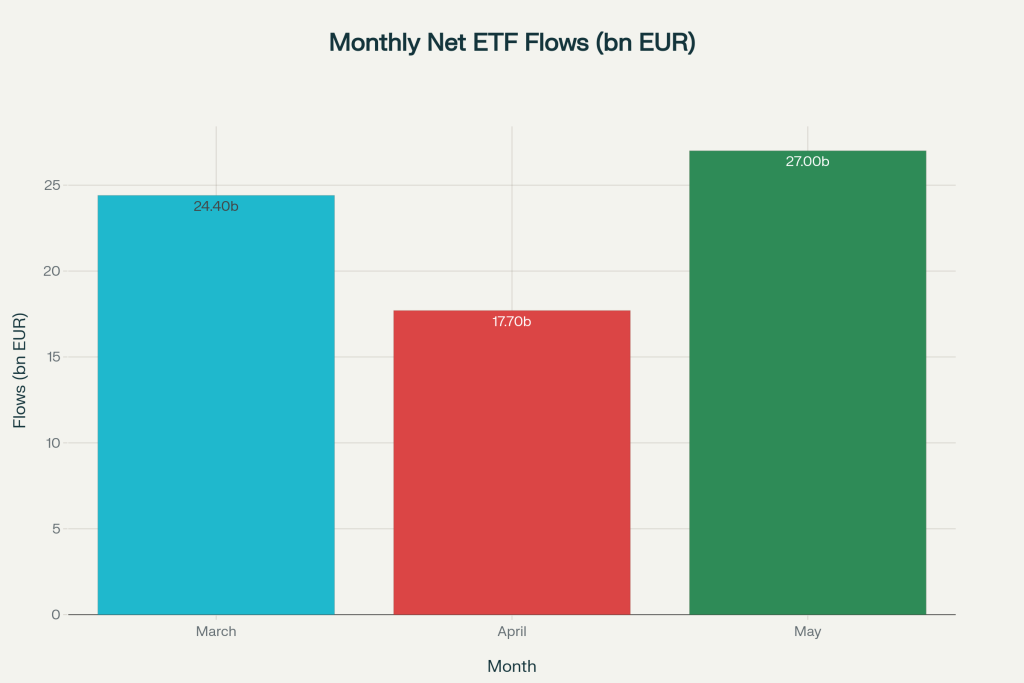
The monthly flow patterns reveal how European investors navigate market volatility. March began the year strongly with €24.4 billion in inflows. However, April saw a temporary slowdown due to geopolitical tensions. By contrast, May’s impressive recovery showed the resilience of European ETF demand.
Asset Class Breakdown: Where Money Flows
European investors continue to show distinct preferences across different asset categories. Equity ETFs dominate the landscape. In addition, they attracted the lion’s share of investment flows throughout 2025.

Equity ETFs Lead the Charge
Equity-focused funds captured €71.3 billion during Q1 2025 alone. This represents roughly 82% of total ETF inflows for the quarter. Notably, this overwhelming preference reflects European investors’ appetite for growth opportunities. Furthermore, it signals their confidence in equity market prospects.
The equity dominance extends well beyond raw numbers. In May 2025, equity ETFs secured €19.0 billion in new investments. Consequently, they kept their position as the most attractive asset class for European investors. In practice, this consistent performance shows sustained institutional and retail confidence in stock market exposure through ETFs.
Fixed Income Maintains Steady Appeal
Bond ETFs attracted €9.3 billion in Q1 2025. Therefore, they ranked as the second-most popular asset class. Despite tensions in global bond markets, particularly around U.S. and Japanese government securities, European fixed income ETFs kept their appeal. Investors still value them for diversification and income generation.
The resilience of bond ETF flows highlights their role as portfolio stabilizers. Indeed, even periods of interest rate uncertainty failed to derail the trend. May 2025 brought continued strength with €7.3 billion flowing into bond ETFs. In short, they remain relevant in balanced investment strategies.
Alternative Assets Show Mixed Results
Money market ETFs gathered €5.5 billion in Q1 2025. Clearly, investors want liquid, yield-generating alternatives to traditional savings accounts. Moreover, these products have gained traction as interest rates remain elevated. They now offer attractive short-term investment opportunities.
Commodities ETFs attracted €0.7 billion during the first quarter. Precious metals showed particular strength. For example, gold ETFs saw significant demand as investors sought safe-haven assets amid global uncertainty.
Mixed-assets ETFs collected €0.3 billion. By contrast, alternatives ETFs were the only category posting outflows, losing -€0.1 billion in Q1 2025.
Geographic Preferences Shape Investment Patterns
European investors are showing notable geographic biases in their ETF selections. European-focused strategies have emerged as clear winners. Notably, Europe-exposed ETFs led all categories with a record $19.4 billion in net inflows during Q1 2025.
This represents nearly one-fifth of total European ETF inflows for the quarter. Broad European equity funds attracted $11.4 billion. Additionally, German equity ETFs specifically drew $5.0 billion in new investments.
Home Bias Strengthens
The preference for European exposure marks a significant shift away from U.S.-focused investments. American equity ETFs experienced $4.5 billion in outflows during Q1 2025. Consequently, this reversed the record demand seen in Q4 2024. This rotation suggests European investors feel increasingly confident in regional opportunities. Furthermore, they want to reduce concentration risk in U.S. markets.
Market Dynamics and Driving Forces
Several key factors propelled European ETF growth in 2025:
Institutional Adoption Accelerates
Large institutional investors continue expanding their ETF allocations. Pension funds, insurance companies, and sovereign wealth funds now see ETFs as efficient tools. They achieve broad market exposure while keeping liquidity and cost effectiveness.
Retail Investor Engagement Grows
Retail participation in ETF investing has surged across Europe. Digital investment platforms, robo-advisors, and simplified access through major brokerages have democratized ETF investing. For example, the Netherlands reports over 400,000 new investors entering markets since 2022. Many of them use ETF structures.
Active Management Evolution
The European market is witnessing rapid growth in actively managed ETFs. Notably, these products attracted significant attention in 2024. Flows jumped from $7 billion to $20 billion. Meanwhile, the number of available products expanded from 103 to 178. This trend kept accelerating through 2025 as investors sought alpha generation within the ETF wrapper.
Regional Outlook and Future Projections
Industry forecasts paint an optimistic picture for European ETF growth. JP Morgan projects European ETF assets will reach $6 trillion by 2030. By contrast, EY estimates a more conservative $4.5 trillion. Both projections indicate substantial growth potential from current levels.
Technology and Innovation Drivers
Technological advancement continues reshaping the ETF landscape. Digital distribution channels, improved trading infrastructure, and enhanced product transparency are removing traditional barriers to ETF adoption. Importantly, the anticipated launch of a consolidated tape across Europe’s 25 jurisdictions and 29 exchanges promises to streamline market access further.
Regulatory Environment Supportive
Recent regulatory developments favor continued ETF expansion. For example, Luxembourg now exempts active ETFs from subscription tax. It also allows delayed portfolio disclosure. These changes mark significant progress for the industry. Consequently, more asset managers are launching European-domiciled ETF products.
Investment Themes and Sector Rotation
European investors are demonstrating sophisticated thematic preferences within their ETF selections:
Sustainable Investing Integration
ESG-focused ETFs maintain strong appeal despite some headwinds. European investors continue prioritizing sustainable investment themes. However, flows have moderated from peak levels as the market matures.
Defense and Security Focus
Geopolitical tensions have driven increased interest in defense-sector ETFs. European defense equity funds attracted significant inflows. Investors are positioning for increased military spending across NATO countries.
Learning ETFs the slow way?
The free 12-page Starter Kit gets you to a first, sensible portfolio faster: the 7-filter fund shortcut, the 3-question broker matrix, and the 7 costliest beginner mistakes.
Energy Transition Opportunities
Clean energy and renewable technology ETFs continue attracting capital. In addition, Europe pursues its green transition agenda. These thematic investments align with both regulatory support and long-term economic transformation trends.
Risk Considerations and Market Challenges
Despite strong growth momentum, several factors warrant investor attention:
Concentration Risk Concerns
The dominance of equity ETFs creates potential concentration risks. Should equity markets experience significant corrections, ETF flows could reverse rapidly. Consequently, this would create market volatility.
Interest Rate Sensitivity
Bond ETF performance remains highly sensitive to central bank policy decisions. For example, rate changes by the European Central Bank, Federal Reserve, or Bank of Japan could significantly impact fixed income ETF flows.
Geopolitical Uncertainties
Ongoing trade tensions, military conflicts, and diplomatic disputes create unpredictable impacts. Both investor sentiment and cross-border capital flows shift in response.
Strategic Implications for European Investors
The current ETF flow environment presents both opportunities and considerations for European investors:
Portfolio Construction Benefits
ETFs provide efficient building blocks for diversified portfolios. The broad range of available products enables precise exposure to specific markets, sectors, or investment themes. Crucially, this happens while maintaining cost efficiency.
Liquidity Advantages
ETF structures offer superior liquidity compared to traditional mutual funds. Therefore, investors can adjust positions quickly in response to changing market conditions.
Cost Efficiency
Low expense ratios make ETFs attractive for long-term wealth building. Notably, the cost advantages become particularly significant for large portfolios held over extended periods.
Conclusion: Sustained Growth Trajectory
European ETF flows in 2025 demonstrated remarkable resilience and growth potential. With record-breaking inflows, expanding product ranges, and increasing investor adoption, the European ETF industry appears well-positioned for continued expansion.
The combination of strong institutional demand, growing retail participation, and supportive regulatory environments creates favorable conditions for sustained growth. However, investors must remain vigilant. Concentration risks, interest rate sensitivity, and geopolitical developments could impact future flows.
European ETFs march toward potential record annual inflows exceeding €300 billion. In short, they represent not just investment vehicles but fundamental infrastructure. They support European capital market development and investor wealth creation.
Sources and further reading
- justETF — European UCITS ETF screener
- Morningstar UK ETF rankings
- ESMA — European Securities and Markets Authority
- Bogleheads wiki — EU investing
- ETF.com industry data
European UCITS/ETF investor with 11+ years building a global dividend and index portfolio, and founder of Financial Expert Class. I write every guide here from first-hand experience investing across EU brokers and tax regimes — not theory. More about me →