
The Fidelity Junior ISA charges no platform service fee, and you can start from £25 a month or a £100 lump sum. It also offers more than 3,000 funds plus shares, investment trusts and ETFs (as of September 2026). You pay only the funds’ own charges, from 0.05%, and dealing fees on shares and ETFs. As a result, it is one of the cheaper ways to invest for a child, especially through index funds.
New to ETFs? Start with the free checklist.
The European ETF Starter Kit: what to check before you buy your first UCITS ETF — domicile, costs, tax and broker set-up.
What a Junior ISA is
A Junior ISA (JISA) is a tax-free savings or investment account for a child under 18 who lives in the UK. GOV.UK sets the limit for the 2026/27 tax year at £9,000. If the child has both a cash Junior ISA and a stocks and shares Junior ISA, that limit covers both. There is no tax on interest, dividends or capital growth inside the account.
The key rules, from GOV.UK and Fidelity:
- A parent or guardian with parental responsibility opens and manages the account, but the money belongs to the child.
- Anyone can pay in. Fidelity says anyone over 18, including grandparents and friends, can contribute. However, it cannot accept money from the child.
- The child can take control of the account at 16 but cannot withdraw until 18. Nobody can take money back out before then, except in cases of terminal illness.
- A child cannot hold both a Junior ISA and a Child Trust Fund. So you have to transfer a CTF into the Junior ISA.
- At 18, the money becomes the child’s to keep invested or withdraw.
The money stays locked away until 18 and then belongs to the child outright. Therefore a JISA suits long-term saving you are happy to hand over. If you want to keep control, a savings or investment account in your own name may fit better. For retirement saving, a Junior SIPP is another option.
Fidelity Junior ISA fees
Fidelity normally charges adult accounts a service fee. That is 0.35% a year on most balances, or £7.50 a month without a regular savings plan below £25,000. However, Junior ISAs and Junior SIPPs are exempt. Fidelity states that it charges no service fee on investments in junior accounts.
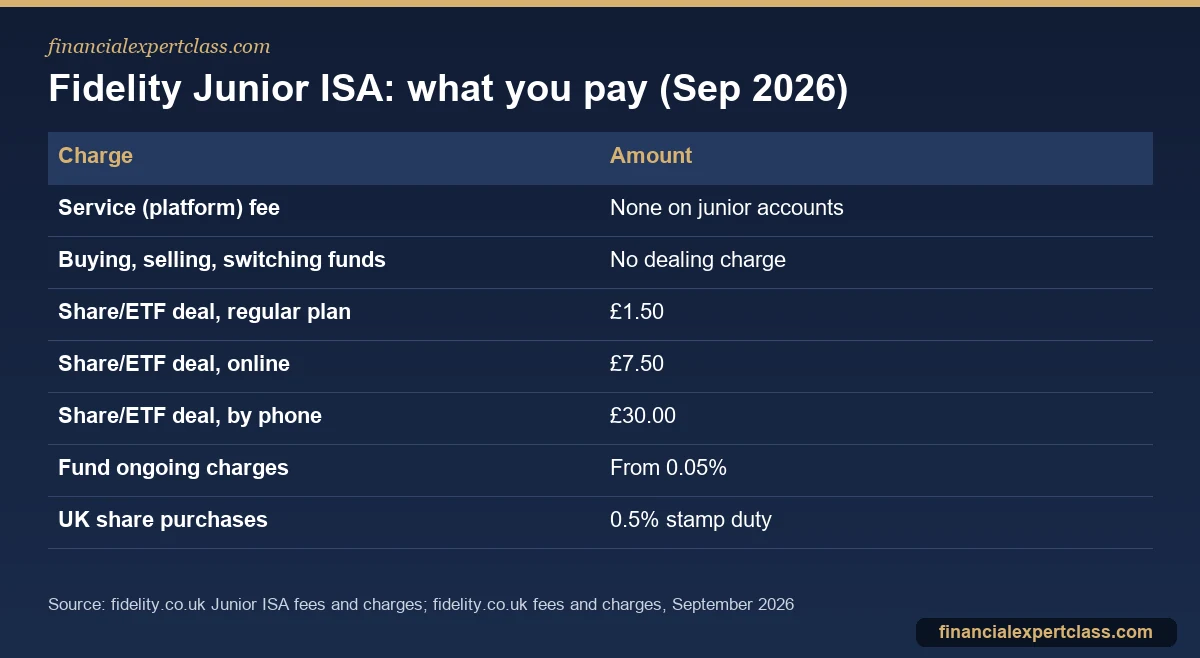
What you do pay depends on what you buy:
- Funds (OEICs and unit trusts): no dealing charge to buy, sell or switch. You pay the fund’s ongoing charge, which comes out inside the fund and starts from 0.05% on Fidelity’s platform. Fidelity also says it has negotiated discounts on hundreds of funds.
- Shares, ETFs and investment trusts: £7.50 for each online deal, £1.50 for deals within a regular savings plan or dividend reinvestment, and £30 by phone. In addition, UK shares carry 0.5% stamp duty on purchase. Foreign exchange charges also apply to international shares and non-sterling offshore funds.
There are no charges for setting up, closing or transferring the account, and no exit fees.
Funds or ETFs in a Fidelity JISA?
This is the most practical decision, and the fee table answers it for most families.

Say you pay in £25 a month. Buying an ETF through a regular savings plan costs £1.50 per purchase, which is 6% of each contribution. By contrast, the same £25 into an index fund costs nothing to deal. Even at £100 a month, the ETF route loses 1.5% on the way in. Over 18 years those fees add up. That is why index funds are usually the better tool for small, regular JISA contributions on this platform.
ETFs make more sense for occasional larger lump sums. For example, on a birthday gift of £2,000, a £7.50 deal is under 0.4% of the amount. They also make sense when a specific ETF has no fund equivalent. Whatever you choose, prefer accumulating versions for a long-term JISA, since these reinvest dividends automatically. Otherwise, every dividend reinvestment you trigger yourself in shares or ETFs costs £1.50. Our guide to accumulating vs distributing funds explains the difference.
What you can invest in
Fidelity lists more than 3,000 funds and more than 2,000 UK and international shares, along with investment trusts and ETFs. For a child’s long-term account, one or two low-cost global index funds serve most parents best. For example, you could pick a fund tracking a world index such as the FTSE All-World or MSCI World. With 18 years to run, the account can usually hold mainly shares. Then, if the child will need the money at 18, you can shift gradually to lower-risk assets in the last few years.
Fidelity also publishes fund shortlists such as its Select 50. Those can help if you are unsure where to start. However, check each fund’s ongoing charge, because actively managed funds typically cost more than index trackers. Cost is one of the few things you control over a long horizon.
How to open a Fidelity Junior ISA
- Check eligibility. The child must be under 18 and living in the UK, and you must be their parent or guardian.
- Apply online on Fidelity’s website with your details and the child’s.
- Choose how to pay in: a regular savings plan from £25 a month or a lump sum from £100.
- Invest the money. Fidelity notes that contributions sit as cash until the registered contact invests them, so do not forget this step.
- Share the account details with family who want to contribute. Also keep total contributions within £9,000 per tax year.
The child may already have a Junior ISA or Child Trust Fund elsewhere. If so, you can transfer it to Fidelity using its transfer process rather than withdrawing and re-paying.
Is Fidelity good for a Junior ISA?
For most families, yes. It has no service fee, low minimums, free fund dealing and a very wide fund range. Together, these make it a strong choice for regular saving into index funds. The weak spot is dealing fees on ETFs and shares, which make small ETF purchases expensive. So if you specifically want ETFs with small monthly amounts, a platform without per-trade dealing fees may cost less. Our overview of investment accounts for children compares options. In addition, the compound growth calculator shows what regular contributions could add up to over 18 years.
Financial Administration Services Limited operates Fidelity’s UK platform. The Financial Conduct Authority authorises and regulates that firm (register number 122169). Before you choose, consider how a JISA fits alongside your own saving. For instance, filling your own ISA or pension first may be the better order. Our ISA, LISA and SIPP decision tree covers that.
Frequently asked questions
Is Fidelity good for a Junior ISA?
It is a strong low-cost option. Fidelity charges no service fee on junior accounts, fund dealing is free and you can start from £25 a month or £100. Costs come from fund charges (from 0.05%) and dealing fees of £1.50 to £30 on shares and ETFs. So index funds suit small regular payments best.
How much can I pay into a Fidelity Junior ISA?
Up to £9,000 per child in the 2026/27 tax year, across all of that child’s Junior ISAs. Fidelity’s minimums are £25 a month by regular savings plan or a £100 lump sum.
What happens to a Junior ISA at 18?
The money becomes the child’s. They can take control of the account from 16 but can only withdraw from 18. At that point, they can keep it invested or take the money out.
Can grandparents pay into a Fidelity Junior ISA?
Yes. Only a parent or guardian can open and manage the account. However, Fidelity says anyone over 18, including grandparents, other relatives and friends, can contribute. All contributions together must stay within the child’s £9,000 annual limit. Also, nobody can withdraw them before the child turns 18.
Cited sources: Fidelity Junior ISA, Fidelity Junior ISA fees and charges, Fidelity fees and charges, and GOV.UK: Junior ISAs. Verify current fund figures before investing. Educational content, not financial advice.
Not personalised financial advice. Verify your situation with a qualified adviser. Operated by Aurum Digital Marketing LTD (UK), Companies House 15203665.
European UCITS/ETF investor with 11+ years building a global dividend and index portfolio, and founder of Financial Expert Class. I write every guide here from first-hand experience investing across EU brokers and tax regimes — not theory. More about me →