
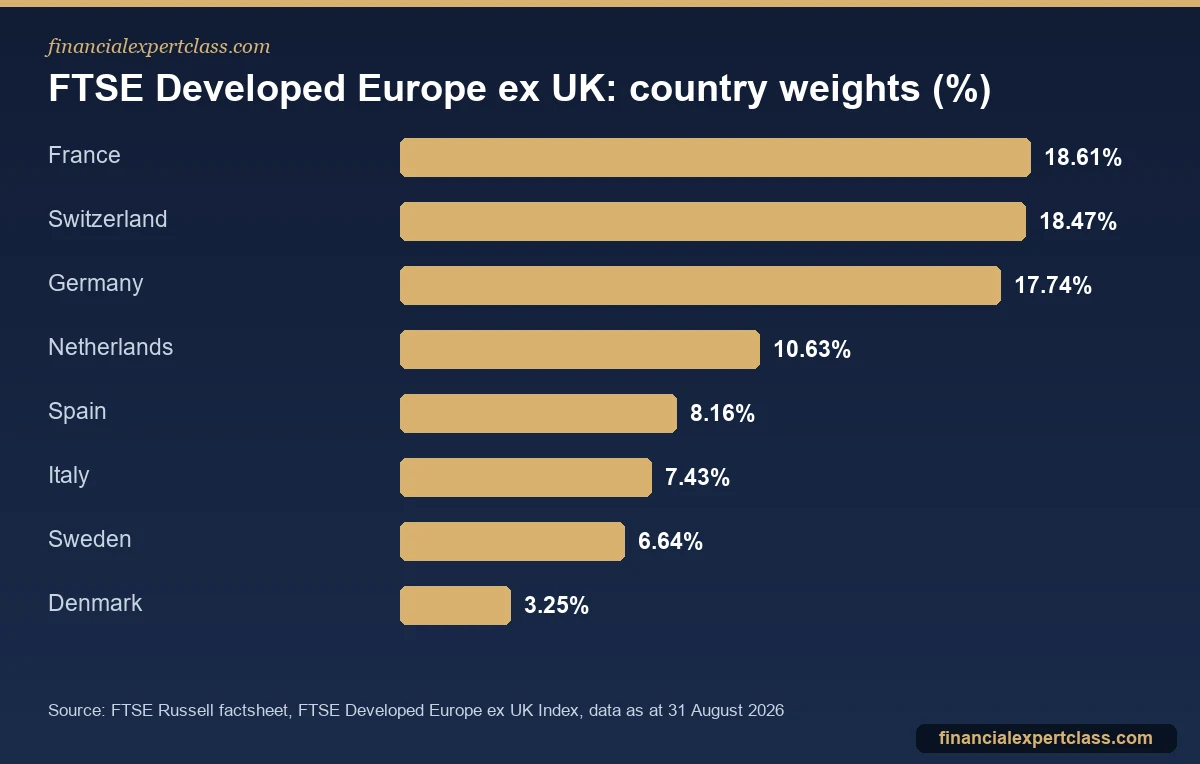
The FTSE Developed Europe ex UK Index tracks 402 large and mid-sized companies in 15 developed European countries, leaving out the UK. At 31 August 2026 France (18.61%), Switzerland (18.47%) and Germany (17.74%) made up more than half. In addition, ASML was the largest holding. Vanguard’s UCITS ETF (VERX) and index fund are the best-known ways to track it.
New to ETFs? Start with the free checklist.
The European ETF Starter Kit: what to check before you buy your first UCITS ETF — domicile, costs, tax and broker set-up.
What the FTSE Europe ex UK index holds
FTSE Russell builds the index from its Global Equity Index Series. It takes the large and mid-cap companies in Europe’s developed markets and excludes the UK. It then weights constituents by free-float market value and screens them for liquidity. FTSE Russell also reviews the index twice a year, in March and September. It has calculated it since 30 June 2000.
The 15 countries at 31 August 2026 were Austria, Belgium, Denmark, Finland, France, Germany, Ireland, Italy, the Netherlands, Norway, Poland, Portugal, Spain, Sweden and Switzerland. The index includes Switzerland, Norway and Sweden, even though they do not use the euro. That is the main difference from eurozone-only indices.
The ten largest companies were ASML (5.66%), Roche (2.67%), Novartis (2.47%), Nestlé (2.18%) and Siemens (2.12%). They also included SAP (1.98%), Banco Santander (1.89%), Allianz (1.73%), Schneider Electric (1.61%) and UBS (1.49%). Together, they made up 23.81% of the index. That is a far less concentrated top ten than in US indices, where a handful of technology firms dominate.
Sector weights: banks and industry, not big tech
Under the Industry Classification Benchmark (ICB), financials were the biggest industry at 25.84%. Next came industrials at 20.03%, health care at 12.78% and technology at 10.87%. Meanwhile, consumer discretionary was 8.12%, consumer staples 5.44%, energy 4.70% and utilities 4.66%.
That mix is the main reason investors add a Europe ex-UK fund. It tilts towards banks, insurers, industrial groups and pharmaceutical companies. These are the parts of the market that are small in a US-heavy global index. It also pays more in dividends. For example, the index yield was 2.70%, compared with 1.57% for the FTSE All-World on the same date.

Europe ex UK vs Europe vs eurozone
FTSE runs several European indices, and the names are easy to mix up:
- FTSE Developed Europe includes the UK. FTSE’s factsheet also compares the ex-UK index with the broader FTSE Europe benchmark, which had 663 constituents against 402.
- The ex-UK version removes the UK. So it is what UK investors use when they already hold a separate UK fund.
- FTSE Eurozone covers only countries that use the euro. As a result, it drops Switzerland, Sweden, Denmark, Norway and Poland.
Other providers have their own versions. For instance, STOXX Europe 600 and MSCI Europe include the UK, while Euro Stoxx 50 is a 50-stock eurozone index. Our guides to the STOXX Europe 600 and Euro Stoxx 50 ETFs explain those alternatives.
Funds that track the index
Vanguard FTSE Developed Europe ex UK UCITS ETF (VERX)
This Irish-domiciled, physically replicated ETF launched on 30 September 2014. It had €4,878 million in total assets at 31 August 2026. The distributing share class pays dividends quarterly and has an ongoing charges figure (OCF) of 0.10%. It trades as VERX on the London Stock Exchange in pounds, and on Euronext Amsterdam and Xetra in euros. It also has UK reporting fund status. The ETF held 415 stocks against 402 in the index. In addition, Vanguard lists an accumulating euro share class for investors who prefer dividends reinvested.
Vanguard FTSE Developed Europe ex-U.K. Equity Index Fund
Some UK investors prefer a traditional index fund (OEIC). They can use this fund, which is available on Vanguard Investor and other UK platforms. The fund had £5,955 million in total assets at 31 August 2026. However, charges differ by share class. The institutional class on the factsheet we checked had an OCF of 0.08%, but retail classes can cost more. So check the key information document for the class your platform offers.
Which listing and share class to buy
Buy the listing in the currency your account holds to avoid broker FX fees. That means the London GBP line for a UK ISA or SIPP, or a Xetra or Euronext euro line for most EU accounts. The trading currency does not change your underlying exposure, though. The fund still holds shares priced in euros, Swiss francs, Swedish kronor and other European currencies.
Then choose between distributing (dividends paid to you quarterly) and accumulating (dividends reinvested). Inside a UK ISA or SIPP, the choice is purely about convenience. In a taxable account, however, check how each type is taxed before you buy. That applies especially in EU countries with specific rules for accumulating funds. The difference can matter more than a few basis points of fees.
For a wider comparison of European equity ETFs, including funds tracking the STOXX Europe 600 and MSCI Europe, see our best Europe ETFs guide. Also see our note on Vanguard’s new Europe ETFs.
Who uses a Europe ex-UK fund, and how
UK investors building by region. Some investors prefer separate funds for the UK, the US, Europe ex UK, Japan and emerging markets rather than one global fund. That way they can set each weight themselves. A Europe ex-UK fund fills the continental slot without overlapping a UK holding such as a FTSE 100 tracker.
Investors who think global funds are too US-heavy. In the FTSE All-World the US was 61.71% at 31 August 2026. It is also a similar majority in the MSCI World. So adding a Europe ex-UK fund is a straightforward way to tilt back towards Europe. That is an active decision. Therefore, size it deliberately and rebalance once a year.
Income investors. With a 2.70% index yield, a distributing Europe ex-UK ETF produces more income than a global tracker. In a UK stocks and shares ISA or SIPP that income is tax-free. Outside a wrapper, however, dividends above your allowance are taxable.
Risks to understand
- Currency. For a UK investor the holdings are priced mainly in euros and Swiss francs. So returns in pounds move with exchange rates, whichever share class you buy.
- Concentration by country. France, Switzerland and Germany are over half the index, so their economies and politics drive much of the return.
- Sector mix. Heavy exposure to banks and industrials means the index behaves differently from technology-led markets, for better and for worse.
Frequently asked questions
What countries are in FTSE Developed Europe ex UK?
Fifteen at 31 August 2026: Austria, Belgium, Denmark, Finland, France, Germany, Ireland, Italy, the Netherlands, Norway, Poland, Portugal, Spain, Sweden and Switzerland. France, Switzerland and Germany were the largest, each with roughly 18% of the index.
Does FTSE Developed Europe include the UK?
Yes, the FTSE Developed Europe Index includes the UK. The ex UK version, however, removes it, leaving 402 constituents at 31 August 2026.
Which ETF tracks the FTSE Developed Europe ex UK Index?
The Vanguard UCITS ETF on this index, ticker VERX, has an ongoing charges figure of 0.10%. It lists in London in pounds and on Euronext Amsterdam and Xetra in euros. Vanguard also offers an index fund (OEIC) on the same index for UK investors.
What is the best European fund to invest in?
There is no single best fund. It depends on whether you want the UK included and which index you prefer. For Europe excluding the UK, a low-cost tracker such as VERX covers the market broadly. If you want the UK in, however, look at STOXX Europe 600 or MSCI Europe trackers instead.
Cited sources: FTSE Russell: FTSE Developed Europe ex UK Index factsheet, Vanguard FTSE Developed Europe ex UK UCITS ETF factsheet, Vanguard FTSE Developed Europe ex-U.K. Equity Index Fund factsheet, and FTSE Russell: FTSE All-World Index factsheet. Verify current fund figures before investing. Educational content, not financial advice.
Not personalised financial advice. Verify your situation with a qualified adviser. Operated by Aurum Digital Marketing LTD (UK), Companies House 15203665.
European UCITS/ETF investor with 11+ years building a global dividend and index portfolio, and founder of Financial Expert Class. I write every guide here from first-hand experience investing across EU brokers and tax regimes — not theory. More about me →