
Vanguard LifeStrategy 100 is an all-equity fund of index funds. In contrast, LifeStrategy 80, 60, 40 and 20 hold that percentage in shares and the rest in bonds. All five charge the same 0.20% ongoing charge and also rebalance automatically. What differs is risk. The lower the number, the more bonds, so the ride is smoother (but usually lower). In addition, about a fifth of every fund’s equity sits in UK shares.
Comparing options? Take the decision workbook with you.
The ETF Comparison Workbook: TER, domicile, withholding tax and overlap checks in one printable spreadsheet.
How the Vanguard LifeStrategy funds work
Each LifeStrategy fund is a UK-domiciled unit trust-style fund. Legally, it is a non-UCITS retail scheme (NURS) that invests at least 90% of its assets in other Vanguard index funds. So instead of buying one global tracker and one bond fund yourself, you buy a single fund. Vanguard then keeps the mix at its fixed equity percentage. Vanguard launched all five on 23 June 2011. They are also ISA-eligible. Each comes in accumulation (income reinvested) and income (income paid out) share classes.
The appeal is simplicity. There is no rebalancing to do and no decision about which bond fund to add. You also get one line on your statement. The trade-off is that you accept Vanguard’s choices about how to split the money. That includes a deliberate tilt towards the UK. Indeed, Vanguard’s own factsheets state that “the UK will generally be one of the largest single country exposures for both shares and bonds.”
The figures below come from Vanguard’s UK factsheets for the accumulation shares. All data is as at 31 July 2026, which was the latest available when I wrote this in September 2026.
The five funds side by side
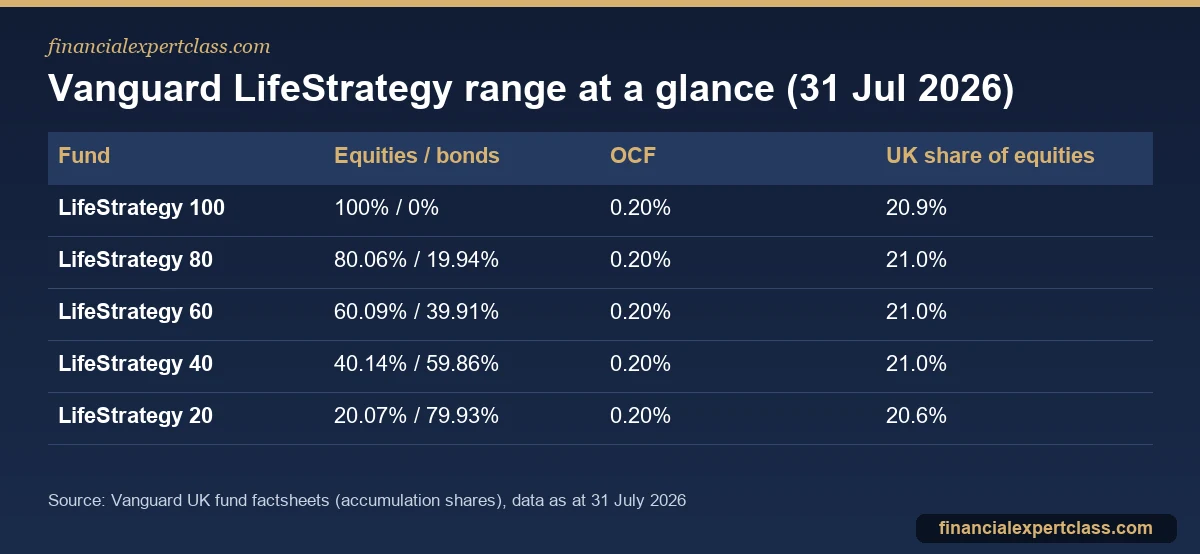
The ongoing charges figure (OCF) is 0.20% on all five. That is the annual fund cost, taken inside the price. As a result, the choice is purely about the asset mix, not cost. However, Vanguard’s platform or your broker may add its own account fee on top, so check the platform you use.
The headline split also drives how the Investment Association (IA) classifies the funds. For example, LifeStrategy 20 sits in the Mixed Investment 0-35% Shares sector and LifeStrategy 40 in 20-60% Shares. LifeStrategy 60 and 80 sit in 40-85% Shares. Finally, LifeStrategy 100 sits in the Global sector.
What is inside: the equity side
Several Vanguard index funds make up the equity portion. In LifeStrategy 100, the largest building blocks at 31 July 2026 were:
- Vanguard FTSE Developed World ex-U.K. Equity Index Fund: 32.7%
- Vanguard U.S. Equity Index Fund: 29.4%
- Vanguard FTSE U.K. All Share Index Unit Trust: 20.9%
- Vanguard Emerging Markets Stock Index Fund: 8.2%
- Vanguard FTSE Developed Europe ex-U.K. Equity Index Fund: 5.0%
- Vanguard Japan Stock Index Fund: 2.7%
The other four funds scale the same building blocks down. For example, LifeStrategy 60 holds 12.6% of its total assets in the FTSE U.K. All Share fund, while LifeStrategy 80 holds 16.8%. By region, UK shares make up 21.0% of the equity inside LifeStrategy 60 and 80. North America, meanwhile, is 53.3% in LifeStrategy 60.
The UK home bias
This is the biggest difference between LifeStrategy and a pure global tracker. A market-cap-weighted world index such as the FTSE All-World gives the UK a much smaller weight. That is because it reflects the relative size of each stock market. LifeStrategy, however, deliberately gives UK shares about a fifth of the equity. The usual case for a home tilt is that UK investors spend in pounds. So holding more sterling assets can reduce currency swings. The counter-argument is that it puts more of your money in one fairly small market with its own sector mix. Neither side is wrong, but you should know the tilt is there.
What is inside: the bond side
The bond portion is mostly global government and investment-grade bonds. In LifeStrategy 60, the largest bond holding was the Vanguard Global Bond Index Fund, at 32.9% of the whole fund. There were also smaller slices in UK gilts, UK investment-grade corporate bonds and UK inflation-linked gilts. In addition, it held a global aggregate bond ETF. Of the bonds in LifeStrategy 60, governments issued 57.6% and companies 20.7%. Also, 49.4% had an AA rating.
LifeStrategy 20 and 40 lean more on the Vanguard Global Aggregate Bond UCITS ETF, alongside the Global Bond Index Fund. That ETF makes up 33.5% and 17.2% of each fund respectively.
Currency exposure and hedging
The practical effect of the bond side shows up in currency exposure. Multi-asset portfolios typically hedge their global bond funds back to sterling. This means the fund uses currency contracts to strip out most exchange-rate movement. As a result, the “safe” part of the portfolio behaves like a sterling asset. Vanguard’s factsheets show exactly how much of each fund ends up in pounds:

LifeStrategy 100 has no bonds, so it has only 24.3% in pounds and 50.2% in US dollars. Its value in sterling therefore moves with the dollar. By contrast, LifeStrategy 20 is 84.6% in pounds. If a weaker or stronger pound would keep you awake, that is a real point in favour of the lower-equity funds.
Which Vanguard LifeStrategy fund suits whom
There is no “best” LifeStrategy fund in general. Instead, there is one that matches your time horizon and your tolerance for falls. As a rough guide:
- LifeStrategy 100: long horizons (15 years or more) and investors who can sit through large drawdowns without selling. It also suits people who already hold cash or bonds elsewhere, such as a workplace pension default fund or an emergency fund.
- LifeStrategy 80: long-term investors who want a modest cushion. Our comparison of the LifeStrategy 80 ETF (V80A) with VWCE covers the EU-listed equivalent.
- LifeStrategy 60: the classic balanced fund. It suits medium horizons, or investors who have seen a bear market and know they dislike them. It is also the largest of the five, with £19,273 million in total fund assets at 31 July 2026.
- LifeStrategy 40: cautious investors, or people within a few years of drawing money.
- LifeStrategy 20: capital preservation with a little growth. With nearly 80% in bonds, it will behave mostly like a bond fund. That includes falling when interest rates rise sharply.
Here is a useful test. First, imagine the equity part falling by a third. Then multiply your pot by the equity percentage and by one third. If that loss in pounds would make you sell, pick a lower number.
Vanguard LifeStrategy vs building it yourself
You can copy a LifeStrategy fund with two or three ETFs: a global equity tracker and a hedged global bond fund. If you do it yourself, you control the UK weighting. In some cases, you also get a lower combined ongoing charge. On the other hand, you have to rebalance. Also, on many platforms fund dealing is cheaper than ETF dealing, or the reverse. For more on one-fund portfolios, including the ETF versions for EU investors, see our guide to all-in-one ETF portfolios: LifeStrategy vs VWCE. Our overview of the 60/40 portfolio with UCITS funds also helps.
Say you hold the fund in a Stocks & Shares ISA or SIPP. In that case, the choice between accumulation and income shares has no tax effect. Outside a wrapper, however, accumulation shares still create taxable income each year even though nothing is paid out. So keep records. Our explainer on ISA, LISA and SIPP choices helps you decide where to hold it.
Frequently asked questions
Is Vanguard LifeStrategy 100 any good?
It is a low-cost, widely diversified all-equity fund with a 0.20% OCF. It also gives you exposure to thousands of companies worldwide. Its main quirk is a UK weighting of about 21% of equity, well above the UK’s share of world markets. If you are happy with that tilt and a 100% equity risk level, it does the job simply.
Which is the best performing Vanguard LifeStrategy fund?
Over long periods of rising stock markets, the funds with more equity have usually returned more. However, in bond sell-offs or crashes the order can reverse. Past performance does not tell you which will do best next. Vanguard publishes each fund’s 1, 3, 5 and 10-year returns on its monthly factsheet, so check the latest before comparing.
What is the difference between LifeStrategy 60 and 80?
LifeStrategy 60 holds about 60% shares and 40% bonds, while LifeStrategy 80 holds about 80% shares and 20% bonds. Both charge 0.20%. At 31 July 2026, LifeStrategy 60 was 54.4% exposed to pounds, against 39.4% for LifeStrategy 80. So the 60 fund is less sensitive to currency moves as well as to stock market falls.
Can I buy Vanguard LifeStrategy outside Vanguard?
Yes. You can buy the UK funds directly from Vanguard and on many other UK investment platforms that offer funds. They are also ISA-eligible. EU investors cannot normally buy the UK unit trusts. Instead, they can use the LifeStrategy UCITS ETFs listed on European exchanges.
Cited sources: Vanguard LifeStrategy 100% Equity Fund factsheet, Vanguard LifeStrategy 80% Equity Fund factsheet, Vanguard LifeStrategy 60% Equity Fund factsheet, Vanguard LifeStrategy 40% Equity Fund factsheet, and Vanguard LifeStrategy 20% Equity Fund factsheet. Verify current fund figures before investing. Educational content, not financial advice.
Not personalised financial advice. Verify your situation with a qualified adviser. Operated by Aurum Digital Marketing LTD (UK), Companies House 15203665.
European UCITS/ETF investor with 11+ years building a global dividend and index portfolio, and founder of Financial Expert Class. I write every guide here from first-hand experience investing across EU brokers and tax regimes — not theory. More about me →