
For a UK investor buying ETFs, InvestEngine and Trading 212 both charge no account fee and no commission. InvestEngine charges no FX fee. However, it trades only ETFs, once a day, and keeps the interest on your uninvested cash. Trading 212 adds individual shares, real-time trading and interest on cash. But it charges 0.15% on currency conversion. So pick InvestEngine for hands-off ETF investing, and Trading 212 for flexibility.
Comparing options? Take the decision workbook with you.
The ETF Comparison Workbook: TER, domicile, withholding tax and overlap checks in one printable spreadsheet.
The short verdict
These two platforms look similar on price, yet they are very different in design. InvestEngine is an ETF-only platform built around portfolios. You choose a set of ETFs and target weights, and it buys them for you in a single daily trade. Trading 212, by contrast, is an app broker that lets you buy thousands of shares and ETFs in real time. It also offers automated Pies, cash savings and a separate CFD account.
Maybe your plan is “put money into two or three index ETFs every month and leave it”. If so, InvestEngine does that with fewer distractions and no FX charge. On the other hand, you may want to pick individual companies or trade at a specific moment. You may also want interest on cash waiting to be invested. In that case, Trading 212 is the better fit. Plenty of investors use both: one for the core ETF portfolio, one for everything else.
InvestEngine vs Trading 212 fees compared
Both providers publish their costs clearly. At the time of writing (September 2026):
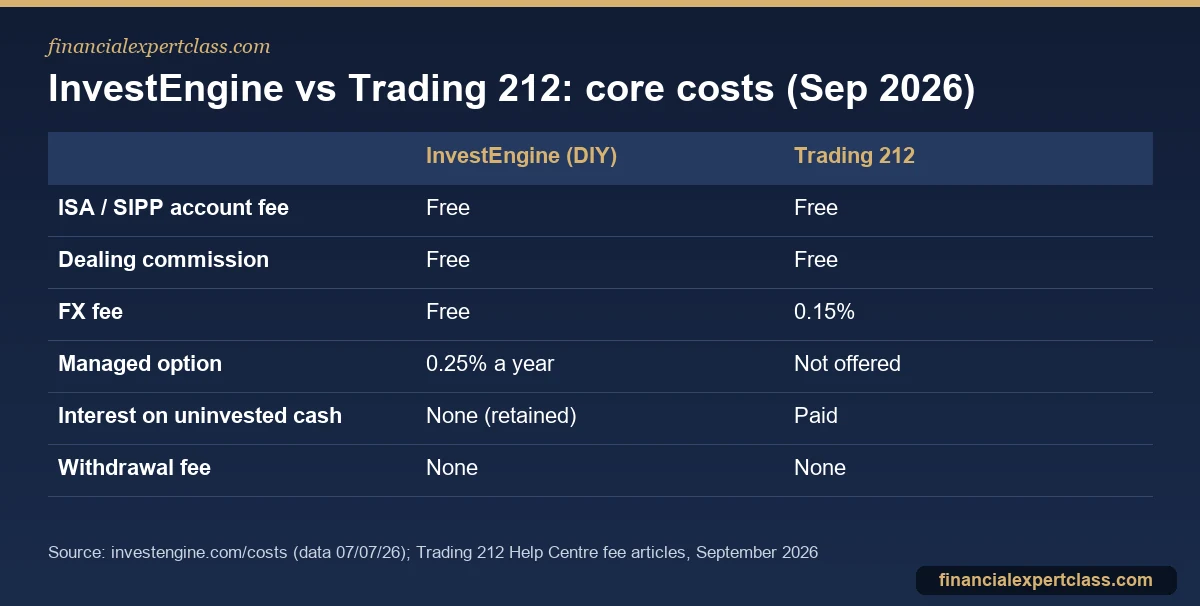
InvestEngine charges no account fee on its ISA, General Account, SIPP or Business Account. On its DIY service, there is also no dealing fee and no FX fee. Its costs page (data accurate as of 7 July 2026) says it does not charge for opening, closing or running an account. In addition, it does not charge withdrawal or transfer fees. If you choose a Managed Portfolio or LifePlan portfolio, InvestEngine charges 0.25% a year on top of the ETF costs. It works this out daily and takes it monthly in arrears.
Trading 212 states that the only fee it can charge on Invest, ISA and SIPP accounts is the FX fee. That is 0.15% when you buy or sell an instrument priced in a currency other than your account currency. Commission and custody are free, and there is no inactivity fee. Card and similar deposits cost 0.7% once you have deposited 2,000 GBP/EUR in total that way. However, bank transfers stay free. Our full breakdown of Trading 212 fees for ETF investors also covers stamp duty and exchange levies.
In practice, the FX fee matters less than it sounds for ETF investors. Most popular UCITS ETFs have a sterling line on the London Stock Exchange. If you buy that line in a GBP account, Trading 212 charges no conversion. On both platforms, you still pay the ETF’s own ongoing charge. You also pay the market spread (the gap between buying and selling prices).
The hidden difference: cash interest
This is where the two differ most. InvestEngine states plainly that “any uninvested cash you hold with InvestEngine doesn’t generate returns”. It keeps the interest earned on that cash, and this is one of the ways it funds its free service. Trading 212, however, pays daily interest on uninvested cash in Invest, ISA and SIPP accounts. It holds that cash with banks or in qualifying money market funds. Rates change, so check the live figure in the app. If you tend to hold a meaningful cash buffer inside your investment account, this can outweigh the FX fee difference.
How trading works
InvestEngine trades once a day. Its order execution policy says you must give ETF instructions before 14:00 GMT for them to go through by the close of the London Stock Exchange that business day. Anything later goes into the next trading cycle. The Help Centre adds that it processes orders after 2:30 pm. Also, you can cancel only before the 2:00 pm cut-off. All trades go through Winterflood Securities. This once-a-day batching is what lets InvestEngine offer fractional ETFs from £1 with no dealing fee.
Trading 212 executes orders during market hours. So you see your price at the time you trade, and you can use limit and stop orders. For a long-term investor this rarely matters. Still, it does matter if you want control over timing.

ISA, SIPP and other accounts
Both offer a Stocks & Shares ISA and a SIPP (self-invested personal pension) with no account fee.
- InvestEngine offers an ISA, General Account, SIPP and a Business Account for limited companies. Its ISA page states that it does not currently offer Cash ISAs, Lifetime ISAs or Junior ISAs. The minimum to open a DIY SIPP portfolio is £100. Regular SIPP contributions start at £20 a week or £50 a month.
- Trading 212 offers Invest (a general account), a Stocks & Shares ISA with a £1 minimum deposit, a Cash ISA, and a SIPP. Its SIPP accepts personal contributions only, not employer contributions. It also claims basic-rate tax relief for you, which the Help Centre says usually arrives in 6 to 11 weeks. However, some products, including ETNs, are not available inside the SIPP.
Trading 212’s ISA is flexible. So you can withdraw and replace money in the same tax year without using up more of your £20,000 allowance. For how ISAs, SIPPs and LISAs fit together, see our UK ISA vs LISA vs SIPP decision tree.
DIY, managed and automation
InvestEngine’s strength is portfolio-level automation. You set target weights across your ETFs, and it splits new money to match. For managed portfolios, Savings Plans also invest automatically from £10 a week. You can also hand the whole thing over. Managed Portfolios cost 0.25% a year plus ETF costs. InvestEngine says those ETF costs average 0.12% a year in its Growth portfolios. However, it had paused new Managed and LifePlan portfolios when I checked in October 2026. Its ISA page also still shows 0.45%, but its costs page and fee help article give 0.25% for every account type.
Trading 212 has no managed service. Indeed, its Help Centre states it does not offer a managed Stocks & Shares ISA. Instead, its version of automation is Pies with AutoInvest, where you set target weights and a recurring deposit. It also shows ready-made Pies from asset managers when you open a SIPP. Our guide to Trading 212 Pies walks through the set-up.
Safety and regulation
Both are UK-authorised firms. The FCA authorises and regulates InvestEngine (UK) Limited (firm reference number 801128). It holds client money in pooled client bank accounts. It also holds client investments in a pooled account at CREST, in the name of InvestEngine Nominees Limited and apart from the firm’s own assets.
Similarly, the FCA authorises and regulates Trading 212 UK Ltd (firm reference number 609146). It holds client money at banks including J.P. Morgan and Barclays. It also uses Bank of New York Mellon and Interactive Brokers as custodians.
The Financial Services Compensation Scheme covers both. The FSCS investment protection limit is £85,000 per eligible person, per firm, if a firm fails and your assets are missing. However, it never covers market falls. For more, see is Trading 212 safe.
Which should you choose?
- Choose InvestEngine if you only want ETFs and like portfolio weights with automatic rebalancing of new money. It also suits you if you want a managed option at a low fee, or run a limited company that wants to invest surplus cash.
- Choose Trading 212 if you want individual shares as well as ETFs, and real-time orders. It also fits if you want a Cash ISA alongside your investments, or interest on cash you hold uninvested.
- Use both if you want a clean ETF core on InvestEngine and a separate account for stock picking. But remember your £20,000 ISA allowance is shared across all your ISAs in a tax year.
For a wider comparison that includes the traditional platforms, see our guide to the best broker for UK investors.
Frequently asked questions
Is InvestEngine trustworthy?
The Financial Conduct Authority authorises and regulates InvestEngine (UK) Limited (FRN 801128), and the FSCS covers it. It holds client investments in a pooled account at CREST under a nominee company, apart from InvestEngine’s own assets. As a result, the firm’s creditors cannot claim them if it fails.
Is InvestEngine cheaper than Trading 212?
For ETF-only investing, they are close. Both charge no account fee or commission. InvestEngine has no FX fee, while Trading 212 charges 0.15% on currency conversion. However, you can usually avoid that by buying sterling ETF lines. Also, Trading 212 pays interest on uninvested cash, but InvestEngine does not.
Can I transfer my ISA from Trading 212 to InvestEngine?
Yes. The rules allow ISA transfers between providers, and InvestEngine says it handles transfers in free of charge. Trading 212 does not charge withdrawal fees. Always use the formal ISA transfer process rather than withdrawing cash. Otherwise, you may lose the tax-free status of that money.
Why does InvestEngine only trade once a day?
InvestEngine says batching all orders into one daily trading cycle keeps costs low. It also makes fractional ETF investing possible. Orders placed before 2:00 pm UK time usually go through the same working day, while later orders wait for the next cycle.
Cited sources: InvestEngine costs, InvestEngine Help: how fees are deducted, InvestEngine order execution policy, InvestEngine ISA, InvestEngine SIPP, InvestEngine Help: when will my order be executed, Trading 212 Help Centre: fees in Invest, ISAs and SIPP, Trading 212 Help Centre: interest on cash, and FSCS investment protection. Verify current fund figures before investing. Educational content, not financial advice.
Not personalised financial advice. Verify your situation with a qualified adviser. Operated by Aurum Digital Marketing LTD (UK), Companies House 15203665.
European UCITS/ETF investor with 11+ years building a global dividend and index portfolio, and founder of Financial Expert Class. I write every guide here from first-hand experience investing across EU brokers and tax regimes — not theory. More about me →