
The FTSE AIM All-Share index tracks every company on the London Stock Exchange’s Alternative Investment Market (AIM) that meets FTSE Russell’s eligibility rules. As at 28 August 2026, it held 528 companies worth £41.3 billion in total. However, the median size was just £16 million. Resources and industrial firms dominate it, and it is also far more volatile than the FTSE 100.
New to ETFs? Start with the free checklist.
The European ETF Starter Kit: what to check before you buy your first UCITS ETF — domicile, costs, tax and broker set-up.
What AIM is
AIM, the Alternative Investment Market, is the London Stock Exchange’s market for smaller and growing companies. According to the AIM Rules for Companies, it opened on 19 June 1995, and the Exchange itself regulates it. Every AIM company must appoint and keep a nominated adviser (a “Nomad”). This firm answers to the Exchange for judging whether the company suits AIM. It also guides the company on its obligations. If a company loses its Nomad, the Exchange suspends its shares.
This is a different regime from the Main Market, where the largest UK companies trade. As a result, investors get a market full of young, small and often loss-making or exploration-stage businesses. So there is more company-specific risk than you find in the big indices.
Also, shares on AIM do not count as “listed” in the tax sense used by HM Revenue & Customs. That is why they get special treatment for inheritance tax and stamp duty (more on both below).
How the FTSE AIM All-Share index works
FTSE Russell runs three main AIM indices, developed with the London Stock Exchange:
- FTSE AIM All-Share: all AIM-quoted companies that meet FTSE’s eligibility criteria. It launched in 1997.
- FTSE AIM 100: the largest 100 eligible companies.
- FTSE AIM UK 50: the largest 50 eligible UK companies.
The index weights constituents by market capitalisation after adjusting for free float (the shares actually available to trade). It also screens them for liquidity. FTSE Russell reviews it quarterly, in March, June, September and December. In addition, it calculates the index in real time, in both price and total-return versions.
The numbers below show what makes AIM different.
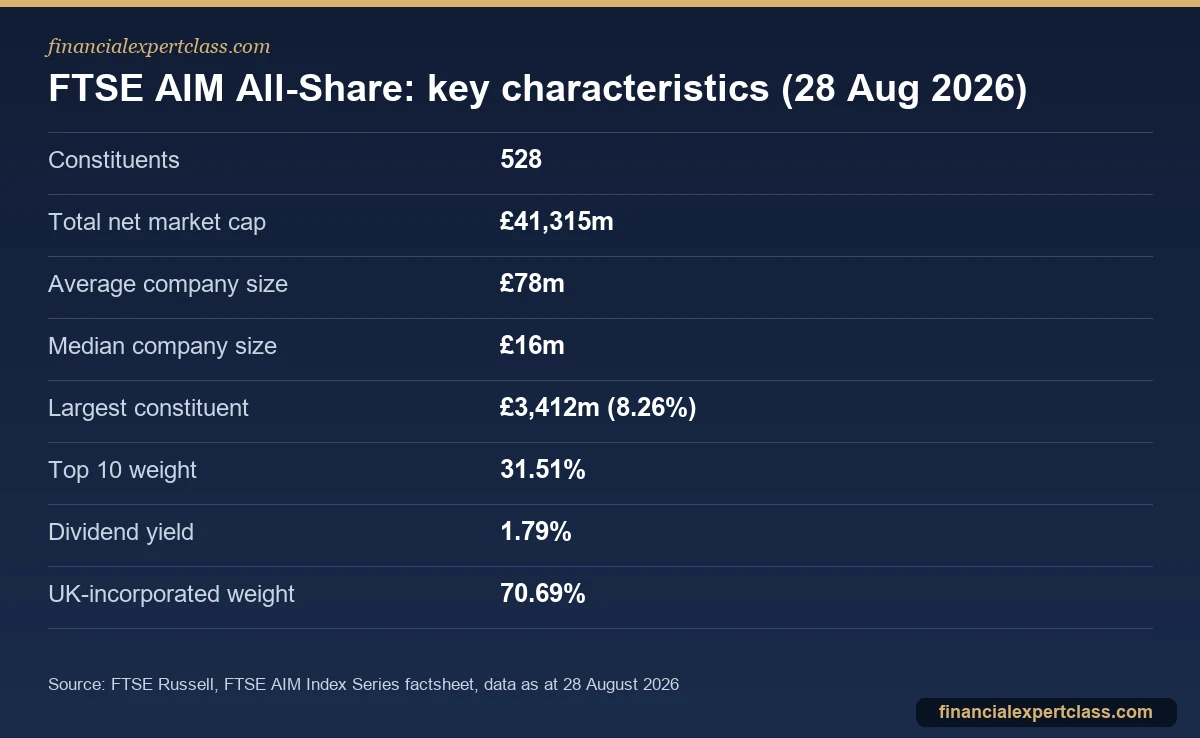
The average company is worth £78 million, but the median is only £16 million. In other words, a small number of larger companies sit on top of hundreds of very small ones. The largest constituent was Greatland Resources, a precious metals miner. It was worth £3,412 million and made up 8.26% of the index on its own. Meanwhile, the top 10 companies together were 31.51%.
Largest companies
FTSE Russell’s factsheet publishes the top 10 of the FTSE AIM 100, which are the biggest names on AIM. As at 28 August 2026, ranked by net market cap:
- Greatland Resources (precious metals and mining, Australia): £3,412m
- Jet2 (travel and leisure, UK): £2,333m
- Yellow Cake (industrial metals and mining, Jersey): £1,401m
- SigmaRoc (construction and materials, UK): £1,283m
- Uniphar (personal care, drug and grocery stores, Ireland): £904m
- Fevertree Drinks (beverages, UK): £789m
- Renew Holdings (construction and materials, UK): £762m
- Polar Capital Holdings (investment banking and brokerage, UK): £749m
- Greencoat Renewables (electricity, Ireland): £746m
- Serica Energy (oil, gas and coal, UK): £640m
Note the country column. AIM is a London market, not a UK-only one. By weight, 70.69% of the All-Share was UK-incorporated. Next came Australia (9.45%), Jersey (5.05%) and Ireland (4.08%).
Sector mix
The sector profile is very different from the big UK indices. For example, there are almost no banks (one, at 0.09%) and very little insurance or utilities. Instead, the index is heavy in natural resources and smaller industrial and technology businesses.

Basic Resources, mostly mining and exploration companies, were 23.21% of the index across 91 constituents. Add Energy at 8.45%, and roughly a third of the index depends on commodity prices. That is worth knowing if you think of AIM as a “UK growth companies” market. In practice, a large slice is exploration-stage miners and oil producers. Their value moves with metal and energy prices.
Performance and volatility
AIM has had a difficult few years. FTSE Russell’s factsheet, with data as at 28 August 2026, shows the FTSE AIM All-Share total return (dividends reinvested) at:
- 12 months: +1.9%
- 3 years: +5.5% cumulative (1.8% a year)
- 5 years: -33.6% cumulative (-7.9% a year)
Calendar-year returns swing widely. For example, it made +26.0% in 2017, -17.1% in 2018, +21.7% in 2020 and -30.7% in 2022. Then came -6.4% in 2023, -4.0% in 2024 and +8.5% in 2025. Five-year annualised volatility was 16.1%. Past performance is not a guide to the future. Still, these figures show how deep and long AIM drawdowns can be. For comparison with the UK’s large-cap index, see our FTSE 100 index guide.
AIM shares and inheritance tax
A big reason UK investors look at AIM is inheritance tax (IHT). Business Relief reduces the value of qualifying business assets in an estate. According to gov.uk’s current guidance, estates can get 50% Business Relief on “shares traded on markets that do not meet HM Revenue and Custom’s definition of ‘listed’, such as the Alternative Investment Market”. However, the deceased must have owned the shares for at least 2 years before death.
Important limits:
- Not every AIM company qualifies. For example, there is no relief if the business mainly deals in securities, land or buildings, or in making or holding investments.
- Relief applies to shares in qualifying companies, not to an index as such. So buying an AIM index product, if one existed, would not automatically qualify.
- For deaths on or after 6 April 2026, 100% relief on other qualifying business and agricultural property has a cap of £2.5 million, with 50% above that.
IHT planning with AIM shares means taking concentrated small-company risk to save tax. Also, a fall in share prices can wipe out the tax saving. So this is an area for regulated financial advice, not a DIY decision.
How to invest in the AIM market
At the time of writing (September 2026), I could not find a UK-listed ETF or index fund that tracks the FTSE AIM All-Share. Instead, the practical routes are:
- Individual AIM shares through a broker. Trading 212’s Help Centre notes that most stocks traded on AIM are exempt from the 0.5% stamp duty reserve tax. That tax applies to other UK share purchases.
- Actively managed AIM funds and investment trusts, some of which aim squarely at Business Relief. They charge active management fees and do not follow the index.
- Broad small-cap trackers. If you want smaller-company exposure without single-stock risk, a global or European small-cap ETF gives thousands of holdings. Our guide to small-cap ETFs for European investors compares the main options.
For most long-term investors, AIM belongs, if at all, as a small satellite next to a diversified core such as a global index fund. Our overview of the best global ETFs for UK investors covers that core. The ISA, LISA and SIPP guide then explains where to hold it.
Frequently asked questions
What is the FTSE AIM All-Share index?
It is FTSE Russell’s index of all companies quoted on the London Stock Exchange’s Alternative Investment Market that meet its eligibility and liquidity rules. As at 28 August 2026, it held 528 companies with a combined net market value of £41,315 million. It weights them by free-float market cap, and FTSE Russell reviews it quarterly.
How risky are AIM shares?
They are riskier than large listed companies. The typical AIM company is very small (the index median was £16 million). Also, many are early-stage or exploration businesses, and many are loss-making or exploration businesses. The index fell 30.7% in 2022, and it was down 33.6% over the five years to August 2026.
Does the FTSE All-Share include AIM?
No. FTSE Russell describes the FTSE All-Share as the aggregation of the FTSE 100, FTSE 250 and FTSE Small Cap indices. Together they represent 98-99% of UK market capitalisation. Instead, FTSE Russell tracks AIM companies separately in the FTSE AIM index series.
Do AIM shares still get inheritance tax relief?
Yes, but at 50% rather than 100%. Gov.uk lists shares traded on markets that are not “listed” under HMRC’s definition, such as AIM, as qualifying for 50% Business Relief. However, the company must be a qualifying trading business, and the owner must have held the shares for at least 2 years before death.
Cited sources: FTSE Russell: FTSE AIM Index Series factsheet, GOV.UK: What qualifies for Business Relief, London Stock Exchange: AIM Rules for Companies, FTSE Russell: UK indices, and Trading 212 Help Centre: stamp duty and AIM. Verify current fund figures before investing. Educational content, not financial advice.
Not personalised financial advice. Verify your situation with a qualified adviser. Operated by Aurum Digital Marketing LTD (UK), Companies House 15203665.
European UCITS/ETF investor with 11+ years building a global dividend and index portfolio, and founder of Financial Expert Class. I write every guide here from first-hand experience investing across EU brokers and tax regimes — not theory. More about me →