
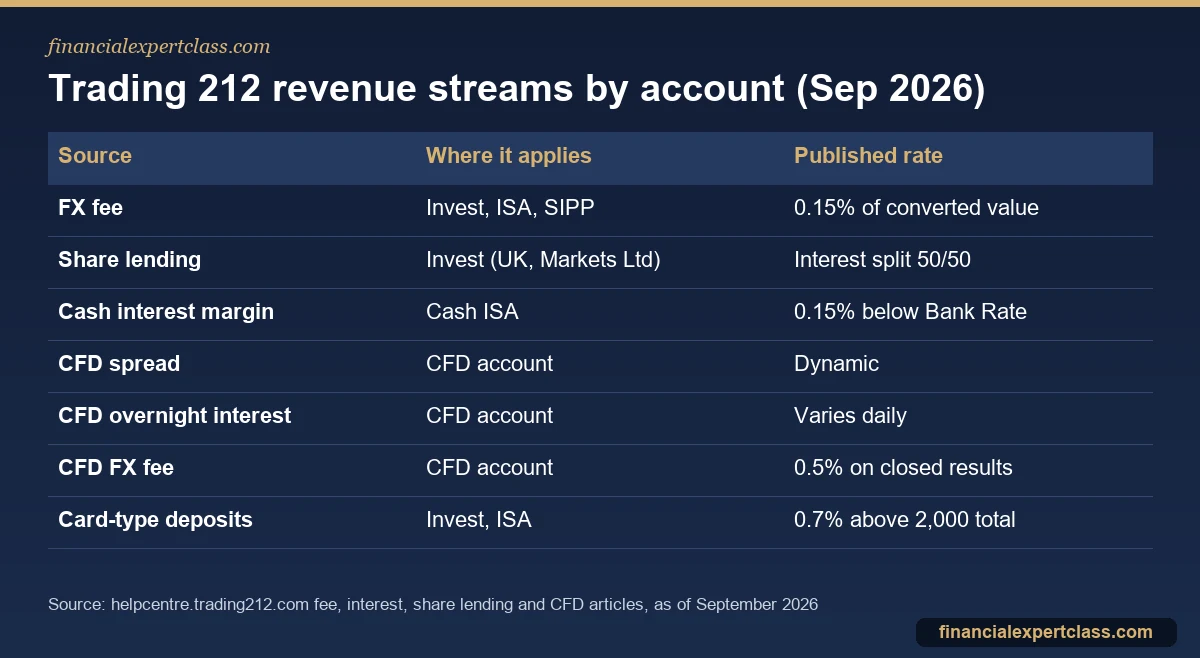
How does Trading 212 make money if dealing is free? Mainly from a 0.15% FX fee when you buy or sell something priced in a currency other than your account currency. It also lends out shares held in Invest accounts. In addition, it keeps a gap between what it earns on client cash and what it pays you. Finally, its CFD business earns spreads and overnight interest. It does not charge commission or a custody fee.
New to ETFs? Start with the free checklist.
The European ETF Starter Kit: what to check before you buy your first UCITS ETF — domicile, costs, tax and broker set-up.
What Trading 212 says about how it makes money
The clearest answer comes from Trading 212 itself. Its Help Centre article “How does Trading 212 make money?” covers both sides of the business. On the Invest and Stocks ISA side, it says “our main revenue streams are the 0.15% FX fee … and share lending proceeds, while on the CFD side, it’s the overnight interest fees and CFD spread.”
That is a short answer, but it tells you a lot. No hidden commission pays for free share dealing. Instead, currency conversion and share lending pay for it. Above all, a separate, higher-margin product pays for it: contracts for difference (CFDs). These are leveraged bets on price moves rather than ownership of the asset.
Trading 212 also explains why the model works for it. In its “How is my money protected?” article, it says free fractional share dealing is cost-effective. That is because it had already “invested significantly in infrastructure and platform development for our CFD business”. The same page states that the company does not rely on venture capital or crowdfunding. It also says it does not use client funds for its own hedging or margin trading.
How Trading 212 can make money: five revenue streams
1. The 0.15% FX fee
Sometimes you place an order in an instrument that trades in a different currency from your account. In that case, Trading 212 converts at the spot exchange rate plus 0.15%. The Help Centre states the FX fee is “the only fee Trading 212 can charge” on Invest, ISA and SIPP accounts. It also applies to orders inside Pies and AutoInvest. However, it does not apply to dividends and other corporate-event payments.
Take a UK investor buying a US-dollar ETF line from a pound account. That is 0.15% going in and 0.15% coming out. So on a £1,000 purchase, the conversion cost is about £1.50. It is small per trade, but it adds up across a large customer base.
2. Share lending
Trading 212 lends shares from Invest accounts to borrowers, typically for short selling, and receives interest. Its Help Centre says it “passes 50% of it to you”. So the other half is Trading 212’s revenue. Borrowers post collateral of at least 102% of the value of the lent shares, and the amount adjusts daily. Trading 212 UK clients get US Treasuries as collateral, while Trading 212 Markets clients get cash.
There are two limits. First, only Invest accounts qualify, not ISAs. Second, accounts registered with Trading 212 EU GmbH cannot take part. You can switch share lending off. While your shares are out on loan, you also lose the right to vote on them. In addition, dividends arrive as “manufactured” payments from the borrower, and some countries tax these differently.
3. Interest on client cash
Trading 212 places uninvested cash with banks or in qualifying money market funds (QMMFs). These are low-risk funds that hold short-term assets. Trading 212 pays interest on that cash, but it does not necessarily pass on everything it earns. The clearest published example is the Cash ISA, which pays a rate “0.15% below the BoE’s base rate”. That 0.15% gap is Trading 212’s margin on the product. For Invest and Stocks ISA cash, you can see the rates on its terms and fees page and in the app. They change with market rates, so check the live figure.
4. The CFD business: spreads and overnight interest
The heavier charges sit in the CFD account. There is still no commission. However, there is a dynamic spread, which is the gap between buy and sell prices. There is also overnight interest, charged daily on leveraged positions you hold past the close. Then there is a 0.5% FX fee on the results of closed positions in another currency. The mandatory warning on every Trading 212 page says 77% of retail investor accounts lose money when trading CFDs with this provider. So if you are a long-term ETF investor, it is best to ignore the CFD account entirely.
5. Deposit fees above a threshold
Deposits by card, Apple Pay, Google Pay and some other methods are free until you have deposited 2,000 GBP/EUR in total. After that, a 0.7% fee applies. Bank transfers and instant bank transfers stay free. This is less a revenue line than cost recovery on expensive payment methods. It is also easy to avoid.
Does Trading 212 use payment for order flow?
Payment for order flow (PFOF) means a market maker pays a broker for sending it customer orders. Many US “free” apps use this model. As a result, it is the first thing sceptical investors ask about.
Trading 212’s pre-trade cost screen includes a line called third-party inducements. It covers payments or rebates from fund managers, market makers or other providers “in exchange for directing customer order flow”. Its Help Centre states: “Trading 212 does not accept any of these payments, so the third-party inducements line always shows zero.” So, on its own published statement, the answer is no.
What this means for ETF investors
Say you buy and hold UCITS ETFs in an ISA or Invest account. In that case, the practical cost picture is simple.

Three things follow from the business model:
- Buy ETF lines in your account currency. Many popular UCITS ETFs have a pound-denominated line on the London Stock Exchange and a euro line on Xetra. If you choose the one that matches your account, you avoid the 0.15% FX fee entirely. That removes Trading 212’s main charge on your activity.
- Decide consciously on share lending. It adds a little income on an Invest account. However, it introduces counterparty risk (which collateral reduces), and you lose voting rights on lent shares. If you prefer not to take part, you can disable it.
- Stay out of the CFD account. The platform earns most per customer from spreads and overnight interest. They suit short-term traders, not long-term investors.
The ETF itself still has its own ongoing charge. That is the fund’s annual fee, which the issuer sets, not Trading 212. Also, UK stamp duty applies to purchases of shares listed on the London Stock Exchange, though not to ETFs. For a full cost walk-through, see our guide to Trading 212 fees for ETF investors. For the wider picture, read our Trading 212 review.
Is a free broker a riskier broker?
A broker earning money in unusual ways is not automatically unsafe. Still, it is sensible to check how it holds your assets. For Trading 212 UK Ltd, the Help Centre explains that client money sits in segregated client money bank accounts under the FCA’s client asset rules. It names J.P. Morgan and Barclays. Custodians including Bank of New York Mellon and Interactive Brokers hold the shares.
Suppose Trading 212 UK itself failed. In that case, the Financial Services Compensation Scheme (FSCS) covers up to £85,000 of investments and cash combined. If one of its partner banks failed, deposit protection covers uninvested cash up to £120,000 per banking group. That limit rose from £85,000 on 1 December 2025. For clients of Trading 212 Markets Ltd (Cyprus), the Investors Compensation Fund gives cover up to €20,000. Similarly, Germany’s EdW covers Trading 212 EU GmbH clients up to €20,000. However, money in a QMMF counts as an investment rather than a bank deposit, so bank deposit protection does not apply to it. Our article on whether Trading 212 is safe goes into more depth.
Frequently asked questions
Is Trading 212 really free?
For buying and holding shares and ETFs, largely yes. There is no commission, no custody fee and no inactivity fee, and withdrawals are free. The main cost is the 0.15% FX fee when the instrument trades in a different currency from your account. Also add exchange and tax charges, such as UK stamp duty on LSE-listed shares.
Does Trading 212 make a profit?
Trading 212 states in its Help Centre that it “has been profitable every single year since its founding 20 years ago”. It also says it has no debt and does not rely on venture capital funding. That is the company’s own claim, so its audited accounts are the place to check the figures.
Does Trading 212 sell my orders to market makers?
According to Trading 212, no. Its pre-trade cost screen shows third-party inducements, which include payments for directing order flow. The Help Centre says Trading 212 does not accept any of these payments. As a result, that line always shows zero.
What happens if Trading 212 goes bust?
The firm keeps client assets separate from company money. For Trading 212 UK Ltd clients, the FSCS covers up to £85,000 of eligible investments and cash combined if the firm fails. For clients of the Cyprus and German entities, their national schemes give cover up to €20,000. However, no scheme ever covers market falls.
Cited sources: Trading 212 Help Centre: how does Trading 212 make money, Trading 212 Help Centre: FX fee, Trading 212 Help Centre: share lending, Trading 212 Help Centre: Cash ISA tracker rate, Trading 212 Help Centre: pre-trade costs and inducements, Trading 212 Help Centre: how is my money protected, and Trading 212 Help Centre: funding fees. Verify current fund figures before investing. Educational content, not financial advice.
Not personalised financial advice. Verify your situation with a qualified adviser. Operated by Aurum Digital Marketing LTD (UK), Companies House 15203665.
European UCITS/ETF investor with 11+ years building a global dividend and index portfolio, and founder of Financial Expert Class. I write every guide here from first-hand experience investing across EU brokers and tax regimes — not theory. More about me →