
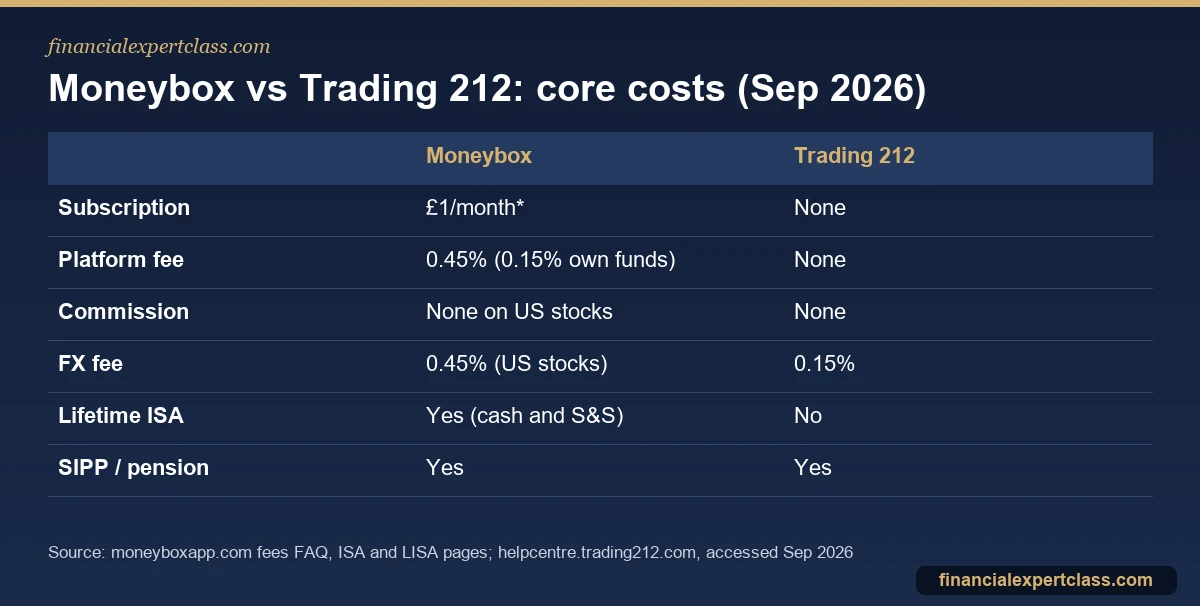
Moneybox vs Trading 212 comes down to one trade-off. Trading 212 is cheaper for investing. It has no subscription, no platform fee and no commission, just a 0.15% FX fee on foreign-currency trades. Moneybox costs more: a £1 monthly subscription plus a 0.45% service fee on most funds. In return, it offers a Lifetime ISA, which Trading 212 does not.
Comparing options? Take the decision workbook with you.
The ETF Comparison Workbook: TER, domicile, withholding tax and overlap checks in one printable spreadsheet.
The short version
- Choose Trading 212 if you want the lowest running costs and a wide choice of individual ETFs and shares. It also suits you if you are happy to pick your own investments.
- Choose Moneybox if you want a Lifetime ISA for a first home or retirement. It also suits you if you prefer a small menu of ready-made funds or like round-up saving features.
- Use both if you want a Lifetime ISA and a low-cost Stocks and Shares ISA. The Lifetime ISA’s £4,000 limit counts towards your £20,000 overall ISA allowance, so you can split contributions across providers.
Fees compared
These are the fees each provider published at the time of writing (September 2026). Check both fee pages before opening an account, because app pricing changes.
Moneybox fees
Moneybox’s support page lists three layers of cost on its investment accounts:
- Subscription: £1 a month, free for the first three months. Moneybox says it waives the fee for customers with £5,000 or more in certain savings or investment accounts.
- Service (platform) fee: 0.15% a year on Moneybox’s own funds and 0.45% on all other funds. It accrues daily and Moneybox takes it monthly. It does not apply to uninvested cash.
- Fund fees: each fund provider sets these, and Moneybox lists them on its funds page. On its ISA page Moneybox quotes a 0.29% fund fee for its own funds.
US shares in the Stocks and Shares ISA carry no commission. However, Moneybox takes a 0.45% currency conversion fee on the value of each trade.
Trading 212 fees
Trading 212’s help centre states one fee only for its Invest, ISA and SIPP accounts: the FX fee of 0.15%. Commission is free and custody is free. Still, exchange and tax charges apply where relevant. For example, there is 0.5% Stamp Duty Reserve Tax on purchases of UK-listed shares, though there is no stamp duty on ETFs. Bank transfers in are free. Card, Apple Pay and Google Pay deposits are free up to £2,000 in total. After that, a 0.7% fee applies.
Now suppose you buy an ETF quoted in pounds, such as a London-listed GBP line. In that case there is no currency conversion at all. So the trade costs nothing beyond the bid-ask spread. Our Trading 212 fees guide walks through every charge.
What that means in pounds
Percentage fees are easy to underestimate. So take a £3,000 Stocks and Shares ISA held for a year. This example ignores the fund’s own charges, which you pay at both providers. It also assumes Moneybox does not waive the subscription:

- Moneybox, other providers’ funds: £12 subscription + 0.45% of £3,000 (£13.50) = £25.50.
- Moneybox, own funds: £12 + 0.15% of £3,000 (£4.50) = £16.50, plus the 0.29% fund fee.
- Trading 212, GBP-quoted ETF: £0 in platform or dealing fees, plus the ETF’s own ongoing charge.
Because Moneybox’s service fee is a percentage, the gap grows with your balance. On £20,000 in other providers’ funds, the 0.45% fee alone is £90 a year. At Trading 212, the platform cost stays at zero regardless of size. To see how a yearly cost compounds over decades, run the numbers in our compound growth calculator.
Accounts available: the Lifetime ISA decides it for many
This is the biggest practical difference. Trading 212’s help centre says you can hold a Cash ISA and a Stocks and Shares ISA with it, one of each. It also offers a SIPP. However, it does not offer a Lifetime ISA.
Moneybox offers both a Cash Lifetime ISA and a Stocks and Shares Lifetime ISA. These sit alongside its Stocks and Shares ISA, general investment account and pension. Under GOV.UK rules you must open a Lifetime ISA and make your first payment before you turn 40. Then you can pay in up to £4,000 a year until 50. In return, the government adds a 25% bonus, up to £1,000 a year. Moneybox’s own page notes a 25% charge on some withdrawals. This applies if the money is not for a qualifying first home (up to £450,000) or retirement. As a result, you can get back less than you paid in.
If you are saving for a first home and want the bonus, Moneybox (or another LISA provider) is the only option of the two. For the wider picture of UK wrappers, see our guide to ISAs, LISAs and SIPPs for UCITS ETF investors.
Investment choice: Moneybox vs Trading 212
Moneybox offers a curated selection. It includes tracker funds and ETFs from providers such as Fidelity, Legal & General and iShares. It also has its own ready-made Moneybox funds, and direct US shares in the Stocks and Shares ISA. The idea is that you choose a style rather than build a portfolio holding by holding.
Trading 212 lists a large range of individual shares and ETFs from UK, US and European exchanges. It offers fractional investing and “pies”, which let you set target weights and automate regular buys. That suits investors who want a specific UCITS ETF, for example a particular global or S&P 500 tracker. Our step-by-step guide shows how to buy ETFs on Trading 212.
The flip side is that Trading 212 gives you more rope. A small menu of diversified funds can protect beginners from over-trading or buying narrow thematic products. So if you pick Trading 212, a plain global index ETF is a sensible default.
Protection and safety
Both firms are UK-regulated, and the Financial Services Compensation Scheme (FSCS) covers both.
- Moneybox states that the FSCS protects investments in its Stocks and Shares ISA up to £85,000.
- Trading 212 UK Ltd states that it holds client money and assets under the FCA’s client asset (CASS) rules. It keeps them segregated from its own funds. Custodians holding the assets include The Bank of New York Mellon and Interactive Brokers. Investment protection is up to £85,000 in total for shares and cash. In addition, cover for cash at its partner banks goes up to £120,000 per person per banking group.
FSCS cover applies if the firm fails and your assets are missing. However, it does not protect against investment losses. We look at the details in is Trading 212 safe?
Cash and interest
Trading 212 pays interest on uninvested cash in its ISA, Invest and SIPP accounts once you enable it. It holds the cash in banks or qualifying money market funds. It publishes rates for new clients on its terms page, and these change over time. Moneybox says it does not charge a service fee on cash in its investment accounts. Instead, it keeps the difference between the interest it earns from its banks and what it passes on. Moneybox also runs separate cash savings products. So compare the live rates on each site rather than relying on a snapshot.
Frequently asked questions
Is Trading 212 cheaper than Moneybox?
For a Stocks and Shares ISA, yes. Trading 212 charges no subscription, platform fee or commission, only a 0.15% FX fee on foreign-currency trades. By contrast, Moneybox charges £1 a month (unless waived) plus a 0.15% or 0.45% service fee. That comes on top of fund charges, as of September 2026.
Does Trading 212 offer a Lifetime ISA?
No. Its help centre says it offers a Cash ISA and a Stocks and Shares ISA (one of each), plus a SIPP. If you want a Lifetime ISA, you need a provider such as Moneybox.
What are the disadvantages of Moneybox?
The main drawback is cost. The monthly subscription and a percentage service fee make it more expensive than commission-free apps, especially as your balance grows. In addition, the investment menu is narrower, so you cannot pick from the full range of UCITS ETFs.
Can I transfer my Moneybox ISA to Trading 212?
Yes. You can transfer an ISA between providers and keep the tax-free status. Just request the transfer through the receiving provider rather than withdrawing the money yourself. However, you cannot move a Lifetime ISA to Trading 212 because it does not offer one.
Cited sources: Moneybox: fees for investment accounts, Moneybox Stocks & Shares ISA, Moneybox Lifetime ISA, Trading 212: fees in Invest, ISAs and SIPP, Trading 212: What are ISAs?, Trading 212 UK: funds and assets protection, Trading 212: funding fees, and GOV.UK: Lifetime ISA. Verify current fund figures before investing. Educational content, not financial advice.
Not personalised financial advice. Verify your situation with a qualified adviser. Operated by Aurum Digital Marketing LTD (UK), Companies House 15203665.
European UCITS/ETF investor with 11+ years building a global dividend and index portfolio, and founder of Financial Expert Class. I write every guide here from first-hand experience investing across EU brokers and tax regimes — not theory. More about me →