
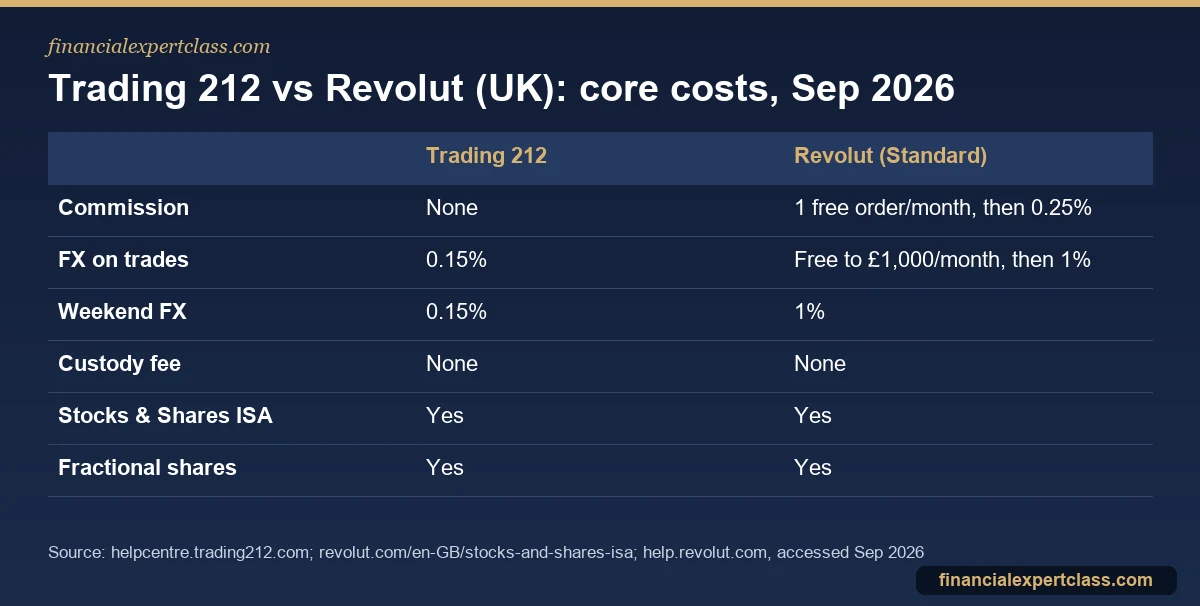
For most UK ETF investors, Trading 212 vs Revolut is an easy call: Trading 212 is the cheaper and more complete option. It charges no commission on any number of trades and a flat 0.15% FX fee. It also offers a Stocks and Shares ISA and a SIPP. By contrast, Revolut’s free Standard plan includes just one commission-free order a month, then charges 0.25% per order. So Revolut makes sense mainly if you already bank with it and invest small amounts occasionally.
Comparing options? Take the decision workbook with you.
- The ETF Comparison Workbook — 10 pages: the 7-filter framework for choosing between two good funds
- + 2 bonus PDFs: ETF Starter Kit and Dividend Starter Sheet
- + a free lesson from the €147 Masterclass
The short answer
- Choose Trading 212 if you invest regularly or spread money across several ETFs. It also suits you if you want a SIPP (Trading 212 offers one alongside its ISA), or the lowest costs without a subscription.
- Choose Revolut if you want investing inside the app you already use for spending. It works best if you place one order a month and are happy to stay within its fair-usage FX limits.
Both offer a flexible Stocks and Shares ISA with a £20,000 annual allowance, fractional shares and no custody fees. However, they differ in trading costs, currency conversion and how they protect uninvested cash.
Fees compared: Trading 212 vs Revolut
Trading 212
Trading 212’s help centre states one fee only for its Invest, ISA and SIPP accounts. That is a 0.15% FX fee when you trade an instrument in a different currency from your account. Commission and custody are free. Bank transfers in are also free. Card and wallet deposits are free up to £2,000 in total and then cost 0.7%. See our Trading 212 fees guide for the details.
Revolut
Revolut’s help centre gives each plan a rolling monthly allowance of commission-free orders. Standard gets 1, Plus 3, Premium 5, and Metal and Ultra 10. Beyond the allowance, each order costs 0.25% of the order amount (0.12% on Ultra), with a minimum fee of £0.01. Revolut’s ISA page lists the paid plans at £3.99 (Plus), £7.99 (Premium), £14.99 (Metal) and £55 (Ultra) a month. It also states there are no custody or subscription fees for the ISA itself.
Currency conversion is where Revolut’s costs can surprise you. Its help centre sets a fair-usage limit on weekday exchanges. On Standard, a 1% fee applies to exchanges over £1,000 in a rolling month. On Plus, it is 0.5% over £3,000. Premium, Metal and Ultra have no extra exchange fees. At weekends, however, Standard customers pay 1% on all exchanges and Plus customers 0.5%. (Weekends here run from 17:00 Friday to 18:00 Sunday, US Eastern Time.)
What it costs in practice
Take a typical monthly plan: £600 split across three ETFs priced in pounds. In that case you need no currency conversion.

- Revolut Standard: the first order is free. The other two cost 0.25% of £200 each, so £1.00 a month, or £12 a year.
- Revolut Plus: three free orders, but the plan itself costs £3.99 a month.
- Trading 212: nothing in commission or platform fees.
If you buy US-listed shares or a dollar-priced ETF line, add FX. That is 0.15% at Trading 212. At Revolut Standard, it is nothing until you pass £1,000 of weekday exchanges in the month, then 1%. For a single small monthly purchase in pounds, Revolut Standard can cost nothing. That is why it works well for casual investors.
ETF choice
Revolut’s UK ISA page advertises 4,000+ stocks and ETFs from UK, US and EEA markets. We have checked the practical ETF line-up in our guide to which ETFs you can buy on Revolut. Trading 212 also lists a large range of UK, US and European shares and UCITS ETFs. In addition, it offers “pies” for building and automating a multi-ETF portfolio.
Consider a core portfolio, such as a global tracker, an S&P 500 ETF and perhaps a bond ETF. For that, both apps usually cover the basics. Still, check that the app lists your exact ETF and share class before you move money. This matters especially if you want a specific accumulating or distributing version.
Custody model and protection
This is the most important difference that most comparisons skip.
Trading 212 UK Ltd is an FCA-authorised investment firm. It says it holds client money and assets under the FCA’s client asset (CASS) rules, segregated from its own funds. Custodians holding its shares include The Bank of New York Mellon and Interactive Brokers. If Trading 212 fails, the Financial Services Compensation Scheme (FSCS) covers up to £85,000 of shares and cash combined. In addition, if a partner bank fails, cover for cash at that bank goes up to £120,000 per person per banking group.
Revolut Trading Ltd (FCA reference 933846) provides the UK investment service. Revolut’s help centre says it follows the CASS rules. It also says a third-party broker holds your shares, with you as the beneficial owner. If it fails and there is a shortfall, FSCS investment protection of up to £85,000 may apply. But Revolut handles uninvested cash in your stock trading account differently. Revolut Ltd safeguards it as an electronic money institution. In Revolut’s own words, “your money is not protected by the Financial Services Compensation Scheme (FSCS)”. Safeguarding keeps customer money separate from the firm’s, but it is not a compensation scheme.
In practice, the difference matters most if you leave large cash balances sitting in the investment account. Our articles is Trading 212 safe? and is Revolut safe for investing? go deeper.
Interest on cash
Trading 212 pays interest on uninvested cash in its Invest, ISA and SIPP accounts once you switch the feature on. It holds the cash in banks or qualifying money market funds. It publishes rates for new clients on its terms page, and these change over time. Meanwhile, Revolut’s help pages describe uninvested cash in the trading account as e-money that Revolut Ltd safeguards, rather than a deposit. So compare the live rates and protection in each app rather than relying on a snapshot.
Which should you use?
If investing is the main goal, Trading 212 wins on cost for almost every pattern of regular investing. It also offers a SIPP as well as an ISA. Revolut is a reasonable place to start if you want everything in one app and make one purchase a month. However, many investors move on once their portfolio grows; we cover that move in outgrowing Revolut. You can also hold both, because ISA rules let you split your £20,000 allowance across providers.
Frequently asked questions
Is Trading 212 cheaper than Revolut?
For most regular investors, yes. Trading 212 charges no commission on any number of trades and a 0.15% FX fee. By contrast, Revolut’s free Standard plan includes one commission-free order a month, then 0.25% per order. On top of that comes a 1% FX fee above £1,000 a month or at weekends, as of September 2026.
What is the downside to Trading 212?
It does not offer a Lifetime ISA. Also, the choice of so many shares and ETFs can tempt beginners into over-trading, and its interest rates and features can change. It is an app-first broker, so you should be comfortable managing your account on your phone or the web.
Does Trading 212 tell HMRC?
Trading 212’s own ISA help pages say HMRC finds out if you pay more than the £20,000 allowance into your ISAs. They add that it will remove the excess when HMRC instructs it to repair the ISA. Outside an ISA, however, you are responsible for reporting taxable dividends and gains yourself.
Is my cash protected in Revolut’s investment account?
Revolut says Revolut Ltd, an electronic money institution, safeguards uninvested money in the stock trading account, and the FSCS does not protect it. Meanwhile, a third-party broker holds your shares with you as beneficial owner. If Revolut Trading Ltd fails, FSCS investment protection of up to £85,000 may apply to a shortfall.
Cited sources: Trading 212: fees in Invest, ISAs and SIPP, Trading 212 UK: funds and assets protection, Trading 212: interest on cash, Revolut Stocks & Shares ISA (UK), Revolut: trading fees, Revolut: currency exchange fees, Revolut: investment account cash protection, and Trading 212: What are ISAs?. Verify current fund figures before investing. Educational content, not financial advice.
Not personalised financial advice. Verify your situation with a qualified adviser. Operated by Aurum Digital Marketing LTD (UK), Companies House 15203665.
European UCITS/ETF investor with 11+ years building a global dividend and index portfolio, and founder of Financial Expert Class. I write every guide here from first-hand experience investing across EU brokers and tax regimes — not theory. More about me →