
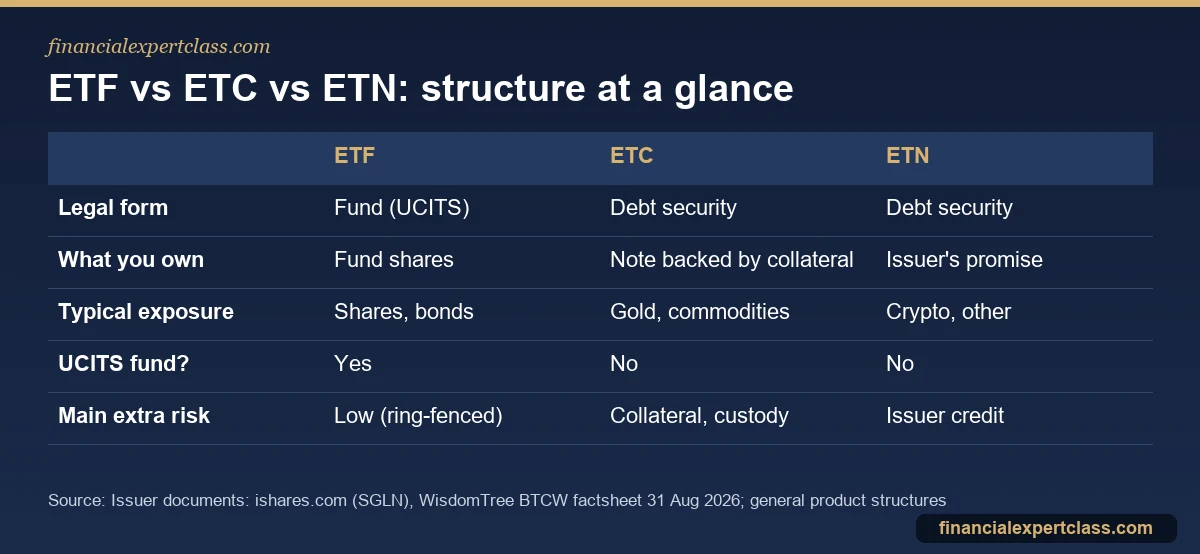
ETN vs ETF comes down to legal structure. An ETF is an investment fund: your money buys shares in a ring-fenced pool of assets. In Europe, it is usually a regulated UCITS fund. By contrast, an ETN (exchange-traded note) is a debt security. The issuer promises to pay you the return of an index or asset, so you also carry the issuer’s credit risk. An ETC is a note too, typically backed by a commodity such as physical gold.
New to ETFs? Start with the free checklist.
- The European ETF Starter Kit — 12 pages: your first fund, a safe low-cost broker and the 7 costliest beginner mistakes
- + 2 bonus PDFs: Comparison Workbook and Dividend Starter Sheet
- + a free lesson from the €147 Masterclass
Why the difference matters
ETFs, ETCs and ETNs all trade on a stock exchange and have a ticker. You can also buy all three through the same broker app. On a price chart they look identical. However, the difference is legal: what you actually own and who you depend on if something goes wrong. Together, people often call them ETPs (exchange-traded products). If you are new to the basic ETF structure, start with our beginner’s guide to ETFs.
ETF: a fund with ring-fenced assets
A UCITS ETF is a fund. It holds a portfolio of shares or bonds through a depositary. (For a synthetic ETF, it holds a basket of securities plus a swap.) Those assets belong to the fund and its investors, not to the fund manager. So if the management company failed, the assets would still be there for investors. UCITS rules also impose diversification limits. As a result, a single-commodity or single-cryptocurrency product generally cannot be a UCITS fund.
That is why almost every broad index product sold to UK and EU investors is a UCITS ETF. This runs from global trackers to S&P 500 funds. For how ETFs replicate their index, see physical vs synthetic ETFs.
ETN vs ETF: a note that depends on the issuer
An exchange-traded note is a debt security. The issuer is usually a special-purpose company set up by a bank or ETP provider. It owes you an amount linked to the price of an index or asset. In other words, you are a creditor, not a fund shareholder.
- Unsecured ETNs rely only on the issuer’s promise. If the issuer defaults, you are an unsecured creditor. So you may lose money even if the underlying index did well.
- Collateralised or physically backed notes reduce that risk. They hold the underlying asset or collateral with a custodian, while a trustee acts for noteholders. Many crypto ETPs sold in Europe use this physically backed model.
WisdomTree Physical Bitcoin (BTCW) is a good example of the second kind. Its factsheet, dated 31 August 2026, describes it as a debt security from WisdomTree Issuer X, domiciled in Jersey. Each share has a claim to a set amount of bitcoin. Custodians Swissquote Bank, Coinbase Custody Trust Company and BitGo Trust Company hold that bitcoin. In addition, The Law Debenture Trust Corporation acts as trustee. The management fee is 0.15%. The factsheet lists it as “UCITS Compliant: No”.
ETC: the commodity version
An exchange-traded commodity (ETC) is a note, usually backed by the physical commodity. It lets you track a single commodity, most commonly gold. UCITS diversification rules would not allow a fund to do that.
The iShares Physical Gold ETC (SGLN) shows how this works. BlackRock’s product page (23 September 2026) lists:
- Issuing company: iShares Physical Metals plc, domiciled in Ireland
- Total expense ratio: 0.12%
- Gold held: 284.74 tonnes in trust, with JPMorgan Chase Bank’s London branch as custodian
- Net assets: about US$39.2 billion
- UCITS: No; ISA eligible: Yes
The page also states that the securities are “limited recourse obligations which are payable solely out of the underlying secured property”. In plain English, your claim is against the gold held for the product, not against BlackRock generally. That is why physical backing and the custodian matter so much with ETCs. We compare the main products in our guide to gold ETFs and ETCs in Europe. We also explain the wider comparison in ETF vs ETC explained.
Crypto ETNs for UK investors: the 2026 rules
Crypto ETNs have a special regulatory position in the UK.
- Retail access: the FCA lifted its ban on retail access to cryptoasset exchange-traded notes from 8 October 2025. Its press release sets conditions. First, they must trade on UK-based recognised investment exchanges. Then, financial promotion rules and the Consumer Duty apply. Finally, “there won’t be coverage from the Financial Services Compensation Scheme (FSCS)”.
- ISAs: HMRC’s tax-free savings newsletter of June 2026 sets a new limit. It states that “cETNs are restricted to Innovative Finance ISAs from 6 April 2026”. If you already held crypto ETNs in a Stocks and Shares ISA immediately before that date, they can stay there. However, HMRC does not permit new purchases or transfers into a Stocks and Shares ISA.
So a UK investor can buy a crypto ETN in a general investment account. But they cannot add new crypto ETNs to a Stocks and Shares ISA in the 2026/27 tax year. Some product factsheets still show a general “ISA eligible” flag. Therefore, check the HMRC rule rather than relying on a marketing document.

Risks to check before buying an ETN or ETC
- Issuer and collateral. Who issues the note? And does the physical asset, or other collateral held with an independent custodian, back it? An unsecured note is only as safe as its issuer.
- Trustee and custody. A named trustee and custodians, disclosed on the factsheet, give noteholders a claim on the backing assets.
- Concentration. ETCs and ETNs usually track a single commodity or cryptocurrency. As a result, they can be far more volatile than a diversified ETF.
- No FSCS protection on the product. The FCA is explicit that crypto ETNs carry no FSCS coverage. FSCS protection for your broker is a separate question. We cover it in what happens to your ETFs if your broker goes bankrupt.
- Costs and tracking. Compare the annual fee and how closely the product has followed its reference price. Do this just as you would with an ETF.
Which should you use?
For the core of a portfolio, such as global shares or bonds, use UCITS ETFs. They offer diversification and ring-fenced assets, and you can hold them cheaply in ISAs. Use a physically backed ETC if you want a small allocation to gold or another single commodity. In that case, choose one with transparent custody. Treat crypto ETNs as a high-risk satellite at most. Remember that in the UK they now sit outside new Stocks and Shares ISA subscriptions and outside FSCS protection.
Frequently asked questions
Is an ETN riskier than an ETF?
Structurally, yes. An ETF’s assets sit ring-fenced in a fund, while an ETN is a debt security. So with an ETN you also depend on the issuer. Physically backed ETNs and ETCs reduce that risk by holding the underlying asset with a custodian. Even so, they are still not UCITS funds.
Is a gold ETC the same as a gold ETF?
Not legally. In Europe, most “gold ETFs” are actually ETCs. That is because UCITS diversification rules do not allow a fund to hold a single commodity. For example, the iShares Physical Gold ETC (SGLN) is a note from iShares Physical Metals plc, backed by physical gold.
Can I hold crypto ETNs in a Stocks and Shares ISA?
Not new ones. HMRC says it limits crypto ETNs to Innovative Finance ISAs from 6 April 2026. Holdings already in a Stocks and Shares ISA before that date can remain. However, you cannot buy or transfer new ones in.
Are ETNs covered by the FSCS?
The FCA has said crypto ETNs have no FSCS coverage. More generally, FSCS protection relates to the failure of an authorised firm such as your broker. It does not cover losses when a product’s issuer or underlying asset falls in value.
Cited sources: iShares Physical Gold ETC (SGLN), WisdomTree Physical Bitcoin factsheet, 31 Aug 2026, FCA: FCA opens retail access to crypto ETNs, and HMRC: Tax-free savings newsletter 21 (June 2026). Verify current fund figures before investing. Educational content, not financial advice.
Not personalised financial advice. Verify your situation with a qualified adviser. Operated by Aurum Digital Marketing LTD (UK), Companies House 15203665.
European UCITS/ETF investor with 11+ years building a global dividend and index portfolio, and founder of Financial Expert Class. I write every guide here from first-hand experience investing across EU brokers and tax regimes — not theory. More about me →