
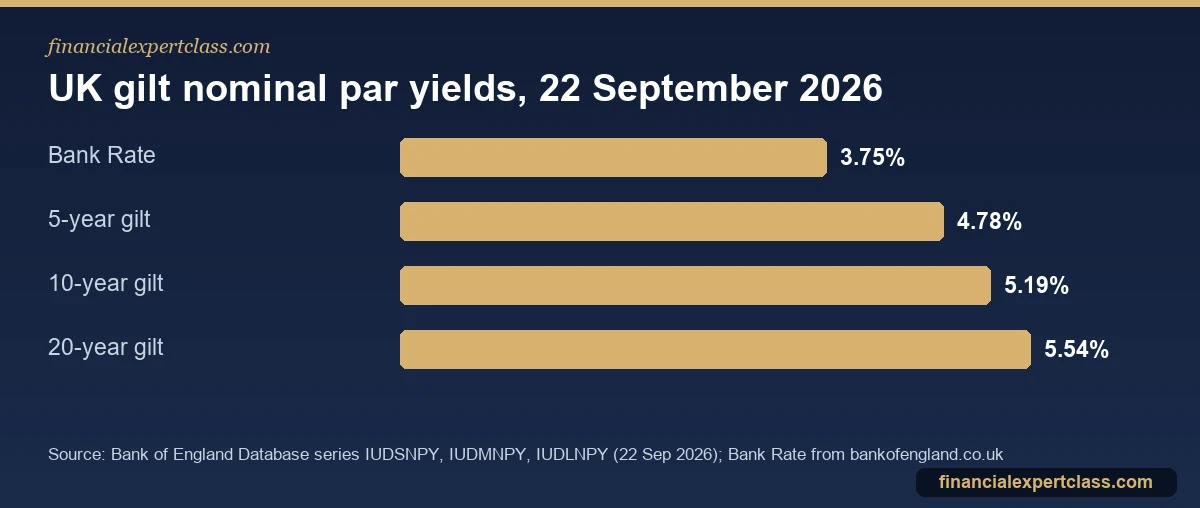
UK gilt yields show the annual return the market demands to lend to the UK government. For example, the 20-year rate is the return for lending for 20 years. The Bank of England’s 20-year nominal par yield was 5.54% on 22 September 2026. That was above the 10-year (5.19%) and 5-year (4.78%) yields. Yields move every trading day, so always check a dated live source before acting.
Building an income portfolio? Use the free sheet.
The Dividend Portfolio Starter Sheet: plan yield, payout dates and withholding tax for a European dividend portfolio.
What a gilt is
A gilt is a UK government bond. The UK Debt Management Office (DMO) describes a gilt as a UK government liability denominated in sterling. HM Treasury issues it, and it lists on the London Stock Exchange. A conventional gilt pays a fixed cash coupon every six months until maturity, then repays its face value. Dealers quote prices per £100 of face value.
There are two main types:
- Conventional gilts pay a fixed coupon and return £100 per £100 nominal at maturity. They are the main type of gilt.
- Index-linked gilts adjust both the coupon and the final repayment in line with the Retail Prices Index (RPI), with a lag. As a result, they protect against inflation. Our guide to inflation-linked bond ETFs covers the fund route.
What “yield” actually means
A bond’s coupon stays fixed from the day it is issued, but its price changes daily. The yield connects the two. The DMO defines the redemption yield (or yield to maturity) as an indication of your return. That is the return if you bought at today’s price and held the gilt to maturity. It includes both the coupons and the gain or loss between the price you pay and the £100 you get back.
That is why prices and yields move in opposite directions. Suppose new gilts come to market paying more. Then existing gilts with lower coupons become less attractive. So their prices fall, and their yields rise until they compete again. A bond bought below £100 has a yield above its coupon; one bought above £100 has a yield below it.
When people quote “the 20-year gilt yield”, they usually mean a representative yield for a 20-year maturity. In other words, it is not one specific bond. The Bank of England estimates it from the prices of all conventional gilts. It then publishes the result as a par yield. That is the coupon a newly issued gilt of that maturity would need to trade at exactly £100.
The UK gilt yield curve: 5, 10, 20 and 30 years
Plot yields against maturity and you get the yield curve. On 22 September 2026 the Bank of England’s nominal par yields were 4.78% for 5 years and 5.19% for 10 years. For 20 years, the figure was 5.54%. Meanwhile, Bank Rate, the Bank’s policy rate, stood at 3.75%. That is an upward-sloping curve, because lenders earned more for lending for longer.
Each part of the curve reflects something different:
- Short end (up to about 5 years): driven mainly by where markets expect Bank Rate to go. The Bank of England held Bank Rate at 3.75%, with inflation at 3.1% against a 2% target. Its next decision was due on 5 November 2026.
- 10 years: the benchmark most often quoted in the news. It mixes rate expectations with inflation and fiscal risk.
- 20 and 30 years: heavily influenced by long-run inflation expectations and government borrowing plans. Demand from pension funds and insurers that need long-dated assets also matters. Investors usually demand a “term premium” for tying money up this long.
The curve can also flatten or invert, with short yields above long ones. Markets often read that as a sign that traders expect rate cuts. The headline par-yield series in the Bank’s database used here stops at 20 years. So for 30-year yields, look at the Bank of England’s full yield curve files. Alternatively, check the DMO’s data on individual long-dated gilts.
Where to see live gilt yields
- Bank of England yield curves: daily estimated nominal and real curves, published by noon on the following business day. There are also downloadable series in the Bank of England Database (the 20-year nominal par yield is series IUDLNPY).
- UK Debt Management Office: gilt market data, such as prices and redemption yields for each bond. This helps if you want the yield on a specific one you could buy.
- Your broker or platform: platforms that deal in gilts typically list each one’s price before you buy, along with its redemption yield.
Commercial market-data sites also quote “UK 20Y” figures in real time. However, they may use slightly different methods from the Bank’s par yields, so compare like with like.
Why gilt yields matter to ordinary investors
These yields feed straight into everyday finance. For instance, long-term borrowing costs, annuity pricing and pension scheme valuations all link closely to them. For investors, the yield on offer sets the bar for every other asset. So when a 20-year gilt offers more than 5%, riskier assets such as shares or corporate bonds have to promise more to be worth owning.
Rising yields also mean falling bond prices, and long-dated gilts are the most sensitive. A bond’s duration gives a rough guide. For example, a fund with a duration of 7 would fall around 7% if yields rose by one percentage point. It would also gain a similar amount if they fell. Our bond duration impact calculator lets you test scenarios. Also, our look back at the 2022 bond meltdown shows what a sharp rise in yields does to long bonds.
Gilts vs gilt ETFs
You can buy individual gilts through most UK platforms, or you can buy a fund that holds many of them. Each has advantages.
Individual gilts give you a known outcome if you hold to maturity. You know the coupons and the £100 repayment in advance. So the yield you lock in is the return you get (in nominal terms). They also carry a UK tax advantage. Gov.uk lists UK government gilts among the assets on which you do not pay Capital Gains Tax. Therefore, low-coupon gilts bought below £100 deliver much of their return as a tax-free gain. That applies to investors holding them outside an ISA or pension. The coupons, however, are interest, and the tax rules treat them differently from the gain. So check how they fit with your own tax position.
Gilt ETFs hold a spread of maturities and never mature themselves, so their duration stays roughly constant. Take the iShares Core UK Gilts UCITS ETF (IGLT), for example. It tracks the FTSE Actuaries UK Conventional Gilts All Stocks Index and charges a 0.07% total expense ratio. As of 22 September 2026, it held 71 gilts with a weighted average maturity of 10.33 years. Its effective duration was 7.11. It is ISA and SIPP eligible and has UK reporting fund status. However, the capital gains exemption applies to gilts held directly, not to a fund that holds them.

Inside an ISA or SIPP, the tax difference disappears. Instead, the choice is about convenience and control. Our comparison of individual bonds vs bond ETFs goes through the pros and cons in more depth.
Frequently asked questions
What is the current UK 20-year gilt yield?
The Bank of England’s 20-year nominal par yield was 5.54% on 22 September 2026. It changes every trading day. The Bank aims to publish each day’s estimate by noon on the next business day. In addition, the DMO publishes data on individual gilts.
Why are long-dated gilt yields higher than short-dated ones?
Investors normally want extra reward for lending for longer. That is because more can go wrong with inflation and government finances over 20 or 30 years. By contrast, Bank Rate anchors short yields, and it was 3.75% in September 2026.
Are gilts free of Capital Gains Tax?
Yes. Gov.uk lists UK government gilts among the assets on which you do not pay Capital Gains Tax. This applies to gilts you hold directly, not to gilt funds or ETFs.
Is it worth buying UK gilts now?
That depends on your goals and time horizon, not on a forecast. A gilt held to maturity locks in its yield in nominal terms, which can suit a known future expense. But if you need flexibility or a spread of maturities, a gilt ETF may suit better. Its price, however, will move with yields.
Cited sources: Bank of England Database: 20-year nominal par yield, Bank of England: yield curves, Bank of England: Bank Rate, UK Debt Management Office: about gilts, GOV.UK: what you pay Capital Gains Tax on, and iShares Core UK Gilts UCITS ETF. Verify current fund figures before investing. Educational content, not financial advice.
Not personalised financial advice. Verify your situation with a qualified adviser. Operated by Aurum Digital Marketing LTD (UK), Companies House 15203665.
European UCITS/ETF investor with 11+ years building a global dividend and index portfolio, and founder of Financial Expert Class. I write every guide here from first-hand experience investing across EU brokers and tax regimes — not theory. More about me →