
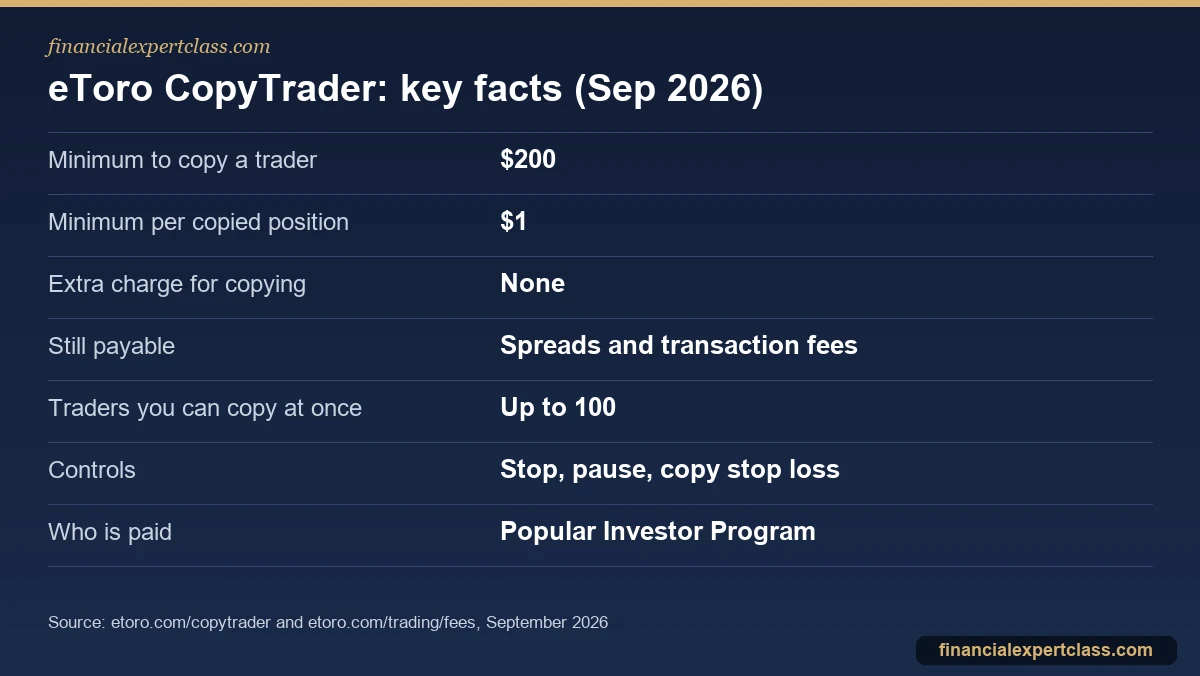
eToro copy trading, called CopyTrader, automatically mirrors another eToro user’s trades in your account. It does so in real time and in proportion to the amount you allocate. It needs at least $200 per trader and carries no extra copying fee. However, you still pay spreads and transaction fees. You also take on all of that trader’s risks, including leverage.
New to ETFs? Start with the free checklist.
- The European ETF Starter Kit — 12 pages: your first fund, a safe low-cost broker and the 7 costliest beginner mistakes
- + 2 bonus PDFs: Comparison Workbook and Dividend Starter Sheet
- + a free lesson from the €147 Masterclass
How eToro copy trading works
eToro describes CopyTrader as a way to “choose an investor to copy, and when they trade, so do you”. First, you find a trader on the Copy Discover page. Then you press Copy and choose how much to allocate. From then on, eToro duplicates the trader’s positions in your portfolio automatically. It does this in real time and in direct proportion to your allocation.
You keep some controls. For example, eToro says you can start or stop copying at any time, add or remove funds, and pause a copy. You can also set a stop loss for the whole copy relationship, so it closes if losses reach a level you choose. You can copy a single person or build a group of up to 100 traders at once.
eToro pays the traders you copy through its Popular Investor Program. Only users approved for that programme receive monthly earnings when others copy them. Other public profiles can still attract copiers, but eToro does not pay them.
What copy trading costs
According to eToro’s CopyTrader page, there is no additional charge for copying another trader. However, you still pay the market spread and any transaction fees on the underlying trades. That is exactly as if you had placed them yourself.
eToro’s fees page adds some useful detail as of September 2026:
- ETFs: zero commission, whether you place the order manually, via CopyTrader or via Smart Portfolios.
- Stock commission: a $1 or $2 fee may apply when opening and closing stock positions, depending on your country and the exchange. But eToro says it does not apply to copy trading or Smart Portfolios.
- Account fees: no account opening, management or inactivity fee. Withdrawals are free from local currency accounts, or $5 otherwise.
- Currency conversion: may apply when your local currency account buys assets priced in another currency. It may also apply when you move money between your USD and local accounts. Rates vary by location, payment method and eToro Club level.
The bigger cost is not a fee at all. If the trader you copy trades often, every round trip pays a spread. In addition, eToro’s fees page states that it executes short-selling orders and leveraged stock positions as CFDs. These incur CFD spreads and overnight fees. Some non-leveraged buy positions also run as CFDs.
The risks you inherit
When you copy someone, you copy everything: their good trades, their bad trades and their appetite for risk. The main risks are:
- Past performance is a poor guide. eToro’s pages show two-year returns for Popular Investors that range widely. For example, the examples on the CopyTrader page in September 2026 ran from strong gains to losses. A good two-year run can reflect luck, a single sector or a risky strategy that has not yet failed.
- Leverage and CFDs. Some copied positions may be CFDs. eToro’s own risk warning on the CopyTrader page states that 51% of retail investor accounts lose money when trading CFDs with this provider.
- Crypto. eToro warns that MiFID protections do not cover its crypto service. These include the Cyprus Investor Compensation Fund and the UK FSCS.
- Timing and slippage. eToro replicates copied trades automatically, but your entry price may differ from the trader’s. Also, it does not open positions below the $1 minimum at all.
- Behavioural risk. It is easy to start copying after a hot streak and stop after a drawdown. That locks in the worst of both.
Is copy trading regulated?
eToro is not one company but a group of regulated entities. The Financial Conduct Authority authorises and regulates its UK entity, eToro (UK) Ltd (FRN 583263). Similarly, the Cyprus Securities and Exchange Commission authorises and regulates its European entity, eToro (Europe) Ltd (CySEC licence 109/10). Which one you deal with depends on where you live. Regulation governs how eToro handles your money and runs its service. However, it does not make the trader you copy an adviser. Nor does it protect you from investment losses. eToro itself notes that copy trading does not amount to investment advice.
Why ETF investors should be careful
For long-term investors, copy trading solves a problem most do not have. Say your goal is to grow wealth over decades. In that case, the evidence-based approach is to own the whole market cheaply and keep adding regularly. For example, you could use a world index such as the MSCI World or FTSE All-World. Copying an individual trader, by contrast, replaces broad diversification with one person’s judgement. It also usually means far more trading.
There is also a tax angle. Every trade a copied investor closes can create a taxable event for you. So a busy trader can generate hundreds a year, while a buy-and-hold ETF portfolio generates very few. Our compound growth calculator shows how much small annual drags add up to over 20 or 30 years.
If you still want to try it, treat copy trading as a small, experimental satellite, not the core of your savings. Keep the core in low-cost, broadly diversified funds that you add to regularly. Then judge the copy experiment over several years, not a few good months.

If you decide to try it
eToro says each Popular Investor has a unique strategy, a risk level and a transparent track record. So use that information properly rather than sorting by the highest recent return. A few habits help:
- Size it deliberately. Decide in advance what share of your investable money you will hand to other people’s decisions, and keep it small. After all, the $200 minimum per trader means spreading across several traders quickly adds up.
- Look beyond the headline. Two years is a short window. So check how the trader behaved in falling markets, how concentrated their positions are and how often they trade.
- Check the instruments. A trader who mainly buys shares and ETFs without leverage is a very different proposition from one who trades leveraged CFDs or crypto.
- Use the copy stop loss. Set it at a loss you could accept without panic. Also remember that a sharp fall can trigger a stop loss and crystallise the loss.
- Keep records. Copied trades are your trades for tax purposes, so download eToro’s statements each year.
Alternatives on eToro
- Buy ETFs yourself. eToro charges zero commission on ETF trades. Our guide on how to buy ETFs on eToro walks through it. Also, our eToro review covers the wider platform.
- Smart Portfolios. Ready-made, analyst-curated thematic portfolios with no portfolio management fee, starting from $500. eToro rebalances them periodically, but they are thematic bets, not broad index funds.
- Recurring investments. eToro’s recurring investment plans let you automate regular purchases. When a plan triggers a deposit, eToro says the currency conversion fee on that deposit is free.
Frequently asked questions
Is it good to copy traders on eToro?
It can work for some people, but you inherit the copied trader’s risk, including leverage. Also, past returns do not predict future ones. For long-term savings, a low-cost diversified ETF portfolio is usually a sounder core. Copy trading is then limited to a small experimental amount.
Is copy trading illegal in the UK?
No. Copy trading is a legitimate service, and the FCA authorises and regulates eToro’s UK entity, eToro (UK) Ltd. However, regulation does not protect you from losing money on the trades you copy.
How much do I need to copy someone on eToro?
eToro’s minimum to copy a trader is $200. In addition, each copied position must be at least $1, or eToro will not open it.
Does eToro charge for copy trading?
There is no additional charge for copying. However, you still pay spreads and any transaction fees on the underlying trades. You also pay any currency conversion fees that apply to your account.
Cited sources: eToro: CopyTrader, eToro: fees and charges, and eToro: Smart Portfolios. Verify current fund figures before investing. Educational content, not financial advice.
Not personalised financial advice. Verify your situation with a qualified adviser. Operated by Aurum Digital Marketing LTD (UK), Companies House 15203665.
European UCITS/ETF investor with 11+ years building a global dividend and index portfolio, and founder of Financial Expert Class. I write every guide here from first-hand experience investing across EU brokers and tax regimes — not theory. More about me →