
REIT ETFs – Real Estate Investment Trusts for European Investors
The four REIT UCITS ETFs a European investor actually needs to compare: HSBC FTSE EPRA NAREIT Developed (IE00B5L01S80, 0.24%, EUR 2,112m) for the global core; iShares European Property Yield (IE00B0M63284, 0.40%, EUR 845m) for a Europe tilt; and two thematic satellites — Global X Data Center REITs & Digital Infrastructure (IE00BMH5Y327, 0.50%, EUR 300m) and WisdomTree New Economy Real Estate (IE000MO2MB07, 0.45%, but only EUR 14m). Distribution yields sit between 2.12% and 2.91%, not the “mid single digits” property funds are assumed to pay. All figures from justETF at 30-31 July 2026.
Key takeaways: European investors can tap property returns without brick-and-mortar hassles. REIT ETFs deliver instant diversification across offices, warehouses, data centres, housing and more. Moreover, the dividends often outpace investment-grade bond funds. They behave differently from mainstream equities. In addition, they offer both inflation resilience and sector-specific growth stories such as digital infrastructure. This guide walks you through the UCITS landscape. It also covers the tax wrinkles between Irish and Luxembourg domiciles. Furthermore, I share how I actually buy these funds through my brokers. Importantly, I flag the pitfalls I keep seeing investors fall into.
If you want your real blended return and a dividend forecast, try the portfolio-analytics dashboard I use.
Related: my listed private equity (IPRV) review covers this in depth.
Related: my gold allocation guide covers this in depth.
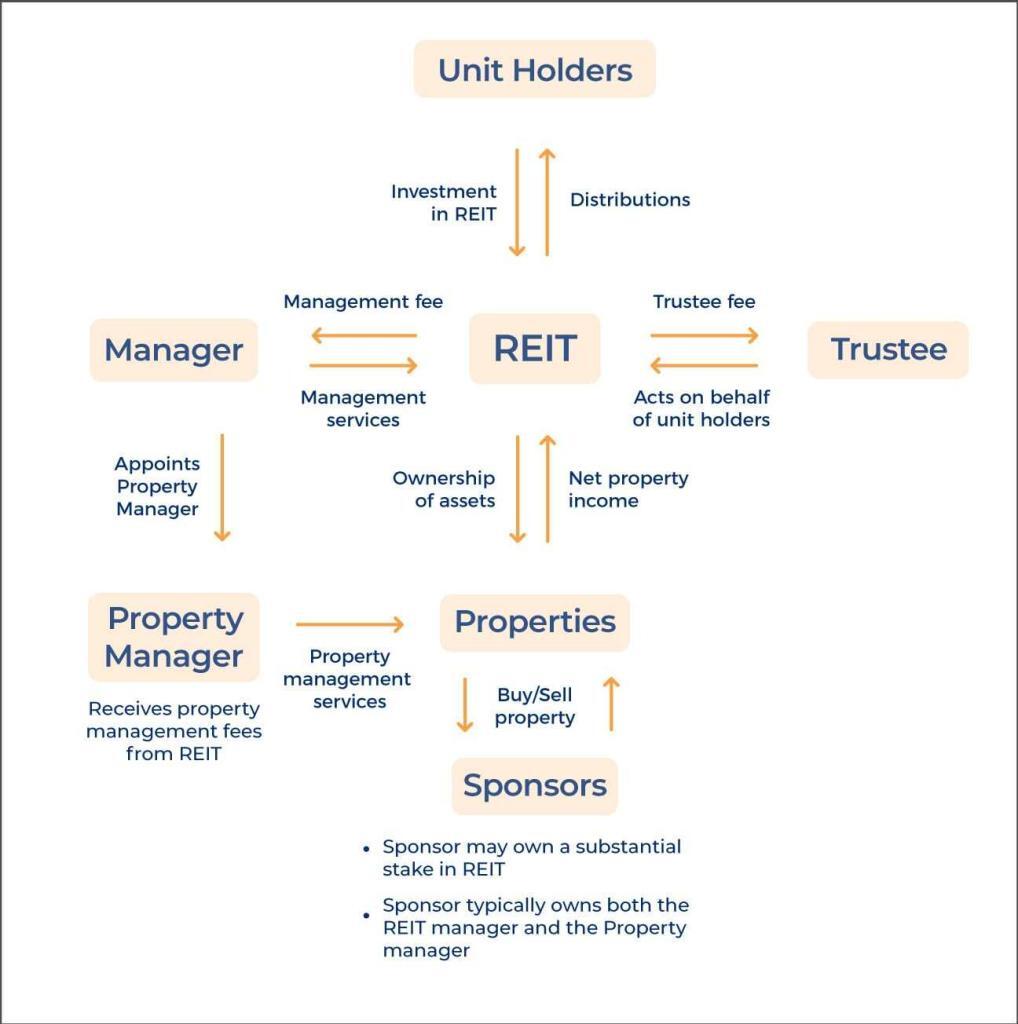
Conceptual infographic showing the structure and key participants of a real estate investment trust (REIT) and their relationships.
Why REIT ETFs deserve a place in European portfolios
REITs must distribute the bulk of their taxable rental income to shareholders in most jurisdictions. Therefore, they turn rental cash flows into regular dividends. When wrapped inside a UCITS ETF on Xetra, Euronext, the LSE or SIX, the structure quietly solves several headaches. European investors often face these headaches when trying to own property directly:
- Built-in diversification – one trade spreads risk across dozens of properties and geographies. By contrast, betting the farm on one flat in Vilnius, Warsaw or Lisbon concentrates risk heavily.
- Liquidity – you can trade during market hours on Xetra, Euronext, LSE or SIX. Try selling a rental apartment in three minutes.
- Cost efficiency, with the actual numbers – broad global property UCITS start at 0.24% (HSBC FTSE EPRA NAREIT Developed) but the shelf runs up to 0.59% (iShares Developed Markets Property Yield), with the Europe fund at 0.40% and the two thematics at 0.45% and 0.50%. “Well below 0.50%” was true of one fund on this page’s own shortlist and false of three.
- UCITS structure, but not a US withholding shelter on REIT income – and this page used to say otherwise. The Irish treaty rate applies to ordinary corporate dividends; Article 10(4) of the US-Ireland treaty expressly withholds the reduced rate from REIT dividends unless the beneficial owner is an individual holding less than 10% (the treaty text, IRS). A UCITS fund is not an individual, so US REIT dividends inside it are withheld at 30% whatever its domicile. The correction below explains what domicile does buy you. See ESMA’s guidance on KIDs/PRIIPs for the disclosure framework.
- Broad access – savings plans on Trade Republic start from a few euros a month. Additionally, most EU brokers list at least a handful of property UCITS.
I run my own dividend portfolio from an EU base and have done so for 11+ years. REIT ETFs sit in the “real-asset sleeve” alongside a small commodities position. They are not a magic bullet. In 2022 they got hammered as rates spiked. However, they bring a return stream that is genuinely different from broad equities and bonds. You can read more about how I structure the rest of the portfolio on my about page.
A personal anecdote that taught me to read the KID before chasing yield: in autumn 2023 I tried to top up a small property ETF position through one of my brokers. The order failed because that share class no longer had an English-language KID on the broker’s platform. This was a hangover from the PRIIPs implementation. Instead, I swapped into the Irish-domiciled accumulating sister fund. I should have picked it in the first place for treaty reasons. The lesson: domicile and share class are not just a tax-nerd detail. Crucially, they affect whether you can even press the buy button.
Performance snapshot
Over multi-decade horizons, listed real estate has historically produced equity-like returns. Notably, the dividend profile differs meaningfully from broad equities. The authoritative free source for long-run index data on global REIT performance is Nareit. On the European side, EPRA publishes monthly returns for the FTSE EPRA Nareit family. Always cross-check the latest factsheets on justETF and Morningstar Europe before pulling the trigger. Numbers move, and a yield that was true last quarter can be stale by the time you buy.
Core property sectors inside REIT ETFs
| Sector | Income drivers | Recent trend | Volatility |
|---|---|---|---|
| Logistics & industrial | E-commerce demand, re-shoring | Strong rental growth, see CBRE/JLL reports | Medium |
| Data centres & towers | Cloud, AI, 5G upgrades | Multi-year outperformer | High |
| Residential | Urban undersupply, rent indexation | Stable, regulation-sensitive | Low |
| Healthcare | Ageing demographics | Steady, lease-length driven | Medium |
| Retail malls & offices | Footfall, return-to-office | Mixed, repricing continues | High |
Sources: CBRE Insights and JLL Trends & Insights publish regular European market reports with the underlying sector data. For ETF-level historical returns by sub-sector, see the issuer factsheets on iShares UK.
The takeaway: when you buy a broad REIT ETF, you are not just buying “property”. Instead, you are buying a basket whose sector weights largely determine your return. A fund tilted heavily to retail malls behaves very differently from one loaded with data centres and towers. Therefore, always open the holdings tab on the issuer’s site. For example, check the iShares product pages over at iShares UK. Then look at the sector breakdown before the headline yield.

Aerial view of a European data center facility representing real estate assets commonly included in REIT ETFs.
Dividend appeal
The search for yield is fierce after the ECB’s long “higher-for-longer” stance. The ECB monetary policy decisions archive documents the policy path. Distributing share classes help meet income targets for FIRE adherents and pensioners alike. Personally, I lean distributing for the portfolio slice I want to spend rather than reinvest. Distribution yields at 30-31 July 2026: HSBC FTSE EPRA NAREIT Developed 2.91%, iShares European Property Yield 2.90%, iShares Developed Markets Property Yield 2.12%. That is low single digits, not the “low-to-mid” this page used to say, and it is worth knowing before you buy property funds for income. However, always check each issuer’s KID and the live screen on justETF before you act on any number you read here.
The EU early-retirement tool models 4% withdrawal across three real European market scenarios.
If your goal is more dividend yield generally — not just from property — have a look at my deeper dividend ETF write-ups: Best dividend growth ETFs for European investors, Top 5 Irish-domiciled ETFs for dividend hunters in Europe, and Which ETFs have the best dividend yield for European investors.
Dividend champions: European REIT ETFs with the richest yields. Verify current numbers on justETF and the issuer KID before buying.
Building a balanced REIT ETF allocation
1. Global core holding
HSBC FTSE EPRA NAREIT Developed UCITS ETF — ISIN IE00B5L01S80 – broad global developed-market property in one trade, covering the US, Europe and Asia Pacific. From justETF at 31 July 2026: TER 0.24%, EUR 2,112m, 352 holdings, Irish-domiciled, distributing quarterly, distribution yield 2.91%. Its listing tickers are HPRD (LSE in USD, Borsa Italiana in EUR), HPRO (LSE in GBX/GBP) and H4ZL on gettex in EUR — note that the “H4ZJ” this page used to list is not one of them. and cross-check on justETF. This is the kind of fund that earns the “set-and-forget” sticker. You get global property exposure without picking individual landlords. Furthermore, you avoid guessing whether Singapore retail will beat US logistics next year.
2. Europe tilt
iShares European Property Yield UCITS ETF (IQQP), ISIN IE00B0M63284 — TER 0.40%, EUR 845m, distributing quarterly, yield 2.90% – this fund focuses on continental landlords. For the official TER, distribution yield and full holdings list, see the product page on iShares UK. Suppose you live in the eurozone and your liabilities sit in EUR. In that case, leaning a slice of property exposure toward EUR-priced assets is a sensible currency-matching choice.
3. Thematic satellites
- Global X Data Center REITs & Digital Infrastructure UCITS ETF (VPN), ISIN IE00BMH5Y327 – a concentrated play on hyperscale data centres and towers, tracking the Solactive Data Center REITs & Digital Infrastructure index. From justETF at 30 July 2026: TER 0.50%, EUR 300m, 24 holdings, and accumulating — so it pays you no income, which matters on a page about property income. Note the name: this page previously called it the “Global X Data Center & Digital Infrastructure UCITS ETF”, which is the name of the US-listed fund (DTCR) that EU retail investors cannot buy. The UCITS one has REITs in its name.
- WisdomTree New Economy Real Estate UCITS ETF (WTRE), ISIN IE000MO2MB07 – logistics, life-science labs and digital infrastructure in one wrapper. TER 0.45%, 56 holdings, accumulating, launched 7 February 2022 — and EUR 14m of assets at 29 July 2026 (justETF). That is small enough to be a closure risk on a page that elsewhere warns you about exactly that, so size it accordingly. A distributing class exists (IE000X9TLGN8).
My rule of thumb: core 60%, regional 25%, thematic 15%. Rebalance annually. The thematic 15% is the bit most likely to feel painful in a drawdown. Therefore, if you can’t stomach a 35% paper loss on that slice, keep it smaller.
Accumulating vs distributing share classes
European brokers increasingly list both flavours:
- Accumulating – the fund auto-reinvests. This is often a sensible default in tax-deferred wrappers (Pension, PEA, certain employer share schemes).
- Distributing – the fund pays quarterly/half-yearly cash. This is useful for drawdown plans and for anyone living off the income.
Due diligence: Irish ICAV structures benefit from the US-Ireland treaty on ordinary corporate dividends — but not on REIT dividends, which are the income this page is about. Share-class choice (accumulating versus distributing) and your own country’s treatment matter more than a 0.05% TER difference; domicile matters less here than on an equity fund, for the reason set out in the tax section below. The European Securities and Markets Authority publishes useful background on the documents you should be reading before you buy. See the ESMA KID/PRIIPs page.
Tax considerations: Irish vs Luxembourg domicile
I am not your tax adviser. Please speak to a local one before acting. However, here are the broad strokes I always think through:
- US dividend withholding — and this is the correction that changes the whole domicile argument on this page. An earlier version said an Irish-domiciled ETF pays 15% US withholding on dividends while Luxembourg structures pay 30%, and that the gap compounds. That is true of ordinary corporate dividends and false of REIT dividends. Article 10(4) of the US-Ireland treaty: “In the case of a REIT, subparagraph b) of paragraph 2 also shall not apply, unless the dividend is beneficially owned by an individual holding a less than 10 percent interest in the REIT” — subparagraph 2(b) being the 15% rate (IRS treaty text). A UCITS fund is not an individual. US REIT dividends inside an Irish REIT ETF are withheld at 30%, exactly as they are inside a Luxembourg one. There is no Irish/Luxembourg gap to compound on this asset class.
- The uncomfortable corollary, stated plainly. On US REIT income the fund wrapper is worse than direct ownership: an individual can claim 15% under Article 10(2)(b) with a W-8BEN, while the fund cannot. What stops a European retail investor buying the US-listed fund instead is PRIIPs, not tax. Domicile still matters for other reasons — the non-REIT slice of a global property fund, KID availability, Irish deemed disposal for Irish residents, and estate-tax exposure — but not for the headline reason this page used to give.
- Your country of residence still taxes you. The fund-level withholding is separate from the personal tax you owe at home (Anlage KAP in Germany, IRPF in Spain, GPM in Lithuania, and so on). Some countries credit foreign tax already paid; others do not.
- Wrappers change everything. A French PEA, a UK ISA, an Italian PIR or a Lithuanian III-pillar pension can shelter dividends or capital gains. Check the eligibility rules for the specific share class you intend to buy.
- Distributing vs accumulating in taxable accounts. Several EU countries (Germany’s Vorabpauschale, for example) tax accumulating funds annually even with no cash payout. Therefore, don’t assume “accumulating = tax-deferred”.
For background reading I lean on Morningstar Europe for fund factsheets and justETF for filtering by domicile, distribution policy and replication method. Both are free for the data you need to make this call.
A real tax-filing wrinkle I hit in April 2024: the German broker statement I receive for the Lithuanian portion of my income reported gross fund distributions before US withholding. Meanwhile, my Lithuanian GPM filing wanted the net figure plus a credit calculation. I spent the better part of a Saturday rebuilding the table from the broker’s annual tax document plus the issuer’s distribution history page. Suppose you live across two jurisdictions. In that case, build a simple spreadsheet from day one. Future-you will thank present-you.
How to buy REIT ETFs via Freedom24, IBKR, XTB and Trade Republic
These are the four brokers I personally use most for European ETF access. Before you open anything new, please read my affiliate disclosure. Some of the broker links across this site earn me a small commission, and I want you to know that upfront.
- Freedom24. Cyprus-regulated (CySEC), wide European and US ETF coverage. It is useful when you want exposure to US-listed funds alongside UCITS. Additionally, the periodic D-account interest offers are nice if you keep cash idle. Watch FX fees if you fund in a different currency than the ETF’s trading currency. Regulator: CySEC.
- Interactive Brokers (IBKR). This is the serious-investor pick. It offers the lowest FX spreads and deepest market access. However, the UI is unforgiving for beginners. It works best when your portfolio creeps over the €50k mark and the savings on FX and commissions matter.
- XTB. KNF-supervised in Poland with EU passporting (regulator: KNF). It offers free real ETF buys up to a generous monthly volume threshold, a friendly app, and decent value for savings-plan style buying of UCITS funds.
- Trade Republic. BaFin regulates this German broker. It offers savings plans from small euro amounts and automated monthly buys of most major UCITS ETFs with zero commission on the plan executions. This is my go-to for boring monthly contributions.
Whichever broker you pick, the actual flow stays the same:
- Search the ETF by ISIN (not the ticker — tickers vary by exchange).
- Pick the trading venue with the tightest spread for your currency.
- Place a limit order rather than a market order, particularly for smaller thematic funds.
- Save the contract note and the KID for your records. You will want them at tax time.
Inflation protection: myth or maths?
Academic and industry research on listed real estate generally finds:
- Little short-run hedge, but a positive long-run relationship with inflation in developed markets. See the literature summarised by EPRA.
- Rental indexation clauses pass through inflation with a meaningful lag, typically several quarters.
- Sectors with shorter lease maturities (self-storage, hotels) adjust fastest; long-lease offices lag.
In short, REITs are a slow inflation hedge, not an overnight one. In 2022 they fell with bonds because the rate-shock dominated the inflation-pass-through. Therefore, holding them as an inflation hedge requires patience and a long enough horizon to let the rent reviews catch up.
Learning ETFs the slow way?
The free 12-page Starter Kit gets you to a first, sensible portfolio faster: the 7-filter fund shortcut, the 3-question broker matrix, and the 7 costliest beginner mistakes.
Risk checklist for 2026
| Risk | Mitigation |
|---|---|
| Interest-rate spikes – higher financing costs squeeze FFO. | Use low-debt funds (net debt/EBITDA < 6×), diversify across sectors with pricing power. |
| Currency swings – USD exposure in global funds. | Choose EUR-hedged share classes or match liabilities (e.g., UK SIPPs holding GBP funds). |
| ESG regulation – EPC ratings, green cap-ex. | Look for ETFs tracking green real estate indices; verify holdings on the issuer’s factsheet and GRESB scores. |
| Concentration in megacaps – top holdings can dominate some indices. | Check the top-10 weights on the factsheet; blend two ETFs if a single landlord dominates. |
| Sector-specific shocks – office vacancy, mall footfall, datacentre power costs. | Stick to broad core funds for the majority of the allocation; keep thematic tilts small. |
Common pitfalls I see European investors make
- Chasing the highest trailing yield. A very elevated yield often signals stress, not opportunity. Look at dividend coverage and the trend of the payout, not just the headline number.
- Confusing REIT ETFs with property crowdfunding. They are not the same risk profile. Listed REITs re-price every second. By contrast, crowdfunding marks itself to model and can hide losses for years.
- Owning US-listed REIT ETFs in a taxable EU account. PRIIPs blocks these at most retail brokers, which is the real obstacle. The tax framing this page used to give was overstated: a US-listed REIT ETF is a RIC, not a REIT, and an EU-resident individual with a valid W-8BEN on file is generally entitled to the 15% portfolio rate under Article 10(2)(b); 30% is the statutory default when no treaty claim is made. IRS Publication 515 puts the USRPI-gain portion of such distributions at 21% (IRS Pub 515). Plus your domestic tax on top, and no PRIIPs KID, which is why the route is closed in practice.
- Buying a thematic ETF after a huge run-up. Data-centre and digital infrastructure names have had spectacular rallies in recent years. The story can be right and the entry price still wrong.
- Forgetting to rebalance. Suppose REITs grow from 10% to 18% of your portfolio. In that case, you are taking more property risk than you signed up for. Trim annually.
- Skipping the KID. The Key Information Document tells you the risk indicator, the cost ladder and the holding period assumption. See the ESMA KID/PRIIPs framework. If you don’t read it, you’re flying blind.
Who REIT ETFs are best for (and who should skip them)
Best for:
- Long-horizon dividend investors who want a real-asset sleeve without managing tenants.
- European savers who already hold a global equity ETF and want to diversify the income stream.
- FIRE-track investors building a passive income ladder where a property dividend yield complements bond coupons and equity dividends.
Probably skip if:
- You already own significant direct property (your home plus rentals). In that case, you may be over-allocated to real estate already.
- You need the money within 3 years. REITs are equity-like in drawdowns.
- You can’t handle a 30–40% paper loss in a rate-shock year without panic-selling.
Case study: digital infrastructure
Europe’s hyperscale data-centre pipeline is expanding rapidly to satisfy AI-driven workloads. For the latest capacity, take-up and rental data, the best free sources are the European data-centre updates from CBRE and JLL. Listed landlords such as Equinix and Digital Realty dominate the publicly tradable side of the niche. Additionally, private platforms (for example DATA4) have been reported in the trade press as potential future listing candidates. However, treat any specific IPO timing claim with caution until the issuer or a primary news source confirms it.
Modern data center facility with organized yellow fibre-optic cables illustrating infrastructure in data centre REIT investments.
I hold a small position in this theme but cap it at 5% of the equity sleeve. The story is compelling, the multiples are not cheap, and any slowdown in AI cap-ex hits these landlords first.
ESG angle: green property ETFs
Several issuers now offer UCITS ETFs tracking green or Paris-aligned real estate indices. These products screen landlords for carbon intensity, green-bond issuance and GRESB scores. Assets in these products are still small compared to mainstream property ETFs. Therefore, check the spread carefully and use limit orders. Verify the live AUM and TER on the issuer KID before buying. Notably, thin funds can be closed if they fail to gather assets.
Outlook: what to watch in 2026-27
- Rate path – track the ECB monetary policy decisions directly rather than relying on stale forecasts. REITs are highly sensitive to the front of the rate curve.
- Logistics supply across Benelux and Iberia. Check the latest European industrial reports from CBRE and JLL for current rental growth figures.
- Self-storage institutionalisation – the European universe continues to expand. Importantly, FEDESSA publishes the annual industry report tracking facility counts and investable assets.
- Tokenisation – UCITS rules may eventually allow blockchain-based fractionalisation of individual properties. Don’t front-run regulation.
- Office repricing – the slow-motion writedown cycle in European offices is not finished. Valuations could still drift lower before stabilising.
Action plan for European investors
- Set target weight – 5-15% of equities depending on income goals and how much direct property you already own.
- Choose domicile for the right reason – not for US withholding on REIT income, where an Irish fund is withheld at 30% like any other, but for KID availability, the non-REIT slice, and your own residence rules. Check the KID.
- Blend core and thematic – capture both stable income and growth megatrends without betting everything on one.
- Re-evaluate quarterly – watch leverage ratios, dividend coverage, and macro.
- Document everything – save contract notes, KIDs and annual statements for your tax filings.
Frequently asked questions
What is the best REIT ETF for European investors?
For a global core, the HSBC FTSE EPRA NAREIT Developed UCITS ETF (IE00B5L01S80) — 0.24%, EUR 2,112m, 352 holdings, quarterly distributions, yielding 2.91%. It is the cheapest broad property UCITS on this page’s shortlist by a wide margin: the iShares Developed Markets Property Yield fund (IE00B1FZS350) does a similar job at 0.59% and yields less, at 2.12%. For a Europe tilt, iShares European Property Yield (IE00B0M63284), 0.40%, EUR 845m, yielding 2.90%. Search by ISIN rather than ticker — the tickers differ on every exchange.
Do REIT ETFs pay dividends?
The distributing ones do, quarterly, and the yields are more modest than the asset class’s reputation suggests: 2.91% on the HSBC global fund, 2.90% on the iShares Europe fund and 2.12% on iShares Developed Markets Property Yield, at 30-31 July 2026. Watch the share class: the two thematic funds on this page — Global X VPN and WisdomTree WTRE — are accumulating, so they pay you nothing at all.
Is there a European REIT ETF?
Yes — iShares European Property Yield UCITS ETF, IE00B0M63284, ticker IQQP: 0.40%, EUR 845m, Irish-domiciled, distributing quarterly, yielding 2.90%. It holds continental and UK listed landlords rather than the global mix, which makes it a tilt rather than a core. One advantage over a global property fund that is worth knowing: it holds no US REITs, so the 30% US withholding problem described in the tax section below does not arise.
Are REIT ETF dividends taxed as ordinary income in Europe?
In most European jurisdictions, yes. REIT distributions inside an ETF are taxed as investment income at your national rate. However, there are exceptions. A French PEA can shield qualifying dividends. Similarly, a UK ISA wraps them tax-free. Additionally, some pension wrappers across the EU defer the tax until withdrawal. Always confirm with a local tax adviser.
Do REIT ETFs actually own physical property?
Indirectly. The ETF holds shares in listed REIT companies that own, lease and manage the physical assets. You are buying an ownership claim on a basket of public landlords, not a deed to a building.
What is the difference between an Irish-domiciled and Luxembourg-domiciled REIT ETF?
Less than this page used to claim. It said Ireland’s treaty gives a 15% rate against Luxembourg’s 30% and that the gap compounds. On REIT dividends there is no gap: Article 10(4) of the US-Ireland treaty denies the reduced rate to anyone but an individual holding under 10%, so a UCITS fund is withheld at 30% wherever it is domiciled. What domicile still decides is the treatment of the non-REIT slice of a global property fund, whether a PRIIPs KID exists for your broker, deemed-disposal rules if you are Irish-resident, and US estate-tax exposure. Those are real, but they are not the headline saving this page previously promised.
The dividend after-tax calculator models WHT + your home rate on any UCITS yield.
Is there a UCITS ETF for pure ESG data-centre exposure?
As of mid-2026, not really. Most European investors combine a green real estate fund (a Paris-aligned property ETF) with a broader digital infrastructure ETF to approximate the exposure. Check the issuer KIDs to confirm the latest available products.
Key things to know about reit etfs
How much of my portfolio should be in REIT ETFs?
My personal rule sits between 5% and 15% of the equity sleeve, depending on whether you already own direct property. Suppose your home equity is already a big share of your net worth. In that case, lean toward the lower end.
Which broker is best for buying REIT ETFs from the EU?
I personally use Trade Republic for small monthly savings plans. I rely on XTB for commission-free larger buys of major UCITS ETFs. Freedom24 covers broader US and EU access. Finally, I switch to IBKR once the portfolio is large enough that FX fees and commissions start to matter. There is no single “best” choice. It depends on your country, size and trading frequency. See my affiliate disclosure for relationships.
Are REIT ETFs a good inflation hedge?
Over the long run, yes. Rental indexation clauses pass inflation through to landlords with a lag of several quarters. However, over the short run they can fall hard if interest rates spike alongside inflation, as 2022 demonstrated.
Where can I verify the latest TER, yield and holdings before buying?
Use justETF for screening and quick comparison. Then check Morningstar Europe for factsheets and ratings. Finally, visit the issuer’s own product page (iShares, Vanguard, HSBC, Xtrackers, Global X, WisdomTree) for the authoritative numbers and the official KID.
Conclusion
REIT ETFs give Europeans a fast lane into property’s defensive income and long-term appreciation. Meanwhile, they help you avoid tenant phone calls and mortgage paperwork. Diversify across sectors, mind the tax treaty tricks, pick your domicile deliberately, and stay alert to megatrends. From e-commerce warehouses to AI data halls, you can make bricks-and-mortar work harder inside a modern ETF portfolio.
For my full ongoing dividend picks (including the specific REIT and dividend ETFs I’m buying month by month), join my paid Substack: getdividends.net.
ETFs for REITs: quick answers
What do ETFs for REITs actually hold? Listed real-estate companies and REITs — owners of logistics warehouses, apartments, data centres and offices — giving you property exposure with stock-market liquidity and none of the direct-ownership hassle.
Why income investors like REIT ETFs: REITs must distribute most of their profits, so distributing share classes yield noticeably more than broad equity funds. The trade-off is rate sensitivity: REIT ETFs behave partly like bonds when interest rates move. The fund comparisons above cover the main UCITS options (iShares Developed Markets Property Yield and its peers) with yields and TERs.
European UCITS/ETF investor with 11+ years building a global dividend and index portfolio, and founder of Financial Expert Class. I write every guide here from first-hand experience investing across EU brokers and tax regimes — not theory. More about me →