
ETF Buy & Hold Strategy: The European Investor’s Path to Long-Term Wealth
ETF buy & hold strategy stands as one of the most powerful wealth-building approaches for European investors today. This long-term passive investing method consistently delivers superior returns. Moreover, it minimizes costs and complexity. For experienced European investors, the UCITS framework adds real nuance. Understanding it can unlock major advantages over traditional active management.
Starting from zero? The free Starter Kit compresses the setup into a 25-minute read.
For a sudden large amount, see my take on investing an inheritance: lump sum or DCA.
The practical walkthrough is here: how I set up a Trade Republic ETF savings plan.
New to this? I wrote my walkthrough of the Scalable savings plan.
For monitoring dividends and allocation in one place, see monitor your allocation with Snowball Analytics.
Want the whole path in one place? — The Masterclass takes you from zero to a running, tax-aware portfolio — 55 text lessons, one weekend to read.
The UCITS portfolio builder stitches your chosen UCITS into a single blended view.
The beauty of ETF buy & hold strategy lies in its elegant simplicity. Instead of timing markets or picking winners, investors systematically build diversified portfolios. They use exchange-traded funds and hold positions for extended periods. This approach harnesses the fundamental driver of long-term wealth: compound growth. Although buy and hold focuses on long-term growth, investors may also explore ETF swing trading strategies to capture short-term moves. By spotting price patterns and trends, these strategies can complement a buy and hold approach. Therefore, they create opportunities for additional gains. Ultimately, balancing both strategies enhances overall portfolio performance and risk management. In addition, investors who want to deepen their grasp of market dynamics can benefit from resources covering ETF trading strategies explained. By learning the mechanics of various trading techniques, investors make better-informed decisions. Consequently, they align choices with overall financial goals. This knowledge empowers them to adjust strategies as conditions evolve, leading to a more resilient approach.
Why European Investors Have a Strategic Advantage
European investors operate within a uniquely favorable environment for ETF investing. The UCITS regulatory framework protects investors well. Moreover, it enables seamless cross-border investment across the European Economic Area. This regulatory advantage translates into practical benefits American investors simply cannot access. Furthermore, deep liquidity and a wide range of opportunities make Europe a prime destination for diversified portfolios. As a result, many turn to platforms like freedom24 for ETF investors. These platforms simplify access to a vast array of ETFs suited to different risk appetites and goals. This combination of regulatory support and innovative trading platforms creates an optimal landscape for stronger returns.
UCITS ETFs offer superior tax treatment for European investors. In particular, they help with US dividend withholding taxes. Irish-domiciled UCITS ETFs benefit from Ireland’s double taxation treaty with the United States. Therefore, withholding tax on US dividends drops to 15% compared to the standard 30% on direct US ETF investments. This seemingly small difference compounds significantly over decades. Additionally, many investors increasingly turn to the top Irish dividend ETFs in Europe to lift returns while minimizing tax bills. These vehicles provide access to a diversified range of US equities. Moreover, they capitalize on the favorable tax treatment available to Irish-domiciled ETFs. Over time, this strategic edge leads to considerable wealth accumulation for European investors who want to optimize their portfolios.
The European ETF ecosystem has matured dramatically. Assets exceeded €1.8 trillion as of 2025. This growth reflects not just institutional adoption but increasingly sophisticated retail participation. Digital platforms and automated investing services drive much of that shift. Consequently, this surge in popularity has lifted demand for investor education. Many investors now want to understand the market’s nuances better. Therefore, resources such as ‘ETF creation processes explained‘ have become essential for both new and experienced participants. As financial technology continues to evolve, the transparency and accessibility of ETFs likely enhance their appeal further. In addition, many platforms now offer comprehensive resources, including guides on ‘etf basics for beginners.’ These educational initiatives empower investors to make informed decisions. Moreover, they build confidence in handling market complexity. As this trend continues, ETFs look increasingly likely to become a mainstay in diversified portfolios. Notably, tailored content such as an ‘equity etfs overview for europe‘ helps investors understand the specific characteristics and performance of these funds within the regional context. This targeted information allows participants to make strategic choices aligned with their financial goals and risk tolerance. As more investors learn about various ETF options, the potential for innovative strategies and broader market participation will keep expanding.
For a beginner-friendly zero-commission option, see eToro for ETF investors.
Historical Performance: The Numbers Don’t Lie
Long-term data demonstrates the compelling case for ETF buy & hold strategies in European markets. The STOXX Europe 600 index has delivered consistent positive returns over extended periods. Notably, the index has shown remarkable resilience through various market cycles.
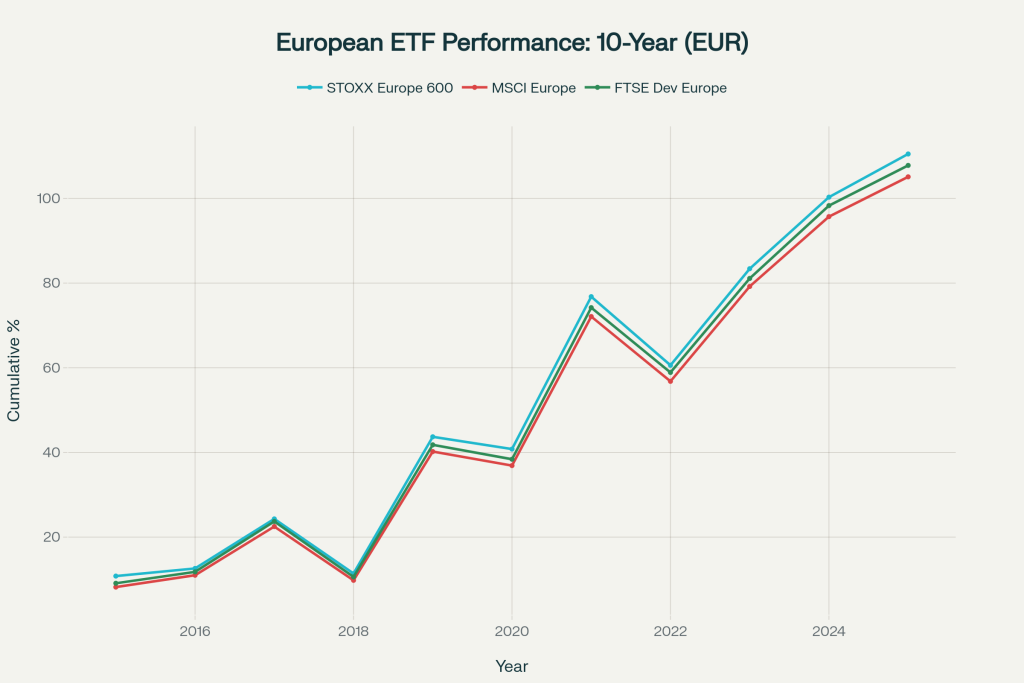
European ETF Index Performance: 10-Year Cumulative Returns show steady long-term growth across major European indices. This consistent upward trajectory in cumulative returns highlights the resilience of the European market. Moreover, it shows how well the region weathers economic fluctuations. Furthermore, the data reflects shifting investor preferences toward diversified and low-cost options, which appear clearly in the evolving ETF investment trends in Europe. As more investors recognize the benefits of ETFs, these products will likely play an even bigger role in shaping the European investment landscape.
The chart above illustrates the 10-year cumulative returns across major European indices from 2015 to 2025. Despite serious volatility during Brexit, the European debt crisis, and the COVID-19 pandemic, patient investors using buy & hold achieved substantial wealth accumulation. The STOXX Europe 600 delivered over 100% cumulative returns during this period. Consequently, this translates to an annualized return exceeding 7%.
These returns become even more impressive when investors reinvest dividends. European companies traditionally maintain strong dividend policies. Notably, many STOXX Europe 600 constituents offer dividend yields between 2.5% and 4%. Accumulating ETFs automatically reinvest these dividends, which maximizes the compound growth effect.
Plug your starting yield and growth rate into our dividend income calculator.
Dollar Cost Averaging: Smoothing the Journey
Dollar cost averaging (DCA) represents the cornerstone implementation strategy for ETF buy & hold investing. This systematic approach invests fixed amounts at regular intervals, regardless of market conditions. For European investors, this translates to euro cost averaging. In practice, this disciplined method turns market volatility from enemy to ally.
I break down fees, savings plans and cash interest in my comparison of Scalable and Trade Republic.

Dollar Cost Averaging in Action: it shows how regular €500 monthly investments smooth out ETF price volatility over 3 years. This strategy not only reduces the impact of market swings. Moreover, it lets investors accumulate more shares when prices fall and fewer shares when prices rise. For those who want to capitalize on this approach, “etf dollarcost averaging explained” can offer valuable insights into how the method works and its potential long-term advantages. Over time, this disciplined approach can lead to significant portfolio gains. Importantly, it helps build wealth while mitigating timing risks.
The practical impact of DCA becomes clear when you examine real-world scenarios. The chart shows how €500 monthly investments in European ETFs smooth out price volatility over a three-year period. During market downturns, the same €500 buys more shares. By contrast, fewer shares get bought during peaks. This automatic rebalancing effect reduces the average cost per share over time.
The drift-rebalancing tool projects how often you need to rebalance given your drift tolerance.
Recent data from German brokerage platforms shows ETF savings plans processing over 10.8 million monthly transactions. Moreover, the average monthly investment stands at €136. This trend reflects growing European investor sophistication in systematic investment strategies.
European brokers have embraced this trend by offering commission-free ETF savings plans. Platforms like Interactive Brokers, Trade Republic, and Scalable Capital enable automated monthly investments with minimal fees. Therefore, DCA implementation has become seamless for European investors.
Tax Optimization Strategies for European Investors
Tax efficiency represents a critical advantage for European ETF investors. However, strategies vary significantly across EU member states. Accumulating UCITS ETFs offer particular benefits by automatically reinvesting dividends within the fund structure. Consequently, they defer taxable events until shares are sold.
Several European countries provide exceptionally favorable tax treatment for long-term ETF investments. These benefits often include reduced tax rates on capital gains and dividends, which can significantly enhance overall returns. Additionally, many countries allow spousal contributions for ETF investing, which enables partners to maximize their tax-advantaged contributions collectively. This potential for collaboration can further amplify the benefits of long-term ETF investing.
- Belgium: 10% capital gains tax since 1 January 2026 (first €10,000 of annual gains exempt; previously 0% for passive investors)
- Germany: No exit tax on positions under €500,000 per individual ETF
- Portugal: 28% on the net gain, reduced by a partial exclusion for longer holdings rather than removed — art. 43(5) CIRS excludes 10% of the gain above 2 years, 20% from 5 and 30% from 8, giving effective rates of 25.2%, 22.4% and 19.6%. There is no holding period at which it reaches zero
- Greece: not the clean zero it is often called — art. 103(5) of Law 4099/2012 exempts holders of UCITS authorised in Greece, which on its wording does not reach an Irish- or Luxembourg-domiciled ETF. Treat the position of a foreign UCITS as unsettled and take local advice
The FASTER directive, implemented across the EU in 2024, streamlines withholding tax procedures. Therefore, investors receive appropriate tax relief more efficiently. This regulatory improvement reduces administrative burden. Moreover, it maximizes net returns for cross-border investments.
For high-net-worth European investors, strategic domicile planning can optimize tax outcomes. However, most investors benefit sufficiently from choosing appropriate UCITS ETFs without complex restructuring.
Core ETF Selection for European Portfolios
Experienced European investors should focus on broad market exposure through low-cost, liquid ETFs. The most effective core holdings include the following. Additionally, allocating part of the portfolio to international ETFs for European investors can enhance growth potential by tapping global markets. Crucially, you must evaluate the underlying assets and geographical diversification these ETFs offer. By keeping a balanced approach, investors can mitigate risks while still reaping the benefits of international exposure. In addition to international ETFs, adding corporate bond ETFs strategies Europe can provide steady income while diversifying fixed-income allocations. By selecting bond ETFs that focus on high-quality corporate debt, investors can reduce volatility and lift overall stability. This layered approach allows for both growth and income, aligning with long-term financial goals. Furthermore, diverse ETF asset allocation strategies can help investors tailor portfolios to their risk tolerance and objectives. Importantly, regular review and rebalancing reflect market changes and personal goals, which keeps performance on track. This proactive management approach keeps investors aligned with long-term strategies. Moreover, it lets them adapt to the evolving landscape of global opportunities. Additionally, for those who want to enhance income, exploring dividendfocused investment strategies can pay off. By integrating dividend-paying stocks and ETFs into portfolios, investors generate reliable income. Moreover, they may also benefit from capital appreciation. In short, this combination supports short-term cash flow needs and long-term wealth accumulation.
European Exposure:
- iShares Core MSCI Europe UCITS ETF (IMEA): 0.12% TER, €11.6 billion AUM
- Amundi STOXX Europe 600 UCITS ETF: 0.07% TER, €12.4 billion AUM
- Vanguard FTSE Developed Europe UCITS ETF: 0.10% TER, €3.7 billion AUM
Global Diversification:
- iShares Core MSCI World UCITS ETF (IWDA): Provides developed market exposure
- Vanguard FTSE All-World UCITS ETF (VWCE): Single-ETF global solution
- iShares Core S&P 500 UCITS ETF (CSSPX): US market concentration
The home bias question remains relevant for European investors. Although global diversification offers risk reduction, moderate European overweighting (15-25% vs. 8% market weight) can provide currency matching and familiarity benefits without excessive concentration risk.
Advanced Implementation Techniques
Rebalancing discipline separates successful long-term investors from mediocre performers. Systematic rebalancing — annually or when allocations drift beyond predetermined ranges (typically ±5%) — maintains intended risk exposure. Moreover, it captures the rebalancing premium from asset class rotation.
Automated investing platforms eliminate emotional decision-making barriers. In practice, European investors can leverage platforms that offer:
- Fractional share investing enabling precise allocation regardless of share prices
- Automatic rebalancing maintaining target allocations
- Tax-loss harvesting where applicable
- Currency hedging options for non-Euro investors
Risk management through ETF buy & hold focuses on time diversification rather than market timing. Historical analysis shows that holding periods exceeding 15 years virtually eliminate the probability of losses in diversified European equity ETFs. Notably, this holds even when accounting for major market disruptions.
Behavioral Considerations and Common Pitfalls
Emotional discipline represents the primary challenge in executing successful buy & hold strategies. Market volatility triggers psychological responses that undermine long-term wealth building. Therefore, European investors must prepare mentally for inevitable downturns. Crucially, they must keep up systematic investment discipline.
Common implementation errors include:
- Performance chasing: Switching between ETFs based on recent performance
- Market timing attempts: Pausing contributions during market stress
- Over-diversification: Holding excessive numbers of overlapping ETFs
- Under-diversification: Concentrating in single markets or sectors
The 2022 market correction provided an excellent case study. Investors who maintained DCA discipline during this period bought shares at significantly discounted prices. Consequently, they benefited substantially from the subsequent recovery. By contrast, those who paused investments or switched strategies missed these opportunities.
Technology Integration and Future Trends
Robo-advisors and automated platforms are revolutionizing ETF implementation for European investors. These services provide personalized investment strategies, low fees, and easy access to a diverse range of ETFs. For newcomers, platforms often include beginner tips for investing in ETFs to help users understand asset allocation, risk management, and market trends. As a result, more individuals can confidently enter the investment landscape with tailored guidance and automated support.
- Algorithm-driven rebalancing maintaining optimal allocations
- Tax-efficient implementation across different account types
- Goal-based investing aligning portfolios with specific objectives
- ESG integration for sustainability-conscious investors
The European ETF market continues expanding with active ETF launches and thematic investing options. However, experienced investors should resist complexity creep. Crucially, they must keep focus on broad market exposure through low-cost vehicles. In this evolving landscape, investors must understand the diverse types of exchangetraded funds available, since these can serve different strategies and risk tolerances. Moreover, staying informed about ongoing developments helps investors enhance portfolios while avoiding unnecessary complications. Therefore, a disciplined approach that prioritizes simplicity and cost efficiency remains essential for long-term success. In addition, investors should weigh the importance of due diligence when navigating ETF investment options, since the proliferation of funds increases the potential for overlapping exposures and unintended risks. By carefully analyzing fund objectives, fees, and historical performance, individuals make more informed choices that align with their financial goals. Ultimately, a proactive approach to understanding market conditions and ETF characteristics leads to better outcomes. Additionally, investors should keep an eye on the latest ETF launches updates to spot innovative products that may align with their strategies. By tracking these developments, they position themselves to take advantage of emerging trends. Moreover, they keep portfolios diversified. Consequently, this vigilance promotes better decisions and helps avoid potential pitfalls associated with new investment vehicles.
Portfolio Construction Examples
Conservative Allocation (Age 50+):
This guide is part of our European FIRE hub.
- 40% European Equity ETFs
- 35% Global Developed Market ETFs
- 20% European Government Bond ETFs
- 5% Commodity/REIT ETFs
Growth Allocation (Age 30-45):
- 30% European Equity ETFs
- 50% Global Equity ETFs (including Emerging Markets)
- 15% European Corporate Bond ETFs
- 5% Alternative investments
Aggressive Growth (Age <35):
- 25% European Equity ETFs
- 65% Global Equity ETFs
- 10% Bond ETFs
These allocations provide starting frameworks. However, they require customization based on individual circumstances, risk tolerance, and market outlook.
Long-Term Wealth Building Mathematics
The compound growth mathematics underlying ETF buy & hold strategies create exponential wealth accumulation over extended periods. Assuming 7% annualized returns, consistent with historical European equity performance, systematic monthly investments demonstrate remarkable wealth-building potential. In practice, a compound interest growth calculator lets investors visualize the significant impact of consistent contributions over time. This tool illustrates how even modest monthly investments can build substantial wealth through compound interest. Moreover, as the horizon extends, the exponential growth curve becomes increasingly pronounced. Therefore, it showcases the long-term benefits of disciplined investing.
Monthly Investment: €500
- 10 years: €82,000 invested → €104,000 value
- 20 years: €240,000 invested → €393,000 value
- 30 years: €180,000 invested → €611,000 value
These calculations exclude dividend reinvestment and tax optimization benefits. Therefore, actual outcomes may exceed projections for disciplined European investors.
Risk Assessment and Mitigation
Sequence of returns risk poses the primary threat to ETF buy & hold strategies, particularly near retirement. European investors can mitigate this through:
- Bond laddering providing income stability
- Geographic diversification reducing single-market dependence
- Gradual allocation shifts decreasing equity exposure approaching retirement
- Emergency fund maintenance preventing forced asset sales
Currency risk affects European investors differently across the eurozone. Non-Euro investors should consider currency-hedged ETFs for portions of their portfolios. By contrast, Euro-based investors benefit from natural hedging through European ETF exposure. For non-Euro investors, currency-hedged ETFs can enhance stability and mitigate potential losses from exchange-rate swings. Additionally, alternative ETF risk management strategies — such as diversifying geographic exposure — can further insulate portfolios against adverse currency movements. Importantly, Euro-based investors should also evaluate asset allocation to make the most of the natural hedging effect European ETFs provide.
Conclusion: The European Advantage in Action
ETF buy & hold strategy represents the optimal wealth-building approach for European investors who embrace long-term thinking over short-term speculation. The combination of UCITS regulatory protection, favorable tax treatment, and a sophisticated European ETF ecosystem creates unprecedented opportunities for systematic wealth accumulation. Investors can leverage the diversity of assets within the European ETF landscape, ranging from equities to bonds. Consequently, they build tailored portfolios that match individual risk preferences. Crucially, understanding how ETFs operate in Europe matters, since regulatory frameworks provide robust safeguards while promoting transparency. This strategic use of ETFs can significantly enhance portfolio performance. Therefore, investors optimize returns over time. Moreover, implementing ETF portfolio rebalancing strategies can lift returns while managing risk. In short, asset allocation stays aligned with long-term goals. This disciplined approach not only capitalizes on market swings. Moreover, it also mitigates the impact of volatility over time. As investors increasingly recognize the benefits of passive management, the ETF landscape continues to evolve, offering innovative solutions tailored to diverse risk appetites and horizons. Additionally, niche sectors such as healthcare keep gaining traction, presenting lucrative diversification opportunities. Notably, Healthcare ETFs for European investors not only provide exposure to a growing industry. Moreover, they align investment choices with personal values, such as supporting advancements in medical innovation. As demand for healthcare solutions rises, these ETFs can serve as a vital component in a well-rounded strategy. In addition, investors should explore various sector and industry ETFs, which help capture specific market trends and economic performance. By understanding sector and industry ETFs explained, investors can identify opportunities aligned with macroeconomic shifts and industry growth forecasts. Consequently, they construct more focused, strategic portfolios. This approach not only enhances diversification. Moreover, it positions investors to potentially outperform the broader market in targeted areas of interest.
Success requires consistent implementation of systematic investment strategies, emotional discipline during volatility, and focus on low-cost, broadly diversified ETF vehicles. European investors who follow these principles position themselves to capitalize on global economic growth. Moreover, they minimize unnecessary risks and costs.
The evidence overwhelmingly supports ETF buy & hold strategy as the foundation for European investor portfolios. Therefore, rather than searching for complex alternatives, experienced investors should perfect this time-tested approach. In short, let compound growth mathematics build substantial long-term wealth.
Sources and further reading
- justETF — European UCITS ETF screener
- Morningstar UK ETF rankings
- ESMA — European Securities and Markets Authority
- Bogleheads wiki — EU investing
- ETF.com industry data
European UCITS/ETF investor with 11+ years building a global dividend and index portfolio, and founder of Financial Expert Class. I write every guide here from first-hand experience investing across EU brokers and tax regimes — not theory. More about me →