
ETF Regulatory Updates – Legal and Compliance Changes
MiFID & MiFIR 2.5: Consolidated Tape and Trading Rules
| Change | What it does | Practical impact for ETF investors |
|---|---|---|
| EU-wide Consolidated Tape for Shares & ETFs | Aggregates post-trade data into a single stream | Transparent liquidity picture slashes hidden spreads; better price formation |
| Revenue-sharing RTS for tape contributors | Venues paid for high-quality data | Exchanges incentivised to publish OTC ETF prints, shrinking “dark” trades |
| Clock synchronisation to ±1 μs | Harmonises timestamps | Tighter best-execution checks for brokers |
| Phase-in of real-time ETF post-trade by 2026 | Near-instant reporting across venues | Retail traders finally see true volume |
Best-Execution Checklist for 2025
- Quote sourcing: Demand RFQs and lit quotes. Notably, new post-trade rules help validate both.
- Time-stamp audits: Ensure algorithms log microsecond time for trade-surveillance.
- Venue ranking: Re-run liquidity heat-maps every quarter. Consequently, new consolidated data reshuffles venue tiers fast.
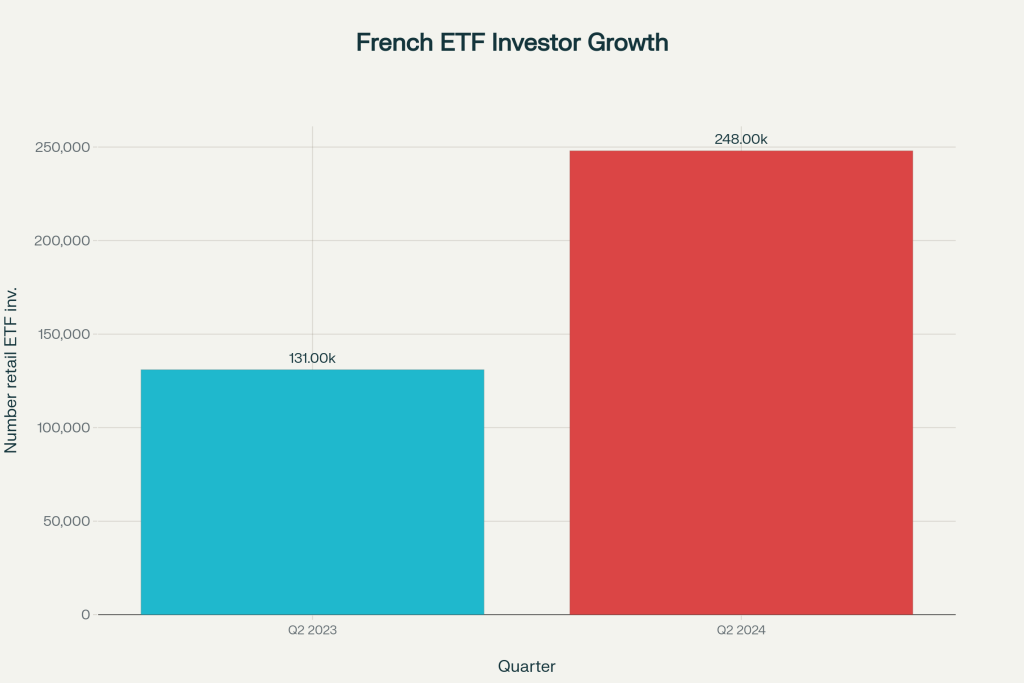
French retail ETF investors surge
SFDR Level 2: The Great Article-9 Downgrade
| Metric | Pre-Level 2 (2022) | Post-Level 2 (July 2025) |
|---|---|---|
| Article 9 ETFs | 100+ funds | ~30 funds remain |
| Assets reclassified | €270 bn to Art 8 | Ongoing trickle |
| Minimum “sustainable” threshold | Ambiguous | 100 % + DNSH + GG |
Key takeaways
This guide is part of our browse-ETFs-by-category page.
- Clarity – with caveats: Level 2 demanded hard evidence of sustainable investments. Consequently, this triggered a mass slide from dark green to light green.
- Data burden: Funds must report Principal Adverse Impact indicators for every holding.
- Label fatigue: Investors learned that Article number does not equal impact. Therefore, due diligence now drills deeper.
Issuer playbook: Launching a thematic hydrogen ETF? Build a taxonomy-aligned basket, pre-compute PAIs, and keep at least 90 % of revenue in sustainable activities. By doing so, you future-proof Article 9 status.
The ESG ETF filter filters the universe by SRI methodology and shows true ESG scores.
UCITS & Active ETF Transparency Relief
Luxembourg green-lit monthly or quarterly portfolio disclosure for active ETFs in December 2024. Ireland followed in April 2025.
- This removes the “daily secret-sauce” fear.
- Moreover, it opens the door for heavyweight mutual-fund houses to spin ETF share classes.
- Investors gain fresh active choices, though tracking insight lags a month.
Compliance corner
- Fact sheets must flag the delayed holdings schedule.
- Additionally, market makers receive daily indicative optimized baskets to keep spreads tight.
- Meanwhile, the PRIIPs KID remains daily-updated on NAV and risk metrics.
Retail Investor Boom Meets Protection Rules
French AMF data show that ETF retail traders doubled in a year. By Q2 2024, the count hit 248k.
- Brokers must embed cost and complexity flags in product governance.
- Additionally, zero-commission neo-brokers must display total cost indicators.
- Circuit-breaker and volatility-control calibration on trading venues and RFQ platforms has reportedly tightened; we could not verify any uniform NAV-deviation pause threshold, so treat venue-level mechanics as indicative rather than a rule.
Investor tip: Use consolidated tape data to verify fills. Then, challenge excessive OTC mark-ups.
How Do Recent ETF Launches Impact Regulatory Compliance and Legal Changes?
Recent ETF launches often bring significant shifts in regulatory compliance and legal landscapes. With each new offering, firms must adapt to evolving regulations. Therefore, ensuring adherence to guidelines becomes essential. Crucially, market participants must stay informed through the latest fund updates. In short, this approach helps them navigate changes and maintain compliance in a dynamic investment environment.
Looking Ahead: 2026-2027 Pipeline
| Forthcoming rule | Expected date | Potential effect |
|---|---|---|
| AIFMD II liquidity RTS | Apr 2026 | Loan-originating ETFs likely forced into closed-end wrappers |
| MiFIR ban on Payment-for-Order-Flow | Jan 2027 | Could reroute retail ETF orders onto lit books |
| CSRD–SFDR alignment package | Q4 2025 proposal | Harmonises corporate and fund-level ESG data, easing PAI collection |
Conclusion
European ETF regulatory updates in 2025 knit together transparency, sustainability discipline and broader product choice. Therefore, leverage the tape and scrutinise SFDR data deeply. Additionally, explore semi-transparent actives to keep your ETF toolkit both compliant and competitive.
Learning ETFs the slow way?
The free 12-page Starter Kit gets you to a first, sensible portfolio faster: the 7-filter fund shortcut, the 3-question broker matrix, and the 7 costliest beginner mistakes.
Sources and further reading
- justETF — European UCITS ETF screener
- Morningstar UK ETF rankings
- ESMA — European Securities and Markets Authority
- Bogleheads wiki — EU investing
- ETF.com industry data
PRIIPs KID 2.0 and the MiCA Crossover: What Changed in 2025-2026
The original 2018 PRIIPs KID drew years of criticism for misleading performance scenarios and unrealistic cost figures. Therefore, the European Commission’s PRIIPs review pushed through targeted amendments that took practical effect from January 2025. Crucially, the revised performance scenarios now anchor moderate outcomes to a longer 10-year lookback. In my experience reading the new KIDs for iShares Core MSCI World UCITS ETF (IE00B4L5Y983) and Vanguard FTSE All-World UCITS ETF (IE00BK5BQT80), the “favourable” projections finally read closer to historical reality rather than the previous fantasy curves. Additionally, the Summary Cost Indicator now separates one-off entry costs from recurring portfolio costs, which matters when you compare a 0.07% TER core fund against a 0.20% thematic ETF.
However, the more interesting story for 2026 is the unexpected crossover between the EU’s Markets in Crypto-Assets Regulation (MiCA), which became fully applicable on 30 December 2024, and the UCITS ETF rulebook. MiCA itself does not authorise crypto-asset UCITS funds. By contrast, ESMA’s July 2024 statement on crypto exposure inside UCITS reaffirmed that direct crypto-asset holdings remain incompatible with eligibility rules. Consequently, the wave of “Bitcoin spot ETFs” approved by the SEC in January 2024 still cannot legally launch as UCITS in Dublin or Luxembourg. European investors who want spot crypto must use Exchange Traded Products (ETPs) such as the 21Shares Bitcoin Core ETP (BTC) or CoinShares Physical Bitcoin (BITC). These trade like ETFs but sit outside UCITS protection. For more detail on the technical standards, ESMA publishes ongoing guidance at esma.europa.eu, while the EIOPA portal at eiopa.europa.eu hosts the consolidated PRIIPs Q&A.
Notably, the practical impact on portfolio construction is sharper than it sounds. I track two implications. First, the Article 5 risk indicator (SRI) in the new KID can shift a fund up one bucket when 10-year volatility recalculates after a single bad year. For example, several emerging market UCITS ETFs moved from SRI 4 to SRI 5 during the 2025 KID refresh, which triggers stricter appropriateness tests at brokers like Trade Republic and XTB. Second, MiCA’s investor-compensation provisions do NOT extend to crypto ETPs, even when they list on Xetra. By contrast, UCITS ETFs benefit from national investor compensation schemes such as the Irish ICS (up to €20,000) and Germany’s EdW. In practice, that protection gap is exactly why I keep my crypto sleeve under 5% and never inside the same custody account as my UCITS core. For asset-class data and SRI history, justETF remains the cleanest free source for European investors.
What is the difference between a UCITS ETF and a MiCA-regulated crypto ETP?
A UCITS ETF sits inside the harmonised EU fund framework with diversification limits, daily NAV oversight and eligibility for national investor compensation schemes. A crypto ETP under MiCA is technically a debt security backed by underlying coins, not a fund. Consequently, you carry issuer credit risk, and MiCA’s authorisation regime does not unlock UCITS marketing rights. In practice, this means brokers may restrict ETPs to “appropriateness-tested” clients and limit them to professional or knowledgeable retail buckets, depending on national overlays.
Did the new PRIIPs KID change my ETF’s risk indicator?
Possibly, yes. The Summary Risk Indicator (SRI) recalculates annually using updated volatility windows. Therefore, single-country emerging market ETFs and small-cap thematic funds have seen the most movement, often shifting one bucket higher in the 2025 and 2026 refreshes. Check the “When was this document produced?” line on the first page of any KID and compare the SRI against the version archived on the issuer’s site. Notably, a higher SRI may trigger your broker to request a fresh appropriateness questionnaire before allowing new buys.
Are crypto ETPs covered by investor compensation if my broker fails?
No, MiCA does not introduce a compensation scheme equivalent to UCITS protection. Instead, you rely on the issuer’s segregated custody model (typically with Coinbase Custody or Komainu) plus your broker’s national investor protection regime, which usually covers cash and securities up to €20,000 but excludes the underlying crypto holdings. By contrast, a UCITS ETF held through a German broker is covered by EdW up to €20,000 plus the fund’s ring-fenced assets. For a topic-by-topic view, the consolidated Q&A at EIOPA is the cleanest primary source.
How often must ETF issuers update the KID under PRIIPs 2.0?
The KID must be reviewed at least annually and republished without delay whenever a material change occurs, such as a TER cut, an index methodology switch, or an SRI bucket shift. Moreover, issuers must store every historical version for five years and provide them on request. In practice, large houses like Vanguard, iShares and Amundi publish refreshed KIDs each January, with mid-year updates when cost structures change. Always download the live KID before placing a buy order, because your broker is required to log the version reference for MiFID II suitability records.

European UCITS/ETF investor with 11+ years building a global dividend and index portfolio, and founder of Financial Expert Class. I write every guide here from first-hand experience investing across EU brokers and tax regimes — not theory. More about me →