
Best Low Cost ETFs for Value-Focused European Investors
This best low cost guide on financialexpertclass.com walks you through what European investors actually need to know. Importantly, you get no hype. By Kestutis Balciunas · Reviewed 29 May 2026
Finding genuinely low-cost ETFs tailored to European investors ranks among the highest-leverage decisions for a long-term portfolio. Fees compound just like returns — in reverse. This guide covers the leading UCITS-domiciled trackers that European investors actually buy. Moreover, it gives an honest look at the difference between “low cost” broad-market exposure and “value factor” investing. They are not the same thing. Additionally, you will learn about tax considerations across Irish vs Luxembourg domiciles. The guide also covers how to purchase via Freedom24, Interactive Brokers and Trade Republic. Finally, I cover the most common pitfalls I see EU investors fall into.
I am a self-directed European investor with over 11 years of passive and dividend-focused ETF experience. However, I am not a regulated adviser. Everything below is educational. For more on how I verify fund data, see my background and editorial process.
Low-cost vs value-factor: clearing up the confusion
Many readers land here searching “low-cost value ETFs.” In practice, they mean two very different things:
The TER drag calculator compounds an expense ratio into a real cost figure for any contribution profile.
- Low-cost ETF = a fund with a tiny Total Expense Ratio (TER), typically below 0.20% p.a., tracking a broad benchmark such as MSCI Europe or STOXX Europe 600.
- Value-factor ETF = a fund that deliberately tilts toward companies trading at low price-to-book, low price-to-earnings or high dividend yield — for example MSCI Europe Value, MSCI Europe Enhanced Value, or fundamental-weighted indices.
This article focuses on the first interpretation. Specifically, broad European equity trackers with rock-bottom fees that any value-conscious investor can use as a core holding. For a pure factor tilt, look for funds with “Value,” “Enhanced Value” or “Quality Value” in the name. Notably, their TERs typically run 0.20%–0.40%, and behaviour during drawdowns differs materially. You can screen both groups on justETF. Additionally, read independent fund analysis on Morningstar Europe.
Why low-cost ETFs matter so much in Europe
Costs are the only variable in investing you can fully control. Consequently, a 0.50% difference in TER over 30 years on a €100,000 portfolio compounds to roughly €30,000–€40,000 of lost terminal wealth. Returns drive the exact figure. In Europe specifically, repeated reports on retail fund performance from ESMA flag that high ongoing charges are the single biggest drag on long-term investor outcomes.
UCITS regulation also gives EU investors structural advantages. These include daily liquidity, depositary oversight, diversification limits (the 5/10/40 rule), and mandatory PRIIPs Key Information Documents (KIDs) that disclose costs in a standardised format. Crucially, always download and read the KID before buying.
Here is a short personal example. Back in 2015, when I first consolidated my European core, I held a fairly mainstream actively-managed European equity fund inside a private pension wrapper at about 1.45% all-in. When I rebuilt the same allocation with a sub-0.20% UCITS tracker in early 2017, the annual fee drag on a €42,000 sleeve dropped by roughly €525 a year. I instantly redirected that cash into top-ups. Multiply that across eight years and the swap alone outvalues my first car. That is the practical case for ruthlessness on TER.
Key selection criteria
- Total Expense Ratio (TER): Lower TER means more of your money stays invested. Target <0.20% for core European exposure.
- Index Exposure: Broad European large-cap coverage (MSCI Europe, FTSE Developed Europe, STOXX 600) versus sector-specific or factor tilts.
- Liquidity & AUM: Higher assets under management (AUM > €500m as a rule of thumb) usually means tighter bid-ask spreads and lower risk of fund closure.
- Domicile & Tax Reporting: Ireland or Luxembourg domiciled for favourable EU tax treaties and access to the US/Ireland treaty rate on dividend withholding.
- Replication Method: Physical replication preferred for transparency; synthetic (swap-based) is acceptable with strong collateral safeguards.
- Distribution policy: Accumulating (Acc) reinvests dividends inside the fund. This route works great for compounding and often more tax-efficient. Distributing (Dist) pays cash, which suits income needs or local tax regimes that prefer it.
- Tracking difference: The realised gap between fund NAV return and benchmark return. Notably, this metric often beats the headline TER alone for informativeness. Both justETF and Morningstar publish this.
Top value-focused, low-cost European ETFs
I cross-checked all fund parameters below against the issuer factsheet linked in each section. ETF data changes — always download and read the live KID before placing an order.
1. Amundi STOXX Europe 600 UCITS ETF Acc (Ticker: LYP6)
| ISIN | LU0908500753 — verify on justETF |
|---|---|
| TER | ~0.07% p.a. (see live factsheet) |
| Index | STOXX® Europe 600 |
| Domicile | Luxembourg |
| Distribution | Accumulating |
| Replication | Physical full replication |
This fund is one of the cheapest broad-European trackers available to UCITS investors. With 600 large, mid and small caps across 17 developed European countries, it provides exceptional diversification for a TER that rounds to almost nothing. Confirm the current TER, AUM and inception date on the issuer’s product page at amundietf.com. Alternatively, use the consolidated UCITS sheet on justETF. It pairs well with the portfolio examples I outline here. Additionally, it works as a core European sleeve regardless of where you sit on the risk spectrum.
Who this ETF is best for: long-horizon accumulators (10+ years) who want maximum diversification, automatic compounding, and an extremely low fee in this category. Luxembourg domicile makes it slightly less tax-efficient on US dividends than Irish-domiciled peers. However, the underlying portfolio is European equities, so this is mostly a moot point.
2. Vanguard FTSE Developed Europe UCITS ETF (Ticker: VGEU)
| ISIN | IE00B945VV12 — verify on Vanguard EU product list |
|---|---|
| TER | ~0.10% p.a. (see live factsheet) |
| Index | FTSE Developed Europe |
| Domicile | Ireland |
| Distribution | Distributing (Quarterly) |
| Replication | Physical full replication |
Vanguard’s Europe ETF is one of the largest and most cost-effective trackers of developed European markets. Quarterly distributions make it attractive for income-focused investors. Moreover, Irish domicile improves tax efficiency on dividends from underlying European holdings in many jurisdictions. You can verify the full product factsheet directly on the Vanguard EU product page. Navigate to the FTSE Developed Europe fund line and download the current KID.
Who this ETF is best for: investors who want a predictable quarterly cash dividend they can either reinvest manually or live off, and who specifically prefer Irish domicile.
3. iShares Core MSCI Europe UCITS ETF (Ticker: EUNK / IQQY)
| ISIN (Acc) | IE00B4K48X80 — verify on iShares UK |
|---|---|
| ISIN (Dist) | IE00B1YZSC51 — verify on iShares UK |
| TER | ~0.12% p.a. (see live factsheet) |
| Index | MSCI Europe |
| Domicile | Ireland |
| Distribution | Accumulating / Distributing share classes |
| Replication | Physical optimised sampling |
iShares Core MSCI Europe is the institutional default for European large-cap exposure. Both Acc and Dist share classes rank among the largest UCITS European equity funds in Europe. Confirm holdings, current TER and AUM on the iShares UK site by searching the relevant ISIN. Alternatively, cross-check via Morningstar Europe.
Who this ETF is best for: investors who want maximum liquidity (very tight spreads), a choice between accumulating and distributing share classes, and the comfort of a multi-billion-euro fund that is not going anywhere. Here is an anecdote. When I bought EUNK on Xetra during a normal mid-morning session in early 2024, my fill landed inside a 3-basis-point bid-ask. That kind of execution cost genuinely does not matter for a long-term holder.
4. Invesco STOXX Europe 600 UCITS ETF (Ticker: SC0C)
| ISIN | IE00B60SWW18 — verify on justETF |
|---|---|
| TER | ~0.19% p.a. (see live factsheet) |
| Index | STOXX® Europe 600 |
| Domicile | Ireland |
| Distribution | Accumulating |
| Replication | Synthetic (swap-based) |
The synthetic structure here is the differentiator. Invesco uses an unfunded swap with multiple counterparties and over-collateralisation. Historically, this approach has produced tighter tracking versus benchmark than physical replication for some European indices. The trade-off is counterparty exposure — even though heavily mitigated. The slightly higher headline TER makes this a niche pick. It serves mainly investors who want a synthetic alternative or want to compare tracking difference vs physical funds on ETF.com. Search the Invesco product page for the ISIN to download the latest swap-collateral disclosure.
Expense ratio comparison
The following chart compares headline TERs of these four ETFs at the time of last review:
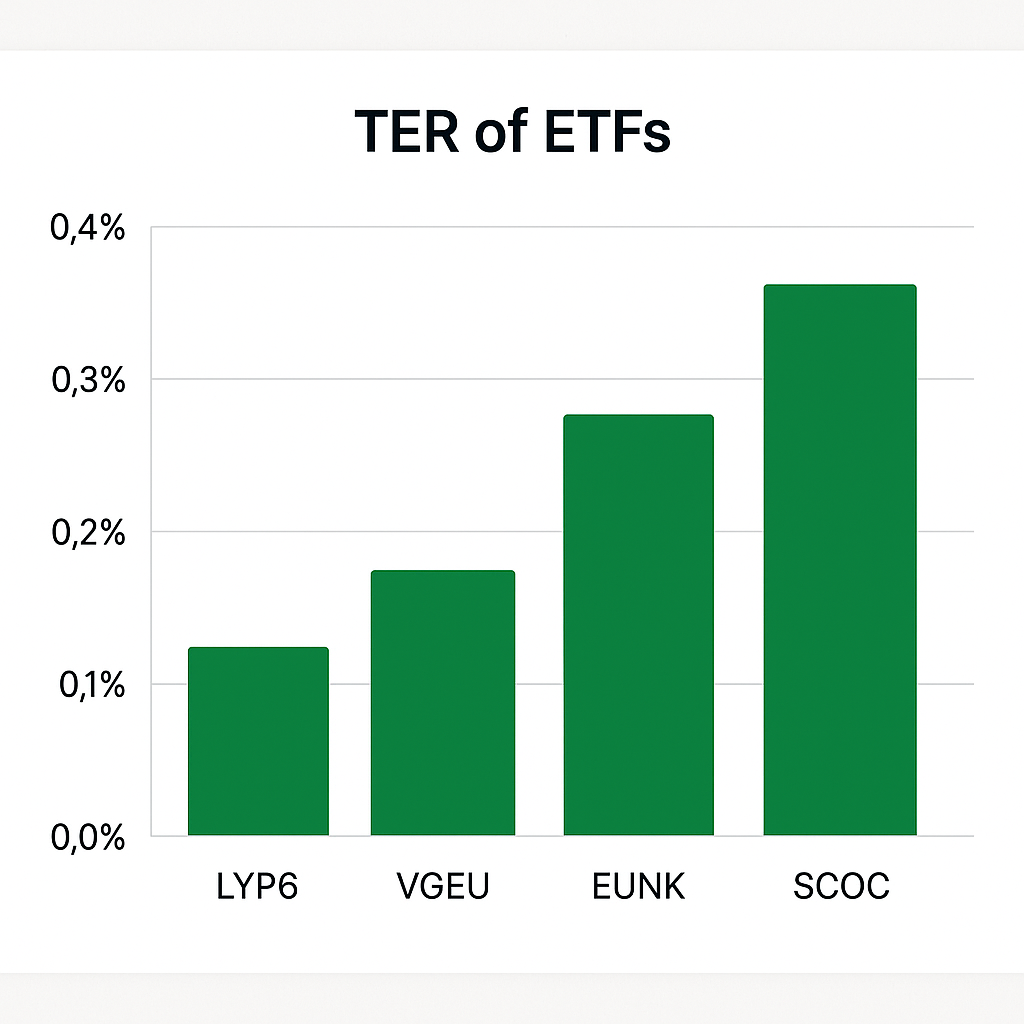
The roughly 0.12-percentage-point spread between the cheapest (Amundi LYP6) and most expensive (Invesco SC0C) listed here looks trivial on paper. However, on a €50,000 buy-and-hold position over 25 years it works out to roughly €1,500–€2,000 of saved fees. That tally arrives before counting the compounding effect on the capital that stayed invested. Verify the current TERs on the linked issuer factsheets before drawing any conclusions for your own portfolio.
Tax considerations for European investors: Irish vs Luxembourg domicile
Domicile matters more than most beginners realise. Most UCITS ETFs aimed at European retail investors sit in Ireland or Luxembourg. The choice affects withholding tax leakage on dividends from underlying holdings.
- Irish domicile (IE-ISIN, prefix IE00…): Benefits from a favourable tax treaty with the United States, reducing withholding on US dividends from 30% to 15%. This matters far more for global or US-equity funds than for pure European equity funds. However, it is still a small advantage on European companies with US-source revenues.
- Luxembourg domicile (LU-ISIN, prefix LU00…): Often a competitive TER (as you see with several Amundi funds) because the fund infrastructure is mature. The dividend-treaty disadvantage is negligible for European-only funds.
On the investor side, your residence country tax rules usually dominate:
- Germany: Accumulating ETFs trigger the annual Vorabpauschale. Distributing funds may be simpler to track.
- Ireland: Funds face a 38% exit tax and an 8-year deemed disposal rule. Therefore, accumulating vs distributing makes less difference.
- Lithuania, Latvia, Estonia: Generally a flat capital gains tax at sale. Accumulating funds defer the tax event and most investors prefer them. From my own filings in Lithuania, having a single accumulating ISIN per asset class made the annual declaration drastically simpler than reconciling four quarterly distributions per fund.
- Spain, France, Italy: Each has its own quirks around “traspasos” (Spain), PEA eligibility (France), or 26% flat rate (Italy).
I am not a tax adviser. Always confirm with a qualified professional in your jurisdiction before you commit material capital. For broader context on tax-efficient Irish-domiciled funds, see my deep-dive on the top 5 Irish-domiciled ETFs for dividend hunters in Europe.
How to buy these ETFs via Freedom24, Interactive Brokers or Trade Republic
Buying via Freedom24
Many European investors use Freedom24 to access global ETFs with transparent pricing. CySEC regulates the platform in Cyprus under MiFID II. Under the All-Inclusive plan, European Stocks & ETFs incur a per-trade fee combining a small percentage of trade value, a fixed order charge and a per-share charge. By contrast, the Smart plan replaces the percentage component with a flat order fee and per-share charge. Exact figures and the current promotional period (e.g. introductory commission-free window) change. Therefore, always check the live tariff page on Freedom24’s site before opening an account. At the time of writing the promotional window for new EU clients was up to 30 days of commission-free trading on selected instruments. Verify in the official tariff before relying on it.
Step-by-step:
- Open a Freedom24 account and confirm the current promotion on the official page.
- Verify identity per CySEC and MiFID II requirements.
- Fund the account via SEPA transfer or card.
- Search the ETF ticker (LYP6, VGEU, EUNK, SC0C) on Xetra or other European venues.
- Place a limit order in your chosen pricing plan.
For a fuller walkthrough including screenshots, see my how to buy ETFs using Freedom24 tutorial and the longer Freedom24 review.
Buying via Interactive Brokers (IBKR)
IBKR offers some of the lowest commissions of any major broker for active investors. Additionally, it provides multi-currency cash accounts and access to virtually every European exchange. European ETF trades under the Tiered structure typically run from approximately €1.25 per order, subject to exchange minimums. Check the live Commissions page on the IBKR site for your specific exchange and currency. Best for investors who already have meaningful capital to deploy or who value institutional execution. The Central Bank of Ireland regulates IBKR Ireland.
Buying via Trade Republic
Trade Republic (BaFin-regulated, see BaFin) is the simplest mobile-first option for many EU residents. ETF orders typically cost a flat €1 external execution fee. Moreover, ETF savings plans on most major UCITS funds (including iShares Core MSCI Europe) come advertised as free of execution fees. Confirm current pricing in the in-app tariff sheet. Trade Republic does not list every fund. Check ticker availability inside the app before assuming you can buy a specific ISIN.
Common pitfalls European investors make
- Chasing the lowest TER without checking spreads. A 0.07% TER fund that trades with a 0.30% bid-ask spread costs more in year one than a 0.15% TER fund with a 0.05% spread. Check live spreads during European market hours, not at the open or close. The first time I learned this properly was placing a market-on-open order on a thin synthetic fund. The print came back 22 bps wide of mid, which wiped out two years of headline TER difference in a single click.
- Mixing Acc and Dist share classes by accident. Same fund family, similar ISIN prefix, very different tax treatment. Read the full ISIN before clicking buy.
- Ignoring local tax reporting status. German Vorabpauschale, Austrian KESt, UK reporting-fund status — each materially affects net returns.
- Confusing “Europe” with “Eurozone”. MSCI Europe includes the UK, Switzerland and the Nordics. By contrast, MSCI EMU only includes Eurozone members. The two have different sector weights and currency profiles.
- Buying a value-factor ETF expecting low cost. Pure value or quality-value factor funds usually cost 0.25%–0.45%. Despite the historical cheapness, they are not 0.07% cheap.
- Forgetting to reinvest distributions. For a distributing fund inside a normal brokerage account, set a calendar reminder each quarter to reinvest the cash. Alternatively, switch to an accumulating share class.
For a broader strategic framing, my piece on the best dividend growth ETFs for European investors covers an adjacent factor approach. Additionally, which ETFs have the best dividend yield compares yield-focused alternatives.
How I verify the fund data in this article
I cross-check every TER and ISIN figure here against (a) the issuer’s factsheet on Vanguard EU and iShares UK by searching the specific ISIN, (b) the justETF UCITS database, and (c) an independent third-party such as Morningstar Europe. Where investor-community sentiment matters — for example, on the durability of synthetic replication structures — I read recent threads on the Bogleheads forum. Fund parameters do change. Therefore, verify the live KID before purchase.
Risks & compliance
Investing carries risk. Past performance is not a reliable indicator of future results. Currency fluctuations may affect returns. Carefully review the PRIIPs KID, fees and taxation in your country. Additionally, do your own analysis before investing.
This article is educational content from an independent European investor, not regulated financial advice. AURUM DIGITAL MARKETING LTD does not hold FCA authorisation. CySEC supervises Freedom24 under MiFID II; BaFin supervises Trade Republic; the Central Bank of Ireland supervises IBKR Ireland. All materials here are fair, clear and non-misleading. I make no unwarranted promises of profits, and I balance benefit statements with risk warnings.
Conclusion
For European investors seeking genuine value-for-money in their core equity allocation, the Amundi STOXX Europe 600 UCITS ETF Acc (LYP6) is hard to beat on headline TER. Vanguard FTSE Developed Europe (VGEU), iShares Core MSCI Europe (EUNK/IQQY), and the synthetic Invesco STOXX Europe 600 (SC0C) follow. Match the share class (Acc vs Dist) to your tax residency, choose a regulated broker that lists the ISIN you want, verify the live factsheet before clicking buy, and avoid the temptation to over-trade. In short, boring works.
Often worth more than the TER gap: the free withholding tax and domicile calculator models fund-level US dividend withholding so you can compare like for like.
Frequently asked questions
What is the cheapest broad European equity ETF in 2026?
At the time of last review, the Amundi STOXX Europe 600 UCITS ETF Acc (LYP6, ISIN LU0908500753) has one of the lowest TERs among large mainstream European equity funds at approximately 0.07% per year. Always verify the current TER on the issuer factsheet before buying, since fees do change.
Is a low-cost ETF the same as a value-factor ETF?
No. A low-cost ETF simply has a small Total Expense Ratio (typically below 0.20%) and usually tracks a broad market index. By contrast, a value-factor ETF deliberately tilts toward stocks trading at low valuation multiples. Moreover, it almost always carries a higher TER — usually 0.25%–0.45%.
Should I prefer Irish-domiciled or Luxembourg-domiciled ETFs?
For European equity funds the difference is small. Irish domicile (ISIN starting IE00) benefits from a favourable tax treaty with the US. This matters more for global or US-equity exposure than for pure European exposure. Luxembourg-domiciled funds (LU00) are sometimes marginally cheaper on headline TER.
Accumulating or distributing — which is better?
It depends on your tax residence and your goal. Accumulating share classes reinvest dividends automatically. Long-term compounders in jurisdictions that tax only on sale usually prefer them. By contrast, distributing share classes pay cash and may suit income-focused investors or those in tax regimes that treat the two equivalently.
Can I buy LYP6, VGEU, EUNK or SC0C on Trade Republic and IBKR?
EUNK and VGEU are widely available on both Trade Republic and Interactive Brokers. Notably, EUNK qualifies for free savings plans on Trade Republic. LYP6 and SC0C are generally available on IBKR and Freedom24. However, availability on Trade Republic can vary — check ticker search inside the app.
What is a synthetic ETF, and is it riskier?
A synthetic ETF gets its return through a total return swap with one or more counterparties instead of physically owning the underlying securities. UCITS rules cap counterparty exposure at 10% of NAV. Moreover, modern synthetic funds carry heavy over-collateralisation. They are generally safe for retail investors but add a layer of complexity that physical funds avoid.
How much should I invest in a single European ETF?
Even a low-cost broad ETF is only one part of a portfolio. A common Bogleheads-style approach combines a global or US equity ETF, a European equity ETF and a bond ETF in proportions matching your risk tolerance and time horizon. See my aggressive vs balanced portfolio examples for concrete allocations.
Where can I read independent reviews of these funds?
Morningstar Europe provides analyst ratings and tracking-difference data. justETF aggregates UCITS factsheets in one place. ETF.com is useful for industry-wide comparisons. Additionally, the Bogleheads forum hosts long-running discussion threads on most major UCITS funds.
Want my full set of dividend ETF picks and monthly portfolio updates? Get them at https://getdividends.net/.
Before you open any account
grab the free 12-page Starter Kit: the 7-filter fund shortcut, the 3-question broker safety matrix, and the 7 mistakes that cost beginners the most.

European UCITS/ETF investor with 11+ years building a global dividend and index portfolio, and founder of Financial Expert Class. I write every guide here from first-hand experience investing across EU brokers and tax regimes — not theory. More about me →