
Cannabis ETFs – Cannabis Industry Exposure
Cannabis ETFs have emerged as a dynamic tool for European investors. Notably, they offer diversified exposure to the fast-changing cannabis sector. Moreover, legalization keeps gaining momentum worldwide. Therefore, ETFs open a convenient gateway to this high-growth industry. In short, this article examines the landscape, benefits, and risks. Additionally, it covers top European cannabis ETFs and shares actionable insights for experienced investors.
Update (August 2026): Both UCITS cannabis ETFs profiled below have since been closed by their issuers. The Rize Medical Cannabis and Life Sciences UCITS ETF (FLWR) held its final trading day on the London Stock Exchange in December 2023 after ARK Invest Europe took over the Rize range, and HANetf’s Medical Cannabis and Wellness UCITS ETF (CBDX) has likewise been liquidated. Europe currently has no dedicated cannabis UCITS ETF. The profiles and risk framework below are kept as a historical case study — the sub-scale AUM risk this article warns about is exactly what ended both funds. Investors wanting cannabis exposure today are limited to individual stocks or non-UCITS products, with the access restrictions those carry.
Why Cannabis ETFs?
Investing directly in cannabis stocks can prove volatile and complex. For example, single companies face regulatory hurdles, price swings, and fragmented markets. By contrast, cannabis ETFs spread risk across multiple companies, geographies, and sub-sectors. Consequently, they deliver several practical benefits across cultivation, biotech, and ancillary services:
- Diversification: Exposure to 10+ companies in one fund
- Liquidity: Traded like stocks on major exchanges
- Cost Efficiency: Lower management fees compared to mutual funds
- Regulatory Safeguards: UCITS compliance ensures investor protection
European Cannabis ETF Landscape
Europe’s cannabis ETF market remains nascent. Notably, two pioneering UCITS ETFs launched in January–February 2020:
| ETF Ticker | Provider | AUM (EUR) | TER (%) | Market Focus |
|---|---|---|---|---|
| CBDX | Purpose/HANetf | 12 m | 0.80 | Medical cannabis, CBD wellness |
| FLWR | Rize/Ark Invest | 14 m | 0.95 | Medical cannabis, life sciences |
Performance Comparison
Since inception and in recent months, CBDX and FLWR have shown wide performance divergence:
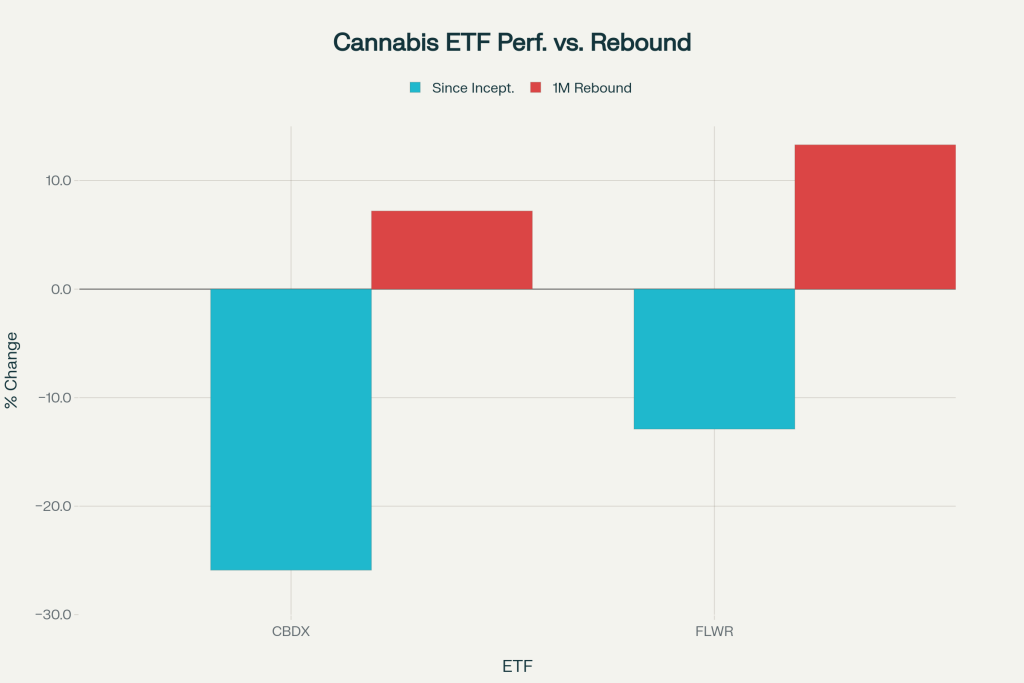
Cannabis ETFs CBDX vs FLWR performance: since inception and recent one-month rebound
This guide is part of our thematic ETF guide.
- Since Inception: CBDX −25.9%, FLWR −12.9%
- Recent 1-Month Rebound: CBDX +7.2%, FLWR +13.3%
FLWR’s lower drop and stronger rebound reflect two factors. Importantly, the fund holds diversified global positions. Additionally, it benefits from a research partnership with New Frontier Data.
Top Cannabis ETFs for European Investors
1. HANetf The Medical Cannabis & Wellness UCITS ETF (CBDX)
| Ticker: | CBDX |
| AUM: | €12 m |
| TER: | 0.80% p.a. |
| Holdings: | 15 North American medical cannabis and hemp companies |
| Key Features: | Physical full replication, accumulating dividends, quarterly rebalance |
Advantages:
- First mover in Europe
- Focus on medical and wellness sub-sector
- Established index methodology
Risks:
- Narrow universe of medical players
- Regulatory shifts in EU markets
2. Rize Medical Cannabis & Life Sciences UCITS ETF (FLWR)
| Ticker: | FLWR |
| AUM: | €14 m |
| TER: | 0.95% p.a. |
| Holdings: | Global pure-play cannabis, biotech, and ancillary firms |
| Key Features: | Collaborated with New Frontier Data, diversified across geographies |
Advantages:
- Broader global exposure
- Lower correlation with North American regulations
- Outperformed CBDX during volatile periods
Risks:
- Higher TER
- Emerging life-sciences companies carry biotech risk
Benefits for Advanced European Investors
- Leverage Sophisticated Strategies: Pair cannabis ETFs with options or futures for hedging.
- Tax Optimization: UCITS ETFs may offer favorable withholding tax treaties in Germany, Ireland, and the UK.
- Portfolio Integration: Allocate 2–5% of high-growth satellite portfolio to cannabis for alpha potential.
- ESG Screening: Consider funds with ESG overlays to align with sustainable mandates.
Risks and Considerations
- Regulatory Uncertainty: EU member states vary on medical vs recreational legality. Shifts in policy can trigger volatility.
- Industry Consolidation: Mergers and delistings may shrink ETF universes, impacting liquidity.
- Currency Exposure: Unhedged USD-denominated holdings introduce FX risk for EUR investors.
- Market Sentiment: Cannabis remains a sentiment-driven theme, prone to rapid reversals.
Real-Life Example: Hedging with Options
Consider an advanced investor expecting a regulatory shock in the U.S. Therefore, that investor could:
- Buy protective put options on FLWR to cap potential losses.
- Sell covered calls on CBDX to generate premium income during sideways markets.
- Monitor EU Commission updates on medical cannabis frameworks and adjust hedge ratios accordingly.
Are Cannabis ETFs Subject to the Same Hidden Risks as Synthetic Replication ETFs?
Investors in cannabis ETFs should watch the nuances of market volatility. Similar to synthetic replication ETFs, they face challenges that may not appear obvious at first. However, understanding the eu etfs replication risks helps investors make informed decisions. Consequently, they stay prepared for potential market fluctuations and hidden pitfalls.
Outlook and Trends
- Expansion into Europe: As more EU nations approve medical cannabis, ETF universes will widen.
- Recreational Legalization: A shift could unlock new growth and diversification opportunities.
- Ancillary Services: ETFs may add firms focusing on cultivation technology, cannabis retail platforms, and biotech R&D.
Conclusion
Cannabis ETFs offer a balanced blend of growth potential and diversification. Notably, they suit European investors who want thematic exposure. In addition, CBDX and FLWR represent the foundational UCITS offerings, each with distinct focuses. Moreover, advanced investors can boost returns through hedging, tax strategies, and thematic allocation. As regulatory environments evolve, cannabis ETFs will likely expand. Consequently, they will present new opportunities for a high-growth satellite portfolio.
Learning ETFs the slow way?
The free 12-page Starter Kit gets you to a first, sensible portfolio faster: the 7-filter fund shortcut, the 3-question broker matrix, and the 7 costliest beginner mistakes.
Sources and further reading
- justETF — European UCITS ETF screener
- Morningstar UK ETF rankings
- ESMA — European Securities and Markets Authority
- Bogleheads wiki — EU investing
- ETF.com industry data
How I size, hold, and stress-test cannabis ETF positions in a European portfolio
I treat cannabis ETFs as a satellite slice. In my experience, sizing this slice carefully matters more than picking between CBDX and FLWR. Both funds stayed sub-€20m in AUM throughout their lives — and that sub-scale size is ultimately what closed them (FLWR in December 2023, CBDX likewise liquidated). Single-fund liquidity risk dominated the picture. I cap thematic positions at 3% of liquid net worth. Moreover, I split that 3% across two issuers when a single fund hovers near the €10m closure threshold many UCITS providers monitor internally.
The legal scaffolding behind these ETFs is genuinely robust. Both CBDX and FLWR are UCITS-compliant, which means depositary segregation, the 5/10/40 diversification rule, and PRIIPs Key Information Documents apply. Crucially, retail investors can read the standardised KID before buying. The KID format itself is mandated by EU regulation; the official policy page sits with EIOPA at eiopa.europa.eu. I always download the latest KID directly from the issuer site before I add to a position. By contrast, secondary aggregators sometimes lag by a quarter on cost figures.
Withholding tax mechanics surprise many newer investors. Both UCITS cannabis ETFs are Ireland-domiciled. Consequently, they benefit from the US-Ireland tax treaty: a 15% withholding on US-source dividends rather than the 30% statutory rate. The Irish Revenue position on Section 110 vehicles and ETF taxation is published at revenue.ie. For German residents, BZSt-administered Teilfreistellung exempts 30% of equity ETF capital gains and distributions; the official Bundeszentralamt page is bzst.de. In practice, that 30% partial exemption matters more for cannabis ETFs than people realise, because the underlying basket is volatile.
I also stress-test the position before buying. Specifically, I model a 40% drawdown across 12 months. Since inception, CBDX is already down 25.9%, so a further 40% leg lower is not unrealistic. Additionally, I check the issuer’s stated closure threshold; HANetf historically liquidates UCITS funds that linger below €5m AUM for extended periods. Notably, a forced liquidation crystallises taxable gains or losses outside your control. For that reason alone, I keep cannabis exposure inside a tax wrapper where possible, not in a taxable brokerage account.
More cannabis ETF questions
Are CBDX and FLWR available on every European broker?
Not consistently. In my experience, CBDX (HANetf, ISIN IE00BG5J1M21) and FLWR (Rize, ISIN IE00BJXRT698) appear on IBKR, XTB, and Trade Republic, but availability shifts as brokers cull thinly traded UCITS lines. Crucially, Trade Republic delisted several sub-€20m funds during 2025. Therefore, I check the ISIN against the broker’s live universe before placing a limit order. The official UCITS authorisation register is searchable via national regulators or via the ESMA fund database at esma.europa.eu.
What happens if a cannabis ETF closes due to low AUM?
UCITS issuers may liquidate a fund when AUM stays uneconomic for too long. In practice, you receive cash equal to NAV on the closure date, minus residual costs. However, that cash payout crystallises a capital gain or loss for tax purposes. Consequently, I avoid holding a fund near the €5m threshold inside a taxable account. Issuers typically give 30 days’ notice. Additionally, you can read closure announcements on the fund factsheet or on aggregator pages such as justetf.com, which usually flag delistings within a week.
Do US-listed cannabis ETFs like MSOS make sense for EU investors?
Generally no, and PRIIPs is the reason. Since 2018, EU brokers cannot offer US-domiciled ETFs to retail investors without a compliant KID. MSOS, MJ, and YOLO lack EU KIDs. Therefore, IBKR and XTB block retail buys. Professional clients can still trade them, but reclassification carries other risks. Moreover, US-domiciled ETFs trigger 30% withholding on US dividends for non-treaty holders and create US estate tax exposure above $60,000. By contrast, UCITS wrappers like CBDX and FLWR sidestep both issues, even with their narrower universes.
How does cannabis ETF volatility compare to broad-market ETFs?
Substantially higher. In my experience tracking these funds since 2020, CBDX and FLWR have realised annualised volatility in the 45-60% range. By contrast, a broad MSCI World UCITS ETF typically sits at 12-18%. Therefore, position sizing is not optional; it is the only durable risk control. I model cannabis as roughly three to four times more volatile than my core holdings. Consequently, a 2-3% allocation behaves like a 6-12% effective risk contribution. The Morningstar fund pages at morningstar.co.uk publish rolling standard deviation figures if you want to verify the numbers yourself.

European UCITS/ETF investor with 11+ years building a global dividend and index portfolio, and founder of Financial Expert Class. I write every guide here from first-hand experience investing across EU brokers and tax regimes — not theory. More about me →