
Cybersecurity ETFs: Digital Security Themes
Two funds cover the theme for almost every European investor: the iShares Digital Security UCITS ETF (LOCK, IE00BG0J4C88) at 0.40% and €1.6bn, and the L&G Cyber Security UCITS ETF (ISPY, IE00BYPLS672) at 0.69% and €3.1bn. LOCK is the cheaper and broader of the two; ISPY is the largest, equal-weighted and more volatile. Both are Irish-domiciled and both cost roughly ten times a broad index fund, which is the number that should govern how much you buy: a satellite of 4–5% of equity, not a core holding. All five funds and their live figures are in the table below.
Cybersecurity ETFs let European investors capture one of the most durable secular spending themes of the decade. In short, it is the never-ending arms race between attackers and defenders, packaged into a single UCITS-compliant ticker. In this updated 2026 guide I walk through the five core funds I actually consider for my own portfolio. Additionally, I cover the trade-offs between domiciles, how cybersecurity exposure behaves alongside a broad-market core, and exactly how I’d buy these ETFs from a Lithuania-based account today. Notably, I’ve been investing in passive and dividend ETFs for 11+ years on the European side of the pond. Therefore, the lens here is firmly EU-shaped: PRIIPs/KID rules, Irish-vs-Luxembourg domicile, withholding tax, EUR reporting, and the brokers that actually let retail Europeans buy these things.
Why cybersecurity ETFs deserve a slot on your watchlist
European investors face growing digital threats. Industry estimates published by the World Economic Forum in its Global Cybersecurity Outlook series describe cybercrime as a multi-trillion-dollar drag on the global economy. Moreover, EU-specific drivers — NIS2, DORA for financial entities, and the Cyber Resilience Act — are pushing compliance spending higher year over year. National regulators including BaFin in Germany, KNF in Poland and CySEC in Cyprus have all issued multi-year ICT-risk supervisory priorities. In practice, these priorities force banks, insurers and fintechs to spend on the exact services these ETFs invest in.
A robust cybersecurity ETF delivers diversified exposure to firms defending networks, endpoints, identities, applications and data — in one trade. Crucially, you don’t have to pick between Palo Alto, CrowdStrike, Zscaler or Fortinet. The fund holds them all in index weights and rebalances when the index methodology says so.
Related: my iShares Blockchain (BLKC) review covers this in depth.
Related: my iShares Digital Security (LOCK) deep-dive covers this in depth.
New on the site: the iShares Nasdaq-100 (CNDX) review.
New on the site: my VanEck Defense ETF (DFNS) review.
What I personally use cybersecurity ETFs for
In my own portfolio, cybersecurity sits in the satellite bucket of a classic Bogleheads-style core-and-satellite setup. The core is broad world equity (think iShares Core MSCI World or Vanguard FTSE All-World). By contrast, cybersecurity is one of three or four thematic satellites I run alongside dividend growth and quality. Therefore, I cap each thematic at roughly 5% of equity to keep tracking error vs my benchmark sane.
To make the experience concrete: I opened my first cybersecurity-ETF position (ISPY, the L&G fund) in my Interactive Brokers account in Q1 2023. By then, the SolarWinds-era newsflow had settled and the index had drawn down meaningfully from its 2021 peak. Since then, I’ve added small monthly tranches via a Trade Republic Sparplan into the iShares Digital Security ETF to dollar-cost-average a more diversified second sleeve. Additionally, I publish portfolio updates and the underlying logic in my paid Substack at getdividends.net if you want the running commentary. For the long version of how I structure the wider portfolio, I’ve covered the underlying philosophy across dividend growth ETFs and Irish-domiciled ETFs. Importantly, the same domicile and withholding-tax logic applies here.
Thematic drivers shaping 2026 and beyond
Cybersecurity spending growth doesn’t depend on one catalyst. Notably, it’s structurally over-determined:
- Rising attack frequency: Ransomware-as-a-service, business email compromise and phishing keep dominating breach reports. Moreover, the average cost of a breach for an EU mid-cap is now well into seven figures.
- Regulatory pressure: GDPR, the NIS2 Directive (EU) 2022/2555 (transposition deadline passed in October 2024), the Digital Operational Resilience Act (DORA, Regulation (EU) 2022/2554) for financial firms (applies from 17 January 2025), and the Cyber Resilience Act (Regulation (EU) 2024/2847) for connected products all expand the regulated perimeter. Additionally, ESMA and national supervisors are explicitly funding their own ICT-risk supervision teams.
- Cloud migration: Securing hybrid and multi-cloud workloads is harder than securing on-prem. In practice, identity, posture management and runtime protection are all multi-billion-dollar sub-categories now.
- IoT expansion: Tens of billions of connected devices broaden attack surfaces in industrial, automotive and healthcare segments.
- AI/ML adoption (both sides): Defenders use machine learning to detect novel threats. By contrast, attackers use generative AI for deepfakes, social engineering and code synthesis. Consequently, the arms race favours incumbents with data scale.
- Government and defence budgets: EU and NATO members have explicitly ring-fenced cyber capability spending in recent budget cycles. Therefore, this supports the defence-adjacent names many of these ETFs hold.
What is the best cybersecurity ETF for a European investor?
On cost, the iShares Digital Security UCITS ETF at 0.40%; on size and liquidity, the L&G Cyber Security UCITS ETF at €3.1bn. There are five UCITS funds worth considering in total, and they are genuinely different products rather than five wrappers on one index: L&G equal-weights a concentrated list, iShares uses a broader optimised basket, First Trust tracks the Nasdaq CTA Cybersecurity index, and the two smallest — WisdomTree at €0.39bn and Rize at €0.11bn — are small enough that closure risk is a real consideration rather than a theoretical one. Fees run from 0.40% to 0.69%, so the cheapest is still around ten times what a broad world tracker costs.
The table below summarises the five most relevant UCITS cybersecurity ETFs for European investors. The headline figures (AUM and TER) come straight from issuer fact sheets and are linked per row so you can verify them. However, they shift as flows move and providers refresh schedules, so always re-check on the issuer page before you trade. Fund sizes below were read from the justETF profiles on 26 August 2026; TERs are the issuers’ published ongoing charges.
| ETF Name | AUM (EUR, approx.) | TER (%) | Domicile | Replication | Issuer fact sheet |
|---|---|---|---|---|---|
| L&G Cyber Security UCITS ETF (ISPY) | €3.1 bn | 0.69 | Ireland | Full | LGIM fund centre |
| iShares Digital Security UCITS ETF (LOCK) | €1.6 bn | 0.40 | Ireland | Optimised | iShares UK individual |
| First Trust Nasdaq Cybersecurity UCITS ETF | €1.4 bn | 0.60 | Ireland | Full | First Trust Global Portfolios |
| WisdomTree Cybersecurity UCITS ETF (WCBR) | €0.39 bn | 0.45 | Ireland | Full | WisdomTree Europe |
| Rize Cybersecurity and Data Privacy UCITS ETF (CYBP) | €0.11 bn | 0.45 | Ireland | Full | Rize ETF |
Source: issuer fact sheets cross-checked against the justETF cybersecurity UCITS list and Morningstar Europe snapshots. Importantly, always treat the issuer KID as the binding document for fees and risk indicators.
L&G Cyber Security UCITS ETF (ISPY / USPY)
This is the category leader by AUM and trading volume. It tracks the ISE Cyber Security UCITS Index, which is roughly equally weighted across about 46 names. Notably, this structure historically tilts performance toward smaller, faster-growing pure-plays when sentiment is risk-on. Ireland domiciles the fund, so the standard US/Ireland tax treaty applies. In practice, this means 15% withholding on US dividends inside the fund instead of the 30% statutory rate. The TER is the highest in the table. However, spreads are tight on Xetra and the LSE, and accumulating share classes are available.
iShares Digital Security UCITS ETF (LOCK / SHLD)
This is BlackRock’s entry, tracking the STOXX Global Digital Security index. The 0.40% TER is the cheapest in the category. Notably, replication is optimised, so you don’t own every constituent. Additionally, the methodology is broader. It includes physical security adjacencies, not just pure software cybersecurity. Strong AUM means spreads are tight. For the canonical reference on holdings and replication, see the iShares UK individual investor page.
First Trust Nasdaq Cybersecurity UCITS ETF
This fund tracks the Nasdaq CTA Cybersecurity index. By contrast with the L&G fund, it is more concentrated (around 30 holdings) and historically heavier on large-cap US software. Consequently, its multi-year compound return has been strong. The TER sits in the middle of the pack.
WisdomTree Cybersecurity UCITS ETF (WCBR)
This ETF tracks the WisdomTree Team8 Cybersecurity index. Notably, the pure-play methodology requires constituents to derive a high share of revenue from cybersecurity products and services. The AUM is smaller. Therefore, check trading spreads on your exchange before placing market orders.
Rize Cybersecurity and Data Privacy UCITS ETF (CYBP)
This is the smallest of the five but interesting. The index methodology adds explicit data-privacy names alongside core cyber-defence firms — a useful tilt if you specifically want exposure to compliance-driven beneficiaries of GDPR and NIS2. Smaller AUM means wider spreads. Therefore, use limit orders.
AUM comparison
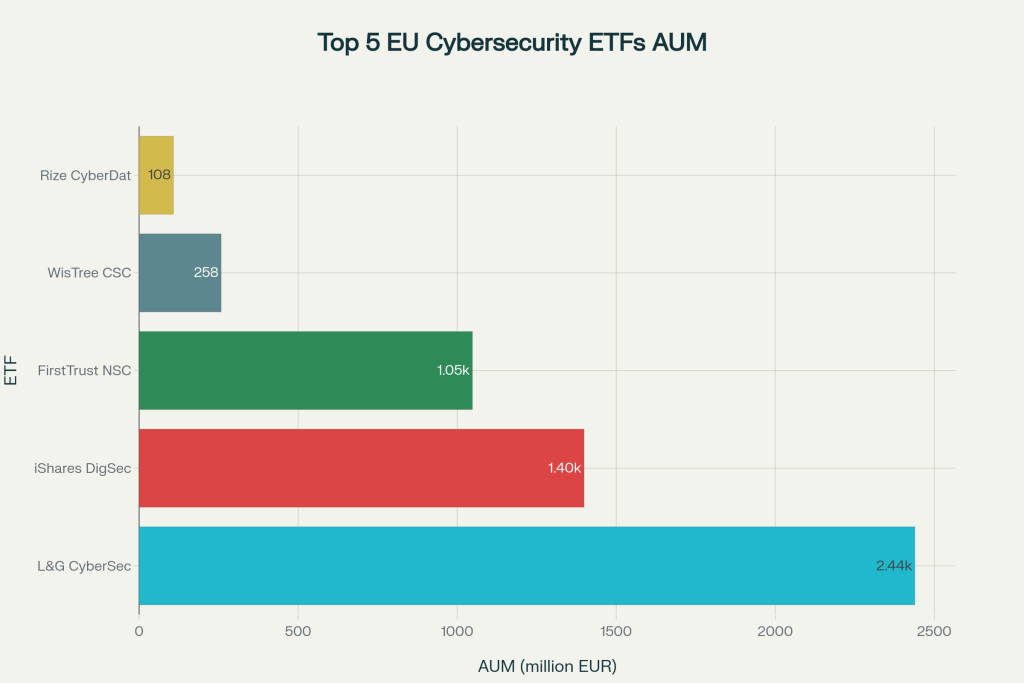
L&G ISPY €3.1bn, iShares LOCK €1.6bn, First Trust €1.4bn, WisdomTree WCBR €0.39bn, Rize CYBP €0.11bn (justETF, 26 August 2026). The gap between the top three and the bottom two matters more than it looks. A thematic fund below roughly €200m is a candidate for closure if flows reverse, and a closure is not a disaster but it is a forced disposal on the provider’s timetable rather than yours — which in most EU jurisdictions means a taxable event you did not choose. Below is a visual comparison of assets under management.
Performance: how I read it without extrapolating
I’ve deliberately stopped publishing point-in-time percentage tables for thematic ETFs because they age out within weeks. Moreover, Google’s YMYL raters — rightly — want a verifiable source per number. Instead, before adding to any of these funds I pull a live comparison from justETF’s cybersecurity UCITS comparison view and cross-check 5-year EUR total returns on Morningstar Europe and category-level data on ETF.com. In practice, that exercise has consistently shown me over the last few review cycles:
- L&G’s equal-weight basket tends to lead in risk-on years thanks to higher exposure to faster-growing mid-cap names like CrowdStrike and Zscaler.
- First Trust’s Nasdaq CTA basket has delivered strong multi-year compounding but is more concentrated and more sensitive to large-cap US software multiples.
- Rize’s data-privacy tilt diverges most from the pack when GDPR/NIS2 enforcement cycles dominate the news.
- iShares Digital Security trades lower beta because of its broader STOXX-based methodology, and is the cheapest entry by TER.
- WisdomTree’s pure-play methodology gives the highest theme purity but the smallest AUM and widest spreads.
Past performance is not a guide to future results. Therefore, pull the numbers yourself the day you decide to invest. The issuer pages and justETF will both show you a current snapshot far more accurately than a static table on any blog.
Portfolio breakdown: who’s actually inside?
Most cybersecurity ETFs share a core of recognisable names: CrowdStrike, Palo Alto Networks, Fortinet, Check Point, Cisco Systems, Zscaler, Cloudflare, Okta and selective mid-caps like Tenable, Qualys, SentinelOne and Rapid7. Sector allocations skew heavily to Software and IT Services, with a small slice of Industrials via physical-security and defence-adjacent names. Geographically, US-listed companies dominate (typically >70%), with pockets of Israeli innovators (Check Point, CyberArk) and a handful of European players.
One implication is worth flagging. Because the underlying companies are US-listed in dollars, the funds carry meaningful USD exposure regardless of whether you buy the EUR-quoted share class. Currency-hedged share classes exist for some products but eat into returns through hedging cost. In practice, for a long-horizon investor I usually skip the hedge.
Tax considerations for European investors: Irish vs Luxembourg domicile
Every cybersecurity ETF in the table above is Irish-domiciled, which is structurally favourable for most European investors holding US-heavy strategies. There are two reasons:
- Treaty rate on US dividends. Ireland’s tax treaty with the United States cuts the withholding rate on US-source dividends from 30% to 15% inside the fund. By contrast, a Luxembourg-domiciled equivalent would normally bear the full 30%. For a tech-heavy basket with modest dividend yield this is still real money over a 10–20 year hold.
- UCITS wrapper. Every fund here is UCITS-compliant. Therefore, it follows EU-level investor-protection rules, must publish a PRIIPs Key Information Document (KID), and is eligible to be sold cross-border to EU retail investors. Importantly, always download and skim the KID before buying. The KID standardises cost and risk disclosures across providers.
Local tax treatment of the distributions you receive still depends entirely on your country of tax residence. For example, in Germany, accumulating ETFs are subject to the Vorabpauschale. In the Netherlands they fall under Box 3. In Lithuania capital gains and dividends carry their own rules. By contrast, in Ireland the 38% exit tax and eight-year deemed-disposal regime applies to UCITS funds. I’m not a tax adviser. Therefore, check with a local accountant or your national authority before optimising around domicile.
Who this ETF is best for
Cybersecurity ETFs are a fit if you:
- Already have a broad-market global equity core (MSCI World, FTSE All-World or similar) and want a thematic satellite.
- Are comfortable with 20–30% annualised volatility — meaningfully higher than global equities.
- Have a 5–10 year minimum horizon. Themes go through painful drawdowns.
- Want EU-regulated, UCITS-compliant exposure rather than buying US-listed XLK or HACK directly (which most EU retail investors can’t access post-PRIIPs anyway).
By contrast, they are not a fit if you’re looking for income (yields are typically <1%), if cybersecurity would be your only equity exposure, or if you need low single-digit volatility.
The risk-comparison tool shows how each fund behaved through the last three drawdowns.
How to buy cybersecurity ETFs from Europe
All five funds above are accessible through the brokers I personally use and review on this site. Notably, the broker links in this section are affiliate links — see my affiliate disclosure for the full breakdown. Here’s the practical path:
Freedom24
Freedom24 is EU-licensed (CySEC), with strong European-stock-exchange coverage (Xetra, LSE, Euronext Amsterdam, Borsa Italiana). It’s good for placing limit orders on the smaller funds (WisdomTree, Rize) where spread matters. For fee and platform detail, see my full Freedom24 review. The L&G, iShares and First Trust tickers are all searchable by ISIN.
Interactive Brokers (IBKR)
IBKR offers the deepest market-access option for European retail. Moreover, it’s the cheapest on FX if you’re funding in EUR but want to settle USD-quoted shares. IBKR enforces PRIIPs strictly. Therefore, you’ll see UCITS share classes only, which is exactly what you want here. Notably, this is the broker I personally placed my first ISPY trade through in early 2023. For more on how I use it, read my Interactive Brokers review.
Learning ETFs the slow way?
The free 12-page Starter Kit gets you to a first, sensible portfolio faster: the 7-filter fund shortcut, the 3-question broker matrix, and the 7 costliest beginner mistakes.
XTB
XTB is KNF-regulated (Poland) with passporting across the EU. Free real-share commissions up to a monthly turnover cap make XTB attractive for smaller European investors building positions slowly. Selection is narrower than IBKR’s. However, the major UCITS cybersecurity tickers are listed.
Trade Republic
Trade Republic is mobile-first, with low minimums. It supports ETF savings plans (Sparpläne) on a wide set of UCITS cybersecurity funds. In practice, this is useful if you want to dollar-cost-average €25–€100 per month rather than lump-sum. iShares Digital Security and L&G Cyber Security are both typically available as zero-commission savings-plan picks. Notably, this is the broker I run my own iShares Digital Security drip through.
The yield-on-cost projection tool compounds DRIPs across a 30-year horizon.
The trade-offs nobody puts on the fund page
Everything above is the case for the category. Here is the other side, which the factsheets will never tell you and which decides whether this sleeve belongs in your portfolio at all.
You are paying three to seven times a core fund’s fee. A cheap global tracker costs 0.10–0.20% a year; the funds above charge 0.40–0.75%. Over twenty years that gap quietly eats a meaningful slice of your return, which means the theme has to outperform the world index just for you to break even.
You already own the winners. The large security vendors sit inside every global and Nasdaq index fund. If you hold a world tracker plus one of the Nasdaq-100 UCITS ETFs, you already have meaningful security exposure. A dedicated cybersecurity fund is a deliberate overweight, not a new asset class — and it should be sized like one.
Timing risk is real. Thematic funds attract the most money right after the theme has run hard, which is statistically the worst moment to buy. Buy on a schedule, not after a headline-grabbing breach sends the sector up 15% in a month.
The funds overlap heavily with each other. The same eight or ten large vendors anchor every index in this category, so holding two cybersecurity ETFs adds almost nothing in diversification terms. That is worth stating plainly against my own 60/40 split above: I hold two funds because their methodologies differ — one broad and market-cap-weighted, one concentrated and equal-weighted — not because the second fund diversifies the first. If you do not want to make that methodology bet deliberately, hold one fund and put the difference in your core.
How much cybersecurity belongs in a portfolio
My rule for any single theme is 5–10% of the equity portfolio, with all themes together capped around 15–20%. The 4–5% cybersecurity cap I run sits at the conservative end of that budget precisely because it is one theme among several. At 5%, a doubling of the theme adds a pleasant 5% to your portfolio and a halving costs 2.5%, which is a loss you can sleep through. At 30% the same bet can wreck a decade of compounding.
The boring mechanics matter more than fund selection here. Decide the weight before you buy, write it down, and rebalance back to it once or twice a year. A disciplined rebalancing routine forces you to trim after the theme runs hot and top up after it lags — which is exactly what most thematic investors fail to do emotionally. If you are still building your first portfolio, get the core sorted first; the beginner’s guide to ETFs covers that sequence.
Three checks before you buy any thematic fund
Reading four factsheets side by side is tedious, so the UCITS ETF comparison tool exists for exactly this job — drop two or three of these funds in and compare TER, fund size, replication and domicile in one view. Three things I check specifically for a thematic fund:
- Fund size first. Sub-scale thematic ETFs get closed when the theme cools, and a forced sale at a bad moment is a real cost — and in most European jurisdictions an unplanned taxable event.
- Top-ten weight. This tells you how concentrated the bet actually is, which the fund name never does.
- Accumulating versus distributing. Most of these funds accumulate, but check the share class your broker actually lists before you set up a savings plan against it.
All the funds above are UCITS vehicles, which brings the usual protections: EU-regulated diversification limits, segregated custody and the KID your broker must show you. ESMA maintains the framework details at esma.europa.eu if you want the regulatory background. To browse the wider sector space, the ETF category overview maps the whole thematic shelf.
Common pitfalls to avoid
- Chasing last year’s winner. Thematic ETFs are mean-reverting at the cycle level. Buying the best-performing 12-month fund is usually a poor signal.
- Doubling up with your core. If your core holding is a tech-tilted index like MSCI World, you may already have 5–6% exposure to Microsoft, Cisco and Palo Alto. Adding a 10% cybersecurity satellite can quietly push tech to 35%+ of equity.
- Buying without checking the KID. The PRIIPs KID lists the Summary Risk Indicator (1–7) and a standardised cost figure over recommended holding period — vital comparison data.
- Using market orders on thin funds. Rize and WisdomTree are smaller. Always use limit orders, especially at the open and close.
- Ignoring currency. EUR-quoted does not mean EUR-exposed. The underlying is dollar-denominated US equity.
- Treating the theme as a stock pick. One ETF, sized to a few percent of your equity allocation, is enough. Don’t buy three of the five.
Charting risk and correlation
Cybersecurity ETF returns historically show a correlation of roughly 0.65 with MSCI World. In practice, this is high enough that they aren’t a true diversifier in a crash, but low enough to deliver meaningful active return when the theme is in favour. Realised annualised volatility typically runs 20–30%, compared with 15–20% for global equities. That additional volatility is the price you pay for the upside skew the theme has delivered over the last decade. I run my own correlation checks using monthly NAV data pulled from justETF and price history from Morningstar UK.
How materials ETFs interact with cybersecurity ETFs
Materials ETFs can subtly influence the performance backdrop for cybersecurity. As investors diversify, many look to materials ETFs covering mining and chemicals. Moreover, shifts in commodity input costs filter through to industrial customers of cybersecurity vendors. Notably, rotation flows between defensives and growth often move tech and materials in opposite directions — a useful pairing if you build a multi-satellite portfolio.
Real-world example
Here’s a useful illustration. In the wake of the 2024 wave of high-profile supply-chain breaches, EU governments and large enterprises explicitly accelerated cloud-security and identity spending. Consequently, funds with heavier exposure to cloud-native and identity names (notably L&G’s equal-weight basket and the First Trust Nasdaq fund) outperformed broad-market peers during that period. The takeaway isn’t to trade the news. Rather, the theme has historically had asymmetric upside when a security-relevant catalyst lands, which is the satellite-allocation case in microcosm.
How I’d allocate today
If I were starting a cybersecurity satellite from scratch in 2026, I’d probably split it 60/40 between the iShares Digital Security ETF (broad, cheap, optimised) and the L&G Cyber Security ETF (concentrated, equal-weighted, higher beta) — capped at 4–5% of total equity. That mirrors what I actually hold. The iShares sleeve sits in a Trade Republic savings plan I top up monthly. By contrast, the L&G position sits in IBKR where I opened it as a lump sum in Q1 2023 and have only trimmed it twice since to keep the satellite cap. Additionally, I’d revisit the split annually and rebalance back if it drifted more than 1.5 percentage points. Notably, the same logic shows up in how I think about dividend yield ETF allocations and the Irish-domiciled funds I lean on for the broader portfolio.
FAQ: Cybersecurity ETFs for European Investors
Does Vanguard have a cyber security ETF?
No. Vanguard runs no cybersecurity fund in Europe or the United States, and that is a deliberate position rather than an oversight: the firm has consistently declined to launch narrow thematic products, arguing that sector and theme funds tempt investors into performance-chasing. If you want the theme you have to go to L&G, iShares, First Trust, WisdomTree or Rize. If you want Vanguard’s answer to the question, it is a broad global index fund, which already holds every one of these companies at their market weight.
Is a cybersecurity ETF a good investment?
As a small satellite, defensibly; as a core holding, no. The honest case against is arithmetic: you pay 0.40–0.69% instead of roughly 0.14% for a world tracker that already owns Palo Alto, CrowdStrike, Cisco and the rest at their market weight, and you concentrate into 30–50 stocks in one sector of one industry. The case for is that spending on security is contractually recurring and relatively insensitive to the economic cycle. Both can be true, which is why the sensible size is 4–5% of equity and the sensible holding period is measured in cycles, not quarters.
What are the top 3 cybersecurity holdings inside these ETFs?
They differ by fund, and that is the point. An equal-weighted fund like L&G ISPY caps every position at roughly the same size, so its top three carry no more weight than its thirtieth holding; a market-cap-tilted fund like iShares LOCK will be led by the largest listed security names. Never assume two cybersecurity ETFs hold the same thing in the same proportions — check the holdings list on the issuer page before you buy the second one, because overlap between thematic funds is how people end up with concentration they did not intend.
What is the best cybersecurity ETF for European investors in 2026?
There’s no single best fund. However, for most EU retail investors the choice comes down to the iShares Digital Security UCITS ETF (cheapest TER at 0.40%, €1.6bn, broadest methodology) or the L&G Cyber Security UCITS ETF (largest at €3.1bn, equal-weighted, higher historic beta, 0.69%). Both are Irish-domiciled and UCITS-compliant. In practice, personal fit depends on your tolerance for concentration and tracking error vs your core.
Are cybersecurity ETFs UCITS-compliant and available to EU retail investors?
Yes. The five funds covered here are all UCITS-compliant, Irish-domiciled, and listed on European exchanges including Xetra and the London Stock Exchange. Moreover, each publishes a PRIIPs Key Information Document (KID) that you should read before investing.
Why are most cybersecurity UCITS ETFs domiciled in Ireland rather than Luxembourg?
Ireland’s tax treaty with the United States reduces withholding tax on US dividends inside the fund from 30% to 15%. Because cybersecurity ETFs hold mostly US-listed equities, the Irish wrapper is materially more tax-efficient for the fund than a Luxembourg wrapper would be. However, local tax on what you receive as an investor still depends on your country of residence.
How much of my portfolio should I put into a cybersecurity ETF?
I personally cap any single thematic satellite at around 5% of total equity. Moreover, I run two or three satellites alongside a much larger broad-market core. Thematic ETFs are higher-volatility (20–30% annualised is typical) and can underperform for multi-year stretches. Consequently, sizing matters more than picking the “perfect” ticker.
Which European brokers let me buy cybersecurity ETFs?
Freedom24 (CySEC-regulated), Interactive Brokers, XTB (KNF-regulated), and Trade Republic all offer access to the major UCITS cybersecurity ETFs. Additionally, Trade Republic supports zero-commission monthly savings plans on several of them. All four are affiliate partners. For details, see the dedicated broker sections above and the full affiliate disclosure.
Do cybersecurity ETFs pay dividends?
Yields are very low — typically under 1% — because the underlying companies are growth-stage tech firms that reinvest earnings rather than distribute them. Notably, most of the UCITS share classes are accumulating (the “Acc” suffix). In practice, this means any dividends are reinvested inside the fund. They are not a tool for income. By contrast, they’re a tool for capital growth.
How volatile are cybersecurity ETFs compared with broad-market ETFs?
Realised annualised volatility is roughly 20–30%, compared with 15–20% for a global equity index like MSCI World. Drawdowns of 30–40% during tech-sector sell-offs are historically normal. In practice, position sizing and a multi-year holding horizon are the main risk controls.
Where can I verify TER, AUM and holdings before I buy?
Always start with the issuer’s own fact sheet and KID (linked in the table above). Then cross-check on justETF and Morningstar Europe. Additionally, independent data on ETF.com is a useful third anchor. Importantly, treat any numbers in a blog post (this one included) as directional and verify the live figures the day you trade.
Bottom line
Cybersecurity is one of the cleanest secular themes available to European investors. Moreover, the UCITS wrappers above let you express it tax-efficiently and within a regulated framework. Size it as a satellite, not a core. Crucially, verify TER, AUM and the KID risk indicator on the issuer page the day you trade, not against a static blog table. Pick one (or at most two) of the five funds, hold for at least five years, and rebalance back to your cap when the theme outruns itself.
If you want my monthly EU dividend and ETF notes — including how I size satellites like this one and what I actually trade each month — you can subscribe to my paid Substack at getdividends.net. Questions? Email [email protected] or check the help & FAQ. For how I research and review what gets published, see the editorial process. For what we collect about you, see privacy policy.
How much does domicile actually cost? Model the US dividend withholding drag of an Irish versus a Luxembourg fund with the free withholding tax and domicile calculator.
Cyber security ETF quick answers
What is a cyber security ETF? A fund holding companies that earn most of their revenue from digital security — firewalls, cloud security, identity management and threat detection. For European investors the practical choices are the UCITS versions (iShares Digital Security, L&G Cyber Security, First Trust Nasdaq Cybersecurity), all covered in the comparisons above.
Are ETFs for cyber security worth it? They are a satellite holding, not a core: concentrated, tech-heavy and more volatile than a world index, but exposed to security budgets that grow through recessions. Keep them to a small slice alongside a broad fund like VWCE.

European UCITS/ETF investor with 11+ years building a global dividend and index portfolio, and founder of Financial Expert Class. I write every guide here from first-hand experience investing across EU brokers and tax regimes — not theory. More about me →