
All-in-One ETFs vs Core-Satellite: Which Approach Fits Busy Professionals?
Because I hold ETFs at several brokers, I consolidate everything with my dividend and performance dashboard.
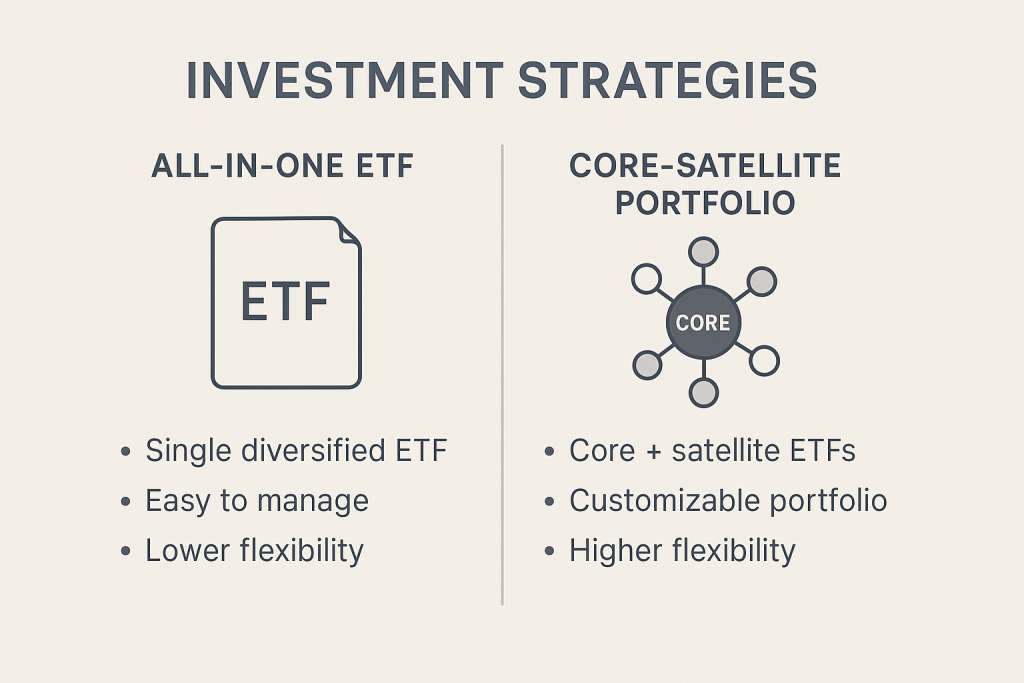
Investment strategy comparison illustration
The Investment Dilemma Every Busy Professional Faces
Time is money. For busy European professionals, juggling demanding careers, family responsibilities, and personal goals often feels overwhelming. Moreover, finding the right investment strategy adds another layer of pressure. With limited hours to dedicate to portfolio management, many face a critical choice. Specifically, the decision lies between All-in-One ETFs and the Core-Satellite approach for efficient wealth building.
The European ETF market has exploded. As of January 2025, it reached a record €2.37 trillion in assets under management. Notably, this growth reflects a fundamental shift in how professionals approach investing. They now seek solutions that deliver strong returns without consuming precious time.
For busy professionals across Europe, returns matter. However, the key question isn’t just about returns. It’s about finding an investment strategy that fits your lifestyle while building long-term wealth. Crucially, your available time will largely determine which approach serves you best. Whether you have 30 minutes per month or several hours sets the direction.
Understanding All-in-One ETFs: The Set-and-Forget Solution
What Are All-in-One ETFs?
All-in-One ETFs represent the ultimate simplicity in investing. These funds combine multiple asset classes into a single, professionally managed package. Specifically, they bundle stocks, bonds, and sometimes alternatives. Think of them as a complete meal rather than individual ingredients you cook yourself.
Popular European options include Vanguard LifeStrategy ETFs. Notably, they offer four different risk profiles. The range spans from conservative (20% equity) to aggressive (100% equity). Moreover, these funds automatically rebalance, maintain target allocations, and provide instant global diversification through a single purchase.
The rebalancing-frequency tool compares calendar vs threshold rebalancing across your contribution profile.
The Power of Simplicity
For busy professionals, All-in-One ETFs offer remarkable efficiency:
- Single decision: Choose your risk level once
- Automatic rebalancing: No manual intervention required
- Global diversification: Access to thousands of securities worldwide
- Professional management: Expert oversight included
- Low minimums: Start with as little as €50-100
Consider the Vanguard LifeStrategy 80% Equity UCITS ETF. For example, it provides exposure to over 14,000 holdings across global markets with just one fund. Achieving this level of diversification through individual stock picking would be impossible.
The Core-Satellite Strategy: Balancing Stability with Opportunity
How Core-Satellite Works
The Core-Satellite approach divides your portfolio into two distinct components:
The Core (70-90% of portfolio): Stable, low-cost index funds or ETFs providing broad market exposure. Importantly, this foundation delivers consistent, market-matching returns while minimizing volatility.
The Satellites (10-30% of portfolio): Targeted investments designed to enhance returns. For example, these might include sector-specific ETFs, emerging market funds, or thematic investments like clean energy or technology.
Strategic Flexibility
This approach appeals to professionals who want more control over their investments. The core provides stability during market turbulence. Meanwhile, satellites allow you to capitalize on specific trends or opportunities.
For example, a European professional might maintain a core position in the STOXX Europe 600 ETF. Additionally, they could add satellites in US technology, emerging markets, or dividend-focused funds. Consequently, this combination offers both stability and growth potential.

Time-constrained professional managing investments
The Time Factor: What Busy Professionals Need to Know
All-in-One ETFs: Maximum Efficiency
For professionals with limited time, All-in-One ETFs deliver unmatched efficiency. Notably, research shows these funds require less than one hour per month for monitoring and decision-making.
Key time advantages:
- No rebalancing decisions: Automatic portfolio maintenance
- Single fund monitoring: Track one holding instead of multiple
- Simplified tax reporting: One fund means easier record-keeping
- Reduced decision fatigue: Fewer choices to make
Core-Satellite: Higher Time Investment
By contrast, the Core-Satellite approach demands 2-4 hours monthly for effective management. This includes:
- Research time: Evaluating satellite opportunities
- Rebalancing decisions: Maintaining target allocations
- Performance monitoring: Tracking multiple holdings
- Tax optimization: Managing multiple fund distributions
Performance Comparison: Returns vs. Complexity
All-in-One Performance Characteristics
All-in-One ETFs deliver market-matching returns with built-in risk management. Notably, historical data shows the following pattern:
| Risk Level | Expected Annual Return | Volatility | Ideal For |
|---|---|---|---|
| Conservative (20% equity) | 4.5% | 8.2% | Near-retirement professionals |
| Balanced (60% equity) | 6.2% | 12.1% | Mid-career investors |
| Growth (80% equity) | 7.8% | 15.4% | Long-term wealth builders |
Core-Satellite Potential
By contrast, the Core-Satellite approach offers potential for outperformance. However, it brings added complexity:
- Conservative strategy: 4.8% expected return (9.1% volatility)
- Balanced approach: 6.8% expected return (13.2% volatility)
- Growth-focused: 8.5% expected return (16.8% volatility)
Crucially, the key advantage lies in the flexibility to adapt. You can adjust to changing market conditions. Moreover, you can capitalize on specific opportunities that All-in-One funds might miss.
Cost Analysis: Every Percentage Point Matters
Fee Structure Comparison
All-in-One ETFs typically charge 0.15-0.35% annually. Notably, most European options sit around 0.25%. This single fee covers all underlying holdings and management.
By contrast, Core-Satellite portfolios present more complex cost structures:
| Strategy Type | Annual Cost | €10,000 Investment Cost |
|---|---|---|
| All-in-One ETF | 0.25% | €25 |
| Simple Core-Satellite | 0.35% | €35 |
| Complex Core-Satellite | 0.55% | €55 |
Hidden Costs to Consider
Beyond expense ratios, consider these factors:
- Trading costs: Multiple ETF transactions
- Currency exchange: For non-EUR denominated funds
- Tax complexity: Multiple holdings create more paperwork
- Time value: Hours spent managing investments
European Market Advantages and Considerations
UCITS Regulation Benefits
European investors benefit from UCITS regulation. Specifically, it ensures the following protections:
- Investor protection: Strict oversight and transparency
- Tax efficiency: Optimized structures for European investors
- Liquidity requirements: Easy buying and selling
- Cost transparency: Clear fee disclosure
Broker Selection for Europeans
For purchasing ETFs, Freedom24 gives European investors access to over 3600 ETFs. Notably, pricing starts at €0.02 per unit (minimum €2). Moreover, the platform connects to major US and European exchanges. Therefore, it suits both All-in-One and Core-Satellite strategies.
Other top European brokers include Interactive Brokers (best overall), DEGIRO (cost-effective), and Trading 212 (commission-free options).
Decision Framework: Which Strategy Fits You?
Choose All-in-One ETFs If You:
- Work 50+ hours weekly with limited investment time
- Prefer simplicity over customization
- Want professional management without paying advisor fees
- Value tax efficiency and simplified reporting
- Are comfortable with market-matching returns
- Have smaller initial investments (under €5,000)
Choose Core-Satellite If You:
- Enjoy investment research and have 2-4 hours monthly
- Want customization and control over allocation
- Seek potential outperformance and are willing to accept higher risk
- Have larger portfolios (€10,000+) where complexity is worthwhile
- Understand different asset classes and market cycles
- Can commit to regular portfolio monitoring
Implementation Guide for Busy Professionals
Getting Started with All-in-One ETFs
Step 1: Determine your risk tolerance using online questionnaires
Step 2: Select appropriate allocation (conservative, balanced, or growth)
Step 3: Choose your broker (Freedom24, Interactive Brokers, etc.)
Step 4: Set up automatic monthly investments
Step 5: Review quarterly, rebalance annually if needed
Recommended European All-in-One ETFs:
- Vanguard LifeStrategy 80% Equity (IE00BMVB5R75): 0.25% TER
- iShares Core Portfolio Balanced (IE00BMVB5S24): 0.25% TER
- Amundi Portfolio Balanced (LU1593301282): 0.35% TER
Building a Core-Satellite Portfolio
Core Foundation (70-80%):
- European exposure: STOXX Europe 600 ETF
- Global diversification: MSCI World or FTSE Developed World
- Bond allocation: European Government Bonds or Global Aggregate
Satellite Options (20-30%):
- Growth sectors: Technology, Healthcare, Clean Energy
- Geographic exposure: Emerging Markets, US Small Cap
- Income focus: Dividend ETFs, REITs
Tax Implications for European Investors
All-in-One Efficiency
Single fund holdings simplify tax reporting significantly. Notably, most European All-in-One ETFs use the accumulating structure. Consequently, dividends are reinvested automatically without creating taxable events.
Core-Satellite Complexity
By contrast, multiple holdings create more complex tax situations:
- Different dividend treatments across funds
- Capital gains from rebalancing activities
- Currency considerations for non-EUR funds
- Withholding tax variations by fund domicile
Technology and Automation: Making It Work
Robo-Advisory Integration
Many European platforms now integrate robo-advisory features with ETF investing:
- Automated rebalancing for Core-Satellite portfolios
- Tax-loss harvesting optimization
- Goal-based allocation adjustments
- Risk monitoring and alerts
Mobile-First Investing
Modern brokers like Trade Republic and Scalable Capital provide mobile-first platforms. Notably, they suit busy professionals well. Features include:
- One-click investing in All-in-One ETFs
- Push notifications for portfolio updates
- Automated savings plans with round-up features
- Real-time performance tracking
Risk Management: What Could Go Wrong?
All-in-One Risks
- Limited customization: Can’t adjust for personal circumstances
- Style drift: Fund management changes over time
- Concentration risk: Heavily weighted toward certain markets
- Timing issues: May not suit all life stages equally
Core-Satellite Risks
- Over-complexity: Too many holdings reduce efficiency
- Behavioral bias: Emotional satellite decisions
- Rebalancing discipline: Requires consistent maintenance
- Cost creep: Multiple funds increase total expenses
Future Trends: What’s Coming Next?
ESG Integration
Environmental, Social, and Governance considerations are becoming standard. Notably, both approaches now factor these in. Moreover, new sustainable All-in-One ETFs and ESG satellite options are expanding rapidly across Europe.
Technology Enhancement
Additionally, Artificial Intelligence and machine learning now improve both strategies:
- Smarter rebalancing algorithms
- Enhanced risk assessment tools
- Predictive portfolio optimization
- Automated tax optimization
Making Your Decision: A Practical Assessment
Consider this decision matrix based on your personal situation:
High-Pressure Job + Limited Time + Simplicity Preference = All-in-One ETFs
Moderate Schedule + Investment Interest + Control Desire = Core-Satellite
Remember, there’s no wrong choice. Only what fits your lifestyle, goals, and preferences matters. In practice, many successful investors start with All-in-One ETFs. Then, they graduate to Core-Satellite as their knowledge and available time increase.
Conclusion: Your Path to Investment Success
For most busy European professionals, All-in-One ETFs deliver the optimal balance of simplicity, diversification, and returns. Moreover, they eliminate the complexity barrier that prevents many from investing effectively. Importantly, they also provide professional-grade portfolio management.
By contrast, the Core-Satellite approach suits those with more time and investment interest. It offers customization and potential outperformance at the cost of increased complexity.
Crucially, your investment success depends more on starting and staying consistent than on choosing the “perfect” strategy. Whether you select the simplicity of All-in-One ETFs or the flexibility of Core-Satellite, taking action remains the most important step.
With platforms like Freedom24 making ETF investing accessible across Europe, the timing has never been better. In short, you can begin building wealth through smart, efficient investment strategies tailored to your busy professional life.
Sources and further reading
- justETF — European UCITS ETF screener
- Morningstar UK ETF rankings
- ESMA — European Securities and Markets Authority
- Bogleheads wiki — EU investing
- ETF.com industry data
Before you open any account
grab the free 12-page Starter Kit: the 7-filter fund shortcut, the 3-question broker safety matrix, and the 7 mistakes that cost beginners the most.
European UCITS/ETF investor with 11+ years building a global dividend and index portfolio, and founder of Financial Expert Class. I write every guide here from first-hand experience investing across EU brokers and tax regimes — not theory. More about me →