
For an ETF-only investor, Trading 212 is cheaper. It has no account charge and no dealing commission, and only a 0.15% FX fee on foreign-currency trades. AJ Bell charges 0.25% a year on shares and ETFs (capped at £3.50 a month in an ISA) and £5 per online deal. However, it offers thousands of funds, a Lifetime ISA, a Junior ISA and a long-established SIPP with drawdown. So choose on what you need to hold.
Comparing options? Take the decision workbook with you.
The ETF Comparison Workbook: TER, domicile, withholding tax and overlap checks in one printable spreadsheet.
Two different business models
AJ Bell is a traditional UK investment platform. It charges a percentage account fee (often called a platform or custody fee), plus a charge each time you trade. In return, it offers a broad menu. That includes shares, ETFs, investment trusts, bonds and gilts, and unit trusts and OEICs (open-ended funds). It describes itself as FCA-regulated and listed on the FTSE 250.
Trading 212, by contrast, is an app broker. It charges no account fee and no commission on shares and ETFs. Its Help Centre states that on Invest, ISA and SIPP accounts, “the only fee Trading 212 can charge” is a 0.15% FX fee. That fee applies to trades in a currency other than your account currency. It does not offer traditional funds (OEICs and unit trusts). Instead, you invest through shares and ETFs, either one by one or in automated Pies.
AJ Bell vs Trading 212 fees compared
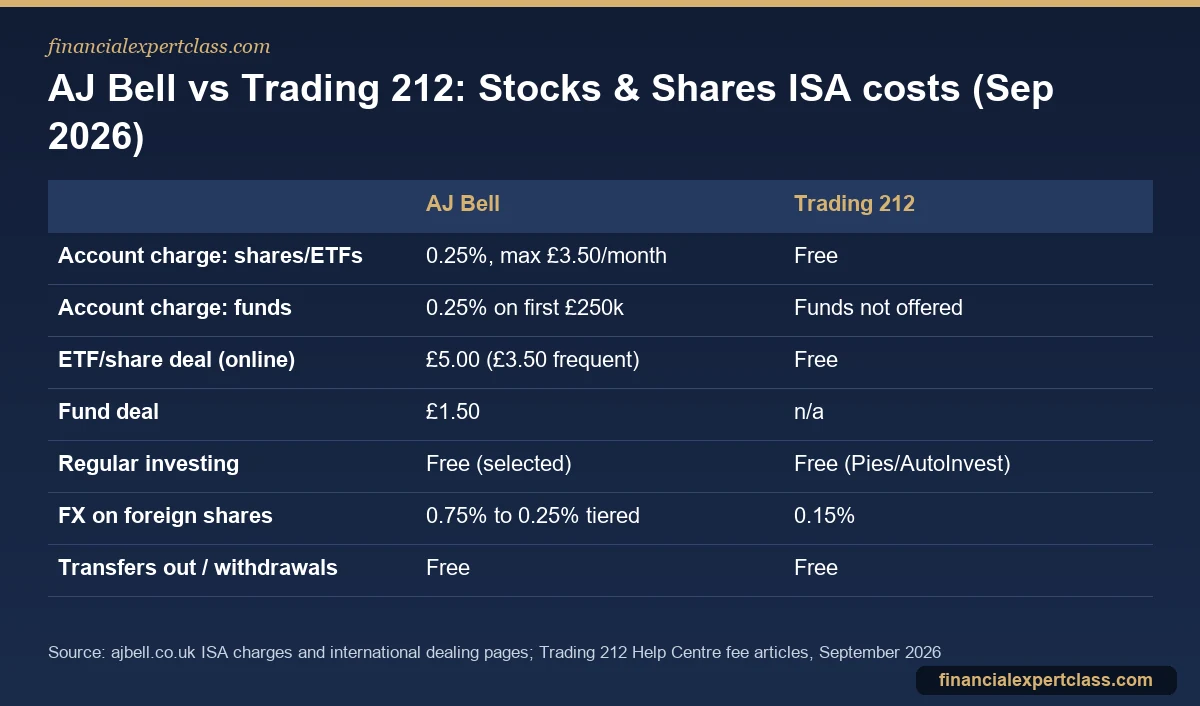
At the time of writing (September 2026), the published Stocks & Shares ISA charges are:
AJ Bell’s charges in detail
- Account charge on shares (which AJ Bell defines as including ETFs, investment trusts, gilts and bonds): 0.25% a year. The cap is £3.50 a month in the ISA and £10 a month in the SIPP.
- Account charge on funds: 0.25% on the first £250,000, 0.10% on the next £250,000, and nothing above £500,000. There is no cap, so large fund portfolios pay more.
- Dealing: £5.00 per online share or ETF deal. This falls to £3.50 if you made 10 or more share deals in the previous month. Fund deals cost £1.50, and telephone deals £25.
- Regular investing: free, from £25 a month, into selected investments. Dividend reinvestment costs £1.50 per deal.
- FX: 0.75% on the first £10,000, 0.50% on the next £10,000 and 0.25% above £20,000. This applies to international shares and foreign currency funds. There is also 0.5% when AJ Bell converts foreign dividends to sterling.
- No charge for transferring in, transferring out, withdrawals or holding cash. In addition, AJ Bell says it will cover exit fees from your old provider up to £500 if you transfer £20,000 or more.
Trading 212’s charges in detail
- Commission, custody and inactivity fees: none.
- FX fee: 0.15% when the instrument trades in a different currency from your account, including inside Pies. However, it does not apply to dividends.
- Deposits: bank transfers are free. Card and similar deposits cost 0.7% once you have deposited 2,000 GBP/EUR in total by those methods.
- Withdrawals: free.
Both platforms pass on UK stamp duty of 0.5% on purchases of UK shares. They also pass on the £1.50 PTM levy on UK share deals over £10,000. However, there is no UK stamp duty on ETFs. For more detail on the app side, see our guide to Trading 212 fees for ETF investors.
What it costs in practice
Percentage fees are hard to picture. So here are some illustrative annual costs for an ISA holding sterling-listed ETFs only. They exclude the ETFs’ own ongoing charges, which you pay on either platform.

AJ Bell caps its charge on shares and ETFs at £3.50 a month. As a result, the account charge tops out at £42 a year in an ISA, which you reach at around £16,800 invested. Beyond that, the ETF-only investor’s cost at AJ Bell is essentially fixed. That makes it competitive for larger ETF portfolios. However, the picture changes if you hold open-ended funds. The funds charge has no cap, so £100,000 in funds costs £250 a year in account charges.
So the real question is what you want to hold. If it is two or three ETFs, Trading 212 costs nothing in platform fees. AJ Bell, meanwhile, costs up to £42 a year in an ISA. But if you want OEIC index funds or active funds, only AJ Bell offers them.
Accounts, SIPPs and product range
- AJ Bell offers a Stocks & Shares ISA, Lifetime ISA, Junior ISA, SIPP, Junior SIPP, Ready-made pension, general Dealing account and a cash savings hub. It also has drawdown for taking a retirement income and dealing in 24 international markets. In addition, it runs its own funds and ready-made portfolios.
- Trading 212 offers Invest (general account), Stocks & Shares ISA, Cash ISA and a SIPP, plus a separate CFD account. Its SIPP accepts personal contributions only, not employer contributions. Also, some products such as ETNs are not available inside it. It shows ready-made Pies from Vanguard, BlackRock and WisdomTree when you open the SIPP.
Perhaps you are consolidating old workplace pensions or want to draw an income in retirement. Or you may need a Lifetime ISA or Junior ISA. In those cases, AJ Bell’s range is broader. If you are building an ISA and SIPP from scratch with ETFs, however, Trading 212 covers the essentials at lower cost. Our ISA vs LISA vs SIPP decision tree helps you decide which wrappers you need.
Cash, dealing and experience
Both pay interest on uninvested cash. Rates change, so compare the live figures. Trading 212 pays interest daily in its Invest, ISA and SIPP accounts. It also keeps its Cash ISA rate at 0.15% below the Bank of England base rate. AJ Bell publishes its cash rates on its interest rates page.
Trading 212 offers fractional shares and real-time dealing in its app. It also has Pies and AutoInvest to automate a target allocation. AJ Bell offers online dealing for shares and ETFs at £5 a deal. It also offers automatic monthly regular investing with no dealing charge. So on AJ Bell, regular investing is the cheapest way to add money. On Trading 212, by contrast, every trade is commission-free anyway.
Safety
Both are UK firms regulated by the Financial Conduct Authority. The Financial Services Compensation Scheme (FSCS) protects up to £85,000 per person, per firm, if an investment firm fails and client assets are missing. However, it never covers market losses. AJ Bell explains that it holds client cash in trust accounts across several UK banks. It adds that FSCS investment protection up to £85,000 is available if a platform fails. A separate bare trustee company also holds its SIPP assets. Trading 212 UK Ltd (FCA reference 609146) holds client money with banks including J.P. Morgan and Barclays. It holds assets with custodians including Bank of New York Mellon and Interactive Brokers. There is more in our article on whether Trading 212 is safe.
Which should you choose?
- Trading 212 if you invest in ETFs and shares only, want zero platform fees, and like an app-first experience. Our Trading 212 review covers it in depth.
- AJ Bell if you need open-ended funds, a Lifetime ISA or Junior ISA, drawdown, or broader pension features. In exchange, you accept a capped account charge.
- Both is also reasonable. For example, you could use a Trading 212 ISA for ETFs and an AJ Bell SIPP for pension consolidation and drawdown.
For a wider shortlist, see our guide to the best broker for UK investors.
Frequently asked questions
Is AJ Bell a good broker?
AJ Bell is a long-established, FCA-regulated UK platform with a wide range of shares, ETFs, funds, ISAs and pensions. It also says it has been Which? Recommended every year from 2019 to 2026. Its costs are low for large ETF and share portfolios, because the shares account charge has a cap. However, it costs more than a commission-free app for small portfolios.
Is AJ Bell cheaper than Trading 212?
For ETF-only investors, usually not. Trading 212 charges no account fee or commission. AJ Bell, by contrast, charges 0.25% a year on shares and ETFs (capped at £3.50 a month in an ISA) and £5 per online deal. Still, AJ Bell’s regular investing is free, which narrows the gap for monthly investors.
Does Trading 212 offer funds like AJ Bell?
No. Trading 212 offers shares and ETFs, including ready-made Pies built from ETFs, but not unit trusts or OEICs. So if you want a specific open-ended fund, such as a Vanguard LifeStrategy fund or an active fund, you need a platform like AJ Bell.
Can I transfer my AJ Bell ISA to Trading 212?
Yes. AJ Bell says it does not charge exit fees for moving an account to another provider. Use the formal ISA transfer process, which the receiving provider starts. Also note that you would need to sell any funds Trading 212 cannot hold and transfer them as cash.
Cited sources: AJ Bell: Stocks and shares ISA charges, AJ Bell: SIPP charges, AJ Bell: international dealing charges, AJ Bell: charges and rates, Trading 212 Help Centre: fees in Invest, ISAs and SIPP, Trading 212 Help Centre: SIPP investment options, AJ Bell: investor protection, and FSCS investment protection. Verify current fund figures before investing. Educational content, not financial advice.
Not personalised financial advice. Verify your situation with a qualified adviser. Operated by Aurum Digital Marketing LTD (UK), Companies House 15203665.
European UCITS/ETF investor with 11+ years building a global dividend and index portfolio, and founder of Financial Expert Class. I write every guide here from first-hand experience investing across EU brokers and tax regimes — not theory. More about me →