
Best Goldman Sachs ETFs for European Investors: The Complete Guide
For the wider context, see our European ETF providers compared 2026 hub. It shows how Goldman Sachs Asset Management compares with Vanguard, iShares, SPDR, Invesco, Amundi and Xtrackers in the European UCITS market. Additionally, if you are still building a core position, the European ETF investing beginner roadmap explains fund selection, broker choice and portfolio construction in plain English.
Goldman Sachs ETFs have quickly gained traction among sophisticated European investors. Notably, they seek smart, low-cost exposure to global and regional markets. Goldman Sachs Asset Management (GSAM) provides diverse strategies. Furthermore, the lineup spans factor-based equity ETFs and actively managed bond offerings. The range suits both risk-averse and growth-seeking investors. In this guide, you discover the very best Goldman Sachs ETFs for Europeans. Moreover, we cover their standout features and explain how to invest through trusted broker Freedom24.
Comparing funds is step one — the Masterclass turns it into a complete plan — fund choice, broker setup, YOUR country’s taxes and the first purchase, in 55 text lessons.
See the full curriculum — €147, 30-day guarantee →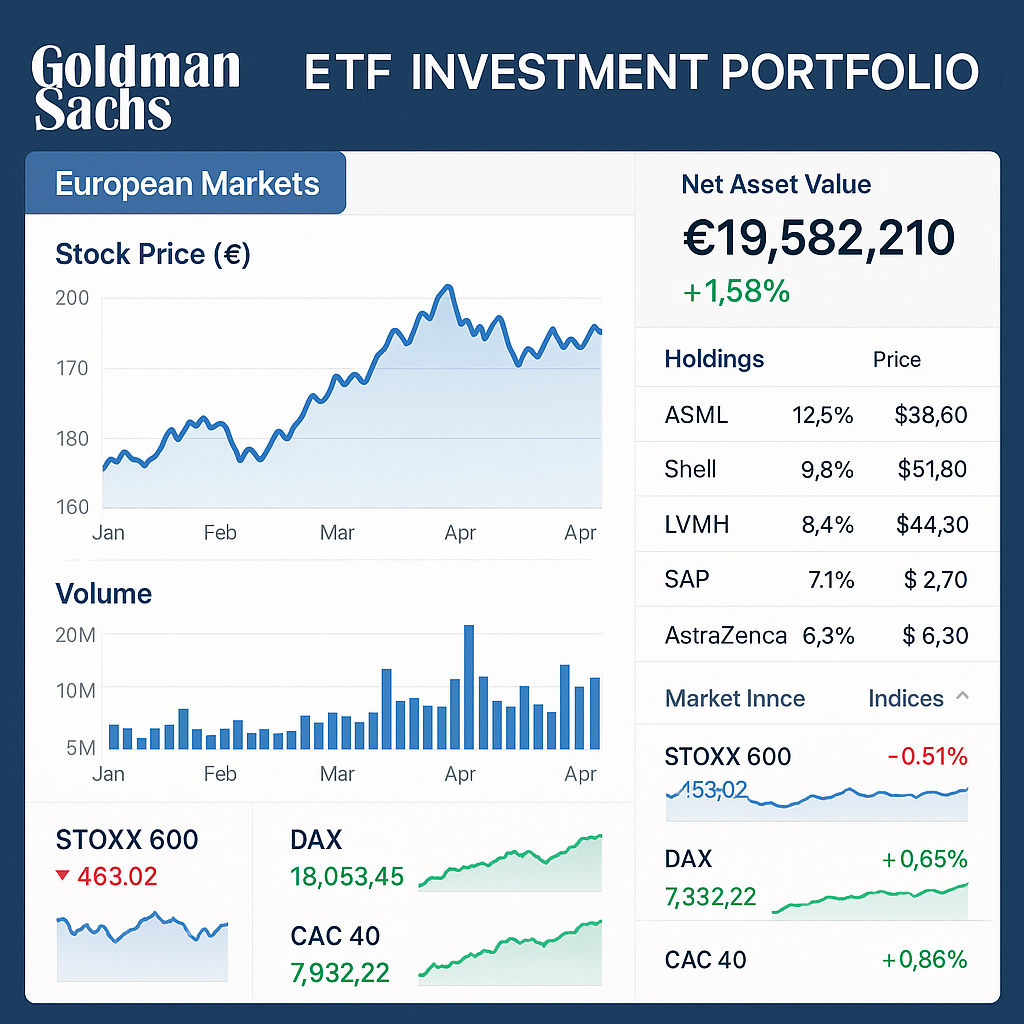
Goldman Sachs ETF investment dashboard for European investors
Why Choose Goldman Sachs ETFs?
Innovation. Scale. Performance. Goldman Sachs brings world-class research, technology and experience to the ETF world. Their funds combine institutional investment philosophies with convenient ETF wrappers. Consequently, investors benefit from:
- Factor and Smart Beta Leadership: Proprietary multi-factor methodologies built on value, momentum, quality, and low volatility.
- Low Fees: Expense ratios often below sector averages, helping boost long-term returns.
- Liquidity: Traded in high volumes on key European exchanges and globally.
- UCITS Compliance: Most funds are domiciled in Ireland for optimal tax efficiency and regulatory safety.
The Role of ETFs in Your Portfolio
ETFs work as efficient vehicles for both core and satellite positions. With Goldman Sachs, you can build a robust global portfolio using:
– Core European or global equity exposure
– Thematic and sector-focused satellites
– Diversifiers, like emerging markets or bonds
Top Goldman Sachs ETFs for Europe
1. Goldman Sachs ActiveBeta Europe Equity ETF (GSEU)
European allocators love GSEU. It tracks the Goldman Sachs ActiveBeta Europe Equity Index. Moreover, it blends value, momentum, quality and low volatility for smart European exposure.
- Type: Equity, Multi-Factor
- Expense Ratio: 0.25%
- Strategy: Physical replication, UCITS compliant
- Key Holdings: Novo Nordisk, ASML, Nestlé, SAP
- Performance: Consistently beats market-cap benchmarks over multi-year periods due to its factor tilt.
2. Goldman Sachs Alpha Enhanced Europe Equity Active UCITS ETF (GQEU)
This 2025 launch is actively managed. Specifically, it seeks outperformance over the MSCI Europe through fundamental stock selection and capital appreciation.
- Type: European equity, actively managed
- Expense Ratio: 0.25%
- Assets: €5m (new fund, strong future growth potential)
- Dividend Policy: Accumulating
- Listings: XETRA, London, Borsa Italiana, SIX Swiss Exchange
What makes GQEU special? Goldman Sachs’ global research desk actively runs the fund. The team is prized for deep-dive analysis on European equities. Furthermore, GQEU offers strict factor discipline and full transparency.
3. Goldman Sachs ActiveBeta Emerging Markets Equity UCITS ETF (GACB)
For global diversification, GACB applies the same winning multi-factor formula to 750 stocks in emerging markets.
- Expense Ratio: 0.49%
- Assets: €9 million
- Replication: Physical
- UCITS: Yes
- Dividend Policy: Accumulating
- Currency: USD-denominated; unhedged risk
| ETF Name | Type | TER | Assets | UCITS | Main Focus |
|---|---|---|---|---|---|
| GSEU | Europe Eq. | 0.25% | €100m+ | Yes | Factor, smart |
| GQEU | Europe Eq. | 0.25% | €5m | Yes | Active |
| GACB | EM Eq. | 0.49% | €9m | Yes | Smart Beta |
4. Goldman Sachs ActiveBeta U.S. Large Cap Equity ETF (GSLC)
GSLC is a top choice for US blue-chip exposure. Notably, it selects US large-caps using the same four-factor system.
- Expense Ratio: 0.09%
- Size: $13B
- Yield: 1.05%
- Top Sectors: Tech, financials, consumer
5. Goldman Sachs S&P 500 Premium Income ETF (GPIX)
This ETF is popular in the US and available to European investors. Importantly, it offers exposure to the S&P 500 plus an income overlay using options for higher yield.
- Current AUM: $1.2B
- Yield: 3.94% (higher than S&P 500 average)
- Expense Ratio: 0.29%
Fixed Income ETF Picks by Goldman Sachs
Goldman Sachs has launched actively-managed corporate bond ETFs in USD and EUR in Europe. Specifically, the 2025 launches GIGU and GIGE provide instant diversified access to top-rated issuers. Moreover, they include active risk management at a 0.25% expense ratio.
This analysis sits within our sector & thematic ETF overview.
The expense-ratio comparator compounds an expense ratio into a real cost figure for any contribution profile.
How we compare: fund picks here follow our published how we compare ETFs — TER, tracking difference, liquidity and domicile, in that order.
Why Bonds Now? Interest rates sat at decade highs in 2025 and yields rose accordingly. Fixed income therefore remains a vital defensive and income-producing portfolio tool.
Rates referenced here follow our EU ETF tax dataset (2026), checked against official sources.
Performance Analysis & Fees

European investor researching Goldman Sachs ETFs performance data
Goldman Sachs ETFs often rank above sector averages for:
- Risk-adjusted returns (thanks to factor filtering)
- Lower drawdowns during market volatility
- Attractive yield for bond and income products
- Transparency: Daily disclosure of all holdings
For example, GSEU delivered 20.8% YTD with an expense ratio of 0.25%. By contrast, classic cap-weighted benchmarks averaged 17%.
| ETF | Expense Ratio | Last 1Y Return | 3Y Avg Return | Yield |
|---|---|---|---|---|
| GSEU | 0.25% | 20.8% | 17.1% | ~2% |
| GSLC | 0.09% | 15% | 19% | 1.05% |
| GACB | 0.49% | 19% | 15% | 2% |
| GPIX | 0.29% | 18.3% | N/A | 3.9% |
All returns trailing 1 year, as of Sep 2025; yields are latest distributions. Always check data on your broker before purchase.
Charts with Analysis
- Multi-year factor outperformance of Goldman Sachs ETFs versus vanilla indices
- Smart beta ETF returns remain competitive in periods of heightened market volatility
How to Buy Goldman Sachs ETFs with Freedom24
Opening an account and buying ETFs on Freedom24 is simple and efficient:
- Register online and verify your account (EU/EEA investors welcome)
- Deposit funds via SEPA, card, or wire
- Search for your chosen Goldman Sachs ETF (by ticker: GSEU, GQEU, GACB, etc.)
- Place your order (real-time market or limit orders)
- Track performance and manage your portfolio 24/7
- Freedom24 broker provides access to 3,600+ ETFs including the full range of Goldman Sachs products for European investors
- Low commissions, intuitive interface, multilingual support
- Safe and regulated: EU-licensed, with robust investor protections
- Freedom24’s platform makes it easy to open an account and purchase ETFs at your convenience
ETF Tax and Compliance Benefits
- Most Goldman Sachs ETFs for Europe are UCITS compliant for optimal EU taxation
- Accumulating and distributing share classes available
- Full transparency for simple tax reporting
Building a Balanced ETF Portfolio
European investors should combine the best Goldman Sachs ETFs for core European and global exposure. Additionally, they should diversify across factors, regions and asset classes. For example, here is a balanced, growth-oriented European portfolio allocation:
| Allocation Area | ETF/Ticker | % Range |
|---|---|---|
| Europe Core Eq. | GSEU, GQEU | 20-30% |
| US Large Cap Eq. | GSLC | 10-20% |
| Emerging Markets | GACB | 10-15% |
| Fixed Income | GIGU, GIGE | 10-25% |
| Thematic/Satellite | GTEK, GPIX | 5-10% |
| Cash/Alternatives | GBIL, others | 5-10% |
Diversification is key. By using the multi-factor approach and mixing active and passive ETFs, you reduce risk. Moreover, you capture more upside through different market cycles.
Why Use Freedom24 for ETF Investing?
- Direct access to the world’s leading exchanges (NYSE, LSE, XETRA, Euronext)
- Multicurrency accounts (EUR, USD, GBP, more)
- Fractional share purchasing for maximum flexibility
- Low minimums, special ETF promotions, and award-winning platform innovation
Freedom24 stands out as a top broker for European ETF buyers. It gives you a one-stop platform for everything from research to execution.
Goldman Sachs ETF UCITS Structure, Domicile and Withholding Tax
Goldman Sachs Asset Management’s European ETF range sits inside the Ireland-domiciled UCITS framework. Importantly, Vanguard, iShares and SPDR use the same regulatory wrapper for their European products. That domicile is not cosmetic. Irish UCITS funds benefit from the US-Ireland double-tax treaty. Consequently, withholding tax on US-source dividends drops to 15% rather than the 30% statutory rate. By contrast, Luxembourg-domiciled funds and non-treaty jurisdictions face the higher rate. For a product like the Goldman Sachs ActiveBeta U.S. Large Cap Equity ETF, that 15-point gap compounds meaningfully over a long holding period. Additionally, the broader UCITS rulebook constrains diversification, leverage, custody and risk management. The EU sets the framework through ESMA. National regulators such as BaFin in Germany and the CySEC in Cyprus enforce it.
Independent fund data on each Goldman Sachs UCITS ETF includes TER, fund size, replication method, tracking difference and full holdings. Crucially, you can cross-check this against justETF and Morningstar UK. Both aggregate KID and factsheet data and update it as providers publish revisions. For UCITS regulatory background, our UCITS ETF complete guide for European investors walks through how the framework protects retail investors. Moreover, it explains why Ireland dominates the domicile league table and what to look for inside any KID before you trade.
How Goldman Sachs ETFs Fit With a VWCE or IWDA Core
For a European investor running a Bogleheads-style core, the Goldman Sachs ActiveBeta and Alpha Enhanced funds work best as satellite or tilt positions rather than core replacements. GSEU and GQEU concentrate on European developed equities. Notably, these already sit inside MSCI World and FTSE All-World benchmarks at roughly 13-15% by free-float weight. Therefore, stacking a 20-30% European satellite on top of a 70% VWCE core pushes your effective European weighting from around 15% to closer to 30-35%. In short, that is a deliberate regional tilt and you should size it intentionally.
The active and factor-based fees on Goldman Sachs ETFs (0.25%-0.49%) sit meaningfully above the 0.07%-0.22% range typical for vanilla cap-weighted MSCI World and FTSE All-World trackers. That cost differential is the price you pay for factor exposure and active stock selection. Moreover, it only makes sense if you actually believe in the multi-factor or active alpha thesis. Investors who want a passive global core without factor bets are usually better served by funds discussed in the VWCE vs FTSE All-World comparison hub. In practice, layer Goldman Sachs products on top only as deliberate tilts. For overall portfolio construction principles, see our balanced ETF portfolio for European investors guide. It also covers how to size satellites against a global core and a bond sleeve.
Frequently Asked Questions
Are Goldman Sachs ETFs UCITS-compliant and safe for EU investors?
Yes. The Goldman Sachs ETFs marketed to European retail investors (GSEU, GQEU, GACB, GIGU, GIGE and related funds) are Ireland-domiciled UCITS funds. Consequently, they comply with the EU’s UCITS V framework on diversification, leverage limits, custody segregation and daily liquidity. Regulatory oversight sits with the Central Bank of Ireland as home regulator. Additionally, ESMA oversees the framework at EU level. National regulators supervise cross-border marketing in each member state.
What is the TER on Goldman Sachs ETFs versus iShares or Vanguard equivalents?
Goldman Sachs ETF TERs sit in the 0.09%-0.49% range. For example, the US-listed GSLC charges 0.09%. By contrast, European-listed factor and active products like GSEU and GQEU charge 0.25%. Emerging-market exposure via GACB costs 0.49%. By comparison, broad cap-weighted MSCI World or FTSE All-World UCITS ETFs from iShares and Vanguard sit at 0.07%-0.22%. The Goldman Sachs premium reflects active management and factor methodology rather than pure index replication.
Where can I check Goldman Sachs ETF TER and AUM data independently?
Use justETF for ticker-by-ticker UCITS ETF data. Specifically, it covers TER, fund size, replication method, distribution policy and listing exchanges. Additionally, Morningstar UK provides analyst ratings, tracking-difference history and risk metrics. For the official source documents, download the KID and factsheet from Goldman Sachs Asset Management’s European ETF portal before trading. TERs and AUM figures change.
Which Goldman Sachs ETF makes sense as a core European equity holding?
For investors who specifically want European developed-market exposure with a factor tilt, GSEU (ActiveBeta Europe Equity) and GQEU (Alpha Enhanced Europe Equity Active) are the closest fits. Notably, GSEU is rules-based multi-factor. By contrast, GQEU is actively managed. However, neither is a substitute for a global core like VWCE, IWDA or SPYI. Both work as European satellites. Always size any single regional satellite based on how much overlap it has with your global core fund.
Are Goldman Sachs factor ETFs better than market-cap ETFs?
Factor ETFs aim to beat market-cap benchmarks by tilting toward value, momentum, quality and low volatility. Academic research from Fama-French and Bogleheads-style practitioners shows these factor premia have existed historically. However, they are not guaranteed. Moreover, they go through long periods of underperformance. The Bogleheads community generally prefers low-cost market-cap funds for simplicity. By contrast, factor investors accept higher TERs and tracking risk in exchange for the chance of long-run outperformance.
Can I buy Goldman Sachs UCITS ETFs through a European broker?
Yes. Goldman Sachs UCITS ETFs trade on Xetra, London Stock Exchange, Borsa Italiana, SIX Swiss Exchange and Euronext, among other venues. Any European retail broker with multi-exchange access will support them. For a vetted shortlist of brokers used by the European retail community, see our best European ETF brokers 2026 hub. It covers commission structure, fractional share support and platform reliability.
Do Goldman Sachs ETFs distribute or accumulate dividends?
It depends on the share class. Notably, GQEU is accumulating. That choice is administratively simpler for long-horizon European investors because dividends are reinvested automatically inside the fund. By contrast, some Goldman Sachs share classes are distributing for investors who prefer cash income. Always check the share class ISIN on the KID before you buy. Otherwise, the wrong choice can create unexpected tax events in jurisdictions like Germany (Vorabpauschale) or Italy.
Is the Goldman Sachs S&P 500 Premium Income ETF (GPIX) suitable for European investors?
GPIX is a US-listed fund. Specifically, it uses an S&P 500 plus options-income overlay strategy. European retail investors who fall under PRIIPs rules may face restricted access through certain brokers. The reason is simple: no UCITS KID is available for the US-listed share class. Where a UCITS equivalent or a broker that supports professional-client access exists, the higher yield comes with capped upside relative to a vanilla S&P 500 tracker. In short, treat it as a satellite income play, not a core holding.
Kestutis Balciunas wrote this analysis. The author is a self-taught European ETF and dividend investor with 11+ years of personal experience building Bogleheads-style portfolios. The analysis reflects publicly available data from Goldman Sachs Asset Management, justETF and Morningstar as of the review date above. Additionally, the existing TER and AUM figures in this article came from provider factsheets at the time of original publication. This is general financial education, not personalised investment, tax or legal advice. The author is not authorised by the FCA or any EU competent authority. Importantly, UCITS regulatory context is overseen by ESMA at EU level. National regulators including BaFin (Germany) and CySEC (Cyprus) supervise local marketing. See our editorial process and affiliate disclosure for full transparency on how this content is produced. Moreover, they explain how affiliate links such as Freedom24 are handled.
Conclusion: Are Goldman Sachs ETFs Worth It for Europeans?
Absolutely. Goldman Sachs’ ETF suite combines world-class research, proven factor and smart beta strategies, and fresh active management. For European investors, the blend of UCITS ETF safety, tax benefits and global diversification is hard to beat. Moreover, add in the stellar buying experience from Freedom24, and you have a winning formula for 2026 and beyond.
Ready to supercharge your portfolio? Open your Freedom24 account now and access the world’s best Goldman Sachs ETFs!
Often worth more than the TER gap: the free withholding tax and domicile calculator models fund-level US dividend withholding so you can compare like for like.
Sources and further reading
- justETF — European UCITS ETF screener
- Morningstar UK ETF rankings
- ESMA — European Securities and Markets Authority
- Bogleheads wiki — EU investing
- ETF.com industry data
European UCITS/ETF investor with 11+ years building a global dividend and index portfolio, and founder of Financial Expert Class. I write every guide here from first-hand experience investing across EU brokers and tax regimes — not theory. More about me →