
Best VanEck ETFs for European Investors in 2026
European investors increasingly turn to VanEck ETFs for thematic diversification and growth. These funds give exposure to sectors that traditional broad-market funds underweight or ignore. Moreover, VanEck has built a strong reputation as a pioneer in thematic UCITS investing. The lineup spans defense, uranium, semiconductors, gold miners, and emerging-markets equities. For wider context on issuer-level differences across providers, see our European ETF providers compared hub. In addition, pair it with the balanced ETF portfolio framework when you decide how big a thematic sleeve should sit alongside a global core.
Comparing funds is step one — the Masterclass turns it into a complete plan — fund choice, broker setup, YOUR country’s taxes and the first purchase, in 55 text lessons.
See the full curriculum — €147, 30-day guarantee →The VanEck UCITS ETF family opens up several powerful categories for European investors. These include emerging markets, defense technologies, precious metals, semiconductors, and uranium — areas that produced standout performance through 2025. Notably, some VanEck thematic ETFs delivered one-year returns above 70%. However, those numbers carry sector-concentration risk that you must size correctly inside a real portfolio. For verification, you can cross-check constituent weights, distribution policies and TER bands on justETF and Morningstar UK.
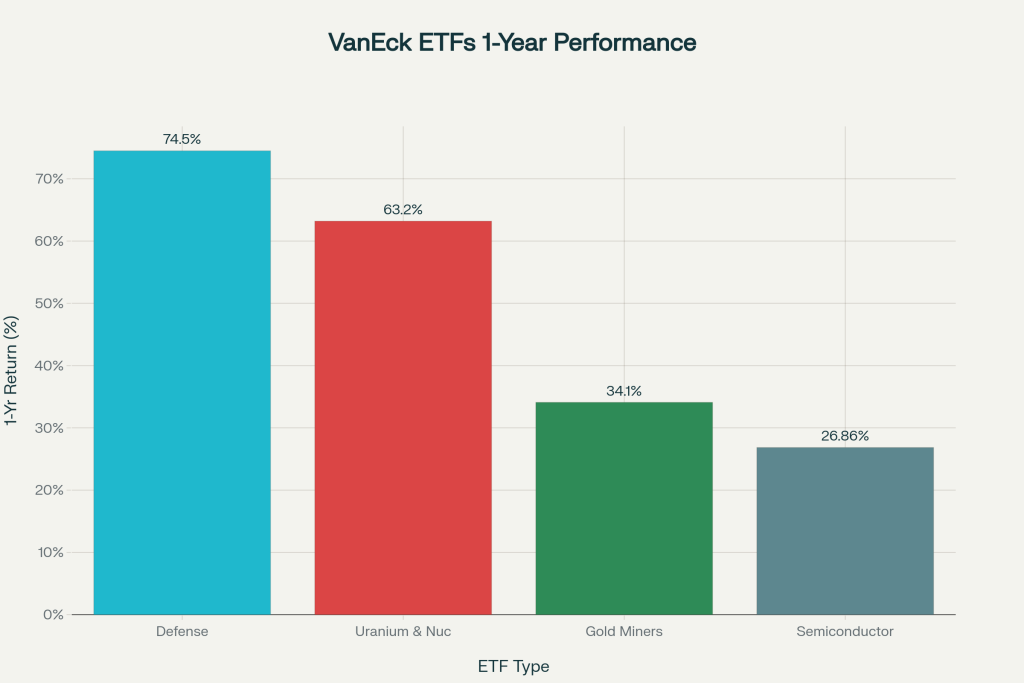
1-Year Returns of Top VanEck ETFs for European Investors in 2025
Why VanEck ETFs Stand Out for European Investors
VanEck’s ETF management approach focuses on identifying long-term structural trends before they go mainstream. Their research-driven methodology consistently positions them ahead of market cycles. For example, they have led in nuclear energy, defense modernisation and semiconductors.
European investors benefit from VanEck’s UCITS-compliant structure. This setup ensures regulatory alignment with EU investment standards. Specifically, ESMA supervises the framework at EU level. National regulators such as BaFin in Germany and the Cyprus Securities & Exchange Commission for funds passported into Cyprus also oversee compliance. Consequently, this regime provides legal protection while preserving access to global investment themes.
The company’s expense ratios remain competitive. They typically range from 0.35% to 0.65% annually for thematic strategies. By contrast, a plain-vanilla S&P 500 tracker charges far less. Still, VanEck pricing sits in line with sector and thematic peers from iShares, Xtrackers and HANetf.
Key Advantages for European Markets
- Regulatory compliance with European UCITS directives
- Currency hedging options available for major European currencies
- Tax-efficient structures for many Irish-domiciled UCITS share classes
- Liquid trading on major European exchanges (Xetra, Euronext, LSE)
Top Performing VanEck ETFs in 2025
VanEck Defense ETF (DFNG)
The VanEck Defense ETF delivered exceptional returns of 74.5% over the past year. This fund gives exposure to companies in defense technologies, cybersecurity, and aerospace innovation.
Key holdings include Leonardo SpA, Hensoldt AG, and Babcock International. These names produced triple-digit growth in the first half of 2025. Furthermore, the fund benefits from rising global defense spending and technological advancement. The EU’s ReArm Europe plan and elevated NATO budget commitments amplify this trend.
European investors can access this ETF through platforms like Freedom24. That platform offers comprehensive ETF trading capabilities. For the full broker context, see the European ETF brokers hub.
Investment Thesis: Rising geopolitical tensions and the modernisation of defense systems create long-term growth opportunities. However, sector concentration also means drawdowns will be sharper than a global tracker if defence spending plateaus.
For the standard-deviation and worst-drawdown comparison, the drawdown analyzer draws the curves.
VanEck Uranium and Nuclear Technologies ETF (NLR)
Nuclear energy’s renaissance propelled the VanEck Uranium ETF to remarkable gains of 63.2% in 2025. This fund captures the growing demand for clean nuclear energy solutions.
The ETF provides exposure to:
- Uranium mining companies
- Nuclear technology developers
- Nuclear power plant operators
- Advanced reactor technology firms
Real-world Impact: European countries increasingly fold nuclear energy into their clean energy strategies. This shift drives demand for uranium and nuclear technologies. In practice, France, Finland and several Eastern European states have re-committed to building or extending reactors through 2035.
VanEck Gold Miners ETF (GDX)
The VanEck Gold Miners ETF achieved 34.1% returns amid economic uncertainty. This fund offers leveraged exposure to gold price movements through mining companies.
Top holdings include Newmont Corporation, Barrick Gold, and Franco-Nevada. These companies benefit from operational leverage when gold prices rise.
Strategic Consideration: Gold miners typically outperform physical gold during bull markets. As a result, they provide amplified returns for risk-tolerant investors. However, the reverse is also true during a falling gold-price environment. Therefore, position sizing matters.

VanEck ETFs Sector Focus and Themes for European Investors 2025
VanEck Semiconductor ETF (SMH)
Technology continues driving market performance. Notably, the VanEck Semiconductor ETF posted 26.86% year-to-date returns. This fund captures the artificial intelligence and digital transformation trends.
Major holdings include:
- Taiwan Semiconductor Manufacturing Company (TSMC)
- NVIDIA Corporation
- Advanced Micro Devices (AMD)
- Synopsys Inc
Market Dynamics: The semiconductor industry remains essential for AI development, autonomous vehicles, and 5G infrastructure. Crucially, European investors should note this is a high-beta sector. Drawdowns of 30-40% in single calendar years have happened before. Moreover, they will happen again.
Specialized VanEck ETFs Worth Considering
VanEck Europe ETF (TEET)
The VanEck Europe ETF provides exposure to the 100 largest European companies. It uses an ESG-screened, equally weighted approach. Consequently, this fund offers a unique perspective on European equity markets.
Unlike market-cap weighted indices, this ETF prevents over-concentration in mega-cap stocks. It therefore delivers more balanced sector representation. Investors interested in ESG-aligned strategies should compare it against alternatives in the best green and ESG ETFs hub.
VanEck Emerging Markets Fund
Emerging markets equities surged in 2025. VanEck’s emerging markets fund outperformed the MSCI EM IMI Index. Notably, the fund achieved 13.79% returns in Q2 2025 alone.
Key Performance Drivers:
- Strong stock selection in Brazil and India
- Exposure to policy-driven growth initiatives
- Currency tailwinds in select markets
How to Invest in VanEck ETFs Through Freedom24
Freedom24 expanded its ETF selection to over 3,600 funds. The list includes comprehensive VanEck offerings. European investors can access these ETFs through Freedom24’s user-friendly platform.
Getting Started with Freedom24
- Open an account at Freedom24
- Complete the verification process (typically 1-2 business days)
- Fund your account using European banking methods
- Search for VanEck ETFs using ticker symbols
- Execute trades with competitive commission rates
Platform Benefits:
- Over one million financial instruments available
- Web and mobile trading platforms
- Competitive pricing structure
- European regulatory compliance
Performance Analysis and Risk Considerations
| ETF Name | 1-Year Return | Sector Focus | Risk Level |
|---|---|---|---|
| VanEck Defense ETF | 74.5% | Defense Technology | High |
| VanEck Uranium ETF | 63.2% | Nuclear Energy | High |
| VanEck Gold Miners | 34.1% | Precious Metals | Medium-High |
| VanEck Semiconductor | 26.86% | Technology | Medium-High |
Risk Management Strategies
Diversification remains crucial when you invest in specialized ETFs. VanEck’s thematic funds should complement broad market exposure, not replace it. For example, pair them with a global all-world tracker such as VWCE, IWDA or SWRD.
Position sizing becomes critical with volatile sectors like defense and uranium. Consider limiting individual ETF exposure to 5-10% of your total portfolio. Additionally, cap the thematic sleeve in aggregate at 15-20%.
Volatility tolerance varies significantly across VanEck’s offerings. Defense and uranium ETFs experience higher volatility than broader market funds. Moreover, they have historically been prone to multi-quarter drawdowns despite strong multi-year trends.
Tax Implications for European Investors
European investors must consider withholding tax implications when investing in US-domiciled ETFs. Importantly, VanEck offers both US and European-domiciled versions of popular funds.
UCITS-compliant versions typically provide better tax efficiency for European residents. In practice, Ireland domiciles these funds and structures them to minimize tax drag at fund level. For the broader regulatory picture see the UCITS ETF complete guide for European investors.
Capital gains treatment varies by European country. Therefore, consult a qualified tax professional to optimize your VanEck ETF investments within your jurisdiction’s framework. In short, this article is educational and not personalised tax advice.
How These VanEck Themes Fit Inside a Real European Portfolio
I have watched dozens of European DIY portfolios. The pattern that works best with VanEck-style thematic ETFs is the classic core-satellite structure. Core: a global all-world UCITS ETF such as VWCE, V3AA or SWRD, sized at 60-80% of total equity. Satellites: a small basket of 2-4 thematic positions. For example, DFNG for defence, NLR for uranium, SMH for semiconductors. Cap each one at 5-10% of the equity allocation. Consequently, this keeps your factor and sector exposure intentional. Otherwise, a single 70%-return year quietly turns into 25% of your net worth.
The second pattern that works is theme rotation discipline. Decide in advance whether a thematic ETF is a 5-year strategic position or a 12-24 month tactical position. For example, semiconductors fit the strategic bucket because the demand thesis spans multiple decades. By contrast, uranium during a clear utility re-contracting cycle is tactical. Crucially, write the timeframe down at the moment of purchase. As a result, the exit decision becomes much easier when the inevitable 30% drawdown arrives.
VanEck Thematic ETFs vs Broad Sector Trackers from iShares and Invesco
European investors often ask a key question. Should they reach for a VanEck thematic ETF or just take broad sector exposure via iShares or Invesco? The two answers differ. A broad iShares MSCI World Energy or Invesco MSCI Europe ETF gives you the whole sector, including the laggards. By contrast, a VanEck thematic ETF like NLR or DFNG is a curated slice of a structural theme. For example, nuclear technology rather than all utilities, defence rather than all industrials. For comparison shopping, see Best Invesco ETFs for European investors alongside this guide.
The trade-off is clear. VanEck’s thematic ETFs typically carry a higher TER (0.35-0.65%) than plain sector trackers (0.10-0.25%). Moreover, they have more tracking sensitivity to a narrow basket of stocks. In exchange, you get a much more concentrated bet on a single structural trend. That works fine as a satellite. However, it is rarely the right answer as your only equity exposure.
Future Outlook and Investment Themes
Emerging Trends in VanEck’s Pipeline
Artificial Intelligence continues driving semiconductor demand. As a result, VanEck’s technology-focused ETFs benefit. Notably, the AI capex cycle creates sustained demand for advanced chips and the equipment to make them.
Clean Energy Transition supports uranium and nuclear technology investments. European energy policies increasingly favour nuclear power as a carbon-free baseload solution. In particular, France, Finland and parts of Central and Eastern Europe lead this shift.
Defense Modernization programmes across NATO countries provide multi-year growth visibility for defense technology companies. Importantly, elevated GDP-of-defence-spending targets agreed within NATO anchor this trend.
Market Positioning for 2026-2027
VanEck’s research-driven approach positions their ETFs to capture emerging trends before mainstream adoption. Moreover, their track record demonstrates an ability to identify transformative sectors early. Still, no issuer is immune from cyclical drawdowns.
Institutional adoption of VanEck’s thematic strategies continues growing. Consequently, this provides additional liquidity and validation for retail investors.
You can start building your VanEck ETF portfolio today through Freedom24’s comprehensive platform. The broker offers access to the full range of VanEck’s UCITS solutions.
Building Your VanEck ETF Portfolio
Core-Satellite Approach
Consider using VanEck’s specialized ETFs as satellite holdings around a core of broad market exposure. This strategy captures thematic growth while maintaining diversification.
Recommended allocation: 10-20% in thematic VanEck ETFs, with remaining assets in broad market funds.
Dollar-Cost Averaging Strategy
Systematic investing works particularly well with volatile sectors like defense and uranium. In addition, regular monthly investments smooth out price fluctuations over time. Consequently, they remove single-entry timing risk.
Rebalancing Considerations
Quarterly or annual reviews help maintain target allocations. VanEck’s specialized ETFs can experience significant price movements. Therefore, rebalancing back to target percentages turns volatility into an advantage. Otherwise, one winner dominates the portfolio.
FAQ: VanEck UCITS ETFs for European Investors
Are VanEck ETFs UCITS-compliant for European investors?
The European versions of VanEck’s flagship thematic ETFs come as UCITS funds. This covers their defence, uranium and semiconductor strategies. Ireland typically domiciles these funds. Furthermore, the EU UCITS framework regulates them, with ESMA and national regulators such as BaFin and the Central Bank of Ireland supervising. By contrast, the US-listed versions are not UCITS. As a result, EU retail investors generally cannot freely buy them via European brokers.
How much should I allocate to thematic VanEck ETFs?
A common Bogleheads-style guideline is simple. Cap your entire thematic sleeve at around 10-20% of total equity. In addition, limit any single thematic ETF to 5-10%. The rest sits in a global core such as VWCE, IWDA or SWRD. Consequently, this keeps thematic conviction intact. Moreover, it stops one strong year (or one bad year) from dominating your wealth.
What are the typical TERs of VanEck UCITS ETFs?
VanEck’s thematic UCITS ETFs typically charge total expense ratios between 0.35% and 0.65% annually. By contrast, a plain S&P 500 tracker charges 0.05-0.20%. However, VanEck’s pricing matches other thematic UCITS funds from iShares, Xtrackers, HANetf and WisdomTree. Always confirm the live TER on the issuer’s KID/KIID before buying.
Can I buy VanEck UCITS ETFs through Freedom24, IBKR, XTB or Trade Republic?
Yes. I track the major European brokers, including Freedom24, Interactive Brokers, XTB and Trade Republic. They all list the main VanEck UCITS thematic ETFs on European exchanges such as Xetra, Borsa Italiana and Euronext. However, availability of specific tickers and savings-plan eligibility varies by broker. Therefore, check the platform’s instrument search before committing.
How are VanEck UCITS ETF dividends taxed for EU investors?
Tax treatment depends on three factors. First, the ETF’s domicile (Ireland is most common). Second, its distribution policy (distributing vs accumulating). Third, your country of tax residence. Notably, Irish-domiciled UCITS ETFs benefit from the US-Ireland tax treaty’s 15% rate on US dividends withheld at fund level. Consequently, this is tax-efficient for most EU residents. Always check your local tax authority’s guidance and the ETF’s KID before purchase. In short, this article is educational and not tax advice.
Are VanEck thematic ETFs suitable for beginner European investors?
Generally no, not as a starting position. A new European investor is better off starting with a globally diversified UCITS core. Our European ETF investing beginner roadmap covers this in detail. Thematic ETFs make sense later. Specifically, once you have a stable core, an understanding of drawdowns, and a clear thesis for the specific theme you are adding.
Where can I check live data on VanEck UCITS ETFs?
Use independent sources. For example, justETF covers European UCITS ETF data and KIDs. Additionally, Morningstar UK provides ratings and historical performance. VanEck’s own issuer pages host official factsheets and prospectuses. ETF.com is useful for US comparables, though those are usually not UCITS.
Sources and further reading
- justETF — European UCITS ETF database
- Morningstar UK — ETF ratings & historical data
- ETF.com — ETF screener & analytics
- ESMA — UCITS regulatory framework
- BaFin — German national regulator
- Bogleheads — Three-fund portfolio and satellite sizing
Conclusion
VanEck UCITS ETFs offer European investors access to innovative investment themes. These include defence, uranium, semiconductors, gold miners, ESG-screened European equities. Moreover, recent performance has been strong. The 2025 results demonstrate the value of thematic investing when combined with solid research and disciplined position sizing.
Defense, uranium, and semiconductor sectors delivered exceptional returns, validating VanEck’s forward-looking approach. Notably, these trends appear sustainable given the underlying macro and geopolitical dynamics. However, they remain concentrated bets that will produce sharper drawdowns than a global tracker.
For European investors seeking portfolio diversification and growth potential on top of a stable global core, VanEck UCITS ETFs provide compelling satellite opportunities. In short, the combination of innovative themes, competitive thematic costs, and strong performance makes them worthy of consideration in modern portfolios.
Start your VanEck ETF research today. Specifically, check the live VanEck UCITS factsheets, compare them on justETF and Morningstar UK, and read your broker’s KID before any purchase.
Educational content, not personalised investment advice. The author is an independent European ETF investor (11+ years), not an FCA-regulated adviser. Always read the KID/KIID and consult a qualified adviser before investing. See our editorial process and affiliate disclosure.
Sources and further reading
- justETF — European UCITS ETF screener
- Morningstar UK ETF rankings
- ESMA — European Securities and Markets Authority
- Bogleheads wiki — EU investing
- ETF.com industry data
Run your own number through our EU FIRE calculator to see your target balance.
European UCITS/ETF investor with 11+ years building a global dividend and index portfolio, and founder of Financial Expert Class. I write every guide here from first-hand experience investing across EU brokers and tax regimes — not theory. More about me →