
Do ETFs pay dividends? Yes, many do. When the shares or bonds inside an ETF pay income, a distributing share class passes that income to you in cash. This usually happens quarterly or twice a year. By contrast, an accumulating share class keeps the income inside the fund and reinvests it, so you receive no payout. The same fund often comes in both versions.
Building an income portfolio? Use the free sheet.
The Dividend Portfolio Starter Sheet: plan yield, payout dates and withholding tax for a European dividend portfolio.
How an ETF dividend actually reaches you
An ETF does not create dividends of its own. Instead, it owns a basket of companies, and those companies pay dividends to the fund. The fund collects that cash and deducts nothing extra beyond its running costs. (It takes those costs from the fund’s assets over the year.) Then it decides what to do with the income, according to the share class you bought.
With a distributing share class, the fund pools the dividends it received over a period. It then pays them to every unit holder on a set schedule. Providers quote the amount “per unit”. So if you hold 100 units and the fund declares US$0.30 per unit, you receive US$30. If your account is in another currency, your broker converts it into pounds or euros.
With an accumulating share class, the fund reinvests the same dividends itself. Nothing lands in your account; instead, the price of each unit reflects the retained income. Over long periods this is the simplest way to compound. That is because there is nothing to reinvest by hand and no small cash balances sit idle.
Bond ETFs work in the same way, except the income is interest (coupons) rather than company dividends. Even so, many providers still call bond ETF payouts “dividends” or “distributions”.
A real example: one index, two share classes
Vanguard’s S&P 500 UCITS ETF shows the difference neatly. It is an Irish-domiciled fund that tracks the S&P 500. Its ongoing charge (OCF) is 0.07% at the time of writing (September 2026). Vanguard also sells it in two versions on the London Stock Exchange:
- VUSA (distributing) pays its income out quarterly. Vanguard showed a historical distribution yield of 0.86% as of 31 August 2026.
- VUAG (accumulating, GBP line; VUAA is the US dollar line) reinvests all dividends. Vanguard’s page states that “all dividends are reinvested for the ‘Accumulation’ shares”.
Both hold the same 504 stocks (as of 31 August 2026) and charge the same fee. The only difference is what happens to the income.
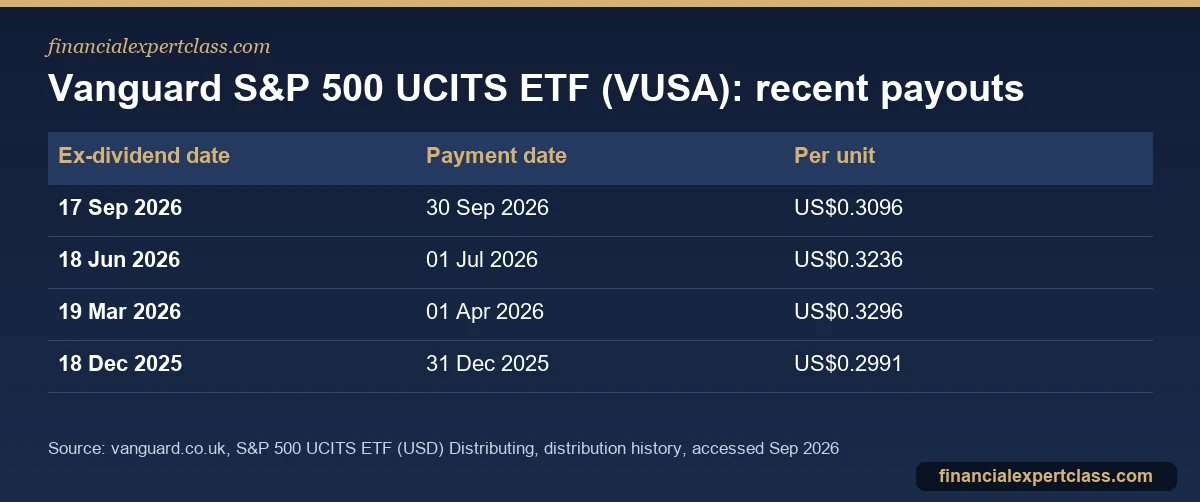
The table shows two dates for each payment. They matter more than most beginners realise.
Ex-dividend dates, payment dates and frequency
The ex-dividend date is the cut-off. You must own the ETF before that date to receive the next payout. If you buy on or after the ex-date, the seller keeps that distribution. On the ex-date the ETF’s price usually drops by roughly the amount of the payout. That is because the cash is leaving the fund. So buying just before an ex-date to “collect” a dividend gains you nothing. You receive the cash, but your units are worth correspondingly less.
The payment date is when the cash actually reaches your broker account, typically a week or two later. In VUSA’s case, the September 2026 distribution went ex on 17 September and the fund paid it on 30 September.
Payment frequency depends on the fund:
- Quarterly is the most common schedule for broad equity ETFs. Examples include VUSA and Vanguard’s FTSE All-World High Dividend Yield UCITS ETF (VHYL).
- Semi-annual or annual schedules apply at some global and European equity funds.
- Monthly payers exist, mostly among bond and income-focused ETFs. We keep a list of monthly dividend ETFs available in Europe.
Payouts are not fixed. Instead, they rise and fall with the dividends the underlying companies pay. VUSA’s own history shows this: the four most recent quarters ranged from US$0.2991 to US$0.3296 per unit.
How much income can an ETF pay?
The yield depends on what the fund owns. A broad S&P 500 tracker has a low yield because many large US companies prefer buybacks or reinvestment to dividends. However, a fund built around higher-yielding stocks pays more. Take Vanguard’s FTSE All-World High Dividend Yield UCITS ETF (VHYL), for example. It holds 2,364 dividend-paying stocks worldwide and charges an OCF of 0.29%. It also showed a historical distribution yield of 2.43%, all as of 31 August 2026.
Two cautions. First, a historical yield describes the last twelve months, not the next. Second, a higher yield usually means a different, more concentrated portfolio. It holds more banks, energy and utilities, and fewer growth companies. So it is a portfolio choice, not free money. Our guide to dividend ETFs for European investors compares the main options.
Withholding tax at fund level: why domicile matters
When a US company pays a dividend to a foreign fund, the US withholds tax at source. This happens before the money arrives. Irish-domiciled ETFs benefit from the reduced rate under the Ireland–US double taxation treaty. That is one reason why most UCITS ETFs sold to UK and EU investors sit in Ireland. The withholding happens inside the fund, before the fund calculates the distribution. As a result, the figure you see per unit is already net of it, and you cannot reclaim it yourself.
Non-US equities inside the fund face their own countries’ withholding rules, which also vary with the fund’s domicile. This fund-level withholding is a hidden cost that does not appear in the OCF. So two ETFs tracking the same index can pay slightly different amounts. For the full picture of how domicile changes the income you keep, see our overview of Irish-domiciled ETFs for dividend investors.
How UK investors pay tax on ETF dividends
Where you hold the ETF matters far more than which ETF you pick.
Inside a Stocks and Shares ISA, GOV.UK is clear: “You do not pay tax on dividends from shares in an ISA.” You can pay in up to £20,000 in the 2026 to 2027 tax year. For most UK investors, this makes the distributing-versus-accumulating choice purely practical rather than a tax question.
Outside an ISA or pension, in a general investment account, you have a £500 dividend allowance for 2026/27. Above that, HMRC taxes equity ETF distributions at dividend rates:

Note the trap with accumulating funds held outside an ISA. Even though you receive no cash, the income the fund retains still counts. For UK investors in reporting funds, it is reportable and taxable each year. We explain that in detail in accumulating vs distributing ETFs and excess reportable income. In addition, HMRC can treat distributions from bond-heavy funds as interest rather than dividends. So check your broker’s annual tax statement rather than assuming. For the wrapper rules side by side, read our guide to ISAs, LISAs and SIPPs for UCITS ETF investors.
EU investors face their own national rules, which differ widely from country to country. Our accumulating vs distributing ETF tax guide covers the main cases.
How to check whether an ETF pays dividends
You do not need to guess. Every ETF discloses its distribution policy in a few standard places:
- The fund name. UCITS ETF names usually end in “Dist”, “Distributing”, “Inc” or “Acc”/”Accumulating”.
- The provider’s fund page. Look for “Distribution policy” or “Use of income” and “Distribution frequency”. Vanguard, iShares, Amundi and others show these near the top.
- The distribution history table. If the page lists past ex-dates and amounts per unit, the share class pays out.
- The KID (Key Information Document). It states whether the fund pays income out or reinvests it.
- The ISIN, not just the ticker. Distributing and accumulating classes of the same fund have different ISINs, so confirm the ISIN before you buy.
Distributing or accumulating: which should you choose?
Choose distributing if you want the cash. For example, you may be drawing an income in retirement. You may like to decide where each payout goes, or want visible income to track. Choose accumulating if you are still building wealth. In that case you simply want every pound reinvested automatically. You avoid a dealing charge and leave no small balances uninvested.
Inside an ISA the tax outcome is identical, so the decision is about convenience. Outside an ISA, many UK investors prefer distributing classes because the taxable income matches the cash received. That makes the annual tax return easier. If you want to see what reinvesting income does over time, try our compound growth calculator.
Frequently asked questions
Are ETFs good for dividends?
They can be. A distributing ETF gives you a share of the dividends from hundreds or thousands of companies in one holding. As a result, it spreads the risk of any single company cutting its payout. Broad index ETFs pay modest yields. By contrast, dedicated high-dividend ETFs pay more but hold a narrower, more sector-concentrated portfolio.
Do S&P 500 ETFs pay dividends?
The distributing versions do. Vanguard’s S&P 500 UCITS ETF (VUSA) pays quarterly. It showed a historical distribution yield of 0.86% as of 31 August 2026. The accumulating version (VUAG/VUAA) reinvests the same dividends instead of paying them out.
Do accumulating ETFs pay dividends?
You receive no cash. The underlying companies still pay dividends to the fund, but an accumulating share class reinvests them. Over time, a higher unit price reflects this. For UK investors outside an ISA, that retained income may still be taxable each year.
How often do ETFs pay dividends?
Most equity ETFs pay quarterly, while some pay twice a year or annually. A smaller group, mainly bond and income funds, pays monthly. The fund’s page lists the frequency and past ex-dividend and payment dates.
Do I pay tax on ETF dividends in the UK?
Not inside an ISA or a pension. In a general investment account you have a £500 dividend allowance for 2026/27. Above that, dividend tax is 10.75%, 35.75% or 39.35%, depending on your income tax band.
Cited sources: Vanguard S&P 500 UCITS ETF (USD) Distributing, Vanguard S&P 500 UCITS ETF (USD) Accumulating, Vanguard FTSE All-World High Dividend Yield UCITS ETF, GOV.UK: Tax on dividends, and GOV.UK: Individual Savings Accounts. Verify current fund figures before investing. Educational content, not financial advice.
Not personalised financial advice. Verify your situation with a qualified adviser. Operated by Aurum Digital Marketing LTD (UK), Companies House 15203665.
European UCITS/ETF investor with 11+ years building a global dividend and index portfolio, and founder of Financial Expert Class. I write every guide here from first-hand experience investing across EU brokers and tax regimes — not theory. More about me →