
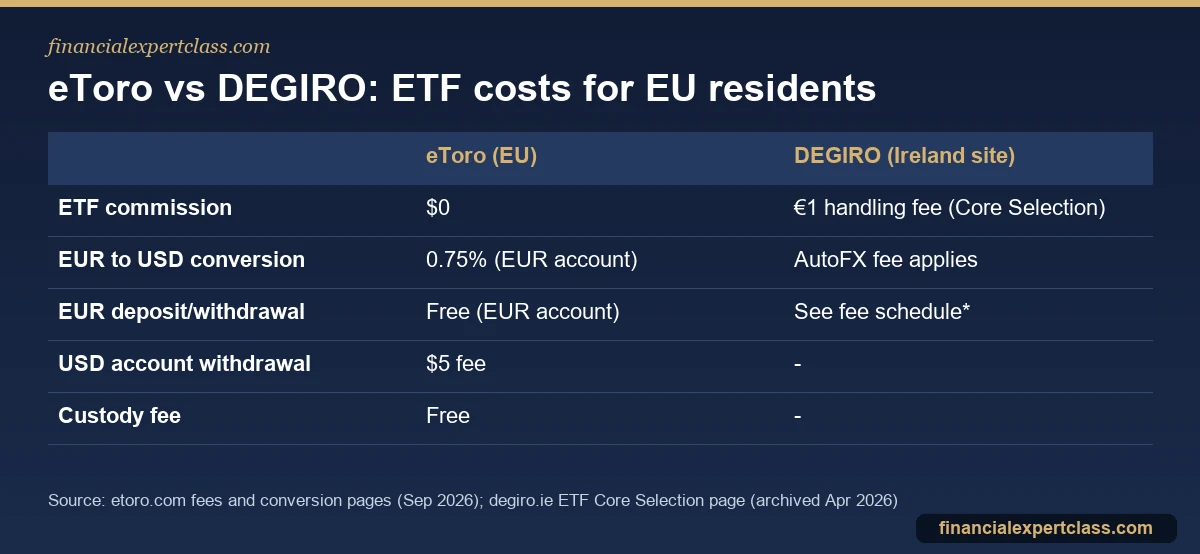
In the eToro vs DEGIRO choice, both brokers are cheap for EU investors buying euro-listed ETFs. eToro charges no commission on ETFs, while DEGIRO charges a €1 handling fee per trade on its ETF Core Selection. The real difference is currency. eToro charges 0.75% to convert between a euro account and US dollars, whereas DEGIRO uses its own AutoFX conversion. Overall, DEGIRO is the more traditional broker, and eToro the more social, app-first one.
Comparing options? Take the decision workbook with you.
- The ETF Comparison Workbook — 10 pages: the 7-filter framework for choosing between two good funds
- + 2 bonus PDFs: ETF Starter Kit and Dividend Starter Sheet
- + a free lesson from the €147 Masterclass
eToro vs DEGIRO at a glance
eToro started as a social trading platform. It still leads with features such as CopyTrader and a community feed, but it now also offers real ETFs and shares with no commission on ETF trades. DEGIRO, by contrast, is a low-cost European broker that focuses on straightforward access to many exchanges. The German bank flatexDEGIRO Bank AG owns it.
A note on sources: eToro figures come from its fee and conversion pages as published in September 2026. However, DEGIRO blocks automated access to its website. So the DEGIRO Core Selection details below come from its Irish fee page as archived in April 2026. DEGIRO fees can also differ by country, so check the live fee schedule for your country before you open an account.
Commission on ETFs
eToro says it charges “zero commission for ETF trades”, regardless of size or how you placed the order. That includes orders through CopyTrader or Smart Portfolios. There is no eToro spread mark-up or custody fee on ETFs, only the market spread.
However, the same page has one caveat. eToro executes short sales and leveraged positions as CFDs (contracts for difference, which do not give you ownership of the ETF). It also notes that “some non-leveraged BUY positions in ETFs are also executed as CFDs” because of product restrictions. The trade window marks any CFD trade, so check before you confirm.
DEGIRO‘s Core Selection, as its Irish site describes it, covers all ETFs, ETCs and ETNs available on the Tradegate exchange. That is more than 1,000 products, for a €1 handling fee per trade, with no fair-use restriction. DEGIRO adds that currency, external product and spread costs may apply. On its Irish platform in 2025, the most traded Core Selection ETFs included Vanguard S&P 500, Vanguard FTSE All-World and iShares Core MSCI World. Trades outside the Core Selection, or on other exchanges, carry different charges. Our guide to DEGIRO fees explains the full structure.
For example, a €200 monthly purchase costs €0 at eToro and €1 at DEGIRO, or 0.5% of each purchase. For a €5,000 purchase, though, DEGIRO’s €1 is 0.02%. So the gap only really matters for small, frequent buys.
Currency conversion: the biggest cost difference
eToro lets EU clients hold a euro account (provided by eToro Money Malta Ltd) alongside the standard US dollar account. According to its conversion fee page:
- Deposits and withdrawals to and from the local euro account have no conversion fee.
- Trading an asset in another currency from the euro account costs 0.75% for UK and European clients. The same applies if you move money between the euro and dollar accounts.
- Paying euros into the dollar account by card or bank transfer costs 150 pips. A pip is 0.0001 of an exchange rate, so 150 pips on EUR/USD is about 1.5 US cents per euro converted.
- eToro Club members can get discounts of 20% to 80% on some conversion fees, depending on tier.
So buying a euro-listed ETF from a euro account costs nothing extra. But buying a US-dollar ETF or share costs 0.75% on the way in and again on the way out. On €10,000 that is €75 each way.
There is one useful exception. eToro says that when a recurring investment plan triggers a deposit, the currency conversion fee on that deposit is free for all users.
DEGIRO, meanwhile, converts currency through AutoFX. Its client agreement defines this as a service under which DEGIRO automatically buys the currency needed for a trade. It charges a fee for this, so check the live fee schedule for the current rate. For EU investors, the simplest fix at either broker is to buy UCITS ETFs listed in euros, since that avoids conversion altogether. Our comparison of broker currency fees puts the numbers side by side.
Deposits, withdrawals and account fees
- eToro: its fee page in September 2026 lists account opening, management and inactivity fees as free. Withdrawals from a local currency account to an external account are also free. However, withdrawals from the USD account cost a fixed $5, with a $30 minimum.
- DEGIRO: its fee schedule for your country sets out deposit methods, withdrawal terms and any exchange connectivity or account charges. So read it before opening an account.
Regulation and how your ETFs are held
The Cyprus Securities and Exchange Commission authorises and regulates eToro (Europe) Ltd (licence 109/10). eToro says it keeps client money in segregated accounts at banks including J.P. Morgan, Deutsche Bank and Coutts. It also says regulatory compensation covers clients (for EU clients, the Cyprus Investor Compensation Fund). In addition, private insurance covers larger balances up to €1 million. However, these MiFID protections do not cover crypto trading.
DEGIRO is the brokerage business of flatexDEGIRO Bank AG, a German bank that BaFin supervises. It operates through its Dutch branch, which the Dutch regulators AFM and DNB supervise. Its client agreement explains that separate Dutch foundations (Stichting DeGiro and related entities) hold clients’ securities. As a result, they stay apart from DEGIRO’s own capital. Our article on whether DEGIRO is safe covers the structure and compensation limits in more detail.
Both are established, regulated firms. The practical difference is that eToro’s platform also offers CFDs and crypto, which carry different risks and protections. In fact, eToro’s own warning says 51% of retail investor accounts lose money trading CFDs with it. So if you only want to own ETFs, make sure your positions are real, not CFDs.
Platform and features
eToro centres on a social feed, copy trading and themed Smart Portfolios, with recurring investment plans. It is easy to start with small sums, and eToro designed its app for beginners. Our step-by-step guide shows how to buy ETFs on eToro.
DEGIRO is plainer. It offers access to a wide range of stock exchanges, ETFs, bonds, funds, options and futures. It also has a web and mobile platform aimed at self-directed investors. There is less hand-holding but more market choice. Read our DEGIRO review for the details.

Which is better for EU ETF investors?
If you invest in euro-listed ETFs, both are low-cost. I would choose eToro if you invest small amounts often and value the app experience. On the other hand, I would choose DEGIRO if you want broader exchange access or a more traditional broker structure. DEGIRO also makes more sense if you plan to buy assets priced in other currencies, because there eToro’s 0.75% conversion fee becomes expensive. Whichever you choose, check that the ETF is a UCITS fund listed in euros. Also check that your eToro position is a real holding rather than a CFD. You can compare more brokers with our EU broker fee comparator.
Frequently asked questions
Is eToro cheaper than DEGIRO for ETFs?
For euro-listed ETFs bought from a euro account, yes. eToro charges no commission, while DEGIRO’s Core Selection costs €1 per trade. However, for anything that needs a currency conversion, eToro’s 0.75% fee usually makes it the more expensive option.
Does eToro charge fees on ETFs?
There is no commission, spread mark-up or custody fee, according to its fee page in September 2026. Still, you pay the market spread and conversion fees if currencies differ. There is also a $5 fee to withdraw from a USD account.
Is DEGIRO safe for EU investors?
DEGIRO is part of flatexDEGIRO Bank AG, which BaFin supervises in Germany, while AFM and DNB supervise its Dutch branch. Separate foundations hold client securities, apart from the bank’s own assets.
Are eToro ETFs real or CFDs?
Most non-leveraged ETF purchases are real holdings. But eToro says it executes short, leveraged and some non-leveraged buy positions as CFDs. The trade window labels CFD trades before you confirm.
Cited sources: eToro: fees and charges, eToro: conversion fees, eToro: investor protection, DEGIRO Ireland: ETF Core Selection (archived April 2026), and DEGIRO: Client Agreement. Verify current fund figures before investing. Educational content, not financial advice.
Not personalised financial advice. Verify your situation with a qualified adviser. Operated by Aurum Digital Marketing LTD (UK), Companies House 15203665.
European UCITS/ETF investor with 11+ years building a global dividend and index portfolio, and founder of Financial Expert Class. I write every guide here from first-hand experience investing across EU brokers and tax regimes — not theory. More about me →