
For most UK ETF investors, Trading 212 is cheaper and Freetrade is broader. Neither charges commission. However, Trading 212’s FX fee is 0.15% on every plan, while Freetrade’s free Basic plan charges 0.99%. Freetrade wins if you want a Junior ISA, mutual funds or gilts in one app. Trading 212, by contrast, wins on cost and on interest across your whole cash balance (as of September 2026).
Comparing options? Take the decision workbook with you.
The ETF Comparison Workbook: TER, domicile, withholding tax and overlap checks in one printable spreadsheet.
Freetrade vs Trading 212 at a glance
Both are app-first UK brokers, and the Financial Conduct Authority (FCA) authorises both. Both also offer commission-free dealing, a flexible stocks and shares ISA, a self-invested personal pension (SIPP) and a general investment account. In addition, the Financial Services Compensation Scheme (FSCS) covers both. So the differences sit in the pricing model and in the range of accounts and products.
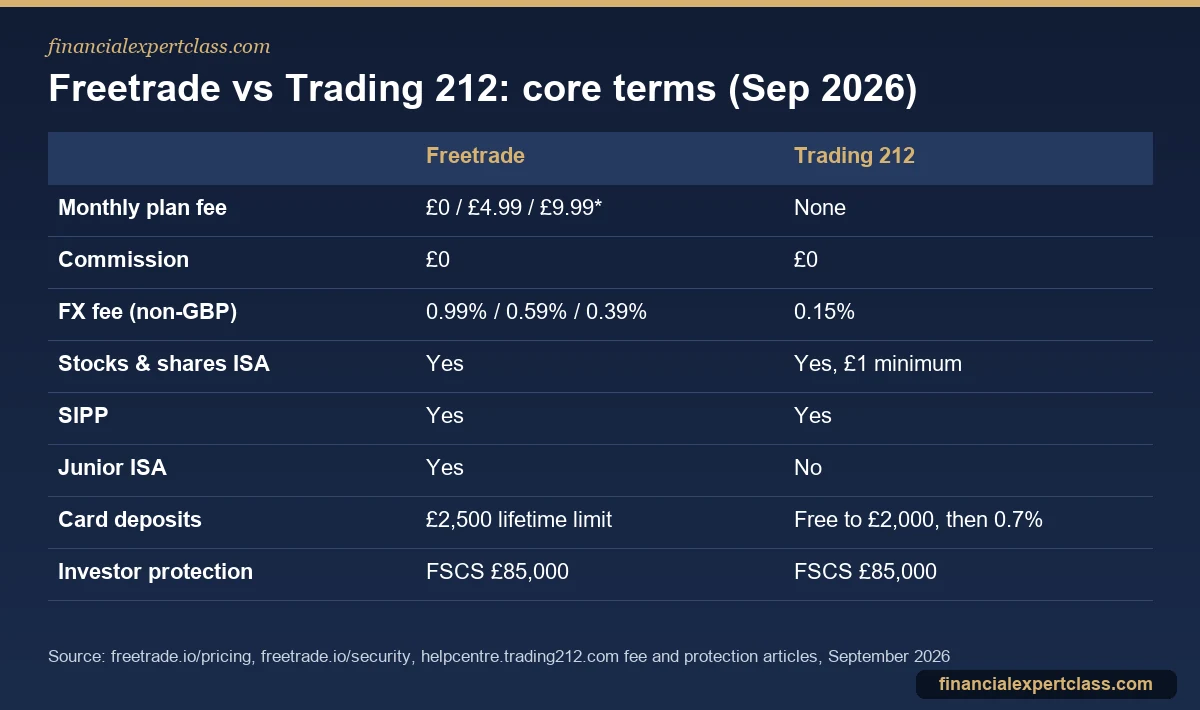
Freetrade uses subscription tiers. Basic is free. Standard costs £4.99 a month billed annually (£59.88 a year) or £5.99 monthly. Plus costs £9.99 a month billed annually (£119.88) or £11.99 monthly. Paying more buys a lower FX fee, more interest on cash and extra features. Trading 212, however, has no tiers. Its help centre states that the only fee it can charge on Invest, ISA and SIPP accounts is the 0.15% FX fee. There is no commission and no custody fee.
Fees: where the real difference is
Neither broker charges commission, so the cost that separates them is foreign exchange. An FX fee applies whenever you buy or sell an investment priced in a currency other than your account currency. Typically, that means US shares or a dollar or euro line of an ETF.

For example, on £1,000 of US shares, the FX fee would be £9.90 on Freetrade Basic and £5.90 on Standard. It would be £3.90 on Plus and £1.50 on Trading 212, and you pay it again when you sell. So if you invest regularly in US stocks on Freetrade’s free plan, those conversions quickly add up.
Here is the part many comparisons miss: if you buy UCITS ETFs through their London-listed sterling lines, there is no FX conversion at all, on either platform. A global tracker such as a FTSE All-World or MSCI World ETF usually has a GBP line on the London Stock Exchange. Buy that, and both brokers are effectively free to trade. Stamp duty does not apply to ETFs. Still, Trading 212 notes that exchange and regulatory charges can apply. One example is the PTM levy of £1.50 on UK orders over £10,000.
Other costs worth knowing:
- Deposits. Trading 212 makes card, Apple Pay and Google Pay deposits free up to £2,000 in total, then charges 0.7%. Bank transfers stay free. Freetrade’s comparison page notes that its Apple Pay and Google Pay deposits have a £2,500 lifetime limit.
- Withdrawals and inactivity. Trading 212 says it charges no withdrawal or inactivity fees. Freetrade’s plan comparison lists free same-day withdrawals as a feature, so check which plan includes it.
Our breakdown of Trading 212 fees for ETF investors goes deeper into what “commission-free” really costs.
Accounts: ISA, SIPP and Junior ISA
Both brokers offer a flexible stocks and shares ISA. That means you can withdraw money and put it back in the same tax year without using up more of your £20,000 annual allowance (2026/27). Trading 212’s minimum to open a stocks ISA is £1. Freetrade, meanwhile, says there is no minimum deposit to open an ISA or SIPP.
- SIPP. Both now offer one. Freetrade includes its SIPP in the free Basic plan. Trading 212’s SIPP gives access to stocks and ETFs and offers ready-made Pies from Vanguard, BlackRock and WisdomTree. It accepts personal contributions only, not employer contributions, and it claims basic-rate tax relief for you.
- Junior ISA. Freetrade offers a Junior stocks and shares ISA with no commission, holding or account fees. Trading 212 does not list a Junior ISA among its account types. As a result, parents who want everything on one app may lean towards Freetrade.
- Cash ISA. Trading 212 also runs a Cash ISA, which Freetrade does not. Note the rule change announced for 6 April 2027. From then, under-65s will be able to put a maximum of £12,000 a year into a Cash ISA, while the overall allowance stays at £20,000.
If you are still deciding which wrapper to fill first, our ISA vs LISA vs SIPP decision tree walks through it.
What you can buy
Freetrade lists more than 8,600 investments. They span UK, US and European shares, ETFs, investment trusts, REITs, mutual funds, gilts and UK Treasury bills. The funds, gilts and Treasury bills are the notable extras. For instance, if you want an index fund (OEIC) or a gilt alongside your ETFs inside one ISA, Freetrade can do it.
Trading 212 focuses on shares, ETFs, ETPs and ETCs, REITs and investment trusts in its ISA, and stocks and ETFs in its SIPP. It does not offer mutual funds. For a pure ETF investor that gap rarely matters, because nearly every major index is available as a UCITS ETF.
Fractional shares are available on both. Trading 212 allows fractional orders on most instruments in Invest and ISA accounts. Freetrade’s plan table, meanwhile, lists fractional investing for US shares. Trading 212 also has Pies, which let you automate regular investing across a portfolio of ETFs. See our guide to Trading 212 Pies for more. Freetrade, for its part, supports automated recurring investments and limit orders.
Interest on uninvested cash
This is a clear split in approach. Freetrade caps the balance that earns interest by plan. It pays 1% AER on up to £1,000 on Basic and 2.5% on up to £2,000 on Standard. On Plus, it pays 3.5% on up to £3,000. Above the cap, cash earns nothing.
Trading 212 pays interest on uninvested cash with no minimum or maximum balance, across Invest, ISA and SIPP accounts. It also makes the payments daily. The broker publishes the rate for new clients on its website, and the app shows your own rate. We could not access the live rate page when writing, so check it before comparing. In addition, Trading 212 can hold part of the cash in qualifying money market funds (QMMFs). It explains that these count as investments rather than bank deposits for protection purposes.
So if you keep a meaningful cash buffer in your investing account, Trading 212’s uncapped approach is likely to earn you more. Any Freetrade plan caps the balance that earns interest.
Safety and ownership
The FCA authorises and regulates Freetrade Limited (firm reference 783189), and IG Group, a FTSE 100 company, owns it. The FCA also authorises and regulates Trading 212 UK Ltd (register number 609146). Per Freetrade’s own comparison page, Trading 212 is privately owned.
Both hold client money and assets in segregated accounts under the FCA’s client asset rules, and both are FSCS members. Suppose either broker failed and your investments or cash went missing. In that case, the FSCS covers up to £85,000 per person. If a bank holding your cash fails, the cover is up to £120,000 per person, per banking group. However, the FSCS does not cover normal market falls. For more detail on Trading 212’s set-up, read is Trading 212 safe?
Which should you choose?
Choose Trading 212 if you want the lowest running cost without a subscription. It also suits you if you buy some US or euro-priced investments. In addition, pick it if you keep cash in the account and want interest on all of it, or if you like automated Pies. Our Trading 212 review covers the platform in full.
Choose Freetrade if you want a Junior ISA alongside your own ISA and SIPP. It also fits if you want mutual funds, gilts or Treasury bills in the same app, or if you value being part of a listed group. If you stick to sterling-priced ETFs, the Basic plan’s 0.99% FX fee may never touch you.
You do not have to pick only one. Many investors run their ISA on one platform and a SIPP or Junior ISA on another. GOV.UK rules let you split your £20,000 allowance across more than one ISA in the same tax year. So you could, for example, pay part into a Trading 212 ISA and part into a Freetrade ISA. If you move an existing ISA, use the formal transfer process rather than withdrawing. Otherwise you lose the tax wrapper.
Frequently asked questions
Is Freetrade or Trading 212 cheaper?
Trading 212 is usually cheaper: no subscription and a 0.15% FX fee on non-GBP trades. By contrast, Freetrade’s free Basic plan charges 0.99% FX. Its lower FX tiers cost £4.99 or £9.99 a month on annual billing. If you only buy sterling-priced ETFs, both are effectively free to trade.
Does Trading 212 have a Junior ISA?
No. Trading 212 offers a stocks and shares ISA, Cash ISA, SIPP and general investment account, but not a Junior ISA. Freetrade, however, does offer a Junior stocks and shares ISA with no commission or account fees.
Is my money safe with Freetrade and Trading 212?
Both are FCA-authorised and keep client assets segregated from their own. Also, the FSCS covers both up to £85,000 per person if the firm fails. For cash at a bank, the cover is up to £120,000 per person, per banking group. Neither protection covers investment losses from market falls.
What happens if Freetrade goes bust?
Freetrade holds your investments separately from its own assets. So you should get them back, or they should move to another provider. If anything were missing, the FSCS would cover eligible losses up to £85,000 per person. Freetrade is part of IG Group, a FTSE 100 listed company.
Which is better for a stocks and shares ISA?
For a low-cost ETF ISA, Trading 212 is hard to beat on price, and it pays interest on all uninvested cash. Freetrade, on the other hand, suits investors who want funds or gilts inside the ISA. It also suits families who want an ISA, SIPP and Junior ISA on one app.
Cited sources: Freetrade plans and pricing, Freetrade: how we protect your money, Freetrade Junior ISA, Trading 212: fees in Invest, ISAs and SIPP, Trading 212: interest on cash, Trading 212 UK: funds and assets protection, Trading 212: ISA allowance changes 2027, and GOV.UK: Individual Savings Accounts. Verify current fund figures before investing. Educational content, not financial advice.
Not personalised financial advice. Verify your situation with a qualified adviser. Operated by Aurum Digital Marketing LTD (UK), Companies House 15203665.
European UCITS/ETF investor with 11+ years building a global dividend and index portfolio, and founder of Financial Expert Class. I write every guide here from first-hand experience investing across EU brokers and tax regimes — not theory. More about me →