
The FTSE 100 dividend yield was 3.05% on 28 August 2026, according to FTSE Russell’s official index factsheet. However, that figure is a trailing yield. It takes the dividends the 100 companies declared over the previous 12 months and divides them by their free-float market value. At around the same time, two popular FTSE 100 income ETFs quoted yields of 2.99% (VUKE) and 3.06% (ISF).
Building an income portfolio? Use the free sheet.
The Dividend Portfolio Starter Sheet: plan yield, payout dates and withholding tax for a European dividend portfolio.
The FTSE 100 dividend yield right now
FTSE Russell publishes a factsheet for the FTSE 100 index every month. The edition with data as at 28 August 2026 lists a dividend yield of 3.05% for the index. It also shows 100 constituents with a combined net market capitalisation of about £2.57 trillion. In this case, net means adjusted for free float, so FTSE Russell leaves out shares locked up by governments, founders or strategic holders.
For context, the same FTSE Russell factsheets give these yields for the wider UK market on that date:
- FTSE 100 (the 100 largest companies): 3.05%
- FTSE 250 (the next 250): 3.05%
- The FTSE 350 (the two combined): 3.05%
- FTSE All-Share (530 companies in total): 3.06%
- FTSE SmallCap (180 smaller companies): 3.78%
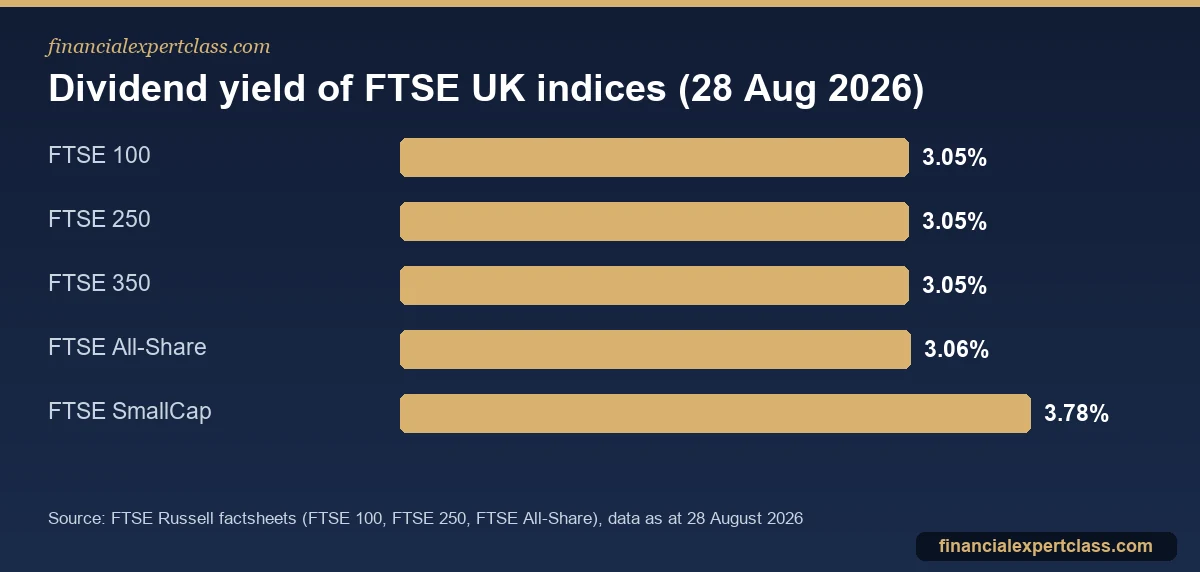
So in the summer of 2026 the blue-chip index was not paying more than the mid-caps. People still talk about the FTSE 100 as the high-income index, but that reputation depends on the moment. At these dates, in fact, the yields of the large and mid-cap indices were level. Always check the date on any yield you read. It moves every day with share prices, and it also moves every time a company declares a dividend.
How the FTSE 100 dividend yield is calculated
FTSE Russell’s guide to calculation for the FTSE UK index series sets out the method. Put simply:
- For each constituent, take the dividends it declared in the previous 12 months. Count each one from its ex-dividend (XD) date.
- Then multiply by the number of shares in issue, adjusted by the company’s free-float factor.
- Next, add those dividend amounts up across all 100 companies.
- Finally, divide by the free-float market capitalisation of the whole index and express the result as a percentage.
Two details matter. First, it uses declared dividends, not forecasts, so the published yield looks backwards. If a large company cuts or raises its payout, the index yield only reflects it once the new dividend goes ex. Second, FTSE Russell converts dividends declared in dollars or euros into sterling. It uses the WM/Reuters 16:00 closing spot rate on the day before the XD date, unless the company announces a sterling equivalent. Some large FTSE 100 companies declare their dividends in US dollars, so currency moves feed into the sterling yield.
Because market value sets the weights, the biggest companies dominate. For example, a 5% yield from a company that is 0.2% of the index barely moves the headline figure. By contrast, a small change at a company worth 10% of the index moves it noticeably.
Which companies and sectors drive the yield
A handful of companies dominate the FTSE 100. On the factsheet date, HSBC alone was 10.19% of the index, while the ten largest holdings made up 48.36%. The top five were:
| Company | ICB sector | Index weight |
|---|---|---|
| HSBC Holdings | Banks | 10.19% |
| Shell | Oil, gas and coal | 7.30% |
| AstraZeneca | Pharmaceuticals and biotechnology | 6.98% |
| Rolls-Royce Holdings | Aerospace and defence | 4.99% |
| Unilever | Personal care, drug and grocery stores | 3.91% |
Grouped by ICB supersector, the factsheet’s own market values give these biggest slices of the FTSE 100:
- banks: about 19.3%
- industrial goods and services: about 12.1%
- health care: about 11.6%
- energy: about 10.4%
- basic resources (the miners): about 8.4%
- personal care, drug and grocery stores: about 6.9%
- food, beverage and tobacco: about 6.7%
That mix goes a long way to explaining the index yield. Banks, oil majors, miners and tobacco groups have long been the heavy dividend payers in London. In contrast, companies such as Rolls-Royce or AstraZeneca carry weight for their size rather than their income. So when bank or oil profits fall, the FTSE 100 dividend pool shrinks quickly. After all, so much of it comes from a handful of sectors. If you want the income without single-company risk, a tracker fund spreads it across all 100 names.
ETFs that pay the FTSE 100 dividend yield: ISF and VUKE
You cannot buy an index, but you can buy a fund that tracks it. The London Stock Exchange lists two well-known income (distributing) ETFs. These are iShares Core FTSE 100 UCITS ETF (ticker ISF) and Vanguard FTSE 100 UCITS ETF Distributing (ticker VUKE). Both are Irish-domiciled UCITS funds, and both pay out every quarter.

Here are a few points from the providers’ own pages:
- ISF has a total expense ratio of 0.07% and holds all 100 index members. It also reported a distribution yield of 3.06% as of 22 September 2026. It launched in April 2000 and had net assets of about £16.5 billion in late September 2026.
- VUKE has an ongoing charge of 0.09% and held 102 stocks at 31 August 2026. At the close on that date, it showed a yield of 2.99%. It launched in May 2012, had total assets of about £4.7 billion and has UK reporting fund status.
However, the fund yields will never match the index yield exactly. Each provider measures on a different date, the fund deducts its charges, and each uses its own yield definition. So treat a gap of a few basis points as noise, not as a reason to pick one fund over the other.
What the quarterly payments look like
Vanguard lists every VUKE distribution. For instance, the four most recent were £0.2297 per share (ex-dividend 18 December 2025) and £0.362 (19 March 2026). They were followed by £0.4532 (18 June 2026) and £0.3968 (17 September 2026). The pattern is uneven. In this run the June payment was the biggest and the December payment the smallest, because of when the underlying companies go ex-dividend. If you need a steady monthly income, plan around that lumpiness or hold cash to smooth it out.
If you do not need the income, an accumulating share class reinvests dividends inside the fund. Our guide to accumulating vs distributing ETFs for UK investors also explains the tax paperwork each one creates outside an ISA.
How UK tax affects what you actually keep
The headline yield is before tax. As a result, what you keep depends on where you hold the fund:
- In a stocks and shares ISA or a SIPP, dividends are tax-free. So for most UK investors chasing FTSE 100 income, this is the obvious home. Our overview of ISAs, LISAs and SIPPs for UCITS ETF investors covers the allowances.
- In a general investment account, GOV.UK says you get a £500 dividend allowance each year. Above that, the rates for 6 April 2026 to 5 April 2027 are as follows. Basic-rate taxpayers pay 10.75%, higher-rate taxpayers 35.75% and additional-rate taxpayers 39.35%.
As a rough illustration of scale only: at a 3% yield, £500 of dividends corresponds to about £16,700 invested. Above that, outside a tax wrapper, the extra dividends start to face tax. Investors outside the UK should check their own country’s rules; our ETF tax guide by country is a starting point.
Is a 3% FTSE 100 yield good?
That depends on what you compare it with and what you need. Here are some honest points to weigh:
- Yield is not total return. A high yield can simply mean share prices have fallen. Over time, what matters is dividends plus price growth, minus costs.
- Dividends are not guaranteed. Companies can cut them. Also, in a concentrated index a few cuts in banks or energy would show up in the index figure.
- The UK is one market. A FTSE 100 fund gives you around 100 companies in one country. So many investors hold it as an income sleeve next to a global fund rather than on its own. Our list of dividend ETFs available to European investors shows the global alternatives.
- Currency comes built in. Many FTSE 100 companies are global businesses that earn much of their revenue outside the UK. As a result, the index is less of a pure bet on the UK economy than its name suggests.
To see what a given yield would pay on your own numbers, try the dividend investing calculator. It lets you vary the amount and the yield, and choose whether to reinvest dividends.
Where to check the latest figure
For the official index number, use the FTSE 100 factsheet on the LSEG FTSE Russell website. FTSE Russell updates it monthly, with a clear “data as at” date. For the fund yields, use the iShares and Vanguard product pages, since they show the date of each yield. Third-party sites often show a different figure because they use forecast dividends or a different date. That is not wrong, just a different measure, so compare like with like.
Frequently asked questions
What is the FTSE 100 dividend yield today?
At the time of writing, the latest official figure is 3.05%. It comes from FTSE Russell’s FTSE 100 factsheet, with data as at 28 August 2026. The yield changes daily with share prices and dividend announcements, so check the current factsheet for an up-to-date number.
Is the FTSE 100 dividend yield paid to me directly?
Only if you own the shares or a distributing fund. For example, a distributing FTSE 100 ETF such as ISF or VUKE collects the dividends. It then pays them out quarterly after its charges. An accumulating fund reinvests them for you instead.
Why is the ETF yield different from the index yield?
Providers measure fund yields on different dates, the fund’s charges reduce them, and each provider follows its own definition. Even so, in September 2026 ISF quoted 3.06% and VUKE 2.99%, both close to the index figure of 3.05%.
Which UK stocks pay the most in FTSE 100 dividends?
By contribution to the index, the heavyweights matter most. For example, HSBC was over 10% of the index in August 2026. In addition, banks, energy, mining and tobacco sectors make up a large share of the index. Individual yields change constantly, so check a company’s own investor relations page for its latest declared dividend.
Do I pay tax on FTSE 100 dividends?
Not inside an ISA or SIPP. Outside them, UK residents have a £500 dividend allowance, according to GOV.UK. Above that, they pay 10.75%, 35.75% or 39.35% depending on their tax band for 2026/27.
Cited sources: FTSE Russell: FTSE 100 index factsheet (data as at 28 Aug 2026), FTSE Russell: FTSE UK Index Series guide to calculation, iShares Core FTSE 100 UCITS ETF (ISF), Vanguard FTSE 100 UCITS ETF (VUKE), and GOV.UK: Tax on dividends. Verify current fund figures before investing. Educational content, not financial advice.
Not personalised financial advice. Verify your situation with a qualified adviser. Operated by Aurum Digital Marketing LTD (UK), Companies House 15203665.
European UCITS/ETF investor with 11+ years building a global dividend and index portfolio, and founder of Financial Expert Class. I write every guide here from first-hand experience investing across EU brokers and tax regimes — not theory. More about me →