
The FTSE MIB is the main benchmark of the Italian stock market. It tracks the 40 most liquid and highly capitalised shares listed on Borsa Italiana. As a result, it covers roughly 80% of Italy’s domestic market value. It leans heavily towards banks, which were 42% of the index at 31 August 2026. It also pays a relatively high dividend yield.
New to ETFs? Start with the free checklist.
- The European ETF Starter Kit — 12 pages: your first fund, a safe low-cost broker and the 7 costliest beginner mistakes
- + 2 bonus PDFs: Comparison Workbook and Dividend Starter Sheet
- + a free lesson from the €147 Masterclass
What the FTSE MIB is
FTSE Russell, part of the London Stock Exchange Group, calculates the index. Its official factsheet calls it the primary benchmark for Italian equities. It is also the large-cap part of the broader FTSE Italia All-Share Index. The name pairs FTSE with MIB, the label Borsa Italiana’s Milan index family has long carried. In fact, Borsa Italiana’s own glossary notes that the index’s base links to the older MIB 30 index. FTSE Russell’s factsheet dates the current index launch to the second quarter of 2009.
Think of it as Italy’s equivalent of the FTSE 100 in the UK or the DAX in Germany. In other words, it is a compact list of the country’s biggest listed companies. Markets use it as the reference point for futures, options, index funds and ETFs.
How the index is built
The factsheet and ground rules set out a small number of construction rules:
- Universe: shares listed on Borsa Italiana’s main markets, now called Euronext Milan and Euronext MIV Milan. Foreign shares are eligible, but secondary share lines are not.
- Size and liquidity: the 40 most liquid and capitalised stocks, screened so that the index is tradable.
- Free-float weighting: each company counts only for the shares that investors can genuinely buy. So blocks held by governments or founding families do not count.
- 15% cap: the ground rules cap constituents at 15% at the time of each quarterly review to avoid over-concentration. Between reviews, however, a strong performer can drift above that level.
- Quarterly reviews: in March, June, September and December, overseen by the FTSE Italia Index Series Technical Committee.
The index also tries to reflect the broad sector weights of the Italian market. That matters, because banks, utilities and energy companies dominate Italy’s listed market.
Sector mix: a bank-heavy index
At 31 August 2026 the FTSE Russell factsheet showed banks at 42.06% of the index across seven constituents. Utilities were the next biggest block at 12.89%, followed by energy at 9.15%. By contrast, technology was a single company, STMicroelectronics, at 3.68%.
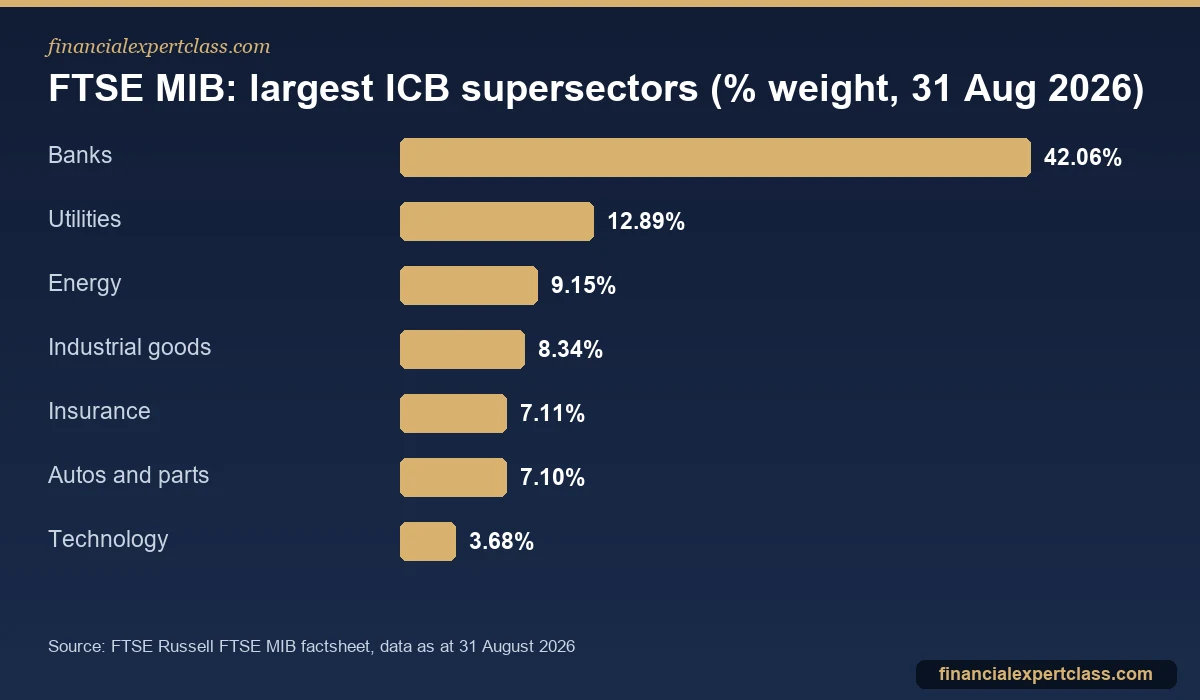
This profile is very different from a global index. In the MSCI World, technology companies dominate. In Italy’s benchmark, however, the economic cycle, interest rates and bank margins drive much of the result. When rates rise, Italian bank earnings typically benefit. But when credit fears return, the index can fall sharply. The factsheet records a maximum drawdown of 41.5% over its ten-year window. That is a reminder that a single-country index can swing hard.
The biggest FTSE MIB companies
The top ten constituents made up 71.83% of the index at 31 August 2026. According to the factsheet they were:
- UniCredit (banks) 16.85%
- Intesa Sanpaolo (banks) 13.85%
- Enel (electricity) 9.50%
- Eni (oil and gas) 5.75%
- Ferrari (automobiles) 5.70%
- Generali (insurance) 5.69%
- Prysmian (electrical equipment) 4.62%
- STMicroelectronics (technology hardware) 3.68%
- Banco BPM (banks) 3.17%
- Banca Monte dei Paschi di Siena (banks) 3.04%
UniCredit’s 16.85% weight shows how the 15% cap works in practice. The cap applies only at rebalances. So a stock that rallies between reviews can sit above it for a while. The total free-float market value of the index was about €746 billion. On that measure, the largest company was worth roughly €126 billion and the smallest about €0.85 billion.
How volatile is the FTSE MIB?
A concentrated, bank-heavy index moves a lot. For example, FTSE Russell’s factsheet (data to 31 August 2026) shows calendar-year capital returns, which exclude dividends. The worst years were a fall of 16.1% in 2018 and 13.3% in 2022. In contrast, the best were gains of 28.3% in 2019, 28.0% in 2023 and 31.5% in 2025. Over the five years to 31 August 2026 the capital return was 102.3%, or 15.1% a year. Annualised volatility was 15.7%.
Those numbers cut both ways. Strong recent years sit alongside the deep ten-year drawdown noted above. Past performance is not a guide to the future. Also, a single-country index can spend long stretches going nowhere. Because these are capital returns, a fund that reinvests dividends would have done better than the figures shown.
Dividends
Italy’s big banks, utilities and energy groups pay generous dividends, and it shows. The factsheet gave a dividend yield of 3.77% for the index at 31 August 2026. Similarly, iShares reported a 12-month trailing distribution yield of 3.66% for its distributing ETF as of 22 September 2026. Yields move with prices and payouts, so treat these as snapshots rather than promises.
Italian companies typically deduct withholding tax on dividends paid to foreign holders. How much you can reclaim depends on your country of residence. It also depends on how the tax interacts with an ETF domiciled in Ireland or France. Our guide to accumulating vs distributing ETFs explains the trade-offs between taking the income and reinvesting it.
ETFs that track the FTSE MIB
You cannot buy an index directly. Instead, several UCITS ETFs track it:
- iShares FTSE MIB UCITS ETF EUR (Dist), ISIN IE00B1XNH568, ticker IMIB. The fund is Irish-domiciled and physically replicated, with a 0.35% total expense ratio, semi-annual distributions and 40 holdings. It trades on Borsa Italiana in euros and on the London Stock Exchange in sterling. It also trades on the Berne exchange in Swiss francs. In addition, iShares lists it as ISA and SIPP eligible with UK reporting fund status.
- The iShares (Acc) share class, ISIN IE00B53L4X51, Borsa Italiana code CSMIB. It is accumulating, and Borsa Italiana shows total annual fees of 0.33%.
- Amundi’s Dist and Acc versions: ISIN FR0010010827 (code ETFMIB) and ISIN FR0014002H76 (code MIBA). These are the former Lyxor funds, now French-domiciled Amundi products. So check the current key information document for the ongoing charge.

Where should you buy these? Our guide to LSE, Xetra or Borsa Italiana explains how the listing venue affects currency and trading costs.
Should the FTSE MIB be a core holding?
For most investors, no. Italy is one country, and the index is concentrated both by company and by sector. Besides, a world index gives you Italy’s large caps anyway, at a small weight, alongside thousands of other companies. So it works better as a satellite. For instance, you might use it to tilt towards European banks and high-dividend value stocks. Or you might use it to express a view on Italy specifically.
Italian residents face their own tax rules on ETFs and foreign accounts. Our best ETFs for Italian investors guide covers the local angle. If you do add a single-country fund, keep it small enough that a 40% drawdown would not derail your plan. Then rebalance back to your target weight once a year rather than chasing recent returns.
Frequently asked questions
What does FTSE MIB stand for?
FTSE refers to FTSE Russell, the index provider that calculates it. MIB is the name of the Milan stock exchange’s index family, which this benchmark succeeded. In fact, its base links to the older MIB 30. Together they name the benchmark of Borsa Italiana’s 40 leading shares.
How many companies are in the FTSE MIB?
Forty. The index holds the 40 most liquid and highly capitalised shares listed on Borsa Italiana. Also, it is reviewed every quarter in March, June, September and December.
Which companies are the largest in the FTSE MIB?
At 31 August 2026 the biggest were UniCredit, Intesa Sanpaolo, Enel, Eni, Ferrari and Generali. Overall, the top ten made up about 72% of the index.
Can UK investors hold a FTSE MIB ETF in an ISA?
iShares lists its FTSE MIB UCITS ETF EUR (Dist) as ISA and SIPP eligible with UK reporting fund status, and it also trades in sterling on the London Stock Exchange. However, whether a particular platform offers it is up to that platform.
Cited sources: FTSE Russell: FTSE MIB factsheet (31 Aug 2026), FTSE MIB Index ground rules (v5.3, Aug 2026), Borsa Italiana glossary: FTSE MIB, iShares FTSE MIB UCITS ETF (Dist), Borsa Italiana: iShares FTSE MIB (Acc), and Borsa Italiana: Amundi FTSE MIB Dist. Verify current fund figures before investing. Educational content, not financial advice.
Not personalised financial advice. Verify your situation with a qualified adviser. Operated by Aurum Digital Marketing LTD (UK), Companies House 15203665.
European UCITS/ETF investor with 11+ years building a global dividend and index portfolio, and founder of Financial Expert Class. I write every guide here from first-hand experience investing across EU brokers and tax regimes — not theory. More about me →