
The HSBC FTSE All-World Index Fund C Acc is a UK-domiciled index fund. It tracks the FTSE All-World Index of large and mid-sized companies in developed and emerging markets. It has an ongoing charge of 0.13% a year. At 31 August 2026, it held 3,433 stocks and had £7.76 billion in assets. As a result, it is one of the cheapest global funds for UK investors.
Comparing options? Take the decision workbook with you.
The ETF Comparison Workbook: TER, domicile, withholding tax and overlap checks in one printable spreadsheet.
Key facts
All figures come from HSBC Asset Management’s factsheet for the Acc C share class, data as at 31 August 2026:
- ISIN: GB00BMJJJF91 (SEDOL BMJJJF9)
- Ongoing charge (OCF): 0.130% a year
- Index: FTSE All-World Index
- Structure: a sub-fund of HSBC Index Tracker Investment Funds, a UK OEIC authorised by the FCA; UCITS-compliant; ISA-eligible
- Income: accumulating (dividends reinvested)
- Dealing: daily, valued at 12:00 UK time
- Fund size: £7.76 billion
- Share class launch: 29 September 2014
The factsheet lists a £1,000,000 minimum initial investment for the C class. However, it adds that minimums vary across distributors. In practice, retail platforms normally offer the C class with small minimums. For example, Fidelity’s factsheet page shows it available in an ISA, SIPP and investment account.
What the fund owns
The FTSE All-World Index covers large and mid-cap companies across developed and emerging markets. Our explainer on the FTSE All-World Index shows how FTSE Russell builds it. Rather than buying every stock, HSBC uses a representative sample. So the fund held 3,433 stocks at the end of August 2026, against 4,225 in the index. Sampling keeps trading costs down while aiming to match the index’s overall characteristics.
Despite the “all-world” name, the United States dominates the fund:
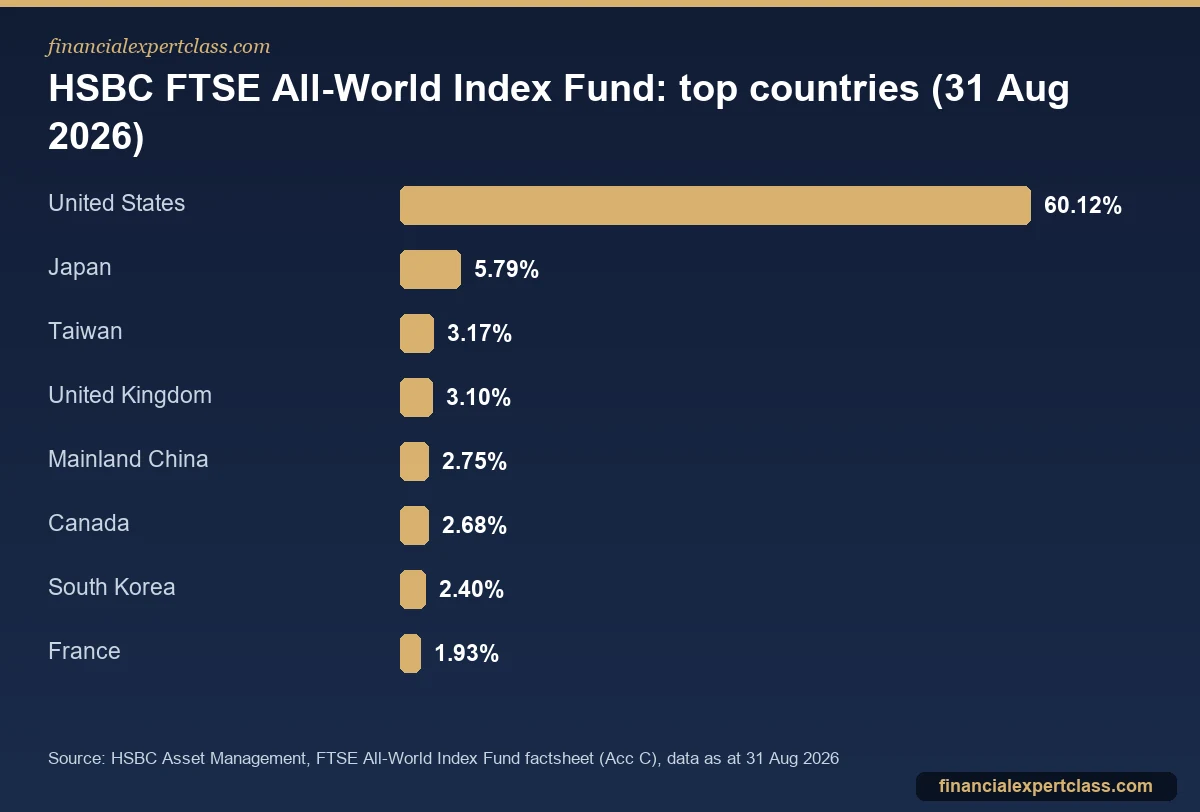
By sector, technology was 33.06%, financials 14.97%, industrials 12.06%, consumer discretionary 10.94% and health care 7.66%. Meanwhile, the ten largest holdings together make up just over 24% of the fund. They were NVIDIA (4.63%), Apple (4.12%), Microsoft (3.39%), Alphabet (3.24%) and Amazon (2.29%). Next came Taiwan Semiconductor (1.68%), Broadcom (1.57%), Meta Platforms (1.14%), Micron Technology (0.99%) and Tesla (0.97%).
This is simply what the global market looks like when you weight it by company value. So if you want a portfolio with less US or technology exposure, you need to add other funds on purpose.
How well does it track?
The OCF is only part of the cost. What matters is how closely the fund follows its index after all costs, known as the tracking difference. HSBC’s factsheet reports annualised tracking differences for the Acc C class against the FTSE All-World Index. These were -0.32% over five years and -0.39% over ten years to 31 August 2026. Those gaps are wider than the 0.13% OCF alone. That is because they reflect the fund’s charges over the whole period and withholding tax on dividends. They also reflect the effects of sampling and cash flows, among other factors. Our guide to tracking difference explains how to read these numbers. Past performance, including tracking, does not predict future results.
Share classes: C Acc, C Inc and S Acc
HSBC sells the same fund in several share classes. That answers the common question “what is a class C fund?”. A share class is simply a version of the fund with its own charges, minimum investment and income treatment. HSBC’s factsheets (31 August 2026) show:
- Acc C (GB00BMJJJF91): accumulating, OCF 0.130%, the class most platforms offer to retail investors.
- Inc C (GB00BMJJJG09): pays income once a year (last ex-date 18 May 2026), OCF 0.140%. It has a trailing dividend yield of 1.26%.
- Acc S (GB00BF0GWY02): OCF 0.120% but a £10,000,000 listed minimum, so it typically suits larger or institutional investors.
Inside an ISA or SIPP, pick Acc if you want dividends reinvested automatically. Instead, pick Inc if you want them paid out.
HSBC All-World vs VWRP vs Vanguard FTSE Global All Cap
These are the three global trackers UK investors compare most often:

- Vanguard FTSE All-World UCITS ETF (VWRP) tracks the same index. It is an Irish-domiciled ETF with an OCF of 0.14%. At the end of August 2026 it held 3,784 stocks and about US$85 billion in total fund assets. It trades on the London Stock Exchange during market hours (VWRP in pounds, VWRA in dollars). So it suits brokers that only offer ETFs or that cap fees on exchange-traded holdings. Our page on the Vanguard FTSE All-World UCITS ETF covers it in detail.
- Vanguard FTSE Global All Cap Index Fund is a UK OEIC that tracks a broader index including small companies. It held 7,495 stocks at 31 August 2026 and charges 0.23%. The extra small caps add diversification, but at a higher ongoing charge.
On fund charges alone, the HSBC fund is the cheapest of the three. However, the real decision usually depends on your platform. Some platforms charge a percentage fee on funds but a flat or capped fee on ETFs. In that case, VWRP can be cheaper overall on a larger pot. Other platforms charge the same percentage on everything, or offer free regular investing into funds. There, the HSBC fund’s lower OCF gives it the edge. See our comparison of the cheapest all-world ETFs and our guide to global ETFs for UK investors for more options.
How to buy it
Because it is an OEIC rather than an ETF, you buy the fund through a fund platform, not on a stock exchange. Search the platform for the ISIN GB00BMJJJF91 (Acc C) or GB00BMJJJG09 (Inc C). That way you pick the right share class, since older or institutional classes can show up under similar names. HSBC prices the fund once a day at its 12:00 UK valuation point. Platforms set their own order cut-off ahead of that. If you place an order after the cut-off, it deals at the next valuation. There is no bid-ask spread, and many platforms let you set up a monthly direct debit into the fund. Also check what your platform charges on top of the 0.13% OCF, as that platform fee is often the larger cost.
Who the HSBC FTSE All-World Index Fund suits
It suits UK investors who want a single, low-cost, globally diversified equity holding in a fund structure. You buy it in pounds, it prices once a day, there is no bid-ask spread, and it is easy to drip-feed monthly. However, it is a pure equity fund. On its own, it takes the full force of stock market falls. So investors who want less volatility typically add bonds or cash alongside it.
It is less suitable if you want small-company exposure; in that case, consider a global all-cap fund instead. Similarly, it suits you less if your broker only offers ETFs.
Frequently asked questions
What is HSBC FTSE All-World Index C Acc?
It is the accumulating C share class of HSBC’s FTSE All-World Index Fund. This is a UK-domiciled OEIC that tracks the FTSE All-World Index. According to HSBC’s factsheet dated 31 August 2026, it charges an OCF of 0.13%, reinvests dividends and is ISA-eligible.
Is the HSBC FTSE All-World Index a good fund?
It is one of the lowest-cost ways for UK investors to own global shares in a single fund. It has a 0.13% OCF and £7.76 billion in assets. Whether it suits you depends on your platform’s charges. It also depends on whether you are comfortable with a portfolio that is about 60% US shares.
Which is better, Vanguard FTSE Global All Cap or HSBC FTSE All-World?
The HSBC fund is cheaper (0.13% vs 0.23%) but excludes small companies. By contrast, Vanguard’s Global All Cap fund covers more of the market with 7,495 holdings. Over long periods the two tend to behave similarly because large companies dominate both. If cost is your priority, HSBC wins; if you want the broadest coverage, Vanguard’s fund does.
What is a class C index fund?
“C” is the name HSBC gives to one share class of the fund. Share classes hold the same investments but differ in charges, minimums and income treatment. For this fund, retail platforms widely offer the C class, with a 0.13% OCF for the accumulating version.
Cited sources: HSBC FTSE All-World Index Fund Acc C factsheet, 31 Aug 2026, HSBC FTSE All-World Index Fund Inc C factsheet, HSBC FTSE All-World Index Fund Acc S factsheet, Vanguard FTSE All-World UCITS ETF (Acc), Vanguard FTSE Global All Cap Index Fund, and Fidelity: HSBC FTSE All-World Index C Acc. Verify current fund figures before investing. Educational content, not financial advice.
Not personalised financial advice. Verify your situation with a qualified adviser. Operated by Aurum Digital Marketing LTD (UK), Companies House 15203665.
European UCITS/ETF investor with 11+ years building a global dividend and index portfolio, and founder of Financial Expert Class. I write every guide here from first-hand experience investing across EU brokers and tax regimes — not theory. More about me →