
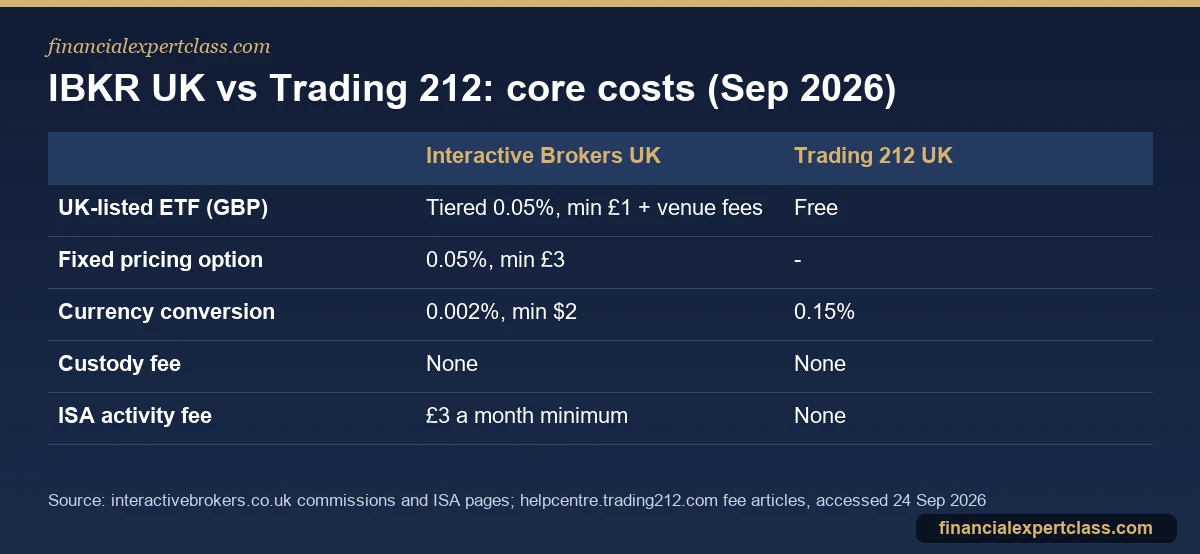
In the Interactive Brokers vs Trading 212 choice, Trading 212 is cheaper for most small and medium ETF purchases. It charges no commission. By contrast, Interactive Brokers UK charges 0.05% of the trade with a £1 minimum on its Tiered plan (£3 on Fixed). However, Interactive Brokers wins on currency conversion, at 0.002% with a $2 minimum against Trading 212’s 0.15%. It also wins on market access. Both are FCA-regulated with FSCS cover.
Comparing options? Take the decision workbook with you.
- The ETF Comparison Workbook — 10 pages: the 7-filter framework for choosing between two good funds
- + 2 bonus PDFs: ETF Starter Kit and Dividend Starter Sheet
- + a free lesson from the €147 Masterclass
Interactive Brokers vs Trading 212 in one paragraph
Trading 212 aims for simplicity. It offers commission-free investing in a mobile app, with Pies for automatic monthly investing, an ISA, a SIPP and a Cash ISA. Interactive Brokers (IBKR), on the other hand, aims for breadth. It gives access to around 170 markets in 40 countries, very cheap currency conversion and professional tools. In exchange, you pay small commissions and face a steeper learning curve. So the right choice depends on how much you invest per trade, which currencies you use and which accounts you need. All figures here are for the UK entities of both firms, taken from their websites in September 2026.
Commission on ETFs
Trading 212 says in its help centre that trading commission and custody are free in Invest, ISA and SIPP accounts. It adds that the only fee it can charge there is the FX fee.
Interactive Brokers UK offers two pricing plans for UK-listed shares and ETFs quoted in pounds:
- Tiered: 0.05% of trade value for monthly volume up to £40 million, with a minimum of £1.00 per order. IBKR also adds exchange and clearing fees on top.
- Fixed (IB SmartRouting): 0.05% of trade value with a minimum of £3.00 per order, and this price includes third-party fees.
For euro-denominated European shares and ETFs, the Tiered minimum is €1.25 and the Fixed minimum €3.00. IBKR’s ISA page also sums up the simplified Fixed pricing as “£3 / €3 per trade for Western European stocks”.
For example, the gap is largest for people who invest small amounts often. Buying £200 of an ETF every month costs nothing at Trading 212. At IBKR, though, it costs at least £1 a month on the Tiered plan, which is 0.5% of each purchase. At £20,000 per trade the IBKR commission is about £10, still small in percentage terms. Our full breakdown of Interactive Brokers fees covers other markets.

Currency conversion
This is where IBKR is dramatically cheaper. For most clients, its spot currency commission is 0.20 basis points of trade value, which is 0.002%. There is also a minimum of USD 2.00 per conversion. By contrast, Trading 212 converts at the spot rate plus 0.15%, including inside Pies (it does not charge FX on dividends).
So on a $10,000 conversion you pay $2 at IBKR against $15 at Trading 212. If you mainly buy sterling-listed ETFs, you never convert, and this does not matter. But if you buy US-dollar or euro lines, or move large sums between currencies, IBKR’s pricing adds up to real savings. See our comparison of broker currency conversion fees for more platforms.
ISA, SIPP and other accounts
- Stocks and Shares ISA. Both offer one. IBKR says there is no minimum deposit, and you must fund the ISA in pounds. It is also cash-only (no margin), you get two free withdrawals a month, and there is a minimum monthly activity fee of £3 for an adult ISA. Trading 212’s ISA, by contrast, has no account fee and is flexible. That means you can withdraw and replace money in the same tax year without using extra allowance.
- Junior ISA. IBKR offers one, with a £1 minimum monthly activity fee.
- SIPP. Trading 212 runs its own SIPP and claims basic-rate tax relief for you. IBKR, however, provides trading for SIPPs through third-party SIPP administrators. These act as the pension trustee and charge their own fees.
- Cash ISA. Trading 212 offers one, while IBKR’s ISA page lists only the Stocks and Shares ISA and Junior ISA.
For an overview of the wrappers themselves, see our guide to ISAs, LISAs and SIPPs for ETF investors.
The IBKR ISA’s £3 minimum monthly activity fee matters most for small, inactive accounts. For instance, on a £3,000 ISA it equals 1.2% a year if you never trade. Trading 212 has no such charge. On the other hand, IBKR says there are no custody fees on any account type. There is also no fee to transfer an account in from another broker. As a result, a larger ISA that trades regularly can be cheap to run.
Interest on uninvested cash
IBKR’s UK interest page covers clients with a net asset value over USD 100,000. At the time of writing, they earn 3.161% a year on GBP balances above £8,000 (and 3.38% on USD above $10,000). But the first £8,000 earns nothing, and smaller accounts receive a lower rate. So a typical small account earns little. Trading 212, meanwhile, pays daily interest on uninvested cash with no minimum balance. It holds that cash in banks and qualifying money market funds, and it shows its current rates for new clients on its terms page and in the app. For a small account with cash waiting to be invested, Trading 212 is likely to pay more, because IBKR pays nothing on the first £8,000. Still, check both rates on the day.
ETF range and platform
Trading 212 offers a large range of UCITS ETFs and shares through a simple app. It also offers fractional shares and Pies, which let you invest a set monthly amount across a chosen mix of funds automatically. You can read how it works in practice in our Trading 212 review.
IBKR offers stocks, ETFs, bonds, options, futures and funds across around 170 markets, plus fractional shares. It also has several platforms, from a simple mobile app to the professional Trader Workstation. That breadth is the reason many experienced investors move to it, but the interface is busier. Our Interactive Brokers review covers the set-up.
Safety and regulation
- Interactive Brokers (U.K.) Limited has FCA authorisation and regulation (reference number 208159). IBKR’s ISA page says that if IBUK became insolvent, the FSCS would cover eligible shortfalls up to £85,000 per client.
- Trading 212 UK Ltd also has FCA authorisation and regulation (reference number 609146). It keeps client money in segregated accounts at banks including J.P. Morgan and Barclays. It also holds assets with custodians including BNY Mellon and Interactive Brokers. In addition, the FSCS covers it for up to £85,000 of investments and cash combined.
Neither scheme protects against market losses. Also, different entities with different compensation schemes serve EU residents, so check which entity you would join before comparing.
Which one should you use?
- Trading 212 suits beginners and regular savers who buy sterling-listed ETFs in small amounts. It also suits those who want an ISA, SIPP and Cash ISA in one app and value automatic investing through Pies.
- Interactive Brokers suits larger portfolios and investors who convert currency often or buy US-dollar and euro ETFs. It is also for anyone who wants markets, bonds or account types Trading 212 does not offer.
- Using both is common, with Trading 212 for a monthly ISA habit and IBKR for larger or more complex holdings in a general account.
Frequently asked questions
Is Interactive Brokers cheaper than Trading 212?
For ETF purchases, usually not, because Trading 212 charges no commission while IBKR UK charges 0.05% with a £1 minimum on Tiered pricing. For currency conversion, however, IBKR is far cheaper, at 0.002% with a $2 minimum against Trading 212’s 0.15%.
Does Interactive Brokers have an ISA?
Yes. IBKR UK offers a Stocks and Shares ISA and a Junior ISA. There is no minimum deposit. But there is a minimum monthly activity fee of £3 for the adult ISA, according to its ISA page in September 2026.
Can I transfer from Trading 212 to Interactive Brokers?
Yes. IBKR says it charges no fee to transfer an account in from another broker. Also, ISAs should always move by formal transfer. Our guide to transferring ETFs out of Trading 212 covers the steps.
Is my money safe with Interactive Brokers and Trading 212?
Both UK entities are FCA-regulated and in the FSCS. It covers eligible losses up to £85,000 if the firm fails. However, neither protects you from investments falling in value.
Cited sources: Interactive Brokers UK: stock and ETF commissions (Europe), Interactive Brokers UK: spot currency commissions, Interactive Brokers UK: ISA accounts, Interactive Brokers UK: interest rates, Interactive Brokers UK: SIPP accounts, Trading 212: fees in Invest, ISAs and SIPP, and Trading 212 UK: funds and assets protection. Verify current fund figures before investing. Educational content, not financial advice.
Not personalised financial advice. Verify your situation with a qualified adviser. Operated by Aurum Digital Marketing LTD (UK), Companies House 15203665.
European UCITS/ETF investor with 11+ years building a global dividend and index portfolio, and founder of Financial Expert Class. I write every guide here from first-hand experience investing across EU brokers and tax regimes — not theory. More about me →