
This InvestEngine review starts with the headline: it is a UK platform that only offers ETFs. For do-it-yourself investors, it is also one of the cheapest options available. There is no platform fee, no dealing commission and no withdrawal fee on ISAs, SIPPs and general accounts. However, there are trade-offs. It trades once a day, pays no interest on uninvested cash, and offers no Lifetime, Junior or Cash ISA.
Comparing options? Take the decision workbook with you.
- The ETF Comparison Workbook — 10 pages: the 7-filter framework for choosing between two good funds
- + 2 bonus PDFs: ETF Starter Kit and Dividend Starter Sheet
- + a free lesson from the €147 Masterclass
InvestEngine review: what the platform is
InvestEngine is an FCA-authorised investment platform (firm reference number 801128) built around exchange-traded funds. So you cannot buy individual shares, bonds or investment trusts there, only ETFs. In September 2026, its site listed 878 ETFs from providers such as Vanguard, iShares, Invesco, Xtrackers, Amundi, HSBC, SPDR and J.P. Morgan.
You can use it in two ways:
- DIY portfolios: you choose the ETFs and their weightings, and InvestEngine buys them for you. This is the free service.
- Managed and LifePlan portfolios: InvestEngine’s team runs these ready-made portfolios for a management fee. At the time of writing, however, its help centre says new clients cannot open them while it makes updates.
InvestEngine fees
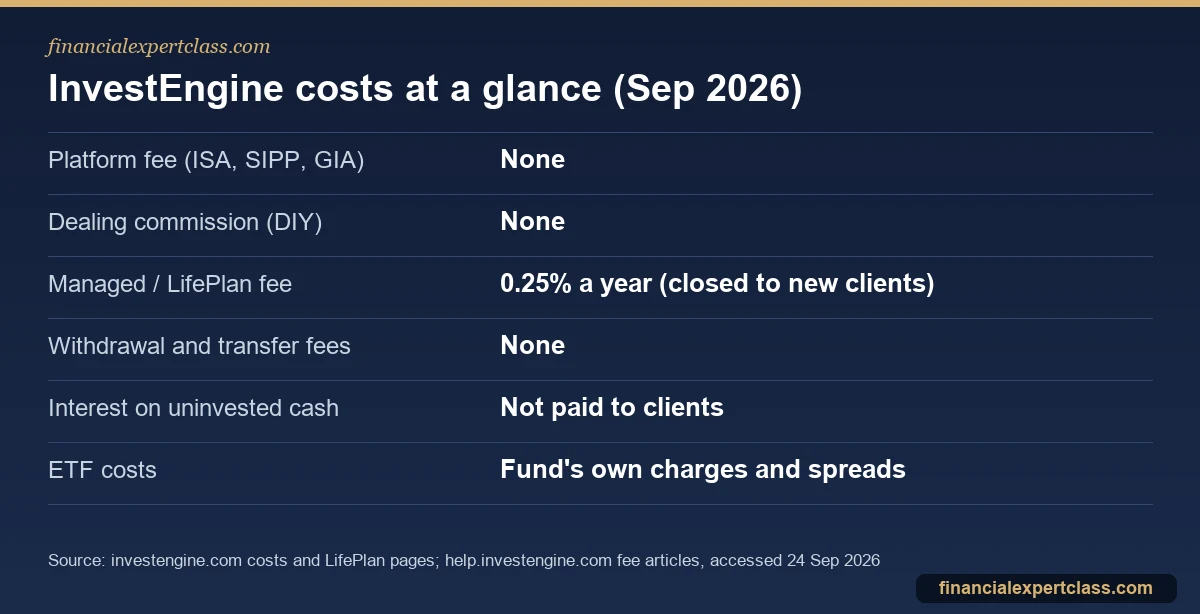
InvestEngine’s help centre says it does not charge for opening, closing or running an account. It also charges no withdrawal or transfer fees. DIY portfolios have no management fee and no dealing commission. In addition, its cost comparison table lists currency conversion as free.
For Managed and LifePlan portfolios, the fees article and the LifePlan page give an annual management fee of 0.25% (about £2.50 per £1,000). InvestEngine works it out daily and takes it monthly in arrears. Its fee help article, updated in September 2026, says the same 0.25% applies whichever account holds the portfolio: ISA, General Account, SIPP or Business Account. However, the ISA landing page and one older ISA help article still show 0.45%. The costs page, the Managed and LifePlan pages and the newer fee articles all give 0.25%, so I treat 0.25% as the current rate. Both services are paused for new clients for now, so check the live costs page if they reopen.
What you always pay is the cost of the ETFs themselves. That means each fund’s ongoing charge and the bid-offer spread when you buy or sell. For a DIY portfolio, the total cost is therefore essentially the fund cost, which you can see on each ETF’s page before buying. Our ETF fee calculator shows how that compares over time with platforms that charge a percentage fee.
How InvestEngine makes money
InvestEngine is open about this. It earns interest on uninvested cash in client accounts and does not pass that interest on to clients. It also receives fees from some ETF issuers for joint marketing activities, although it says these do not influence product placement. The practical lesson is to keep cash invested rather than sitting idle in the account, because it earns you nothing there.
Accounts: ISA and SIPP, but no LISA

- Stocks and Shares ISA: this is a flexible ISA, so you can withdraw and replace money within the same tax year without affecting your £20,000 allowance. ISA transfers in are free, though your old provider may charge exit fees.
- SIPP: this is for UK residents aged 18 to 75, with no account fee and tax relief added to contributions. InvestEngine also says it now accepts pension transfers from most major providers.
- General and business accounts: these suit money beyond your ISA allowance or company cash.
- Not offered: InvestEngine’s help centre states plainly that it does not offer Cash ISAs, Lifetime ISAs or Junior ISAs.
If you want a Lifetime ISA for a first home, you will need another provider for that part. Our guide to ISAs, LISAs and SIPPs explains how the allowances fit together.
Transfers in are straightforward. InvestEngine does not charge for ISA transfers, and it says it handles the process for you. However, it warns that your old provider may charge exit fees. Your old provider may also need to sell your holdings before sending cash, which can leave you out of the market for a while. Because InvestEngine only holds ETFs, any funds or shares you own elsewhere will usually arrive as cash to reinvest. There is no minimum transfer value, although the £100 portfolio minimum still applies once the money arrives.
How trading works: once a day
InvestEngine does not trade in real time. According to its help centre, orders placed before 2pm UK time on a working day go into that day’s trading cycle. That cycle runs after 2:30pm, once US markets have opened. Later orders, by contrast, go into the next working day. You can cancel only before 2pm on the day.
This batching is how it offers fractional investing and free dealing. For long-term investors it rarely matters, but it does mean you cannot pick an exact price. If you want to trade during the day, a broker such as Trading 212 is a better fit, so see our Trading 212 review.
Minimums are low. You need £100 to open a portfolio, and then £1 per ETF order in DIY portfolios thanks to fractional investing. Recurring top-ups or AutoInvest start at £10. For a SIPP, regular contributions start at £20 a week or £50 a month. Also, Savings Plans and AutoInvest can invest new money automatically according to your chosen weightings.
Withdrawals
InvestEngine says a withdrawal from an invested portfolio typically takes three to four working days. First, it sells the ETFs in the next daily cycle. Then the trade takes two working days to settle. Finally, the bank transfer usually takes one to two more working days. For uninvested cash, InvestEngine usually processes withdrawals within one working day. Money only goes to your nominated UK bank account, and there is no withdrawal fee.
Is InvestEngine safe?
InvestEngine says it keeps client money in pooled client bank accounts. It holds investments in a pooled client account at CREST, which Euroclear UK and Ireland operates. These sit in the name of InvestEngine Nominees Limited, separate from the firm’s own assets. InvestEngine is also a member of the Financial Services Compensation Scheme, which protects eligible clients up to £85,000 if the firm fails. As with any platform, though, that protection does not cover falls in the value of your investments.
InvestEngine pros and cons
Pros
- No platform fee or dealing commission on DIY ETF portfolios, including in the ISA and SIPP.
- A large ETF range for a curated platform, with fractional investing from £1.
- Automation through Savings Plans and AutoInvest, plus a look-through of what your portfolio holds.
Cons
- ETFs only: no individual shares or investment trusts.
- Trades once a day, with a 2pm cut-off.
- No interest on uninvested cash.
- No Lifetime, Junior or Cash ISA, and managed portfolios closed to new clients at the time of writing.
Who InvestEngine suits: our review verdict
I would consider InvestEngine if you want a simple, low-cost home for a long-term ETF portfolio in an ISA or SIPP. It also fits if you invest a fixed amount each month and do not need real-time trading. For example, a one- or two-fund portfolio built from a global tracker is a natural fit. Our list of global ETFs for UK investors is a good place to find candidates. But if you also want shares, a Lifetime ISA or interest on cash, compare this InvestEngine review with the options in our guide to the best brokers for UK investors.
Frequently asked questions
How safe is InvestEngine?
The FCA authorises and regulates InvestEngine (FRN 801128). It is also a member of the FSCS, which protects eligible clients up to £85,000 if it fails. InvestEngine holds investments at CREST in the name of InvestEngine Nominees Limited, separate from the company’s own assets.
Which is better, Trading 212 or InvestEngine?
Both charge no commission on ETFs. InvestEngine is ETF-only and trades once a day, while Trading 212 offers shares too, real-time trading, a Cash ISA and interest on uninvested cash. So for a hands-off monthly ETF portfolio either works, but for flexibility Trading 212 offers more.
Does InvestEngine offer a Lifetime ISA?
No. Its help centre says it does not currently offer Lifetime ISAs, Junior ISAs or Cash ISAs. Instead, it offers a Stocks and Shares ISA, a SIPP, a general account and a business account.
How do I get my money out of InvestEngine?
Request a withdrawal in the app or on the website. InvestEngine then sells invested money in the next daily trading cycle, and it settles in two working days. The cash typically reaches your nominated UK bank account three to four working days after the request. There is no withdrawal fee.
Cited sources: InvestEngine: how fees are deducted, InvestEngine: costs page, InvestEngine: which ISAs are offered, InvestEngine: minimum and maximum investment, InvestEngine: when orders are executed, InvestEngine: withdrawal timelines, InvestEngine: safe and secure, and InvestEngine: ETF range. Verify current fund figures before investing. Educational content, not financial advice.
Not personalised financial advice. Verify your situation with a qualified adviser. Operated by Aurum Digital Marketing LTD (UK), Companies House 15203665.
European UCITS/ETF investor with 11+ years building a global dividend and index portfolio, and founder of Financial Expert Class. I write every guide here from first-hand experience investing across EU brokers and tax regimes — not theory. More about me →