
Risk warning: when you invest, your capital is at risk. The value of investments can go down as well as up, and you may get back less than you put in. Terms apply. Nothing here is personal investment advice.
This Lightyear review matters to me personally: Lightyear is an Estonian-founded broker, born in my own Baltic region, and over the past few years it has grown into a genuinely credible low-cost option for European ETF investors. Founded by ex-Wise (TransferWise) employees, it carries the same clean, low-fee, mobile-first philosophy across from money transfers into investing. For 2026, this is an honest, hands-on look at whether Lightyear deserves a place on your broker shortlist — including exactly how to open an account, how to use a promo code, and how to place your first ETF order, with screenshots of the platform along the way. (Lightyear’s product and fees change — always verify current terms in-app.)
As a Lithuanian investor who has been buying ETFs for eleven years, I’m openly rooting for a Baltic-founded broker to succeed. But rooting for it doesn’t mean overlooking the trade-offs — and the worst thing a reviewer can do is let regional pride blur the numbers. So here’s the view I’d give a friend: warm about the things Lightyear genuinely gets right, and frank about where a broader platform might still serve you better.
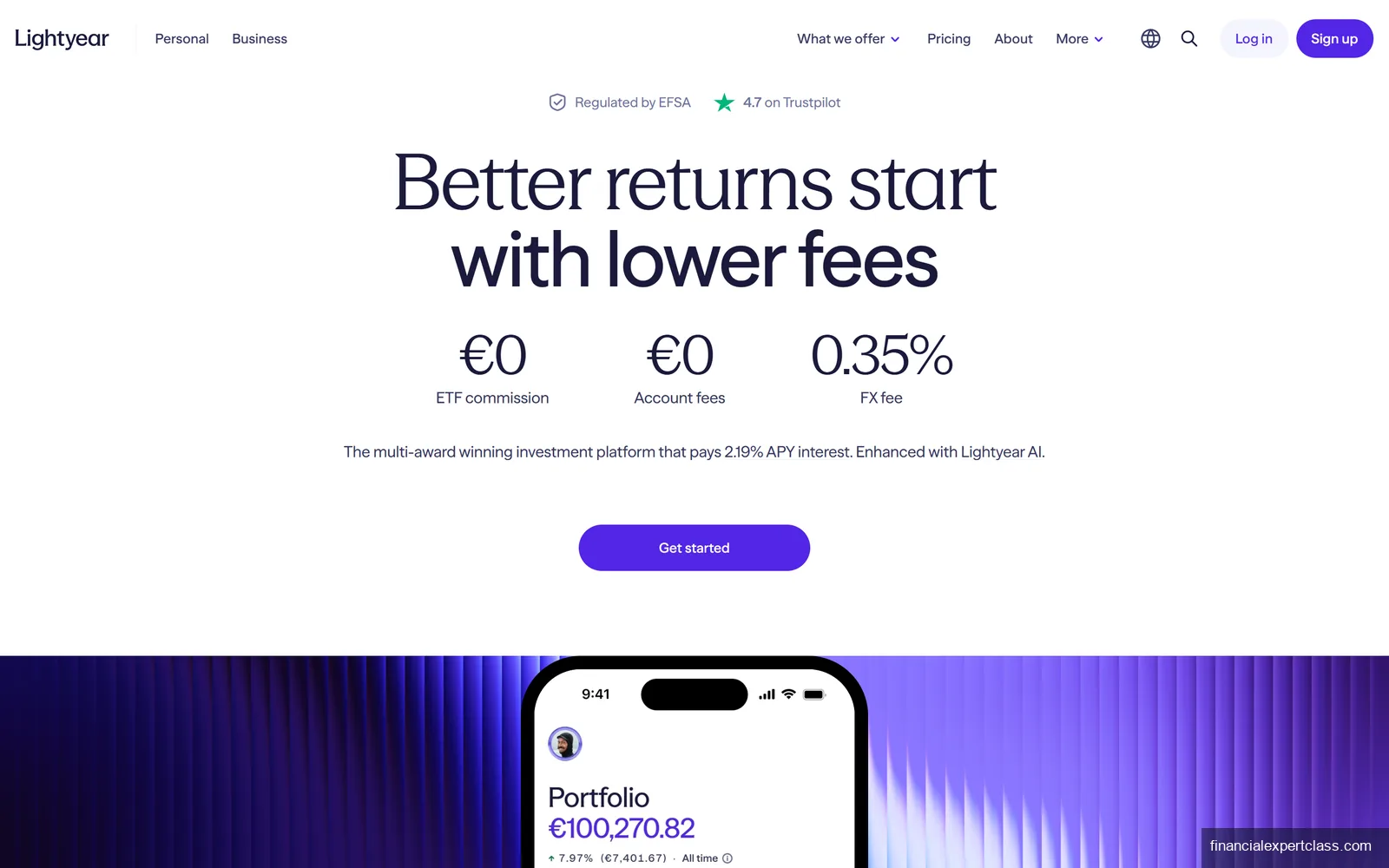
What Lightyear offers in 2026
Lightyear’s pitch is simple and, refreshingly, mostly accurate: a low-cost, transparent, app-first home for your ETFs and shares. As of July 2026, the headline numbers on Lightyear’s own site are hard to argue with — but verify them in-app, because terms change:
How we rate: see the how we rate brokers behind every broker score on this site.
- €0 commission on ETFs — no execution or custody fees on the UCITS ETF range (the fund’s own TER still applies, as everywhere).
- €0 account fees — no charge for simply holding your money and investments.
- 0.35% currency conversion — a flat, visible FX fee, with free multi-currency balances in EUR, USD and GBP so you convert once, not on every trade.
- Interest on uninvested cash — around 2% APY on euro balances at the time of writing (rate varies), plus money-market Vaults for parked cash.
- 6,000+ instruments — stocks, a growing UCITS ETF selection, and money market funds; fractional investing supported.
- Regulated in the EU — Lightyear Europe AS is authorised by Estonia’s Financial Supervision Authority (EFSA), with a 4.7 rating on Trustpilot at the time of writing.

For a low-cost, app-first experience, Lightyear is a strong contender. If you’re still weighing several platforms against one another, my guide to choosing the right ETF broker sets out the full vetting framework I use before committing capital anywhere.
How to open a Lightyear account (step by step)
Opening an account took me minutes, and the flow is the same on the website and in the iOS/Android app. Here is exactly what to expect:
- Create your login. Go to lightyear.com (or download the app), tap Get started, and enter your email plus a password of at least 8 characters with a letter and a number.
- Confirm your email and phone. You’ll receive a verification code — standard stuff.
- Enter a promo code if you have one. During onboarding you’ll be asked whether you have a code — this is the moment to use it (more on this in the next section).
- Verify your identity. Have your ID card or passport ready; you’ll photograph it and take a quick selfie. As an EU-regulated broker, Lightyear runs full KYC. Approval typically comes quickly — mine was same-day.
- Answer the investor questionnaire. A few questions about your experience and goals — an EU regulatory requirement, not marketing.
- Fund the account. SEPA bank transfer for euros (free), with USD and GBP balances available too. Small amounts are fine to start — there’s no minimum that matters in practice.
That’s it: from download to funded account is realistically one coffee, plus however long your bank takes to send the SEPA transfer.
How to use a Lightyear promo code
Lightyear runs promo codes that reward new customers — typically with a bonus added to your account once you meet the conditions. The mechanics are simple, but the timing rules matter, so read them once before you start:
We are finalising a dedicated Financial Expert Class promo code for Lightyear readers — it will appear here shortly. The steps and conditions below are how Lightyear’s codes work, so you know exactly what to expect.
- Enter the code during sign-up. Codes are for new users — you’ll be prompted for one during onboarding. Codes generally must be used within 15 days of creating the account, and only one promotional code can ever be claimed per person.
- Complete onboarding within 15 days of entering the code (the ID verification step above).
- Deposit at least €100 into your personal account within 15 days of code entry.
- Receive the reward. Once conditions are met, Lightyear typically adds a bonus — for current promotions this is a random value between €10 and €100 — to your account within 10 working days.
Promotion terms are Lightyear’s, can change, and standard fees apply — always read the current conditions in-app before relying on them. When you invest, your capital is at risk.
How to buy your first ETF or stock on Lightyear
This is where Lightyear’s app-first design shows. The buying flow is one of the cleanest I’ve used — here’s the exact process:
- Search for your instrument. Tap the search icon and type the ticker or name — for example VUAA (Vanguard S&P 500 UCITS, accumulating) or VWCE. Check the ISIN on the instrument page to be sure you have the right fund and share class.
- Open the instrument page. You’ll see the chart, key stats, and — a nice touch — analyst context and company/fund information in plain language.
- Tap Buy and choose your order. For long-term ETF investing a simple market order during exchange hours is fine; limit orders are there if you want to name your price. Fractional investing means you can invest a fixed euro amount — say €100 — rather than buying whole shares.
- Check the cost line before confirming. ETF orders carry no Lightyear commission; if you’re buying a USD-priced instrument from euros, you’ll see the 0.35% conversion applied — or convert once into your USD balance first and trade from that.
- Confirm, and you’re an investor. The position appears in your portfolio immediately, with average cost and performance tracked for you.
To automate it: Lightyear supports recurring investments, so you can set a fixed amount to buy your chosen ETF on schedule — the same discipline I recommend on every platform. Set it, forget it, and let the fund you chose carefully do the work.
Lightyear fees in detail
The fee page is refreshingly short — Lightyear lists what you pay for and what’s free, and the free column is long:
- ETFs: free. No execution or custody fees — the fund manager’s TER is the only ongoing cost, and that’s true at every broker.
- Shares: small flat commissions (roughly the €1/£1/$1 order of magnitude depending on market — check the live pricing page for your exchange).
- FX: 0.35% per conversion — and because you can hold EUR, USD and GBP balances, you can convert once and avoid repeat conversion on every trade.
- Deposits and withdrawals: free by bank transfer.
- Crypto: 0.45% per order, if that’s your thing — it isn’t mine.
Run your own numbers against the alternatives with the EU broker fee comparator — a platform that’s cheap for a monthly €500 ETF buy can look different for large lump sums or frequent share trading. For context on how much FX fees matter across brokers, see my currency-conversion cost comparison.
Interest on cash and Vaults
Uninvested cash is where many brokers quietly earn at your expense. Lightyear pays interest on uninvested euro balances (around 2% APY at the time of writing — the rate tracks market conditions), and offers Vaults — money market funds for cash you want earning while it waits, at fund-level risk rather than deposit-guarantee protection. It’s a genuinely useful feature for the “parking money between decisions” problem I wrote about in where to park cash short-term.
Is Lightyear safe? Regulation and asset protection
The question I’m asked most. The structural answer is reassuring, with the usual caveats:
- Regulation: Lightyear Europe AS is an investment firm authorised and supervised by the Estonian Financial Supervision Authority (EFSA) — a full EU regulator. (UK customers are served by a separate FCA-registered entity.)
- Asset segregation: your stocks and ETFs are held separately from Lightyear’s own assets with custodians, so they remain your property if the company itself ever failed — the same principle I explain in what happens if your broker goes bankrupt.
- Investor compensation: the Estonian investor protection scheme covers eligible claims up to €20,000 — the standard EU-scheme backstop for the rare fraud/shortfall scenario, not for market losses.
- What protection does not cover: investment risk. Your ETFs can fall in value — no regulator insures that, at Lightyear or anywhere.
Moving an existing portfolio to Lightyear
If you already hold ETFs elsewhere, Lightyear supports portfolio transfers — moving your existing positions across rather than selling and rebuying (which can trigger a taxable event). The process starts from the app, and the practical rules are the same as any in-specie transfer: whole shares move, fractions usually have to be sold, and timelines run days to weeks depending on the sending broker.
The Baltic and EU traction angle
There’s a regional dimension to Lightyear that I don’t think gets enough credit. Most low-cost brokers a Baltic investor reaches for are German or pan-European; Lightyear is one of the few built with the Baltic and broader European saver in mind from day one. That shows up in small but meaningful ways — multi-currency handling that suits people who earn in euros but want USD exposure, and an onboarding flow that doesn’t assume you live in a Tier-1 financial capital. For tax and residency specifics that matter in this region, my best broker for Lithuanian investors guide is the companion piece to read alongside this review.
Lightyear strengths and watch-points at a glance
The table below is my summary of where Lightyear shines and where you should keep your eyes open. Treat the right-hand column as a checklist, not a verdict — and always confirm the live detail in-app.
| Area | Strength | Watch-point |
|---|---|---|
| Fees | €0 ETF commission, €0 account fee, transparent 0.35% FX | Share orders carry small commissions — check your market’s rate |
| FX | Multi-currency EUR/USD/GBP balances; convert once, not per trade | 0.35% still matters on large sums — IBKR is cheaper for big conversions |
| ETF range | Growing UCITS selection plus money market funds and fractional buys | May not match IBKR’s breadth — verify your core fund is listed |
| App | Clean, mobile-first, beginner-friendly; recurring investments supported | Advanced order types are thinner than on pro platforms |
| Regulation | EFSA-authorised (EU); segregated custody; €20k Estonian scheme | Compensation covers shortfall events, never market losses |
| Cash | Interest on uninvested EUR; Vaults for parked cash | Vaults are funds, not deposits — fund risk, no deposit guarantee |
A worked example
Let me make the fee story concrete with a simple, illustrative scenario — figures are for explanation only, so check the live numbers in-app before you act. Suppose you invest €500 a month into a single accumulating world-equity UCITS ETF, and you’ve been doing so on a platform that quietly applies a 0.5% FX spread because the fund is USD-denominated. On a €500 buy, that hidden spread costs you roughly €2.50 every month — about €30 a year — money you never see itemised on a statement.
Fee figures in this guide are cross-checked against our broker fee data table, reviewed quarterly.
On Lightyear, the same situation looks different in two ways: if you buy a EUR-listed UCITS ETF, there’s no conversion at all and no commission; if you buy a USD-priced instrument, the 0.35% conversion is visible on the order screen, and you can cut it further by converting one larger amount into your USD balance and trading from that. The lesson isn’t that Lightyear is automatically cheapest for every profile; it’s that the transparency lets you actually see and compare the number. Run your own contribution, FX exposure and trading frequency through the EU broker fee comparator and the answer for your situation falls out quickly.
How I’d use Lightyear
If I were opening a Lightyear account today, I wouldn’t treat it as an all-or-nothing decision. I’d start by confirming my one core holding — a broad accumulating world tracker — is available, because if my anchor fund isn’t there, nothing else matters. Then I’d fund a modest amount and run a single real buy, watching the FX line closely so I know exactly what I’m paying rather than trusting the marketing.
For the multi-currency angle, I’d lean on Lightyear precisely where it’s strongest: holding a euro balance, earning interest on the idle part, and converting cleanly when I buy USD-priced instruments. And I’d download a tax statement early in the relationship, not in a panic the following spring. That’s the pattern: prove the core, exploit the FX and cash strengths, and verify the paperwork before it’s urgent.
Who Lightyear suits — and when to consider alternatives
- Good for: Baltic and EU investors who want a low-cost, clean, app-first broker with €0 ETF commissions, transparent FX and interest on idle cash — especially beginners who value a platform that doesn’t bury costs.
- Consider alternatives if: you need the widest possible UCITS range or advanced order types — IBKR remains the breadth leader. If your priority is sheer cost-and-breadth on a simple savings-plan setup, a large pan-European alternative such as Trade Republic is worth comparing head-to-head on the fee comparator before you decide.
For another app-first option in the same mould, my Revolut Investing ETF review covers a close competitor, and the European ETF brokers hub places all of these on the same map so you can see how Lightyear stacks up against the wider field.
Key takeaways
- Lightyear is a credible low-cost, app-first broker — Estonian-founded by ex-Wise people, EFSA-regulated, with €0 ETF commissions and a transparent 0.35% FX fee.
- Opening an account takes minutes: email, ID verification, questionnaire, SEPA deposit — promo codes are entered during onboarding.
- Buying an ETF is a four-tap flow with fractional amounts and recurring investments; the cost line is visible before you confirm.
- Idle euro cash earns interest, and Vaults offer money-market yield — with fund risk, not deposit protection.
- Its UCITS range is growing but may not match IBKR’s breadth — confirm your core fund is listed first, and always check live terms in-app. Capital at risk.
FAQ
Q: Is Lightyear a good broker for ETFs?
A: Yes — it’s a credible low-cost, app-first option with €0 ETF commissions, transparent fees (built by ex-Wise people) and a growing UCITS range. It’s especially strong for Baltic and EU investors who value clean pricing and good multi-currency handling. As always, capital is at risk when you invest.
Q: How do I open a Lightyear account?
A: Sign up with email and password at lightyear.com or in the app, verify your identity with an ID document and selfie, answer the investor questionnaire, and fund by SEPA transfer. The whole flow typically takes minutes, plus your bank’s transfer time.
Q: How does a Lightyear promo code work?
A: Promo codes are for new users and are entered during onboarding. Typical terms: complete onboarding within 15 days of code entry and deposit at least €100 within 15 days, then the reward — currently a random €10–€100 — is added to your account within 10 working days. Only one code can be claimed per person; terms can change, so read the in-app conditions.
Q: Who founded Lightyear?
A: Lightyear was founded by former Wise (TransferWise) employees in Estonia, bringing the same low-fee, transparent, mobile-first philosophy from money transfers to investing.
Q: How do Lightyear’s fees compare?
A: ETF trading is commission-free, accounts are free, FX conversion is a flat 0.35%, and deposits/withdrawals are free. Share orders carry small commissions. Compare total cost for your usage against alternatives with the fee comparator.
Q: Does Lightyear have enough ETFs?
A: Its UCITS range is growing but may not match IBKR’s breadth. Confirm your preferred core fund is available before committing.
Q: Is Lightyear safe?
A: Lightyear Europe AS is authorised by Estonia’s EFSA, client assets are held segregated from the company’s own, and the Estonian investor protection scheme covers eligible claims up to €20,000. That protects against broker failure — not against your investments falling in value.
Q: How does Lightyear handle multiple currencies?
A: It offers free multi-currency balances in EUR, USD and GBP with a 0.35% conversion fee — genuinely useful when you earn in euros but buy USD-priced instruments. Convert once into a currency balance and trade from it to avoid repeat conversions.
Q: Is Lightyear good for beginners?
A: Yes — the clean app, fractional investing, recurring orders and transparent pricing make it one of the friendlier on-ramps. Confirm your intended core fund is available and download a tax statement early so filing season is painless.
Q: How does Lightyear compare to Revolut or Trade Republic?
A: Revolut is another app-first option with a smaller investing menu; Trade Republic competes hard on cost and breadth for savings-plan investors. The right choice depends on your fund needs and usage — run all three through the fee comparator before deciding.
Q: Does Lightyear support tax reporting in my country?
A: Support varies by country, so check what year-end reports Lightyear provides for your jurisdiction before committing — brokers differ widely in the documentation they supply.
Q: Should I use Lightyear instead of IBKR?
A: For a low-cost, beginner-friendly, app-first experience, Lightyear is excellent. If you need the widest possible UCITS range or advanced order types, IBKR still leads on breadth — many investors keep one of each.
The bottom line
For 2026: Lightyear is a genuinely credible low-cost, app-first broker — Estonian-founded by ex-Wise people, EFSA-regulated, with €0 ETF commissions, transparent 0.35% FX, interest on idle cash and a clean buying flow that makes first-time investing unintimidating. It’s an excellent fit for Baltic and EU investors who want clean pricing without hidden spreads. Before committing, confirm your preferred core fund is available, check the tax-reporting support for your country, and read the live terms in-app. If you need the absolute widest UCITS range, IBKR still leads on breadth. Compare the options with the broker fee comparison tool, see the best Lithuanian broker guide for the regional picture, and the Revolut Investing review for another app-first option.
Risk warning: when you invest, your capital is at risk. Investments can fall as well as rise, past performance does not guarantee future results, and you may get back less than you invest. Interest rates and promotional terms change. Terms and conditions apply — see lightyear.com for current details.
Cited sources: lightyear.com (product, pricing and help pages, screenshots July 2026), Estonian Financial Supervision Authority (EFSA), and ESMA investor protection. Lightyear’s terms change — verify in-app before acting. Educational content, not financial advice.
Before you open any account
grab the free 12-page Starter Kit: the 7-filter fund shortcut, the 3-question broker safety matrix, and the 7 mistakes that cost beginners the most.
Related reading: the best investing apps for European beginners.
European UCITS/ETF investor with 11+ years building a global dividend and index portfolio, and founder of Financial Expert Class. I write every guide here from first-hand experience investing across EU brokers and tax regimes — not theory. More about me →