
S&P 500 index funds track the 500 large US companies in the S&P 500. UK investors can buy one as a UK-domiciled fund (an OEIC) or as an Irish-domiciled UCITS ETF. Costs are now very close. At the time of writing (September 2026), the main OEICs charge 0.06% to 0.09% a year and the biggest ETFs 0.07%. So your platform’s fees usually matter more than the fund’s.
Comparing options? Take the decision workbook with you.
The ETF Comparison Workbook: TER, domicile, withholding tax and overlap checks in one printable spreadsheet.
S&P 500 index funds or ETFs: what is the difference?
Both types hold the same companies. What differs is how you buy and sell them.
- An index fund (OEIC or unit trust) sells you units directly at its next valuation price. HSBC’s American Index Fund, for example, values its units once a day at 12:00 UK time. You can invest round pound amounts, and regular monthly investing is usually free on fund platforms.
- An ETF (exchange-traded fund) trades on a stock exchange like a share, at live prices throughout the trading day. You pay a small bid-ask spread, which is the gap between buying and selling price. Depending on the broker, you may also pay a dealing charge. However, many apps now offer fractional ETF shares. That removes the old problem of needing enough cash for one whole unit.
Say you are a long-term investor drip-feeding money into a Stocks and Shares ISA. In that case neither structure is better in itself. Instead, the choice usually comes down to which platform you use. Some charge a percentage fee on funds but cap the fee on ETFs and shares. Others only list exchange-traded products. We cover the trade-offs in more depth in index funds vs ETFs.
The main S&P 500 trackers available in the UK
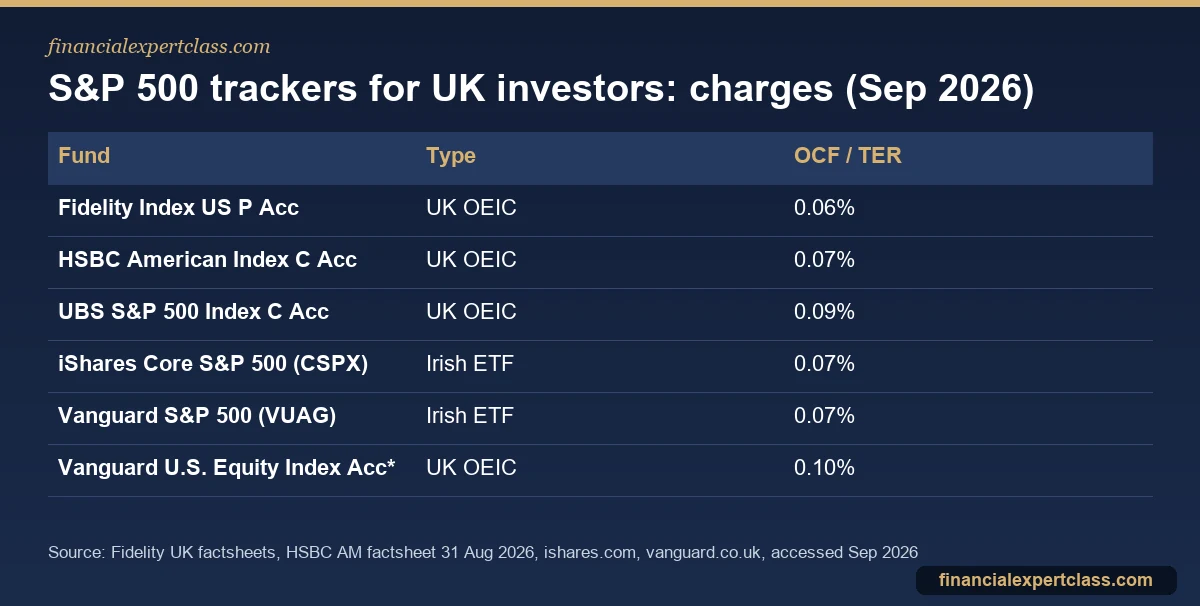
These are the most widely held options. We took the ongoing charges (OCF, or TER for ETFs) from each provider’s own factsheet or fund page in September 2026:
Fidelity Index US Fund (P Accumulation)
This UK OEIC tracks the S&P 500, with an OCF of 0.06%. According to Fidelity’s factsheet, it holds about £11.07 billion. Its listed benchmark is the S&P 500 net total return index (net of 15% withholding tax, in US dollars). On paper, it is the cheapest of the group.
HSBC American Index Fund (C Accumulation)
This is the largest of the UK S&P 500 funds, at £21.66 billion as of 31 August 2026. HSBC’s factsheet gives an OCF of 0.070% and confirms ISA eligibility. It also shows full replication of the index: 506 holdings ex cash against 500 index constituents. The factsheet lists a £1,000,000 minimum for the C share class. However, it notes that minimums vary across distributors. In practice, on retail platforms you can typically invest much smaller sums.
UBS S&P 500 Index Fund (C Accumulation)
This is a smaller UK OEIC, with about £1.99 billion and an OCF of 0.09%. Per Fidelity’s factsheet data, it tracks the S&P 500 net return index in pounds.
iShares Core S&P 500 UCITS ETF (CSPX)
The biggest S&P 500 ETF sold in Europe, with net assets of about US$158.5 billion as of 23 September 2026. It is Irish-domiciled, accumulating, ISA-eligible and has a TER of 0.07%. It trades in US dollars on the London Stock Exchange under CSPX. Our CSPX review covers it in detail.
Vanguard S&P 500 UCITS ETF (VUAG / VUSA)
Vanguard’s ETF charges 0.07% and holds all 504 stocks in the index (as of 31 August 2026). VUAG is the accumulating pound-traded line, VUSA the distributing one that pays dividends quarterly. See VUSA vs CSPX for a head-to-head.
A common mix-up: Vanguard U.S. Equity Index Fund
Search for “Vanguard S&P 500 index fund” and you will often land on the Vanguard U.S. Equity Index Fund. However, its GBP Acc share class is not an S&P 500 tracker. Vanguard’s own page lists its benchmark as the S&P Total Market Index. The fund held 3,447 stocks as of 31 August 2026, against about 500 in an S&P 500 fund. It charges 0.10%.
That is not a bad thing. The extra holdings are mid and small US companies, which make up a small slice of the total market by value. As a result, the two funds tend to move closely together. But if your goal is specifically the S&P 500, choose Vanguard’s S&P 500 UCITS ETF (VUAG/VUSA) instead of the U.S. Equity Index Fund.
What you actually own
Every S&P 500 tracker holds the same companies in the same market-value weights. So the portfolio is identical whichever provider you choose. That also means the same concentration. In HSBC’s fund, the ten largest holdings made up 38.49% of the portfolio at the end of August 2026. Information technology alone was 37.13%.

This is worth knowing before you make the S&P 500 your whole portfolio. It is a bet on large US companies, priced in dollars, with a heavy technology tilt. Many UK investors therefore use it as a core holding alongside a global or UK fund. To see how that choice compares, read S&P 500 vs an all-world portfolio. For index background, see our S&P 500 guide.
How to choose between them
With fund charges this close, a gap of 0.01% to 0.03% a year is small next to your other costs. Focus on these, in order:
- Platform fee. A 0.25% or 0.45% platform charge on funds dwarfs the gap between a 0.06% and a 0.09% OCF. If your platform caps fees on ETFs and shares but not funds, the ETF can be much cheaper on a large pot.
- Dealing costs. Regular investing into OEICs is often free. By contrast, ETF trades can carry a commission and always carry a spread. Commission-free brokers remove most of the dealing cost for ETFs.
- Currency. All of these funds hold dollar assets, so you carry US dollar risk whichever you buy. A GBP-priced fund or ETF line avoids a conversion fee on the trade. But it does not hedge the currency.
- Tracking quality. The OCF is not the whole cost. So compare how closely each fund followed its index over several years. Our explainer on tracking difference shows how to read it.
- Accumulating or income. Most platforms offer both. Inside an ISA the tax result is the same, so pick based on whether you want the dividends paid out.
US-domiciled ETFs such as VOO and SPY are generally not available to UK retail investors. That is because they do not provide the key information document UK rules require. We explain that in why UK investors can’t buy VOO or SPY. The UCITS ETFs and OEICs above are the practical route.
Tax wrappers
According to their providers, all of the funds listed are ISA-eligible. Inside a Stocks and Shares ISA you pay no UK tax on dividends or gains. Outside an ISA, note that accumulating funds still generate taxable income each year, even though you receive no cash. If you invest more than your ISA allowance, a SIPP (self-invested personal pension) offers similar shelter with different access rules.
Frequently asked questions
Which S&P 500 fund is best in the UK?
There is no single best one, because they hold the same companies. On charges alone, all four of these are very cheap as of September 2026: Fidelity Index US (0.06%), HSBC American Index (0.07%), iShares CSPX (0.07%) and Vanguard VUAG (0.07%). Pick the one that is cheapest to hold on your platform after platform and dealing fees.
Can I invest in the S&P 500 index in the UK?
Not in the index directly, but you can buy a fund that tracks it. For example, UK investors can use a UK-domiciled index fund such as HSBC American Index or Fidelity Index US. Alternatively, they can use an Irish-domiciled UCITS ETF such as CSPX or VUAG, including inside a Stocks and Shares ISA.
Does Vanguard have an S&P 500 index fund in the UK?
Vanguard offers the S&P 500 UCITS ETF (VUAG accumulating, VUSA distributing) at 0.07%. Its U.S. Equity Index Fund is a different product that tracks the broader S&P Total Market Index, with around 3,400 holdings.
Is the S&P 500 good for beginners?
It is simple, cheap and diversified across 500 large companies, which suits many beginners. However, it is US-only, priced in dollars and heavily weighted to a handful of technology giants. So some beginners prefer a global fund as their core holding.
Cited sources: HSBC American Index Fund factsheet, 31 Aug 2026, Fidelity Index US Fund P Acc, UBS S&P 500 Index Fund C Acc (Fidelity factsheet), iShares Core S&P 500 UCITS ETF, Vanguard S&P 500 UCITS ETF (Acc), and Vanguard U.S. Equity Index Fund GBP Acc. Verify current fund figures before investing. Educational content, not financial advice.
Not personalised financial advice. Verify your situation with a qualified adviser. Operated by Aurum Digital Marketing LTD (UK), Companies House 15203665.
European UCITS/ETF investor with 11+ years building a global dividend and index portfolio, and founder of Financial Expert Class. I write every guide here from first-hand experience investing across EU brokers and tax regimes — not theory. More about me →