
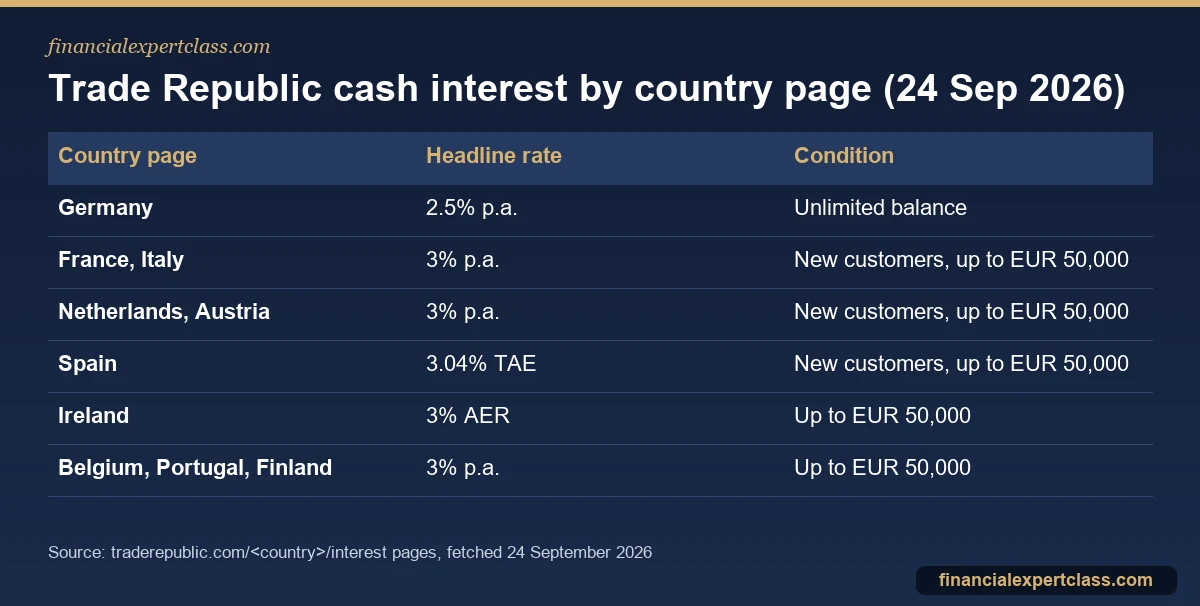
Trade Republic pays 2.5% a year on uninvested cash for customers in Germany (as of 24 September 2026). Also, there is no cap on the balance, and it pays the interest out monthly. That rate matches the European Central Bank deposit rate, which rose to 2.50% on 16 September 2026. In several other EU countries, however, it advertises 3% for new customers on balances up to €50,000.
New to ETFs? Start with the free checklist.
The European ETF Starter Kit: what to check before you buy your first UCITS ETF — domicile, costs, tax and broker set-up.
What Trade Republic pays in interest on cash right now
Trade Republic runs a separate interest page for each country it serves. As a result, the offer is not identical everywhere. On 24 September 2026 the German page promised “2.5% interest on your unlimited cash”. You can deposit and withdraw that money freely, and the interest arrives monthly. Most other country pages we checked showed a higher headline figure of 3%. However, that figure comes with two conditions. First, it is only for new customers. Second, it applies to cash balances up to €50,000. The Spanish page quotes the same offer as 3.04% TAE. That is the annualised equivalent once you count monthly compounding.
The French and Italian pages explain where that 3% comes from: interest “from partner banks, liquidity funds and our top-up”. In plain terms, the base rate follows the central bank. Trade Republic then adds a promotional top-up to win new customers. A top-up is a marketing decision, so the broker can shorten, reduce or withdraw it. The pages we fetched did not state an end date. So check the terms in the app before you plan around it.
Trade Republic does not operate in the UK. Instead, UK readers should compare the interest on uninvested cash inside a stocks and shares ISA. Some UK investing apps also pay it. Our guide to money market ETFs versus Trading 212 cash interest covers that side.
How the rate tracks the ECB deposit rate
The ECB deposit facility rate is what eurozone banks earn when they park money overnight at the central bank. It is the anchor for almost every euro savings product. In fact, Trade Republic’s German rate sits exactly on it. The ECB’s own table of rate decisions makes the link obvious. First, the deposit rate fell from 3.50% in September 2024 to 2.00% in June 2025. Then it rose to 2.25% in June 2026, and to 2.50% from 16 September 2026.

The practical consequence is simple: this is a variable rate, not a fixed deposit. When the ECB cuts, expect the cash rate to follow. When it hikes, you should benefit. If you want certainty for a fixed period, a term deposit or a short-dated government bond does that job better. However, if you want flexibility and a rate close to the policy rate, a broker cash account is convenient. You also do not need to choose a product.
Where your cash is actually held
Trade Republic is a German bank. But your uninvested cash does not simply sit on its own balance sheet. According to its help centre, the broker spreads cash among partner banks and holds it in escrow (fiduciary) accounts. These banks include Citibank Europe, Crédit Agricole CIB, Deutsche Bank, HSBC Continental Europe, J.P. Morgan, Natixis CIB and SEB. For higher balances, part of the cash goes into liquidity funds, which are money market funds. This only happens once you have activated the Trade Republic IBAN.
That split matters for protection:
- Cash at partner banks has cover from deposit guarantee schemes. Trade Republic states that the schemes protect deposits on each escrow account up to €100,000. It also points customers to each bank’s depositor information sheet for details.
- Money in liquidity funds sits on a segregated custody account, under the same safekeeping rules as your shares and ETFs. It stays separate from the bank’s own assets. However, deposit guarantee schemes do not apply, because it is a fund holding rather than a deposit.
Money market funds are low-risk, yet nobody guarantees them. Their value can also dip slightly in unusual market conditions. So if you hold a large balance, keep one point in mind. Part of it is no longer a bank deposit at all. For a wider view of the broker’s regulation and custody, see our Trade Republic review.
How the interest is paid
Trade Republic pays interest out monthly. You do not need to lock the money away or give notice. Cash you withdraw or use to buy an ETF simply stops earning interest. Because the credit is monthly, the effective annual yield is marginally higher than the quoted nominal rate. That holds if you leave the interest in the account. For this reason, the Spanish page shows 3.04% TAE for a 3% nominal offer.
A useful habit is to treat the cash balance as a staging area. For example, money waiting for your next ETF savings plan execution earns interest until you invest it. So there is little cost to funding the account a few days early.
How the interest is taxed
Interest is generally taxable investment income across the EU. However, who handles the paperwork depends on where you are tax resident.
- Germany: Trade Republic withholds capital gains tax (Abgeltungsteuer) plus solidarity surcharge and, if relevant, church tax. You can also set an exemption order (Freistellungsauftrag) of up to €1,000 a year in the app. The broker then pays interest up to that amount gross. According to Trade Republic, setting the order later in the year can trigger a refund of tax withheld that year. However, this does not work for earlier years.
- Other countries: Trade Republic’s handling varies by country. Where it does not withhold, you must declare the interest yourself in your annual return. The annual tax report in the app (Profile, then Tax) lists your investment income and any tax withheld.
Trade Republic does not give individual tax advice, and neither do we. If your cash balance is large, check your own country’s rules on interest income. Also check whether you should report it alongside capital gains.
Cash account or money market ETF?
The main alternative for idle euros is a money market ETF, such as funds that track the euro overnight rate. Both options earn roughly the policy rate. However, they behave differently:
| Trade Republic cash | Money market ETF | |
|---|---|---|
| Return | Rate set by the broker (ECB-linked) | Tracks overnight rates, minus the fund’s fee |
| Protection | Deposit guarantee at partner banks; none on the liquidity-fund part | Segregated fund assets; no deposit guarantee |
| Access | Instant | Sell on exchange, settlement takes a couple of days |
| Costs | None | Fund fee and any order fee |
| Tax | Interest income | Depends on your country’s fund tax rules |
For a few thousand euros that you might need at short notice, the cash account is simpler. There is no order to place and no fee. By contrast, a money market ETF can suit larger amounts or balances above a promotional cap. It can also suit countries where fund taxation is more favourable than interest taxation. Our XEON review explains how the most widely used euro cash-parking ETF works. In addition, our comparison of money market ETFs, bonds and deposits helps you decide which fits your time horizon.
Who the cash rate suits, and who should look elsewhere
Trade Republic’s cash interest is a strong fit if you already use the app to invest. It also suits you if you want your emergency fund and your investing money in one place. In addition, it works if you value instant access over squeezing out the last fraction of a percent. The uncapped German rate is especially convenient, because you do not need to manage multiple accounts.
However, it is less compelling in three cases. First, you may want a guaranteed rate for a fixed period. Second, your balance may be well above €100,000 and you want all of it in guaranteed deposits. Third, the 3% promotional offer in your country may have ended while a local bank pays more. Remember that cash, even at 2.5%, only keeps pace with inflation in good years. So money you will not need for five years or more usually belongs in a diversified ETF portfolio instead.
Frequently asked questions
What is the Trade Republic interest rate in 2026?
On 24 September 2026 Trade Republic’s German page advertised 2.5% a year on unlimited cash. That is in line with the ECB deposit rate of 2.50%, which took effect on 16 September 2026. In addition, several other country pages advertised 3% for new customers on balances up to €50,000. Rates are variable, so check the interest page for your country.
Is my cash at Trade Republic protected?
According to Trade Republic, deposit guarantee schemes cover cash held at partner banks up to €100,000 per escrow account. For larger balances, part of the money can go into liquidity (money market) funds in a segregated custody account. That part stays safe if the bank becomes insolvent. However, no deposit guarantee covers it.
How often does Trade Republic pay interest?
Trade Republic pays interest out monthly. There is no lock-in, so you can withdraw or invest the cash at any time. It then simply stops earning interest.
Does Trade Republic deduct tax from interest?
For German tax residents, yes. It withholds capital gains tax and surcharges, and you can set an exemption order of up to €1,000 a year. However, in other countries handling differs. Where it does not withhold tax, you must declare the interest in your own tax return.
Is a money market ETF better than Trade Republic’s cash interest?
Not automatically. Both earn close to the policy rate. Cash is instant and free, and deposit guarantees cover part of it. A money market ETF, by contrast, has a small fund fee and a settlement delay but no promotional cap. So the better choice depends on the balance, your access needs and how your country taxes funds versus interest.
Cited sources: Trade Republic interest page (Germany), Trade Republic interest page (France), Trade Republic interest page (Spain), Trade Republic: How is my money protected?, Trade Republic: exemption order, Trade Republic: tax report, and ECB key interest rates. Verify current fund figures before investing. Educational content, not financial advice.
Not personalised financial advice. Verify your situation with a qualified adviser. Operated by Aurum Digital Marketing LTD (UK), Companies House 15203665.
European UCITS/ETF investor with 11+ years building a global dividend and index portfolio, and founder of Financial Expert Class. I write every guide here from first-hand experience investing across EU brokers and tax regimes — not theory. More about me →