
Yes, Trading 212 operates in Ireland. Irish residents open their Invest accounts with Trading 212 EU GmbH, a German firm that BaFin regulates. So the UK ISA and FSCS protection do not apply. Shares and ETFs trade commission-free with a 0.15% FX fee. However, Trading 212 does not deduct Irish tax. Instead, you self-assess, and ETFs fall under Ireland’s 38% exit-tax regime.
New to ETFs? Start with the free checklist.
- The European ETF Starter Kit — 12 pages: your first fund, a safe low-cost broker and the 7 costliest beginner mistakes
- + 2 bonus PDFs: Comparison Workbook and Dividend Starter Sheet
- + a free lesson from the €147 Masterclass
Which Trading 212 company serves Ireland?
Trading 212 runs four regulated entities and assigns you to one based on your country of residence. Its Help Centre lists Ireland under Trading 212 EU GmbH. Germany, Austria, the Netherlands, France, Spain, Portugal, the Nordic countries and others sit there too. By contrast, UK residents are with Trading 212 UK Ltd. Meanwhile, several other EU countries (such as Italy, Poland and the Baltic states) are with Trading 212 Markets Ltd. You can confirm your own entity in the app by tapping the menu and scrolling to the bottom.
This matters because many reviews of Trading 212 target UK users. However, the ISA, the UK SIPP and the FSCS limits you read about do not apply to an Irish account. In fact, Trading 212’s ISA page is clear that you must be a UK tax resident to open one.
Is Trading 212 safe in Ireland?
Germany’s Federal Financial Supervisory Authority (BaFin) regulates Trading 212 EU GmbH under the German Securities Trading Act. According to Trading 212’s Help Centre:
- Client assets (your shares and ETFs) sit in segregated accounts with two sub-custodians, Interactive Brokers and Bank of New York Mellon. They stay separate from Trading 212’s own assets.
- Client money sits with large banks, including J.P. Morgan, under agreements that it belongs to you.
- Investor compensation: the German scheme EdW protects 90% of eligible funds up to €20,000 per person if the firm fails to return them.
- Bank deposits: deposit protection covers uninvested cash at German partner banks up to €100,000 per person per bank. That limit also includes any other money you hold at the same bank.
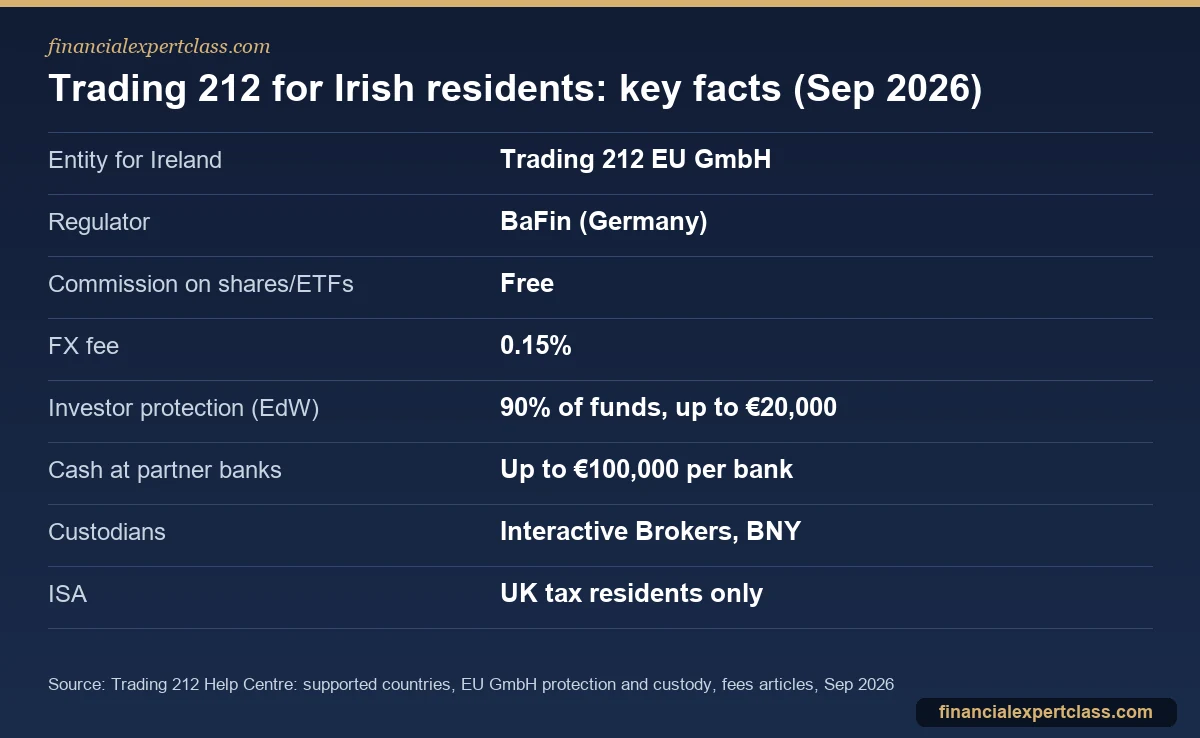
Segregation is the main line of defence. In other words, if the broker failed, your securities should still be yours. The compensation scheme is a backstop for shortfalls. Also, €20,000 is lower than the UK’s £85,000, so it is worth understanding. Our full analysis is in Is Trading 212 safe?
Trading 212 Ireland fees
Trading 212 describes the FX fee as the only fee it can charge in its Invest account. Commission and custody are free. When you trade an instrument in a currency other than your account currency, the conversion uses the spot rate plus 0.15%. This also applies to trades inside pies. However, dividends carry no FX fee.
So for an Irish investor with a euro account, buying euro-listed ETFs avoids the FX fee entirely. On the other hand, buying a US share or a London-listed ETF priced in dollars or sterling adds 0.15% each way. Exchange taxes still apply where relevant. For example, Trading 212 notes that France charges a 0.4% financial transaction tax on purchases of shares in large French companies. Our Trading 212 fees guide covers the details.
Trading 212 also pays interest on uninvested cash in eligible accounts, and the app shows the rates. In addition, its automated “pies” let you invest a fixed amount on a schedule without commission.
Irish tax: the part Trading 212 does not handle
Trading 212 does not deduct Irish tax for you. Revenue’s guidance on exchange-traded funds explains why. Because investors buy and sell ETF units on the stock market, the fund does not deduct exit tax. Instead, an Irish-resident holder must self-assess and include the income and gains on their tax return. The same applies to gains on individual shares.
The rules differ sharply between shares and ETFs:
- Individual shares: gains face Capital Gains Tax at 33%. Also, individuals have an annual exemption of €1,270, according to Revenue.
- ETFs domiciled in Ireland, the EU, the EEA or an OECD state (which covers the UCITS ETFs most people buy): Revenue taxes gains and income at 38% for chargeable events on or after 1 January 2026, down from 41%. There is also a deemed disposal every 8 years. That means you pay tax on the growth even if you have not sold. In addition, Revenue’s manual says that no CGT or other loss relief is available if you make a loss when you dispose of an EU, EEA or OECD fund of this kind.

Older advice on US and treaty-country ETFs
One change catches out people who read older advice. Revenue previously accepted that some ETFs could face tax like ordinary shares. These were ETFs domiciled in the USA, or in EEA or OECD states with which Ireland has a double tax treaty. However, its ETF manual states that this confirmation no longer applies with effect from 1 January 2022. Where Revenue finds such an ETF equivalent to an Irish ETF, the 8-year deemed-disposal clock starts from 2022. So the earliest deemed disposal for those holdings is in 2030.
This is why some Irish investors hold individual shares or investment trusts instead of ETFs. Others, however, accept the ETF regime for simplicity and diversification. Our guides to Irish ETF tax and deemed disposal and shares vs ETFs under exit tax go through worked examples. Revenue’s manuals run to many pages, so if your situation is complex, speak to a tax adviser.
Opening an account from Ireland
Account opening follows the usual EU identity checks. Trading 212 asks for a Tax Identification Number to meet its reporting obligations. Its Help Centre confirms that for Ireland this is your Personal Public Service (PPS) number. So have it ready alongside your ID before you start.
Once the account is open, keep your own records from day one. Note the date, quantity and euro cost of every purchase. That is because Irish ETF holders need them to work out each 8-year deemed disposal, and share investors need them for CGT. Download Trading 212’s annual statements and store them with your tax papers. For example, for an ETF bought in 2026, the first deemed disposal falls in 2034, long after you will remember the details. A simple spreadsheet with one row per purchase is enough. It will also save you or your accountant hours later.
Is Trading 212 the best choice for Irish investors?
Trading 212 is a strong low-cost option: no commission, a low FX fee, fractional shares, pies and a simple app. But there are points to weigh. First, it offers no Irish tax reporting help. Second, the German scheme’s investor-compensation limit is €20,000. Finally, Irish investors’ main tax decision (shares vs ETFs) matters more than the broker. Our comparison of the best brokers for Irish investors sets Trading 212 against the alternatives. Also, our Trading 212 review covers the platform in depth.
Frequently asked questions
Does Trading 212 operate in Ireland?
Yes. Trading 212 lists Ireland among its supported countries. Irish residents open their accounts with Trading 212 EU GmbH, which BaFin regulates in Germany.
Is Trading 212 safe in Ireland?
Client assets sit in segregated accounts with Interactive Brokers and BNY, while client money sits with large banks such as J.P. Morgan. The German EdW scheme covers 90% of eligible funds up to €20,000 if the firm fails. In addition, deposit protection covers cash at partner banks up to €100,000 per bank.
Can I open a Trading 212 ISA in Ireland?
No. ISAs are a UK product, and Trading 212 requires you to be a UK tax resident to open one. Instead, Irish residents use the standard Invest account.
Does Trading 212 deduct Irish tax?
No. You must self-assess and report gains, dividends and ETF deemed disposals to Revenue yourself. Revenue taxes ETFs domiciled in Ireland, the EU, EEA or an OECD state at 38% from 1 January 2026. By contrast, share gains face CGT at 33% after the €1,270 annual exemption.
Cited sources: Trading 212: supported countries and entities, Trading 212 EU GmbH: funds and asset protection, Trading 212 EU GmbH: custody, Trading 212: fees, Trading 212: ISA eligibility, Revenue TDM 27-04-01: offshore funds (38% from 2026), Revenue TDM 27-01a-02: investment undertakings, and Revenue: how to calculate CGT. Verify current fund figures before investing. Educational content, not financial advice.
Not personalised financial advice. Verify your situation with a qualified adviser. Operated by Aurum Digital Marketing LTD (UK), Companies House 15203665.
European UCITS/ETF investor with 11+ years building a global dividend and index portfolio, and founder of Financial Expert Class. I write every guide here from first-hand experience investing across EU brokers and tax regimes — not theory. More about me →