
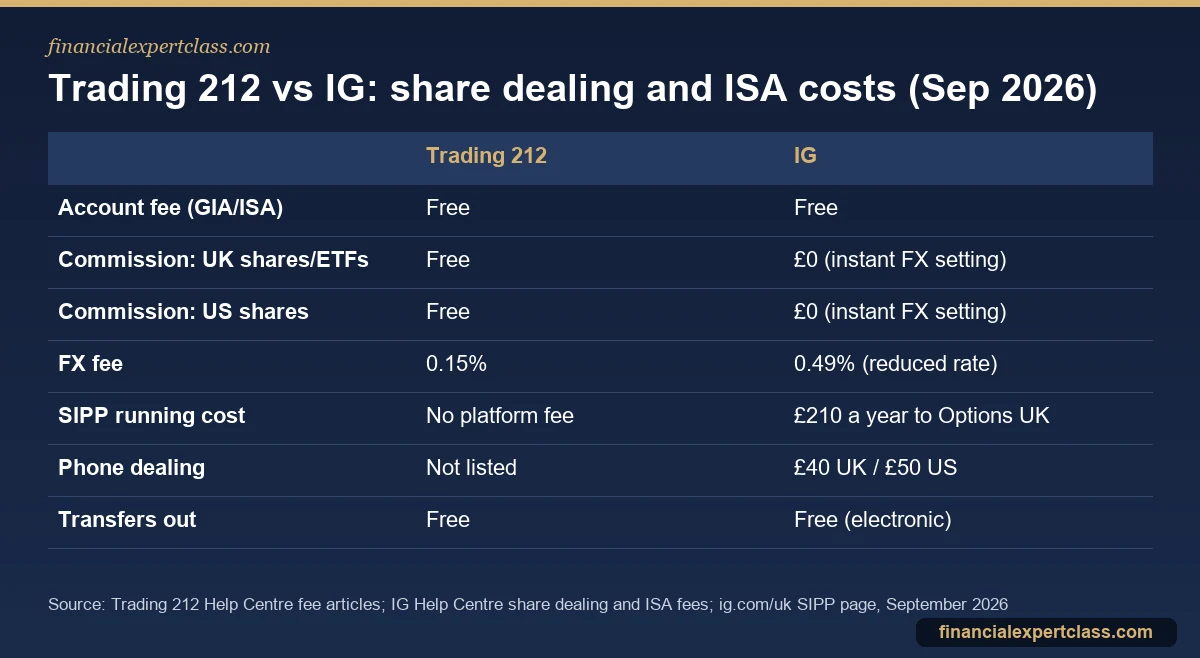
For a UK ETF investor, Trading 212 is usually cheaper than IG. Both charge no commission and no account fee on share dealing and ISAs. However, Trading 212’s FX fee is 0.15%, against IG’s 0.49%. Also, Trading 212’s SIPP has no platform fee, while IG’s SIPP costs £210 a year in administration. IG suits more active traders who also want spread betting, options or managed portfolios.
Comparing options? Take the decision workbook with you.
The ETF Comparison Workbook: TER, domicile, withholding tax and overlap checks in one printable spreadsheet.
Two brokers with trading roots
Both companies run leveraged-trading businesses alongside their investment accounts. IG, registered in London, offers spread betting, CFDs and options. It also offers share dealing, ISAs, a SIPP and managed “Smart Portfolios”. Trading 212, for its part, says its commission-free share dealing is cost-effective because of the platform it had already built for its CFD business.
For a long-term ETF investor, however, what matters is the investing side. That means the share dealing account (a general investment account, or GIA), the Stocks & Shares ISA and the SIPP. On those, the two are closer than you might expect. Still, there are a few important differences in FX and pension costs.
Trading 212 vs IG fees compared
Published charges at the time of writing (September 2026):
IG in detail
- Commission: IG’s help centre says that with the default “instant FX conversion” setting, trading is commission-free on all global shares. Its share dealing page adds that stocks and ETFs are commission-free in a UK GBP GIA, ISA and SIPP. But if you switch to manual FX conversion, UK shares cost £3 a trade. US shares then cost 3 cents per share, with a $15 minimum.
- FX: 0.49% added to the exchange rate. IG describes this as a reduced rate “offered at IG’s discretion” that “will apply for a minimum period until 4 September 2026”. Its own comparison table also shows a 0.7% figure. So check the live rate before relying on it.
- Account fees: IG’s share dealing page shows no account fee for the GIA and ISA.
- SIPP: IG runs it with Options UK, an independent pension administrator. You pay Options UK an annual administration fee of £210.
- Other: telephone deals cost £40 (UK) or £50 (US). Electronic transfers in and out are free. However, transferring paper share certificates costs £100 plus VAT per certificate.
Trading 212 in detail
- Commission and custody: free on Invest, ISA and SIPP accounts, with no inactivity fee.
- FX: 0.15% on trades in a currency other than your account currency, including inside Pies. However, it does not apply to dividends.
- SIPP: no platform fee. Indeed, the Help Centre says the FX fee is the only fee Trading 212 can charge on Invest, ISA and SIPP accounts.
- Deposits: bank transfers are free. Card and similar deposits cost 0.7% once you have deposited 2,000 GBP/EUR in total by those methods. Withdrawals are also free.
Both pass on UK stamp duty (0.5% on UK share purchases) and the PTM levy on large UK trades. But there is no UK stamp duty on ETFs.
What the FX difference means
Say you only buy sterling-listed UCITS ETFs in a GBP account. In that case, neither broker charges FX, so costs are effectively zero on both. The gap opens when you buy US shares or foreign-currency ETF lines. For example, on a £5,000 purchase that needs conversion, 0.15% is £7.50 and 0.49% is £24.50. Then you pay again when you sell. So for a portfolio of US stocks traded regularly, that adds up.
The SIPP difference is the other big one. On a £30,000 pension, IG’s £210 administration fee is 0.7% a year. On £200,000, however, it is about 0.1%. So a flat fee suits large pots, while Trading 212’s no-fee SIPP suits smaller and growing ones. One practical point does favour IG. Its SIPP accepts contributions from you, your employer or anyone else on your behalf. In contrast, Trading 212’s SIPP currently accepts personal contributions only.
Accounts and investment range

IG says it offers over 20,000 shares and ETFs in its ISA and share dealing accounts. It also says mutual funds are not currently available. Its ISA is flexible, but IG does not offer Cash, Junior or Lifetime ISAs. Its Smart Portfolios are managed portfolios. IG says its in-house team manages the Smart Portfolio SIPP, using asset allocation insights from BlackRock.
Trading 212 offers thousands of shares and ETFs and fractional investing. It also has a flexible Stocks & Shares ISA with a £1 minimum, a Cash ISA and a SIPP. It has no managed service. Instead, it offers Pies, where you set a target mix and invest automatically. In the SIPP, it shows ready-made Pies from Vanguard, BlackRock and WisdomTree. Our guide to automating a portfolio with Trading 212 Pies explains how they work. Also, Trading 212 account types covers each account.
Cash and extras
Trading 212 pays daily interest on uninvested cash in Invest, ISA and SIPP accounts. It holds that cash with banks or in qualifying money market funds. It also pays its Cash ISA at 0.15% below the Bank of England base rate. We have not included an IG cash rate, because we could not confirm a current published rate for its share dealing accounts. So ask IG directly if cash interest matters to you.
IG’s extras target traders: spread betting, CFDs and options, plus research and analysis tools. Both firms carry the regulator’s CFD warning. IG states that 69% of retail investor accounts lose money when trading spread bets and CFDs with it. Similarly, Trading 212 states 77% for its CFD accounts. Neither leveraged product belongs in a long-term ETF plan.
Safety and regulation
IG Trading and Investments Ltd provides IG’s share dealing, ISA and Smart Portfolio accounts. The Financial Conduct Authority authorises and regulates it (register number 944492). Its SIPP trustee is MK SIPP Trustees UK Ltd, with Options UK Personal Pensions LLP as administrator. Trading 212 UK Ltd is FCA-authorised (firm reference 609146). It holds client money with banks including J.P. Morgan and Barclays. It also uses custodians including Bank of New York Mellon and Interactive Brokers.
The FSCS protects up to £85,000 per person, per investment firm, if a firm fails and assets are missing. However, it never covers market losses. For more on Trading 212, see is Trading 212 safe.
Which should you choose?
- Trading 212 if you are building an ETF portfolio in an ISA or SIPP and want the lowest FX fee. It also suits you if you want a SIPP with no platform charge, and interest on uninvested cash. Our Trading 212 review goes deeper.
- IG if you also want spread betting or options in the same group, or a managed portfolio option. It also fits if you want a SIPP that accepts employer contributions, with a flat fee that becomes cheap on a large pot.
For other options, including the traditional platforms, see our guide to the best broker for UK investors.
Frequently asked questions
Is IG cheaper than Trading 212?
Usually not for investors. Both charge no commission and no account fee on share dealing and ISA accounts. However, IG’s FX fee is 0.49%, against Trading 212’s 0.15%. Also, IG’s SIPP carries a £210 annual administration fee, while Trading 212’s SIPP has no platform fee. Still, IG can be competitive for large SIPPs, where a flat fee is a small percentage.
What is the downside of Trading 212?
It does not offer mutual funds, a managed ISA, or Junior or Lifetime ISAs. Its Help Centre says you can have a Cash ISA and a Stocks & Shares ISA. It also does not take employer contributions to its SIPP, and its app-first design is not for everyone. In addition, its API and some features still carry a beta label. For simple ETF investing, however, the cost structure is hard to beat.
Does IG offer a Lifetime ISA or Cash ISA?
No. IG’s help centre says it offers flexible Stocks & Shares ISAs that can hold shares, funds and IG Smart Portfolios. But it does not offer Cash, Junior or Lifetime ISAs. Trading 212, by contrast, offers a Cash ISA alongside its Stocks & Shares ISA.
Can I transfer my ISA from IG to Trading 212?
Yes. IG says it does not charge for electronic broker-to-broker transfers in or out, including ISA transfers. Start the transfer from the receiving provider, so the money keeps its ISA status. Do not withdraw the cash yourself.
Cited sources: IG Help Centre: share dealing and ISA charges, IG Help Centre: types of ISA, IG: SIPP, IG: share dealing, Trading 212 Help Centre: fees in Invest, ISAs and SIPP, Trading 212 Help Centre: SIPP, Trading 212 Help Centre: interest on cash, and FSCS investment protection. Verify current fund figures before investing. Educational content, not financial advice.
Not personalised financial advice. Verify your situation with a qualified adviser. Operated by Aurum Digital Marketing LTD (UK), Companies House 15203665.
European UCITS/ETF investor with 11+ years building a global dividend and index portfolio, and founder of Financial Expert Class. I write every guide here from first-hand experience investing across EU brokers and tax regimes — not theory. More about me →