
Vanguard sells two different emerging markets trackers in the UK, and they do not follow the same index. The FTSE Emerging Markets UCITS ETF (VFEM distributing, VFEG accumulating) costs 0.17% a year and excludes South Korea. By contrast, the Emerging Markets Stock Index Fund tracks the MSCI Emerging Markets index and costs 0.23%. It also had about 21% in South Korea at 31 August 2026.
Comparing options? Take the decision workbook with you.
- The ETF Comparison Workbook — 10 pages: the 7-filter framework for choosing between two good funds
- + 2 bonus PDFs: ETF Starter Kit and Dividend Starter Sheet
- + a free lesson from the €147 Masterclass
The two Vanguard emerging markets funds at a glance
Search for “Vanguard emerging markets” and you will find both products on Vanguard’s UK site. They look similar, but they are built on different index families, and that one choice changes what you own.
- Vanguard FTSE Emerging Markets UCITS ETF tracks the FTSE Emerging Index, which covers large and mid-sized companies in emerging markets. It comes in two share classes: VFEM, which pays dividends quarterly, and VFEG, which reinvests them. Both have an ongoing charge (OCF, the annual fund cost) of 0.17%.
- Vanguard Emerging Markets Stock Index Fund is a traditional index fund (an Irish-domiciled UCITS, not an ETF) that tracks the MSCI Emerging Markets Index. The GBP accumulation class has an OCF of 0.23%, no entry or exit charge, and a daily dealing deadline of 3pm.
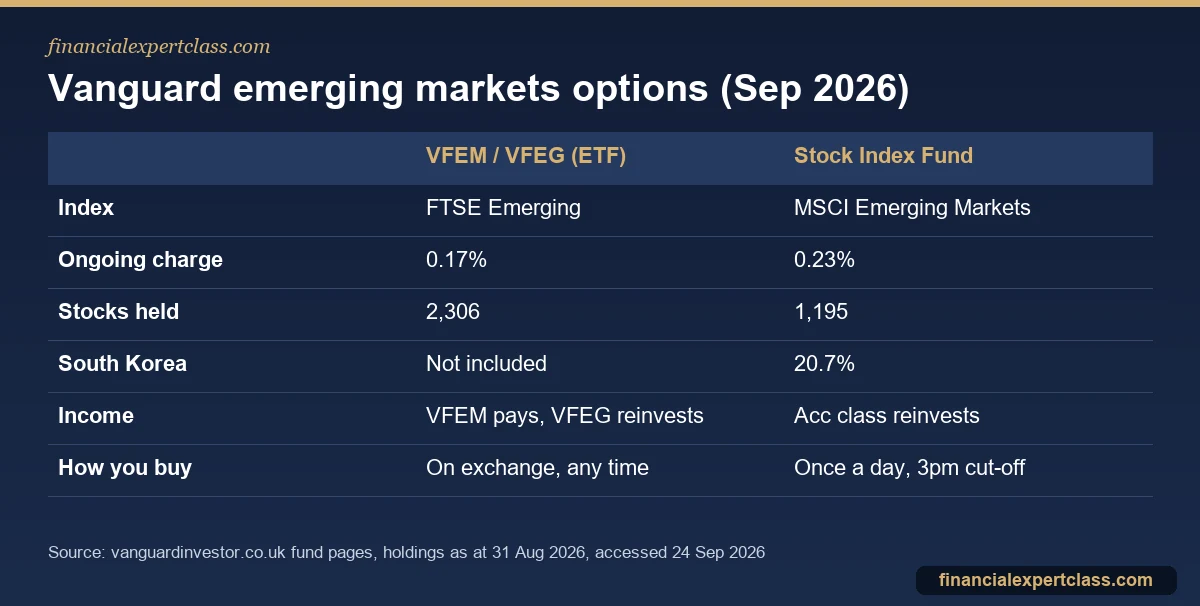
All figures above are from Vanguard’s UK fund pages, with portfolio data as at 31 August 2026. Charges change, so check the live pages before you buy.
The big difference: South Korea
Index providers disagree on which countries count as “emerging”. FTSE Russell’s equity country classification, as published in April 2026, lists South Korea (and Poland) as developed markets. MSCI still treats both as emerging. So:
- The FTSE Emerging index behind VFEM and VFEG has no South Korean companies. Korea sits in FTSE’s developed indices instead.
- The MSCI Emerging Markets index behind the Stock Index Fund includes South Korea. In fact, Korea was 20.7% of the fund at 31 August 2026, making it the second-largest country after Taiwan.

As a result, the gap shows up clearly in the top holdings. In the Stock Index Fund, Samsung Electronics (7.03%) and SK hynix (5.34%) sit just behind Taiwan Semiconductor Manufacturing (TSMC, 14.78%). In VFEM, neither Korean company appears; TSMC is 16.84%, followed by Tencent (3.30%), Alibaba (2.53%) and MediaTek (1.66%).
Neither approach is wrong. What matters is what else you hold. Say your developed-markets fund follows a FTSE index, such as a FTSE Developed World or FTSE All-World fund. Then it already includes South Korea, so pairing it with the FTSE Emerging ETF gives you each country once. If your developed fund follows MSCI World, which leaves out Korea, an MSCI emerging fund fills that gap. However, mixing an MSCI World fund with the FTSE Emerging ETF leaves South Korea out entirely. Our explainer on MSCI versus FTSE index families goes into these classification gaps.
One more change to note: FTSE Russell announced that Greece would move from emerging to developed status effective 21 September 2026. VFEM still showed a 0.9% weight in Greece at 31 August, so expect that to disappear from the FTSE fund’s country list after the change.
What you actually own
Both funds are dominated by Asia and by technology. At 31 August 2026:
- VFEM held 2,306 stocks. Its largest markets were Taiwan (32.8%), China (27.1%) and India (15.8%). Technology was 35.1% of the fund, while financials were 21.4%.
- The Stock Index Fund held 1,195 stocks. Its largest markets were Taiwan (27.6%), South Korea (20.7%), China (20.6%) and India (11.4%). Information technology was 41.9% and financials 19.5% (MSCI uses slightly different sector labels from FTSE).
The FTSE ETF holds almost twice as many companies, but both are market-cap weighted, so the smallest positions barely affect returns. The single biggest risk in both is concentration: one chipmaker, TSMC, is around a sixth of each fund.
VFEM’s distribution yield was 2.02% at the close on 31 August 2026, paid quarterly. VFEG pays nothing out and reinvests instead, which suits investors building wealth rather than drawing income. According to Vanguard, both ETF share classes and the index fund have UK reporting fund status. That matters for the tax on gains outside an ISA.
ETF or index fund: which suits you?
The structure affects how and where you can buy:
- The ETF trades on the stock exchange throughout the day, so you can buy it at almost any broker that offers London-listed ETFs, including commission-free apps. You pay the bid-offer spread and any broker FX or platform fee.
- The index fund is priced once a day and bought through fund platforms, including Vanguard Investor. It suits regular monthly investing into an ISA or pension, and there is no spread to pay.
On cost alone the ETF is cheaper by 0.06 percentage points a year. On £10,000 that is about £6 a year, which is small compared with platform fees that can differ by much more. Our guide to index funds versus ETFs compares the two structures in more detail.
The OCF is not the whole cost. Vanguard’s pages note that transaction costs apply on top, and with the ETF you also pay the bid-offer spread each time you trade. Emerging markets ETFs can have wider spreads than developed-market funds, so for regular small purchases a limit order or a commission-free, low-FX platform helps.
How it compares with other emerging markets ETFs
For most UK and EU investors, the main alternative is the iShares Core MSCI EM IMI UCITS ETF (ticker EIMI). According to iShares, it has a total expense ratio of 0.18% and held 2,957 companies in September 2026. It tracks the MSCI Emerging Markets Investable Market Index, which adds small caps to the standard MSCI index. It is also accumulating and, like the Vanguard Stock Index Fund, includes South Korea.
So the realistic choice is:
- FTSE Emerging, no Korea: VFEM or VFEG at 0.17%. Best paired with FTSE-based developed funds.
- MSCI EM with small caps: EIMI at 0.18%, the broadest option.
- MSCI EM as a fund: the Vanguard Stock Index Fund at 0.23%, for platform-based regular investing.
Our wider list of emerging markets ETFs covers single-country and ex-China options. If you invest through Vanguard’s own platform and want other providers’ ETFs too, see buying iShares ETFs on Vanguard Investor.
Is Vanguard emerging markets a good investment?
As trackers, both Vanguard products do what they say: follow a broad emerging markets index at a low cost. Vanguard publishes each fund’s yearly returns next to its benchmark, so you can check the tracking yourself. Whether emerging markets suit you is a separate question. Vanguard rates them 6 out of 7 on its risk scale (higher than the 5 of its FTSE 100 and European ETFs). They are also heavily exposed to Taiwan and China. In addition, they carry currency risk for sterling and euro investors. So many investors hold emerging markets as a minority slice alongside a developed-markets fund rather than as a core holding.
Frequently asked questions
What is the best Vanguard emerging markets fund?
It depends on your other holdings. The FTSE Emerging Markets ETF (VFEM or VFEG) is cheaper at 0.17% but excludes South Korea, so it pairs best with FTSE-based developed funds. The Emerging Markets Stock Index Fund (0.23%) follows MSCI and includes Korea, which fits alongside an MSCI World fund.
What is the difference between VFEM and VFEG?
They are two share classes of the same ETF with the same 0.17% charge and holdings. VFEM distributes dividends quarterly (its yield was 2.02% at 31 August 2026); VFEG, launched in September 2019, reinvests them automatically.
Why does the Vanguard emerging markets ETF not hold Samsung?
Because it tracks the FTSE Emerging Index, and FTSE Russell classifies South Korea as a developed market. Samsung and other Korean companies appear in FTSE developed indices instead. The MSCI-based Vanguard Stock Index Fund does hold Samsung.
Can I hold Vanguard emerging markets funds in an ISA?
Yes. Vanguard marks both the FTSE Emerging Markets ETF and the Emerging Markets Stock Index Fund as ISA-ready on its UK pages. Check that your own platform offers the share class you want.
Cited sources: Vanguard FTSE Emerging Markets UCITS ETF (VFEM), Vanguard FTSE Emerging Markets UCITS ETF (VFEG), Vanguard Emerging Markets Stock Index Fund, FTSE Russell: equity country classification (April 2026), and iShares Core MSCI EM IMI UCITS ETF (EIMI). Verify current fund figures before investing. Educational content, not financial advice.
Not personalised financial advice. Verify your situation with a qualified adviser. Operated by Aurum Digital Marketing LTD (UK), Companies House 15203665.
European UCITS/ETF investor with 11+ years building a global dividend and index portfolio, and founder of Financial Expert Class. I write every guide here from first-hand experience investing across EU brokers and tax regimes — not theory. More about me →