
This Vanguard Investor review finds a low-cost stocks and shares ISA for investors happy to use only Vanguard funds. The self-managed account costs £4 a month below £32,000 invested. Above that, it costs 0.15% a year capped at £375, plus fund charges from 0.06% (as of September 2026). You can start with £500 or £100 a month. However, you cannot buy iShares, HSBC or individual shares there.
Comparing options? Take the decision workbook with you.
The ETF Comparison Workbook: TER, domicile, withholding tax and overlap checks in one printable spreadsheet.
What Vanguard Investor is
Vanguard Investor is the UK direct-to-consumer platform of Vanguard Asset Management, Limited. The Financial Conduct Authority (FCA) authorises and regulates that firm. Instead of going through a fund supermarket such as Hargreaves Lansdown or Fidelity, you buy Vanguard’s funds and ETFs directly from Vanguard.
The account types are:
- Stocks and Shares ISA, self-managed or managed, with the £20,000 annual ISA allowance (2026/27).
- Junior ISA for children under 18, with a £9,000 annual allowance.
- Personal Pension, Vanguard’s self-invested pension.
- General Account for money beyond your ISA and pension allowances.
All accounts are for UK residents only, and the service is not available to US persons.
Fees: the £32,000 threshold is the key number
Vanguard’s pricing has three layers. First, there is an account fee. Second, there are the fund’s own costs. Finally, the Managed ISA alone adds a management fee.
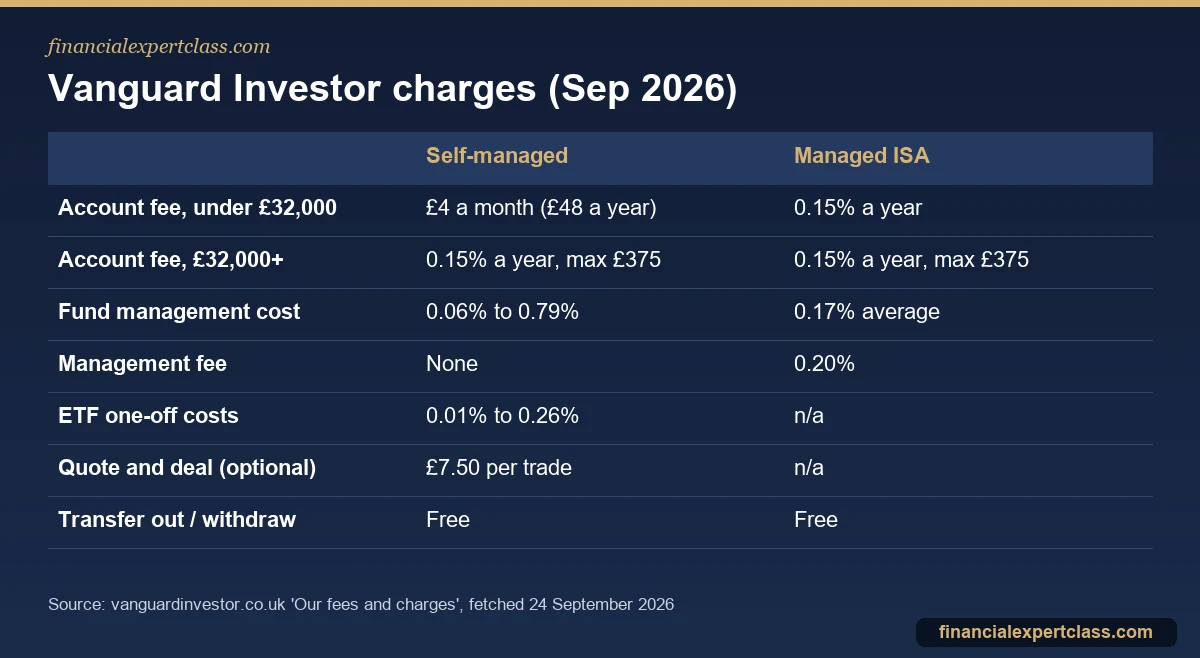
For the self-managed service, the account fee is a flat £4 a month (£48 a year). That applies until your invested balance across all your Vanguard accounts reaches £32,000. From £32,000, it becomes 0.15% a year, capped at £375. You pay only one account fee even if you hold several accounts. Also, Vanguard does not charge on cash sitting uninvested. It takes the fee every three months, by Direct Debit or from cash in your account. If there is no cash, Vanguard sells units from your largest fund to cover it.
What the flat fee means in practice depends heavily on your balance:

On £5,000, £48 a year is almost 1% of your money before any fund charge, which is expensive. On £20,000 it is 0.24%. Between £32,000 and £250,000 it is a flat 0.15%. Above £250,000, however, the £375 cap makes Vanguard one of the cheaper percentage-fee options. Vanguard gives its own example. £20,000 in a LifeStrategy fund would cost about £88 a year in total. That is the £48 account fee plus £40 in fund costs at an average 0.20%.
There are no charges for switching funds, withdrawing, transferring out or closing your account. There are also no fund entry or exit charges. ETF purchases carry a one-off cost of 0.01% to 0.26% from the bid-offer spread. Vanguard normally places ETF orders at its set dealing points (10:15am or 2:10pm) with no brokerage charge. If you want to trade at a live quoted price, the optional quote and deal service costs £7.50 per trade.
The fund range: Vanguard only
Vanguard says you can choose from more than 85 Vanguard funds. These include index funds, ETFs, ready-made portfolios such as the LifeStrategy funds, and some actively managed funds. Fund management costs range from 0.06% to 0.79%.
The catch is in the name: everything is Vanguard. You cannot buy iShares, HSBC, Invesco or Xtrackers funds, investment trusts, or individual company shares. For many index investors that is fine, because Vanguard covers the essentials. For example, it offers global trackers such as the FTSE Global All Cap fund and the FTSE All-World ETF, plus regional equity and bond funds. If you want a specific fund from another provider, see our guide on buying iShares ETFs when you use Vanguard Investor.
The LifeStrategy range is popular with beginners. That is because each fund mixes shares and bonds in a fixed proportion and rebalances automatically. Our comparison of LifeStrategy versus an all-equity world ETF explains the trade-offs.
Minimums and how to open an account
To open a Stocks and Shares ISA, you make a first payment of at least £500 as a lump sum or £100 a month by Direct Debit. The key features document states these minimums apply per fund you choose. So you cannot split a small first payment across several funds. There is no minimum if you are transferring an ISA from another provider.
The Junior ISA has the same £500 or £100-a-month starting point. Only a parent or legal guardian can open and manage it. However, anyone can pay in, up to £9,000 a year in total. The child cannot touch the money until they turn 18, when it becomes theirs. Vanguard’s Junior ISA page shows the account fee as 0.15% a year on any balance (capped at £375). In addition, its fee schedule says the £4 minimum does not apply if you hold a Junior ISA only alongside a Managed ISA.
The Managed ISA
If you would rather not choose funds, Vanguard’s Managed ISA builds and runs a portfolio for you at a risk level you choose. You pay the 0.15% account fee (capped at £375) and a 0.20% management fee. You also pay fund costs, which Vanguard estimates average 0.17% for a moderate portfolio. Vanguard’s example for £20,000 is about £104 a year in total. That is cheaper than many managed services. Still, it costs more than a self-managed LifeStrategy fund that does a similar job.
Safety and protection
The Financial Services Compensation Scheme (FSCS) covers Vanguard. If Vanguard were unable to meet its financial obligations to you, you may be entitled to compensation. Vanguard notes this can apply separately to your investments and to any cash in your Personal Pension. The FSCS limit for investment claims is £85,000 per eligible person, per firm. Your investments sit in regulated funds. However, the FSCS does not cover normal falls in market value.
Vanguard Investor vs Trading 212 and other platforms
Overall, this review finds Vanguard Investor strongest for mid-sized balances of Vanguard funds, where the 0.15% fee is competitive. There you can also buy index funds (OEICs) at a single daily price, without the bid-offer spread that applies to ETFs. By contrast, it is weaker for small balances, where £48 a year is a large percentage. It is also weaker for anyone who wants choice beyond one fund house.
App brokers such as Trading 212 charge no account fee at all. They also let you buy Vanguard’s ETFs alongside iShares and others, and their main cost is a 0.15% FX fee on non-sterling trades. The trade-off is that they sell ETFs rather than Vanguard’s OEIC index funds. So you trade at market prices rather than a single daily fund price. Our Trading 212 review and best broker for UK investors guide compare the alternatives.
Vanguard Investor review verdict: who it suits
- Good fit: hands-off index investors with £32,000 or more who are happy with Vanguard’s range. It also suits LifeStrategy users, and parents who want a simple Junior ISA.
- Poor fit: beginners with a few thousand pounds, because the flat fee bites. The same applies to investors who want individual shares, investment trusts or non-Vanguard ETFs. Finally, it is a poor fit for anyone who wants to trade at live prices without paying £7.50.
If you are still deciding which tax wrapper to fill first, our ISA, LISA and SIPP decision tree sets out the order.
Frequently asked questions
Is Vanguard good for a stocks and shares ISA?
Yes, if you only want Vanguard funds and have a moderate balance. The fee is 0.15% a year from £32,000 (capped at £375) plus fund costs from 0.06%. Below £32,000, however, the flat £48 a year makes it relatively expensive for small pots.
Is Vanguard good for beginners in the UK?
It is simple to use, and the LifeStrategy funds give beginners a ready-made mix of shares and bonds. The drawbacks are the £500 lump sum or £100 monthly minimum per fund. Also, the flat £4 monthly fee is a large percentage of a small balance.
What’s better, Vanguard or Trading 212?
Trading 212 has no account fee and a wider range, including non-Vanguard ETFs and shares. So it is usually cheaper for small balances. Vanguard suits investors who want Vanguard’s index funds and a simple, hands-off service. Its 0.15% fee, capped at £375, becomes competitive at larger balances.
Can I hold ETFs from other providers on Vanguard Investor?
No. As this review explains, Vanguard Investor offers only Vanguard’s own mutual funds and ETFs. To hold iShares, HSBC or other providers’ funds, you need a different platform.
Cited sources: Vanguard Investor: our fees and charges, Vanguard Investor: Stocks and Shares ISA, Vanguard Investor: ISA investment choice, Vanguard Investor: Junior ISA, Vanguard key features: ISA, Junior ISA and General Account, Vanguard Investor: FSCS cover, FSCS: investment protection, and GOV.UK: Individual Savings Accounts. Verify current fund figures before investing. Educational content, not financial advice.
Not personalised financial advice. Verify your situation with a qualified adviser. Operated by Aurum Digital Marketing LTD (UK), Companies House 15203665.
European UCITS/ETF investor with 11+ years building a global dividend and index portfolio, and founder of Financial Expert Class. I write every guide here from first-hand experience investing across EU brokers and tax regimes — not theory. More about me →