
UK dividend tax for the 2026/27 tax year (6 April 2026 to 5 April 2027) works like this. The first £500 of dividends is tax-free. Above that, you pay 10.75% in the basic-rate band, 35.75% in the higher-rate band and 39.35% in the additional-rate band. The basic and higher rates each rose by 2 percentage points from 2025/26. However, you pay nothing at all on dividends inside an ISA or pension.
Building an income portfolio? Use the free sheet.
The Dividend Portfolio Starter Sheet: plan yield, payout dates and withholding tax for a European dividend portfolio.
The 2026/27 UK dividend tax rates
HM Revenue & Customs (HMRC) publishes the rates on gov.uk. For 2026/27:
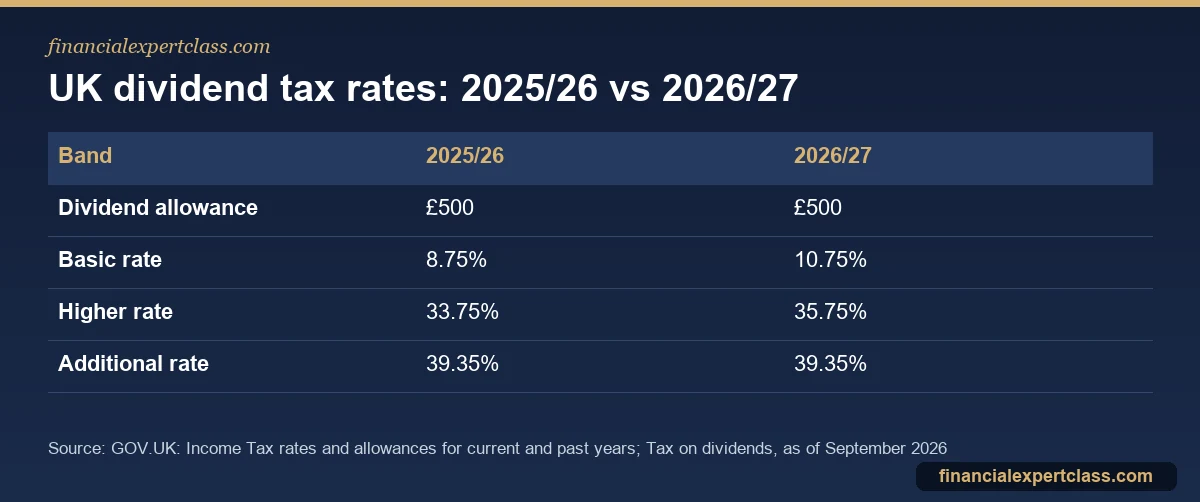
The dividend allowance stays at £500, the same as 2024/25 and 2025/26 (it was £1,000 in 2023/24). What changed is the rate you pay above it. Basic-rate taxpayers now pay 10.75% instead of 8.75%. Similarly, higher-rate taxpayers pay 35.75% instead of 33.75%. The additional rate, however, stays at 39.35%.
These rates apply across the whole UK. Scotland sets its own rates on wages and pensions. But gov.uk confirms that Scottish taxpayers “pay the same tax as the rest of the UK on dividends and savings interest”. Still, Scotland’s different bands can affect which rate you fall into. So check your position if you live there.
How to work out what you owe
You do not need a special calculator, because the method is five steps.
- Add up all your income for the tax year: salary, pension, rental profit, savings interest and dividends. Gov.uk says to “add your total dividend income to your other income” to work out your band.
- Take off your Personal Allowance. The standard allowance is £12,570. It falls by £1 for every £2 of adjusted net income above £100,000, and it is zero at £125,140 or more. Also, any dividends that fall within unused Personal Allowance are tax-free.
- Find your band. With the standard allowance, basic rate covers taxable income from £12,571 to £50,270. Then higher rate covers £50,271 to £125,140, and additional rate applies above £125,140.
- Apply the £500 dividend allowance to the first £500 of dividends.
- Charge the rest at 10.75%, 35.75% or 39.35%, depending on the band each pound falls in. If your dividends straddle a band, you pay more than one rate.
Here is gov.uk’s own example. Take £29,570 of wages plus £3,000 of dividends, which gives total income of £32,570. After the £12,570 Personal Allowance, taxable income is £20,000, so it all sits within the basic-rate band. You pay 20% on £17,000 of wages and nothing on £500 of dividends. Then you pay 10.75% on the remaining £2,500 of dividends, which is £268.75.
Worked examples for 2026/27
Here are five common situations, worked out with the gov.uk rates. Each assumes a standard Personal Allowance, no Scottish residence and no other savings income.

A few notes on the examples:
- The £15,000 dividends-only case shows how powerful the Personal Allowance is. It covers the first £12,570 of dividends. Next, the dividend allowance covers £500. As a result, HMRC charges tax on only £1,930.
- In the £150,000 case, income is above £125,140. So the Personal Allowance has gone completely. Therefore every dividend pound above the £500 allowance costs 39.35%.
- Between £100,000 and £125,140 of income, the tapering Personal Allowance creates a much higher effective marginal rate. So if you are in that range, extra dividends can cost more than the headline rate suggests.
ISAs and SIPPs: the simplest fix
Gov.uk is explicit: “You do not pay tax on dividends from shares in an ISA.” Pensions work in a similar way while the money stays invested. Investments inside a SIPP grow free from UK income tax and capital gains tax. For an ETF investor, the whole question therefore disappears if your income funds sit inside a wrapper.
- Stocks & Shares ISA: up to £20,000 a year in 2026/27 across all your ISAs. Dividends and gains are tax-free, and you do not need to report them.
- SIPP: contributions get tax relief, and HMRC does not tax income inside the pension as it arises. However, you generally pay income tax on withdrawals later, apart from any tax-free lump sum.
For most investors, the practical order is simple. First, fill the ISA with your dividend-paying and bond funds. Then, if you run out of allowance, hold lower-yielding or accumulating growth funds outside it. Our ISA vs LISA vs SIPP decision tree helps with the choice of wrapper.
ETF dividends, bond funds and foreign income
Many UCITS ETFs that UK investors buy are domiciled in Ireland or Luxembourg. So their distributions count as foreign income. A few rules matter:
- Equity ETF distributions count as dividends at the rates above, and they use the same £500 allowance.
- Bond ETF distributions are different. HMRC’s Investment Funds Manual covers an offshore fund that holds more than 60% of its assets in interest-bearing (or economically similar) form. In that case, HMRC treats distributions as interest, not dividends. They then use your savings allowances and savings tax rates instead.
- Accumulating ETFs still create taxable income. Offshore reporting funds report reinvested income to investors as “excess reportable income”. You owe tax on it even though you received no cash. Our guide to accumulating vs distributing ETFs and excess reportable income explains how to find and report it.
- Withholding tax. A foreign company or fund may have already deducted tax. If so, you can usually claim Foreign Tax Credit Relief on your tax return. The relevant double-taxation agreement limits that relief, as does what the UK tax would have been. Also, tax withheld on dividends received inside an ETF (for example on the US shares it holds) is a cost the fund bears. It does not appear on your own tax return. Our ETF withholding tax calculator compares Irish and Luxembourg domicile.
How to report dividend income to HMRC
Gov.uk sets out two routes:
- Dividends up to £10,000: if you already file a Self Assessment return, report them there. If not, tell HMRC after 5 April and before 5 October. You can either ask HMRC to update your tax code or contact the helpline. However, you do not need to tell HMRC if your dividends are within the dividend allowance.
- Dividends over £10,000: you must complete a Self Assessment return. If you do not usually file one, register by 5 October after the end of the tax year.
For foreign dividends, gov.uk says you may not need a return. That applies if your only foreign income is dividends and your total dividends, including UK ones, are below the £500 allowance. You must also have nothing else to report.
If you are an EU resident rather than UK, the rules are completely different. Our EU dividend tax calculator by country covers that side.
Frequently asked questions
What is the dividend allowance for 2026/27?
It is £500. You pay nothing on the first £500 of dividends in the tax year from 6 April 2026 to 5 April 2027. That is on top of any unused Personal Allowance. The allowance was also £500 in 2024/25 and 2025/26, and £1,000 in 2023/24.
What are the dividend tax rates for 2026/27?
On dividends above the £500 allowance, the rates are 10.75% for basic-rate taxpayers and 35.75% for higher-rate taxpayers. Additional-rate taxpayers pay 39.35%. The basic and higher rates rose from 8.75% and 33.75% in 2025/26.
How much tax will I pay on £10,000 of dividends?
It depends on your other income. With no other income, the Personal Allowance covers £12,570 of dividends, so £10,000 is tax-free. But if you are already a higher-rate taxpayer from salary, you pay 35.75% on £9,500, which is £3,396.25. If the dividends straddle bands, you pay each rate on the part that falls in that band.
Do I pay dividend tax on ETFs in an ISA?
No. Dividends and distributions from ETFs held in a Stocks & Shares ISA are tax-free, and you do not need to report them to HMRC. The same is true inside a SIPP, although you pay income tax on pension withdrawals later.
Cited sources: GOV.UK: Tax on dividends, GOV.UK: Income Tax rates and allowances, current and past, GOV.UK: Income Tax rates and Personal Allowances, GOV.UK: Scottish Income Tax, GOV.UK: Tax on foreign income, HMRC Investment Funds Manual IFM13320, GOV.UK: Individual Savings Accounts, and Trading 212 Help Centre: what is a SIPP. Verify current fund figures before investing. Educational content, not financial advice.
Not personalised financial advice. Verify your situation with a qualified adviser. Operated by Aurum Digital Marketing LTD (UK), Companies House 15203665.
European UCITS/ETF investor with 11+ years building a global dividend and index portfolio, and founder of Financial Expert Class. I write every guide here from first-hand experience investing across EU brokers and tax regimes — not theory. More about me →