
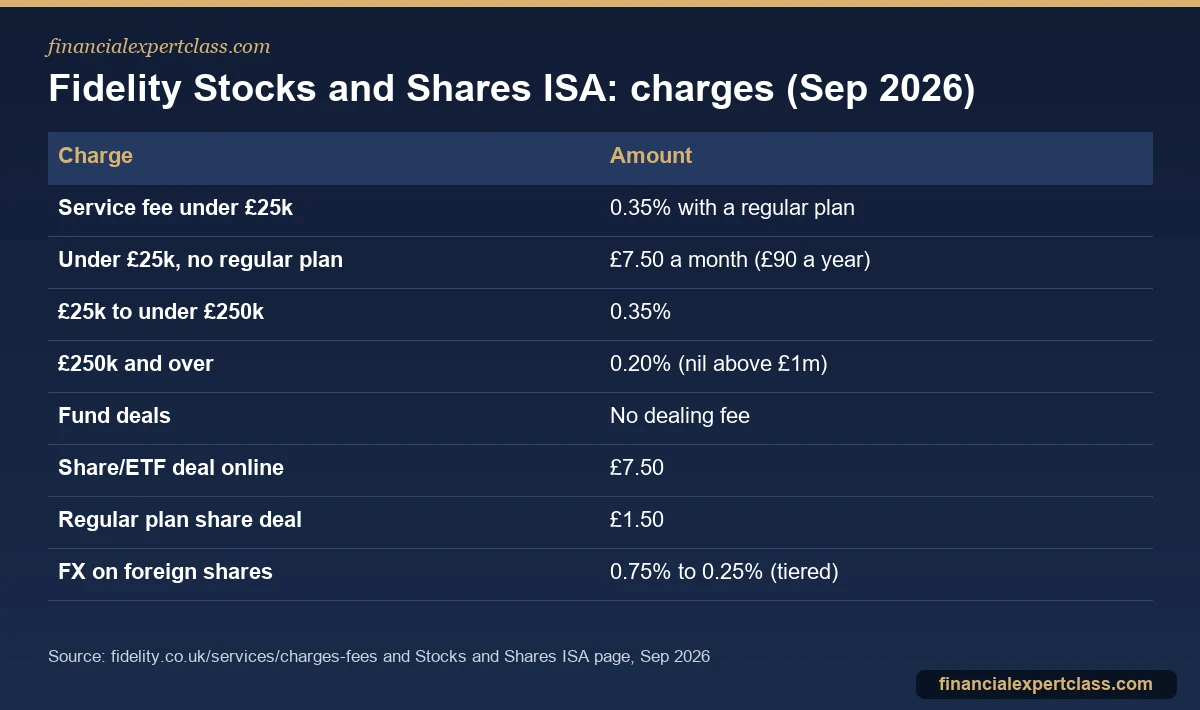
The Fidelity Stocks and Shares ISA suits UK investors who mainly buy funds. Fund deals carry no dealing charge, and the service fee is 0.35% a year. It falls to 0.20% above £250,000 and is capped at £2,000. However, small accounts without a regular savings plan pay a flat £90 a year instead. Also, share or ETF deals cost £7.50 online.
Comparing options? Take the decision workbook with you.
- The ETF Comparison Workbook — 10 pages: the 7-filter framework for choosing between two good funds
- + 2 bonus PDFs: ETF Starter Kit and Dividend Starter Sheet
- + a free lesson from the €147 Masterclass
Fidelity ISA at a glance
Financial Administration Services Limited runs Fidelity’s UK investment platform. The Financial Conduct Authority authorises and regulates it (FCA register number 122169). It is one of the UK’s large fund supermarkets. For example, Fidelity says it serves more than 1.7 million UK investors (as at 30 June 2026). It also says its investment finder covers more than 3,000 funds, alongside shares, ETFs and investment trusts. Fidelity Index World and the other main trackers are compared, with platform costs, in our global index funds guide.
The Stocks and Shares ISA lets you use your full annual ISA allowance. Gov.uk confirms this is £20,000 for the 2026 to 2027 tax year. You can start with a £25 monthly regular savings plan or a £1,000 lump sum. Alongside the ISA, Fidelity offers a SIPP, a general Investment Account, and Junior ISA and Junior SIPP accounts.
Fidelity Stocks and Shares ISA service fee
Fidelity’s main charge is a service fee based on the total you hold with it across your personal accounts:
- Less than £25,000: 0.35% a year if you have a regular savings plan. If you do not, it is a flat £7.50 a month (£90 a year).
- £25,000 to under £250,000: 0.35% of the total value.
- £250,000 to under £1 million: 0.20%, plus access to Fidelity’s Wealth Management Service benefits.
- £1 million or more: 0.20% on the first £1 million and nothing above that. So the most you will ever pay in service fees across all personal accounts is £2,000 a year.
There is an important detail for ETF investors. Take exchange-traded investments (shares, ETFs and investment trusts) held in an ISA or SIPP. On these, the service fee is 0.35% (0.20% above £250,000), but it has a cap of £7.50 a month. In addition, junior accounts pay no service fee. Fidelity does not charge a service fee on cash or an exit fee either.
Dealing charges
Fidelity does not charge dealing fees on fund deals. As a result, buying, selling and switching unit trusts and OEICs is free at the platform level. Dealing fees apply only to exchange-traded investments:
- £7.50 for each share, ETF or investment trust deal placed online.
- £1.50 for deals made as part of a regular savings or withdrawal plan, or to reinvest income or a dividend.
- £30 for a deal placed by phone.
Stamp Duty of 0.5% applies to purchases of UK shares (1% for Irish shares). For international shares, Fidelity also adds a tiered FX charge. It is 0.75% on the first £10,000 and 0.50% on the portion between £10,000 and £20,000. Above that, it falls to 0.25%. For example, Fidelity’s own example of a £15,000 international share purchase comes to £107.50 in FX and dealing charges. However, if you buy a London-listed ETF priced in sterling, that FX layer does not apply.
Fund and ETF running costs sit on top of the platform charges. Fidelity notes that fund ongoing charges on its platform start from as low as 0.05%.
What it costs in practice
Fidelity publishes worked examples of the annual service fee. At £5,000 invested, you pay £17.50 a year with a regular savings plan but £90 without one. At £55,000 the fee is £192.50, and at £100,000 it is £350. Then at £250,000 it drops to £500 thanks to the lower 0.20% rate.

Two practical conclusions follow. First, if your ISA is under £25,000, set up a regular savings plan, even a small one. It turns a flat £90 into a percentage fee that is much lower on modest balances. Second, percentage fees grow with your pot. So once you pass roughly £50,000 to £100,000, a flat-fee platform or a zero-commission app can work out cheaper. That is especially true for a simple ETF portfolio. Our compound growth calculator shows what a 0.35% drag means over 20 or 30 years. It is worth running the numbers for your own expected contributions before you commit.
Investment choice
Fidelity’s strength is breadth. Its ISA page highlights funds from Fidelity, M&G, Fundsmith, Vanguard and many other managers. It also offers UK, European and US shares. For hands-off investors there is a ready-made ISA option built on Fidelity’s diversified funds. In addition, a “Select 50” shortlist narrows more than 3,000 funds to around 50 picks.
For index investors, the choice is between a fund version and an ETF version of the same index. Funds deal free but carry the uncapped percentage service fee. ETFs, on the other hand, cost £7.50 per online deal (or £1.50 in a regular plan). But their service fee has a cap of £7.50 a month. So for a large portfolio held in one or two world ETFs, that cap can make a real difference. Our guide to index funds vs ETFs explains the trade-off. Also, our best global ETFs for UK investors lists candidates.
Cash, interest and transfers
Fidelity keeps cash in your account as cash. It does not charge a service fee on cash or for withdrawals, and it pays interest on cash balances. Fidelity is open about the trade-off, though. It keeps part of the interest it earns from its banks to fund development and keep platform fees low. Its “how we manage your cash” page lists the rate it pays and the banks it uses. So check them if you tend to hold large cash balances between investments.
To move an existing ISA to Fidelity, you use its transfer service. This also handles pensions, investment accounts and junior accounts. Always transfer rather than withdraw and re-deposit. That is because withdrawing money from an ISA and paying it into another provider can use up your annual allowance. Before you move, compare the new service fee with what you pay now. For instance, on a £60,000 portfolio a 0.35% fee is £210 a year. The gap to a flat-fee or zero-commission platform then compounds over time.
Is the Fidelity ISA right for you?
- Good fit: investors who want a large fund range, free fund switching, research tools and phone support. It also suits those who want a long-established provider, especially with a regular savings plan.
- Weaker fit: small lump-sum investors without a regular plan, since the £90 flat fee bites. It is also weaker for very large simple ETF portfolios better suited to flat-fee platforms, and for frequent traders of shares.
Still choosing between wrappers? Our overview of ISA, LISA and SIPP for UCITS ETF investors covers the rules. Fidelity also accepts transfers of existing ISAs, pensions and investment accounts, and does not charge an exit fee.
Frequently asked questions
Is Fidelity good for a Stocks and Shares ISA?
It is a strong choice for fund investors who use a regular savings plan. Fund dealing is free, and the service fee is 0.35%, falling to 0.20% above £250,000. However, it is less competitive for small lump sums without a regular plan, which pay £90 a year.
What is the downside to Fidelity?
The first drawback is the flat £7.50 monthly fee for accounts under £25,000 without a regular savings plan. Next, there is the £7.50 charge on online share and ETF deals. Finally, there is a tiered FX charge starting at 0.75% on international shares.
How much do I need to open a Fidelity ISA?
According to Fidelity’s ISA page, you can start from £25 a month with a regular savings plan. Otherwise, you can start from £1,000 as a lump sum.
Can I hold ETFs in a Fidelity Stocks and Shares ISA?
Yes. Fidelity’s ISA offers shares, ETFs and investment trusts alongside funds. ETF deals cost £7.50 online or £1.50 through a regular savings plan. Also, the service fee on exchange-traded investments is 0.35%, capped at £7.50 a month.
Does Fidelity charge to transfer out?
No. Fidelity lists exit fees among the things it does not charge for. It also does not charge a service fee on cash held in your accounts.
Cited sources: Fidelity: charges and fees, Fidelity: Stocks and Shares ISA, and GOV.UK: Individual Savings Accounts. Verify current fund figures before investing. Educational content, not financial advice.
Not personalised financial advice. Verify your situation with a qualified adviser. Operated by Aurum Digital Marketing LTD (UK), Companies House 15203665.
European UCITS/ETF investor with 11+ years building a global dividend and index portfolio, and founder of Financial Expert Class. I write every guide here from first-hand experience investing across EU brokers and tax regimes — not theory. More about me →