
Global index funds for UK investors now cost between 0.07% and 0.23% a year. However, the platform you hold them on often costs more than the fund itself. For most people, the HSBC FTSE All-World Index Fund (0.13%) is the cheapest one-fund OEIC that includes emerging markets. Meanwhile, Vanguard’s new VALL ETF (0.07%) is the cheapest way to own the whole world, small companies included. So the real decision is a route: a fund on a percentage-fee platform, or an ETF on a flat-fee or zero-fee one. This guide prices both, using each provider’s own October 2026 figures.
Comparing options? Take the decision workbook with you.
- The ETF Comparison Workbook — 10 pages: the 7-filter framework for choosing between two good funds
- + 2 bonus PDFs: ETF Starter Kit and Dividend Starter Sheet
- + a free lesson from the €147 Masterclass
The short answer: which global index fund suits whom
All the global index funds below track the world stock market, so they behave much alike. In practice, the cost of the account and the type of index matter more than the brand on the fund. Here is the summary before the detail.
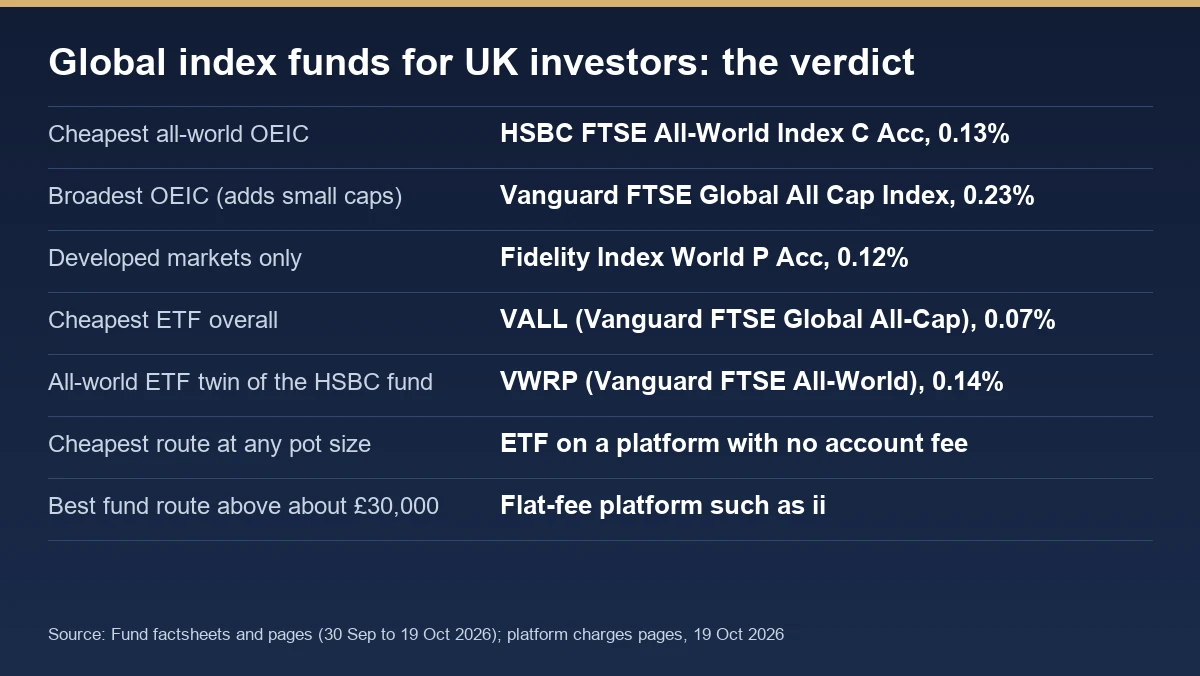
- Saving £50 to £500 a month: an ETF such as VALL or VWRP on a platform with no account fee. On £200 a month, the first year costs under £1 on InvestEngine or Trading 212, against about £50 on Vanguard Investor.
- A lump sum of £20,000 to £100,000: still an ETF route if you want the lowest cost. Alternatively, AJ Bell’s capped ETF charge keeps VALL under £120 a year even at £100,000.
- You want a traditional fund (OEIC): the HSBC FTSE All-World Index Fund on AJ Bell, or on interactive investor once your pot passes about £30,000.
- You want small companies too: VALL as an ETF, or the Vanguard FTSE Global All Cap Index Fund as an OEIC.
- Developed markets only: Fidelity Index World (0.12%), which leaves out emerging markets.
The contenders at a glance
We compared four UK global index funds (OEICs) with the two biggest Vanguard ETFs. All figures come from the provider’s own factsheet or fund page. Holdings and country weights are at 30 September 2026.

Two things stand out. First, all of these global index funds put about three fifths of your money in the US, because US companies are the largest. Second, the number of holdings varies a lot. That is because the indices differ, not because one fund is more careful than another.
The four global index funds (OEICs)
An OEIC is a UK-based open-ended fund. You buy and sell units directly with the fund manager at one price a day. These four are the most widely held global index funds on UK platforms.
HSBC FTSE All-World Index Fund
This fund follows the FTSE All-World Index of large and medium-sized companies in developed and emerging markets. The C accumulation class has an ongoing charge of 0.130%. The fund holds 3,311 shares against 4,167 in the index, because it buys a representative sample. It also manages about £7.8 billion and values its units once a day at 12:00 UK time.
The US is 61.24% of the fund, Japan 5.98% and the UK 3.03%. Over the 12 months to 30 September 2026 it returned 18.60%, against 18.67% for the index. Over ten years the gap is 0.33 percentage points a year, so the fund tracks closely. Our full HSBC FTSE All-World review covers the share classes in more detail.
Vanguard FTSE Global All Cap Index Fund
This is the broadest of the four. It tracks the FTSE Global All Cap Index, which adds small companies to the large and mid-sized ones. As a result, the fund holds 7,336 shares against 10,221 in the index. Its total assets are about £10.6 billion. The retail accumulation class charges 0.23%, plus transaction costs of 0.03%.
The US is 62.5% of the fund, Japan 6.1% and the UK 3.1%. Over the 12 months to 30 September 2026, the accumulation class returned 17.81%, while the index made 18.02%. So the higher charge shows up as a slightly wider gap. That is the price of small caps in a fund wrapper.
Fidelity Index World Fund
Fidelity’s fund tracks the MSCI World Index. In other words, it covers developed markets only and leaves out China, India, Taiwan and the other emerging markets. The P accumulation class charges 0.12%, with transaction costs of 0.01%. It holds 1,252 shares and manages about £16.7 billion.
Because it skips emerging markets, its top ten holdings make up 27.52% of the fund. That is more concentrated than an all-world fund. Over the 12 months to 30 September 2026 it returned 17.44%. If you choose it, you can add an emerging-markets fund such as the Vanguard Emerging Markets Stock Index Fund for a full world mix.
Vanguard LifeStrategy 100% Equity
LifeStrategy 100 is not a pure global tracker. Instead, it is a fund of Vanguard index funds with a deliberate tilt towards the UK. At 30 September 2026, the Vanguard FTSE UK All Share fund made up 19.98% of it. By contrast, the UK is only about 3% of a world index. The A accumulation class now charges 0.20%, after a cut in January 2026.
So LifeStrategy 100 suits people who want more UK exposure on purpose. If you simply want the world market, the three funds above do that more directly. Our LifeStrategy comparison covers the versions that hold bonds too.
Comparing funds? The 7 filters that shrink 3,000+ ETFs to a shortlist. Run any fund through seven checks in the right order, with worked examples on October 2026 data. The full lesson, free, no sign-up.
Read the free lesson →The ETF alternatives: VWRP and VALL
ETFs are funds that trade on the stock exchange like shares. Both ETFs below are Irish-based, and both can sit in an ISA or SIPP on the platforms in this guide. Above all, they are the lowest-cost way to own the world market on many UK platforms. VALL has UK reporting status; if you hold any ETF outside a wrapper, check it on HMRC’s list of reporting funds.
Vanguard FTSE All-World UCITS ETF (VWRP)
VWRP is the accumulating London listing of one of Europe’s largest ETFs. It tracks the same FTSE All-World Index as the HSBC fund. Vanguard cut its ongoing charge from 0.19% to 0.14% on 28 July 2026. The fund holds about 3,755 shares and has around £66 billion in total net assets. Therefore, it is the closest ETF match to the HSBC fund, at a similar price.
Vanguard FTSE Global All-Cap UCITS ETF (VALL)
VALL launched on 18 August 2026 and charges 0.07%. It tracks the same FTSE Global All Cap Index as Vanguard’s 0.23% index fund. In other words, it gives you the same market, small caps included, at less than a third of the fund’s charge. It holds 6,977 of the index’s 10,221 shares and had $2.6 billion in assets after six weeks. The London listing VALL trades in pounds. Our VALL review compares it with the other all-world ETFs.
If you prefer an ETF on the MSCI World Index instead, the iShares Core MSCI World ETF (SWDA) charges 0.20%. Our guide to the best global ETFs for UK investors covers more of them.
OEIC or ETF: what actually differs for a UK investor
Inside an ISA or SIPP, global index funds and ETFs that track the same index give you almost the same result. The differences sit in how you buy them, what the platform charges and how tax works outside a wrapper.
Pricing and dealing
An OEIC deals once a day at a single price, for example at 12:00 for the HSBC and Vanguard funds. You can invest any amount, and most platforms let you buy fractions of a unit. An ETF, by contrast, trades all day at the market price. So you pay a small bid-offer spread, and sometimes a dealing charge per trade. However, many platforms now offer free regular investing and fractional ETFs, which removes most of that difference.
Vanguard also uses swing pricing on its funds. This means the price can move slightly on busy days, so that large buyers and sellers pay their own trading costs. It protects existing investors, but it can widen the gap to the index for a day.
How platforms charge for each
For global index funds, this is the difference that matters most. Many UK platforms charge a percentage on funds with no cap. Yet the same platforms often cap the charge on ETFs and shares. For example, HL charges 0.35% on funds up to £250,000, but caps its charge on ETFs at £12.50 a month. AJ Bell charges 0.25% on funds, but caps ETFs at £3.50 a month. As a result, a large pot in an ETF can cost far less than the same pot in an OEIC on the same platform.
Tax outside an ISA or SIPP
Inside an ISA or SIPP, neither type creates UK tax for you. Outside a wrapper, both accumulation OEICs and accumulation ETFs create taxable income, even though you never receive it in cash. The difference is the paperwork. A UK fund shows that income on its tax voucher. An offshore ETF with UK reporting status reports it as excess reportable income, which you look up yourself. Our guide to excess reportable income explains how.
What protects your money
The assets of global index funds and ETFs sit with a separate depositary, not with the fund manager or the platform. On top of that, the Financial Services Compensation Scheme covers up to £85,000 per person, per firm, if an authorised firm fails and money or assets go missing. It does not cover losses from falling markets. This applies to OEICs and ETFs alike.
What global index funds really cost on each platform
We modelled the full yearly cost of ten common routes into global index funds. The cost includes the platform’s account charge, the dealing charge on one purchase and the fund’s ongoing charge. First, here are the platform tariffs we used, taken from each provider’s own charges page on 19 October 2026.
The platform charges we used
The full cost grid for global index funds
Next, the full grid. Each figure is the total cost for one year, with the value held steady. The monthly saver column assumes £200 a month for twelve months, so about £1,300 sits invested on average.
| Route (fund @ platform) | £200 a month, year one | £5,000 lump sum | £20,000 lump sum | £50,000 lump sum | £100,000 lump sum | £250,000 lump sum |
|---|---|---|---|---|---|---|
| HSBC All-World fund on HL | £6.24 | £25.95 | £97.95 | £241.95 | £481.95 | £1,201.95 |
| HSBC All-World fund on AJ Bell | £4.94 | £20.50 | £77.50 | £191.50 | £381.50 | £951.50 |
| HSBC All-World fund on Fidelity | £6.24 | £24.00 | £96.00 | £240.00 | £480.00 | £825.00 |
| HSBC All-World fund on ii | £73.57 | £82.37 | £101.87 | £140.87 | £205.87 | £506.37 |
| Vanguard Global All Cap fund on Vanguard | £50.99 | £59.50 | £94.00 | £190.00 | £380.00 | £950.00 |
| VWRP on Vanguard Investor | £49.82 | £55.00 | £76.00 | £145.00 | £290.00 | £725.00 |
| VALL on HL | £5.46 | £27.95 | £90.95 | £191.95 | £226.95 | £331.95 |
| VALL on AJ Bell | £4.16 | £21.00 | £61.00 | £82.00 | £117.00 | £222.00 |
| VALL on Interactive Brokers | £36.91 | £39.50 | £57.00 | £93.00 | £153.00 | £333.00 |
| VALL on InvestEngine or Trading 212 | £0.91 | £3.50 | £14.00 | £35.00 | £70.00 | £175.00 |
Two pot sizes side by side
At £20,000, the gaps are already clear. The cheapest route costs £14 a year, while the most expensive costs about £102.
At £100,000, the picture changes. Percentage fees on funds now cost hundreds of pounds, so the flat or capped routes pull ahead.
What the numbers show about global index funds
- A zero-fee ETF route is cheapest at every size. VALL on InvestEngine or Trading 212 costs only its 0.07% charge, for example £70 a year at £100,000.
- AJ Bell is the best value of the percentage platforms. Its ETF cap makes VALL cost £117 at £100,000, and its 0.25% fund charge is the lowest for the HSBC fund up to about £30,000.
- Flat fees win for big fund pots. On interactive investor, the HSBC fund costs £206 a year at £100,000, against about £482 on HL.
- Small monthly savers should avoid minimum fees. Vanguard Investor’s £4 a month and interactive investor’s £5.99 a month dwarf the fund charge on a £1,300 pot.
These are first-year figures for a single purchase. Real costs also include ETF bid-offer spreads and any extra trades you make. Platforms change their prices too, so check the live charges page before you choose.
Where Interactive Brokers fits
Interactive Brokers offers a Stocks and Shares ISA through Interactive Brokers (U.K.) Limited. There is no custody fee and no platform fee. However, the ISA has a minimum activity fee of £3 a month, and your trading commissions count towards it. UK-listed ETFs cost from £3 a trade, or 0.05% above £6,000 on the fixed plan. In addition, currency conversion costs about 0.03%, which helps if you hold assets in dollars or euros.
In our model, VALL in an Interactive Brokers ISA costs £153 a year at £100,000. That beats every fund route in our table. It also beats Vanguard Investor and HL for ETFs at that size. On the other hand, the £3 monthly minimum makes it a poor choice for small monthly savers. For example, £200 a month costs about £37 in the first year, against under £1 on a zero-fee app.
So Interactive Brokers suits larger pots, investors who want both ETFs and other global assets in one ISA, and people who move money between currencies. It also offers mutual funds in the ISA, at nil to £4.95 a deal for UK funds, so check its fund search for the OEIC you want.
How to buy VALL on Interactive Brokers
The steps are short, so most people finish in one sitting:
- Open a Stocks and Shares ISA with Interactive Brokers and fund it in pounds.
- Search for the ticker VALL on the London Stock Exchange, or VWRP if you prefer the All-World index.
- Place a limit order close to the current price during London market hours.
- Then set up a recurring investment if you want to add money each month.
Our Interactive Brokers ISA guide walks through each screen.
Which global index fund should you pick?
With global index funds, start with the index, then pick the cheapest route to it. The steps below settle most cases.
For most beginners, one all-world fund is enough. For instance, the HSBC FTSE All-World fund and VWRP give you about 4,000 companies in one holding. If you also want the long tail of smaller companies, VALL or the Vanguard Global All Cap fund adds thousands more. Either way, keep it simple: one global fund, plus cash or bonds if you need lower risk.
If you want a fund that already includes bonds, look at Vanguard LifeStrategy 60 or 80. If you are weighing funds against ETFs more broadly, our index funds vs ETFs guide goes further.
Common mistakes with global index funds
- Buying the wrong share class. Funds have income and accumulation units, and some classes cost more. Check that you buy the class your platform quotes, such as HSBC’s C class at 0.13%.
- Holding two world funds at once. A world fund plus an all-world fund mostly owns the same companies twice. Our overlap calculator shows how much.
- Ignoring the platform charge. On a £100,000 pot, a 0.35% uncapped fee is £350 a year, which is almost three times the HSBC fund’s own charge.
- Assuming LifeStrategy is a world tracker. It holds about a fifth in UK shares by design.
- Chasing last year’s winner. The three OEICs with a full year of data returned between 17.44% and 18.60% over the 12 months to September 2026. So costs and the index you choose matter more than recent returns.
Where to buy each global index fund
Not every platform sells all of these global index funds. In particular, the zero-fee apps only offer ETFs, while some fund platforms only sell their own funds. This table shows where each route is available.
Fund platforms
| Platform | What you can hold | Charges in brief (ISA, October 2026) |
|---|---|---|
| Hargreaves Lansdown | All the OEICs here, and also VWRP and VALL. | Funds cost 0.35%, tiered down from £250,000. However, shares and ETFs are capped at £12.50 a month. A fund deal is £1.95 and a share deal £6.95, but monthly Direct Debits are free. |
| AJ Bell | All the OEICs here, and also VWRP and VALL. | Funds cost 0.25%, tiered. Meanwhile, shares and ETFs are capped at £3.50 a month. A fund deal is £1.50 and a share deal £5, while regular investing is free. |
| Fidelity | All the OEICs here, and also VWRP and VALL. | The fee is 0.35%, then 0.20% from £250,000. Also, ETFs in an ISA are capped at £7.50 a month. Fund deals are free, but under £25,000 you need a regular savings plan or you pay £7.50 a month. |
| interactive investor | All the OEICs here, and also VWRP and VALL. | The Core plan is £5.99 a month up to £100,000, then Plus is £14.99. Trades cost £3.99 on Core, while regular investing is free. |
| Vanguard Investor | Vanguard funds only, such as Global All Cap and LifeStrategy, and also Vanguard ETFs such as VWRP. | The fee is £4 a month under £32,000, then 0.15% capped at £375 a year. Also, there is no fund dealing charge. |
| Chip | The HSBC FTSE All-World fund, but not these ETFs. | The fee is 0.25% a year, or instead £5.99 a month with ChipX. |
ETF platforms and brokers
| Platform | What you can hold | Charges in brief (ISA, October 2026) |
|---|---|---|
| Interactive Brokers | VWRP and VALL, and also mutual funds at nil to £4.95 a deal, so check its fund search for your fund. | There is no custody fee. However, a £3 monthly minimum applies, UK trades start at £3 and FX costs about 0.03%. |
| InvestEngine | ETFs only, so VWRP and VALL but no OEICs. | There is no platform fee on DIY ISAs, SIPPs and general accounts, and also no dealing fee. |
| Trading 212 | ETFs only, so VWRP and VALL but no OEICs. | There is no account fee and also no commission on UK-listed ETFs. |
| Lightyear | UK-listed ETFs, but no OEICs. | There is no account fee and no transaction fee, while non-sterling assets carry 0.10% FX (June 2026). |
More platform guides
For a fuller platform comparison, see our guides to the best broker for UK investors, InvestEngine vs Trading 212, AJ Bell vs Trading 212 and Hargreaves Lansdown vs Trading 212. We also cover the Vanguard Investor platform, the Fidelity ISA and the InvestEngine platform in separate reviews.
Frequently asked questions
What is the best global index fund in the UK?
For a single OEIC, the HSBC FTSE All-World Index Fund is the cheapest all-world option at 0.13%. However, the best overall route for most people is an ETF such as VALL (0.07%) or VWRP (0.14%) on a platform with no account fee.
Is an index fund or an ETF better in a Stocks and Shares ISA?
Inside an ISA they give almost the same result if they track the same index. So the platform decides it: ETFs usually win on platforms that cap ETF charges or charge nothing, while funds suit platforms with free fund dealing.
What is the cheapest global tracker for UK investors?
At October 2026 prices, VALL is the cheapest at 0.07% a year. On InvestEngine or Trading 212, which charge no account fee, that is the whole yearly cost apart from small trading spreads.
Is the Vanguard FTSE Global All Cap Index Fund a good fund?
Yes, it is a broad, well-run tracker with about 7,300 holdings. But its 0.23% charge is now high next to VALL, the 0.07% ETF on the same index.
Can I buy the HSBC FTSE All-World Index Fund on Trading 212?
No. Trading 212 offers shares and ETFs, not OEICs. Instead, you can buy VWRP there, which tracks the same FTSE All-World Index.
Are global index funds risky?
Yes. Global index funds hold only shares, so their value can fall sharply in a downturn. For example, the HSBC fund lost 3.27% in the year to September 2022. Spreading money across thousands of companies reduces company risk, but not market risk.
Cited sources: HSBC All-World factsheet (Sep 2026), Vanguard Global All Cap fund page, Global All Cap charges (Fidelity), Fidelity Index World data, LifeStrategy 100 data, VWRP data, VWRP fee cut (ii), VALL factsheet (Sep 2026), SWDA charges, HL ISA charges, AJ Bell ISA charges, Fidelity charges, ii charges, Vanguard Investor fees, Interactive Brokers ISA, IBKR commissions, InvestEngine fees, Chip fund page, Lightyear UK pricing, and FSCS investments. Verify current fund figures before investing. Educational content, not financial advice.
Not personalised financial advice. Verify your situation with a qualified adviser. Operated by Aurum Digital Marketing LTD (UK), Companies House 15203665.
European UCITS/ETF investor with 11+ years building a global dividend and index portfolio, and founder of Financial Expert Class. I write every guide here from first-hand experience investing across EU brokers and tax regimes — not theory. More about me →