
In the Hargreaves Lansdown vs Trading 212 contest, Trading 212 is much cheaper for a simple ETF portfolio. It charges no account fee and no commission, only a 0.15% FX fee on foreign-currency trades. By contrast, HL charges 0.35% a year (capped at £12.50 a month on ETFs and shares) and £6.95 per online share deal. However, it offers thousands of funds, a Lifetime ISA, phone support and research.
Comparing options? Take the decision workbook with you.
- The ETF Comparison Workbook — 10 pages: the 7-filter framework for choosing between two good funds
- + 2 bonus PDFs: ETF Starter Kit and Dividend Starter Sheet
- + a free lesson from the €147 Masterclass
Hargreaves Lansdown vs Trading 212: the short answer
Hargreaves Lansdown (HL) and Trading 212 sit at opposite ends of the UK market. HL is a full-service investment platform with a large fund range and research. It also has a Bristol-based support team and every mainstream account type. Trading 212, on the other hand, is an app-first broker. It charges no commission and no custody fee on shares and ETFs. Instead, it makes its money mainly from its FX fee and share lending. Our global index funds comparison works out the yearly cost of the HSBC fund and VALL on HL and on the zero-fee apps.
- Choose Trading 212 if you invest in ETFs and shares and want the lowest running costs. It also suits you if you are comfortable doing everything in an app.
- Choose HL if you want open-ended funds (unit trusts and OEICs), a Lifetime ISA, research and phone support. It also fits if you value one provider for ISA, SIPP, cash savings and children’s accounts.
Account charges
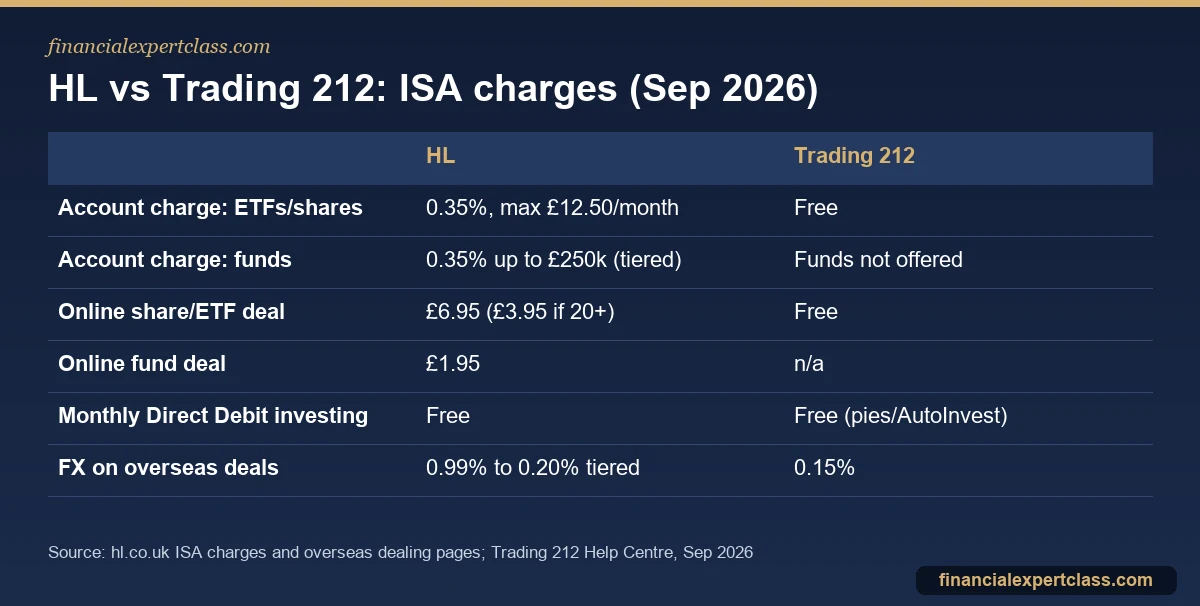
HL’s Stocks and Shares ISA has two account charges, billed monthly:
- Funds: 0.35% a year on the first £250,000 and 0.25% from £250,000 to £1 million. Then it is 0.10% from £1 million to £2 million, and nothing above £2 million.
- Shares and other equities, including ETFs, investment trusts, bonds and gilts: 0.35% a year, capped at £12.50 a month.
HL does not charge for holding uninvested cash, for opening or closing an account, or for transferring out. The same account-charge structure also applies in the HL SIPP.
Trading 212’s Help Centre says the only fee it can charge in the Invest account, the ISAs and the SIPP is the FX fee. Trading commission is free and custody is free. So on an ETF-only ISA, the difference is clear. For example, £20,000 of ETFs costs £70 a year in account charges at HL and nothing at Trading 212. However, HL’s cap means the charge on shares and ETFs never exceeds £150 a year, however large the pot.
Dealing charges and FX
At HL, online share deals (including ETFs, investment trusts, bonds and gilts) cost £6.95. That falls to £3.95 if you made 20 or more share trades the previous month. Fund deals cost £1.95 online, while phone or postal deals cost £29. Regular monthly investing by Direct Debit is free for funds. It is also free for selected shares, investment trusts and ETFs.
For overseas shares, HL adds a tiered FX charge to each band of the deal. It is 0.99% on the first £10,000 and 0.50% from £10,000 to £25,000. Above £25,000, it is 0.20%. So a £15,000 US share purchase pays 0.99% on the first £10,000 and 0.50% on the next £5,000. On top of that comes the £6.95 commission.
Trading 212 charges no commission. When you trade an instrument in another currency, it converts at the spot rate plus 0.15%. It shows this on the review screen before you confirm, including inside pies. Dividends carry no FX fee. However, the government taxes still apply on both platforms. First, there is 0.5% Stamp Duty Reserve Tax on UK share purchases (Trading 212 notes it does not apply to ETFs, gilts or bonds). Second, there is the £1.50 PTM levy on UK share trades over £10,000.
What it costs in practice
Take a UK investor holding only ETFs in a Stocks and Shares ISA and adding money by monthly Direct Debit. At HL the account charge is 0.35% up to the £150 annual cap, and the regular purchases are free. At Trading 212 the account charge is zero. Also, buying sterling-priced ETFs means no FX fee either.

The gap narrows in percentage terms for larger ETF portfolios because of HL’s cap. Still, on cost alone Trading 212 stays ahead for ETF investors. For fund investors, however, the maths is different. Trading 212’s Stocks and Shares ISA offers shares, ETFs and ready-made pies rather than unit trusts and OEICs. So if you want a specific active fund, HL may be the only one of the two that can hold it. HL also negotiates fund discounts on more than 500 funds. Our compound growth calculator helps you see what £150 a year means over several decades.
Accounts and wrappers
HL’s range is broad. It includes a Stocks and Shares ISA and a Lifetime ISA (with the 25% government bonus of up to £1,000 a year). There is also a Junior Stocks and Shares ISA, with no account charge or online dealing charge. In addition, HL offers a Fund and Share Account, SIPP, Junior SIPP, bare trust accounts, a Cash ISA and an Active Savings account.
Trading 212 offers an Invest account, a flexible Stocks and Shares ISA, a Cash ISA and a SIPP. It does not list a Lifetime ISA, and you can hold one of each ISA type. Its SIPP has no account fee, custody fee, commission or transfer fee. It also claims basic-rate tax relief for you, but it accepts only personal contributions. If you are deciding which wrapper to fill first, our guide to ISA, LISA and SIPP for ETF investors sets out the rules.
One rule matters for both: the overall ISA allowance stays at £20,000, as Trading 212’s Help Centre explains. The government had planned to cap Cash ISA contributions at £12,000 a year for people under 65 from 6 April 2027, but the Budget of 28 October 2026 reversed that cut.
What you get for HL’s higher price
HL argues that value matters more than the headline fee. For example, its charges page points to thousands of investment options, expert analysis and an award-winning app. It also highlights a Bristol-based client support team. In addition, HL says it finds a better share price than the quoted market price on 95% of trades. It says this saved clients more than £190 million on share deals in one year. Finally, it says it negotiates discounts averaging 17% on the ongoing charges of more than 500 funds.
Whether that is worth paying for is personal. If you hold a handful of ETFs and rarely need help, most of those benefits go unused. In that case, Trading 212’s zero account fee wins. But if you want a wide menu of funds, research to lean on and someone to call, HL’s charges buy something real. Some investors split the difference. They use a low-cost app for a simple ETF core and a full-service platform for pensions or funds that the app cannot hold.
Safety and service
The Financial Conduct Authority authorises and regulates Hargreaves Lansdown Asset Management Limited (firm reference 115248). Trading 212 UK Ltd. is also FCA-regulated and holds client money and assets under the FCA’s CASS rules. It states FSCS investment protection of up to £85,000 if the firm fails. It also states deposit protection of up to £120,000 per banking group if a partner bank fails. We cover Trading 212’s arrangements in detail in Is Trading 212 safe?
On service, HL leans on research, market commentary and UK-based phone support. Trading 212, meanwhile, leans on its app, pies and automation. Our Trading 212 review and the Trading 212 fees guide go further on the app side.
Frequently asked questions
Is Trading 212 cheaper than Hargreaves Lansdown?
For shares and ETFs, yes. Trading 212 charges no account fee or commission, only a 0.15% FX fee on foreign-currency trades. HL charges 0.35% a year on shares and ETFs (capped at £12.50 a month) and £6.95 per online share deal. However, monthly Direct Debit investing is free.
Can I hold funds like unit trusts at Trading 212?
Trading 212’s Stocks and Shares ISA centres on shares, ETFs and ready-made pies. So if you want traditional open-ended funds, a fund platform such as HL is the more natural home.
Does Trading 212 offer a Lifetime ISA?
Trading 212 lists a Cash ISA and a Stocks and Shares ISA among its ISA products, not a Lifetime ISA. By contrast, HL offers a Lifetime ISA with the 25% government bonus of up to £1,000 a year.
Can I transfer my ISA from HL to Trading 212?
Yes, you can move ISAs between providers, and HL says it does not charge for transferring out. Always use the formal ISA transfer process rather than withdrawing cash. Otherwise, you may lose the tax wrapper on that money.
Cited sources: HL: Stocks and Shares ISA charges, HL: pricing, fees and charges, HL: overseas share dealing, Trading 212: fees in Invest, ISAs and SIPP, Trading 212: FX fee, Trading 212: ISAs, Trading 212: ISA changes from April 2027, and Trading 212: how money is protected. Verify current fund figures before investing. Educational content, not financial advice.
Not personalised financial advice. Verify your situation with a qualified adviser. Operated by Aurum Digital Marketing LTD (UK), Companies House 15203665.
European UCITS/ETF investor with 11+ years building a global dividend and index portfolio, and founder of Financial Expert Class. I write every guide here from first-hand experience investing across EU brokers and tax regimes — not theory. More about me →