
ETF Arbitrage – Price Efficiency Mechanisms
ETF arbitrage is the invisible engine. It keeps an exchange-traded fund’s market price tethered to the basket of securities it actually owns. For European investors holding UCITS ETFs through brokers like Interactive Brokers, Freedom24, XTB or Trade Republic, arbitrage matters. Crucially, it explains why premiums and discounts appear. Moreover, it shows why they usually disappear within seconds. In addition, it reveals why a handful of funds occasionally drift further than you expect during stressed markets. This guide walks through the creation/redemption mechanism in plain English. Additionally, it covers the friction points European investors should watch. Finally, it shares the practical workflow I use before I place a limit order on a UCITS ETF.
What Is ETF Arbitrage?
An ETF pools a basket of securities. It then issues shares that trade on an exchange. However, its market price can diverge from its net asset value (NAV). Arbitrageurs step in to profit from that gap. By buying the cheap side and selling the expensive side, they force prices back into line. The activity is mechanical and near-continuous during exchange hours. Notably, professional intermediaries handle almost all of it rather than retail investors. For someone like me clicking “buy” on a UCITS ETF from a kitchen table in the EU, the result is reassuring. In short, the price I see on screen normally reflects what the underlying holdings are worth at that moment.
The European Securities and Markets Authority (ESMA) supervises UCITS structures and their disclosures. Consequently, UCITS ETFs in Europe tend to behave well during normal conditions. Pre-trade transparency on most major exchanges, plus the standardised PRIIPs Key Information Document, gives both arbitrageurs and end investors comparable data to work from.
Creation and Redemption Mechanism
The heart of ETF arbitrage lies in the creation and redemption mechanism. Large institutions called Authorized Participants (APs) transact directly with the ETF issuer. When an ETF trades at a premium (market price > NAV):
- AP buys the underlying basket of securities in ETF proportions.
- AP delivers that basket in-kind to the ETF issuer at NAV.
- Issuer hands over new ETF shares.
- AP sells ETF shares on the exchange at the higher market price.
By contrast, when an ETF trades at a discount (market price < NAV):
- AP buys ETF shares on the exchange at the lower price.
- AP delivers shares to issuer for redemption in-kind.
- AP sells underlying securities in the market at NAV prices.
This in-kind plumbing matters for two reasons. First, it shifts the trading cost of the underlying basket from the fund itself (and its long-term holders) to the AP. Therefore, this protects the rest of us from silent dilution. Second, the AP only acts when there is profit to be earned. Consequently, the spread between market price and NAV gets squeezed automatically rather than by someone’s discretion.
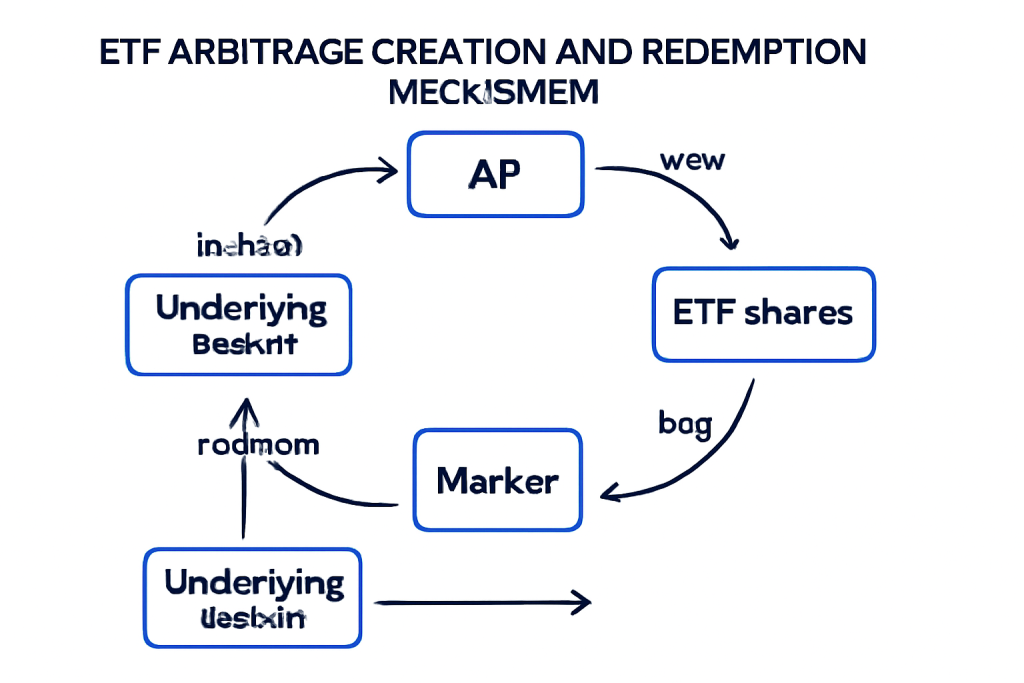
Illustration of ETF creation and redemption mechanism driving arbitrage.
Why Mispricing Occurs
Premiums and discounts arise due to a range of factors:
- Liquidity mismatches: Underlying bonds often trade OTC, making real-time pricing hard.
- Global trading hours: Europe-listed ETFs tracking U.S. stocks may trade when U.S. markets are closed.
- Market volatility: Sudden swings can temporarily widen spreads.
- Transaction costs: Fees, taxes, and bid-ask spreads can limit arbitrage speed.
- Currency translation: A USD-denominated underlying basket priced via a EUR-listed share class can drift when FX markets move and the ETF’s last printed trade does not.
- Settlement and creation-unit thresholds: APs transact in defined creation units. These commonly range from 10,000 to 100,000 shares depending on the issuer’s prospectus. Therefore, micro-distortions below that block size can persist for a few minutes. The exact size for any specific fund appears in its prospectus on the issuer’s product page (for example, the iShares fund documentation library at iShares UK).
For UCITS bond ETFs in particular, the underlying market structure is the dominant explanation. When dealers step back from quoting investment-grade or high-yield bonds during a stressed session, the ETF screen price often becomes the truer real-time signal while the published NAV lags. Therefore, discounts that look alarming on a chart can simply reflect how prices are reported, not a structural failure of the fund.
How Arbitrage Restores Efficiency
When an arbitrage trade executes, it exerts opposing pressure on ETF and underlying prices:

ETF market price converges to NAV through arbitrage.
- ETF price converges toward NAV.
- Underlying basket prices adjust.
This cycle repeats whenever deviations appear. Consequently, ETFs usually trade within a tight band around NAV. Academic studies confirm that for liquid equity ETFs, average premium is near zero. The Bogleheads community has long argued the practical implication. In short, for diversified, large-AUM UCITS equity ETFs, picking the cheapest fund by TER almost always beats trying to time premium/discount fluctuations. The friction you avoid is bigger than the edge you could capture. You can dig into community threads on the Bogleheads forum for representative discussions on this trade-off.
Pairs Trading Arbitrage
Another arbitrage form pairs two similar ETFs tracking the same index. When one ETF trades at a discount to its peer, traders buy the cheaper fund and short the richer one. As the price gap narrows, they unwind positions for profit. This strategy works best on highly liquid, same-index ETFs.
In Europe this often appears across cross-listings of the same UCITS share class on Xetra, Borsa Italiana, Euronext Amsterdam, and the London Stock Exchange. The ISIN is identical, and the AP set overlaps. Yet local order flow can create tiny, fleeting gaps. For retail investors the takeaway is simpler than the trade itself. When buying a popular UCITS ETF, the venue with the deepest local book usually gives you the tightest spread. Therefore, I tend to default to the Xetra or Borsa Italiana line for euro-denominated execution.
Efficiency in European UCITS ETFs
European ETFs follow the UCITS framework. They benefit from transparent disclosures of their basket and NAV calculation. However, cross-border ETFs can show slightly wider premiums due to time-zone gaps and currency impacts. Choosing ETFs with frequent NAV updates (e.g., every 15 seconds) reduces stale pricing. You can verify NAV publication frequency and indicative NAV (iNAV) availability on the issuer’s product page, for example via iShares UK or Vanguard UK’s professional product list. Additionally, you can cross-check fund-level liquidity stats on justETF.
Examples of European ETF Pricing Behaviour
The table below lists representative blue-chip European equity UCITS ETFs. Based on the fund pages linked beneath the table, they typically trade within a few basis points of NAV during core European hours. I have intentionally avoided quoting precise premium/discount decimals because those numbers shift intraday. The most honest answer is “go look at the live fund page yourself before clicking buy.”
| ETF Name | Underlying Index | Typical Pricing Behaviour | Where to Verify |
|---|---|---|---|
| iShares Core MSCI Europe UCITS | MSCI Europe | Within a few bps of NAV in core hours | Issuer fund page on iShares UK |
| Vanguard FTSE Developed Europe UCITS | FTSE Developed Europe | Within a few bps of NAV in core hours | Issuer fund page on Vanguard UK |
| Xtrackers STOXX Europe 600 UCITS | STOXX Europe 600 | Within a few bps of NAV in core hours | Fund comparison on justETF |
Caption: live premium/discount data should be read from the linked issuer pages on the day you trade. Past behaviour is not a guarantee of identical behaviour on any future session.
Spreads stay tight on these funds because the underlying baskets (European blue chips) trade in the same time zone as the ETF listings. Therefore, iNAV is essentially live during the arbitrage window. The picture changes for funds tracking US or Asian stocks. The printed NAV can come from stale closing prices while the ETF screen price reflects ongoing global news. This is normal and not a fault of the fund.
Who Should Care About ETF Arbitrage?
You don’t need to run an arbitrage desk to benefit from this knowledge. The practical audience splits roughly into three:
- Long-term passive investors placing monthly orders into a core UCITS ETF: knowing arbitrage exists is enough. Use a limit order, ignore daily premiums, focus on TER and tracking difference.
- Dividend-focused European investors rotating between regional sleeves: be aware that cross-listed funds may trade at different spreads on Xetra vs Borsa Italiana, so check both venues in your broker’s order ticket.
- Active traders and tax-loss harvesters: pairs arbitrage and creation-basket analysis become directly relevant, especially around index reconstitutions and large dividend dates.
If you fall into the first group, the rest of this article is mostly defensive knowledge. In practice, it helps you avoid mistakes rather than generate alpha. For a clearer picture of broader European ETF selection criteria, my guide on Irish-domiciled ETFs for dividend hunters in Europe covers domicile and withholding-tax issues that compound with execution quality.
Tax Considerations for European Investors (Irish vs Lux Domicile)
Arbitrage shapes price efficiency. However, domicile shapes what you keep after tax. Two practical points stand out:
- Irish-domiciled ETFs (suffix IE in the ISIN) benefit from the US-Ireland tax treaty. Under Article 10, the treaty reduces the withholding rate on US-source dividends from the statutory 30% to 15% at the fund level. Irish Revenue and the US IRS publish the treaty text itself. See Revenue’s overview of double-taxation agreements on the Irish government tax authority site, and confirm the dividend article in the treaty before relying on it. For European investors holding US-equity exposure, this treaty benefit can outweigh any micro-edge from buying at a 5 basis point discount.
- Luxembourg-domiciled ETFs (suffix LU) may still be useful for euro-denominated bond and EU equity exposure. However, they generally suffer worse withholding on US-source dividends than IE-domiciled siblings. Luxembourg’s US treaty does not extend the same 15% rate to fund-level distributions in the same way.
Local tax treatment then layers on top. German investors face the Teilfreistellung partial-exemption regime. French investors deal with PFU on capital gains. Lithuanian and Polish investors typically pay flat capital-gains tax on realised disposals. Additionally, the rules around accumulating vs distributing share classes vary widely. Always cross-check your national regulator’s published guidance (for example BaFin for Germany, KNF for Poland, and CySEC for Cyprus-regulated brokers). Where the numbers are large, consult a local tax adviser. This article is educational and not personal tax advice.
For a fuller comparison of domicile-driven outcomes, see which ETFs have the best dividend yield for European investors.
Key Risks and Frictions
ETF arbitrage is not riskless. Key frictions include:
- Liquidity mismatch: For bond ETFs, underlying instruments may be illiquid, reducing AP capacity.
- Inventory constraints: APs hold bond positions; large distortions can limit their willingness to arbitrage.
- Market stress: Extreme volatility can widen bid-ask spreads, hindering arbitrage speed.
- Shorting costs: Fees to borrow securities or ETF shares can reduce profit margins.
- Counterparty and settlement risk: Failed deliveries during stressed sessions can temporarily decouple ETF price from NAV.
- Regulatory frictions: Short-sale bans or trading halts in single names can leave the AP unable to replicate the basket.
These risks compound on each other. The well-documented March 2020 episode in investment-grade bond UCITS ETFs is the textbook case. Discounts widened sharply for a few sessions. Then they snapped back as central-bank backstops calmed dealer balance sheets. ESMA’s Trends, Risks and Vulnerabilities reports covered this period in detail. Additionally, contemporaneous BIS analysis reached similar conclusions about underlying bond market dysfunction rather than ETF structural failure. The lesson isn’t that ETFs broke. Rather, during liquidity events the ETF often re-prices faster than the legacy NAV, and that gap can be uncomfortable to watch if you’re not prepared.
How to Capitalize Safely
For individual investors, direct arbitrage is impractical due to scale and costs. Instead, use these guidelines:
- Choose ETFs with high daily volume and narrow bid-ask spreads.
- Monitor premiums via real-time platforms or broker tools.
- Avoid thinly traded funds where premiums can persist.
- Use limit orders to control execution price.
- Trade during overlap hours when both the ETF and its underlying basket are open.
- Compare cross-listings: the same UCITS ISIN may have noticeably better spreads on one European venue than another.
If you build dividend portfolios methodically, my deeper write-up on the best dividend growth ETFs for European investors walks through these execution checks for the specific tickers most readers hold.
How Do Price Efficiency Mechanisms Affect the Performance of Emerging-Markets ETFs?
Price efficiency mechanisms play a crucial role in shaping the performance of emerging markets ETFs. These mechanisms help align asset prices with their intrinsic values. Consequently, investors can make informed decisions. As market inefficiencies decrease, the potential for better returns on emerging markets ETFs increases. This attracts more capital. In practice, EM ETFs face wider tracking variability than developed-market funds. Some constituents trade in markets with restrictions, holidays that don’t overlap with European sessions, and FX layers that compound the basket valuation. APs adapt by using local market makers. In some cases, they use futures or ADR baskets as the hedging instrument. This tightens spreads but introduces a basis the long-term investor should know about when reading short-term performance.
How to Buy ETFs via Freedom24, Interactive Brokers, XTB or Trade Republic
The arbitrage backbone described above works the same regardless of the broker you use. However, execution quality and venue choice do vary. The five brokers I personally use or follow closely for European readers are Freedom24, Interactive Brokers (IBKR), XTB, Nexo, and Trade Republic. For UCITS ETF buy-and-hold, all of them give workable access. However, they differ in venue choice, FX handling, fractional support, and how transparent their fee schedules are.
Our Nexo earnings calculator runs the math for USDT, USDC, BTC, ETH and EUR balances.
Freedom24 is one widely used platform for European ETF trading. It offers:
- Access to 2,500+ ETFs across major European exchanges.
- Real-time quotes and streaming charts (free download of the platform).
- Demo mode that is free of risk for practice trading.
- Competitive fees—see platform for details as certain fees may apply.
To open an account and start trading ETFs:
- Register at Freedom24’s website and complete KYC.
- Fund your account within your risk profile limits.
- Search for your chosen ETF ticker and place orders.
- Monitor performance and premiums via built-in tools.
For investors who want maximum venue choice across Xetra, Borsa Italiana, LSE, and Euronext lines of the same UCITS, Interactive Brokers tends to be my reference setup. By contrast, Trade Republic and XTB suit euro-denominated accumulating positions where simplicity matters more than venue selection. Make all broker selection decisions against your own circumstances and after reading the relevant Key Information Documents. See my affiliate disclosure for the relationships I maintain with the brokers mentioned here.
Investing is a risk. The forecasts and past performance are not reliable indicators of future performance. It is important to do your own analysis before making any investment. This post may contain affiliate links that, at no cost to you, I may earn a small commission.
Common Pitfalls When Trading Around Premiums and Discounts
- Trading market-on-open or market-on-close: The widest UCITS spreads of the day typically occur in the first and last 10 minutes of the European session.
- Using market orders for cross-listed funds: A market order on the thinner of two venues can fill several basis points worse than the same order on the primary venue.
- Confusing tracking difference with arbitrage premium: A fund can be priced perfectly to NAV every day and still trail its index because of fees and withholding tax.
- Trading US-equity UCITS before US open: The European morning is when iNAV is most stale; spreads typically tighten when New York opens.
- Ignoring KID/PRIIPs documentation: The PRIIPs KID is the cleanest one-page source for cost and risk before clicking buy.
About the Author
I’m Kestutis Balciunas, an EU-based independent investor. I have over 11 years of self-directed passive and dividend ETF investing experience. I run financialexpertclass.com and the paid Substack at getdividends.net. Notably, I am not an FCA-regulated adviser. This site publishes educational content under AURUM DIGITAL MARKETING LTD (UK Companies House #15203665). Read more on the About Me page and how I work on the editorial process page.
FAQ
Q1: Can a retail European investor actually profit from ETF arbitrage?
Realistically, no. Direct creation/redemption requires Authorized Participant status, large block sizes, and institutional execution infrastructure. However, retail investors can benefit indirectly. Select liquid UCITS ETFs, use limit orders, and trade during the deepest part of the European session.
Q2: Why do bond ETFs sometimes show big discounts during market stress?
In stressed sessions, the underlying bonds often stop trading actively. The ETF screen price keeps moving in line with live information. However, the published NAV lags because it comes from stale or model-derived bond prices. The “discount” often reflects the ETF being correctly priced while NAV is the one catching up.
Q3: Is a UCITS ETF safer than a US-listed ETF for European investors?
Most EU retail investors cannot purchase US-listed ETFs directly because of PRIIPs documentation rules. By contrast, UCITS ETFs are designed for EU retail distribution. ESMA-aligned frameworks supervise them. Moreover, they come with a standardised KID, which is a meaningful baseline of investor protection.
Q4: Does it matter whether the ETF is Irish-domiciled or Luxembourg-domiciled?
For US-equity exposure, yes — Irish-domiciled funds usually receive US dividends net of 15% withholding tax under the US-Ireland tax treaty, compared with 30% for many non-treaty domiciles. For euro bond or EU-equity exposure the gap is smaller. Always check the latest fund prospectus on the issuer’s site.
Q5: How tight are average UCITS ETF spreads in practice?
For large, liquid blue-chip European equity UCITS ETFs, on-screen spreads on Xetra or Borsa Italiana are routinely just a few basis points during core hours. However, wider funds (small caps, EM, niche thematics) and stressed sessions can be 10–30 basis points or more. Therefore, limit orders matter.
Q6: Where can I monitor real-time premiums and discounts?
Your broker terminal is usually the most practical source. For research, justETF and Morningstar Europe publish bid-ask and tracking data. Additionally, the issuer pages from iShares and Vanguard publish daily NAV and basket holdings.
Q7: Is this article personal financial advice?
No. I am an independent EU-based investor and educator, not an FCA-regulated financial adviser. AURUM DIGITAL MARKETING LTD operates this site for educational publishing only. Always read the relevant KID and consider your own situation, ideally with a regulated adviser, before investing.
Q8: Where can I get more dividend-focused picks?
I publish detailed European dividend selections and updates on my paid Substack — getdividends.net.
Conclusion
ETF arbitrage underpins price efficiency. It harnesses creation/redemption, pairs trades, and AP expertise to keep market prices in line with NAV. European investors benefit from UCITS transparency and robust AP networks. While risks exist—especially for bond ETFs—understanding the mechanisms helps you choose the right ETFs and brokers. Moreover, it helps you place limit orders calmly during volatile sessions. Additionally, it helps you avoid mistaking short-lived premiums for genuine investment edge. The most useful application of this knowledge for a long-term EU investor is defensive. In short, trade liquid UCITS funds, in core hours, with limit orders. Then use the time you save to focus on asset allocation and contribution rate, which dominate long-run results.
For my full dividend picks and ongoing analysis, get them at https://getdividends.net/. For affiliate relationships referenced in this article, see the affiliate disclosure. Questions? Email [email protected] or check the help/FAQ page.
How much does domicile actually cost? Model the US dividend withholding drag of an Irish versus a Luxembourg fund with the free withholding tax and domicile calculator.
Before you open any account
grab the free 12-page Starter Kit: the 7-filter fund shortcut, the 3-question broker safety matrix, and the 7 mistakes that cost beginners the most.
European UCITS/ETF investor with 11+ years building a global dividend and index portfolio, and founder of Financial Expert Class. I write every guide here from first-hand experience investing across EU brokers and tax regimes — not theory. More about me →