
How To Legally Buy USA ETFs From Europe
If you want to buy US ETFs from Europe, you have probably hit a wall: your broker shows the famous low-cost American funds, then blocks the buy button. I have invested through EU brokers for eleven years, and I have lived this exact frustration. The good news is that several legal routes exist, and most do not require a EUR 500,000 portfolio. This guide walks through every one honestly, with the real trade-offs and the tax traps nobody warns you about.
Why you cannot simply buy US ETFs from Europe
The block is not a glitch, and it is not your broker being lazy. It is European law. Since 2018, the PRIIPs Regulation (EU) No 1286/2014 requires every “packaged retail investment product” sold to EU retail clients to publish a Key Information Document, known as a KID. This is a short, standardised fact sheet in your local language.
This guide is part of our country-by-country ETF tax map.
How we calculate: see the tax calculation assumptions for the exact assumptions behind these figures.
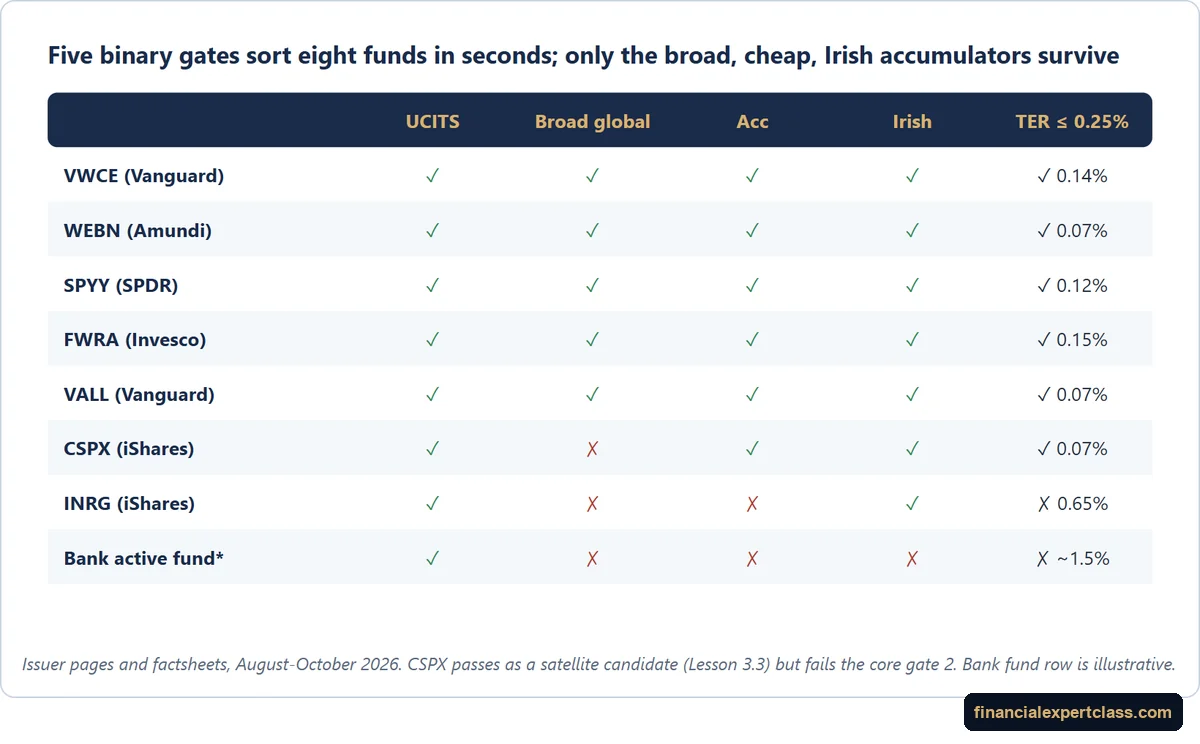
Comparing funds? The 7 filters that shrink 3,000+ ETFs to a shortlist. Run any fund through seven checks in the right order, with worked examples on October 2026 data. The full lesson, free, no sign-up.
Read the free lesson →Can’t buy US ETFs? Buy the UCITS version that does the same job.
- The ETF Comparison Workbook — 10 pages: the 7-filter framework for choosing between two good funds
- + 2 bonus PDFs: ETF Starter Kit and Dividend Starter Sheet
- + a free lesson from the €147 Masterclass
For the head-to-head verdict, read my side-by-side of the two premium brokers.
Here is the problem. US ETF issuers like Vanguard USA and BlackRock’s US arm do not produce an EU-format KID. They follow American disclosure rules instead. Therefore, with no compliant KID on file, an EU-regulated broker may not legally sell those funds to a retail client.
However, the rule has a crucial gap. The KID requirement applies to retail clients only. Professional clients sit outside it. As a result, the whole game becomes about either avoiding US-listed products, or changing your client classification, or using a broker that EU rules do not bind. Let me show you each path.
The MiFID II professional client test
Many investors assume “professional” means working in finance. It does not. Under MiFID II, you can ask to be reclassified as an elective professional client if you meet at least two of these three criteria.
- Your financial instrument portfolio is worth more than EUR 500,000 (cash plus investments).
- You have carried out, on average, ten significant trades per quarter over the past four quarters.
- You have worked at least one year in a professional role in the financial sector that required the relevant knowledge.
Meeting two of three can unlock US ETFs at a broker that offers an elective-professional route, such as Interactive Brokers. Yet it comes at a cost. You surrender several retail protections, which I cover later. For most readers, the EUR 500,000 portfolio is the sticking criterion. Therefore the routes below that avoid it matter most.
It is worth pausing on what “professional” really signals here. The label is about your assumed ability to bear risk and assess products, not about prestige. The regulator presumes a professional client needs less hand-holding. So when you opt in, you are telling your broker you no longer need certain warnings and checks. That is a meaningful shift, and you should make it deliberately rather than just to unlock a single fund.
The four legal routes to buy US ETFs from Europe
There is no single best answer, because the right route depends on your portfolio size, your country, and your appetite for paperwork. Here are the four legitimate paths, ranked roughly from easiest to most advanced.
- Route A — UCITS equivalents. Buy the European twin of the US fund. Best for most people.
- Route B — Options exercise (unconfirmed). Often repeated online, but not confirmed by any broker or regulator, so we do not recommend it.
- Route C — Non-EU brokers. Use a US or international broker that EU PRIIPs rules do not bind.
- Route D — Elective professional status. Qualify under MiFID II and buy US ETFs directly on an EU broker.
Let me take each one in turn.
Route A — UCITS equivalents: the easiest way to buy US ETFs from Europe
This is the route I personally use, and it is the one I recommend to nine readers out of ten. Instead of fighting the regulation, you sidestep it. For almost every popular US ETF, a UCITS-compliant European version exists. UCITS funds carry the required KID, so any EU broker sells them to you freely.
These twins track the same indices, often with the same provider. They are domiciled in Ireland or Luxembourg rather than the United States. Crucially, an Irish-domiciled fund typically suffers only 15% US dividend withholding at the fund level, thanks to the US–Ireland treaty. Therefore the tax drag is usually small.
The pattern is simple. A US S&P 500 fund has a European S&P 500 twin. A US total-market fund pairs with a global or US UCITS equivalent. I will not quote specific tickers or fees here, because they change and because the wrong one costs you money. Instead, always confirm the exact ticker, index and TER on the issuer factsheet before you buy.
One worry I hear often is cost. Investors fear the European version must be more expensive. In reality, the gap is now tiny. Many flagship UCITS funds charge fees within a few hundredths of a percent of their US cousins. Over a lifetime, that difference is dwarfed by the tax and estate-tax advantages you gain. So do not let a rounding-error fee push you toward a far riskier route.
You also keep practical conveniences. Because UCITS funds trade on European exchanges, you can buy them in euros, avoid US dollar funding, and use automated savings plans. Therefore the whole process feels native to a European investor, rather than bolted on. For most readers building wealth over decades, that simplicity compounds quietly in your favour.
To understand why domicile drives your returns, read our Irish vs Luxembourg ETF tax guide. For the bigger picture on why most Europeans should prefer the UCITS wrapper, see our breakdown of UCITS vs US ETFs.
Where to buy the UCITS route
The UCITS route works at almost any decent EU broker. However, fees, ETF range and savings-plan support vary widely. Below are the brokers I rate, each with a one-line fit. Pick the one that matches how you actually invest.
| Broker | Best for | One-line fit |
|---|---|---|
| Interactive Brokers | Broadest access | Widest market reach, lowest fees, and the only broker for the options route. |
| Freedom24 | US stocks plus EU exchanges | EU/CySEC broker; US stocks and UCITS ETFs on the major European exchanges for retail clients. |
| XTB | Commission-free EU ETFs | Zero-commission EU ETF buying with a polished, beginner-friendly app. |
| Trade Republic | Automated savings plans | Free recurring ETF savings plans, ideal for hands-off monthly investing. |
| Saxo | Premium multi-asset | Bank-grade platform with a very broad UCITS and multi-asset range. |
| eToro | Simple beginners | Zero-commission stocks and ETFs with a clean, social-first interface. |
| DEGIRO | Low-cost core ETFs | Long-standing low-cost broker with a free core-ETF selection. |
| Lightyear | Baltic investors | Baltic-friendly app with competitive FX and a growing ETF range. |
If you are still weighing options, our best European ETF brokers hub compares the whole field. To check who is cheapest for your trade size, run the numbers through our EU broker fee comparator.
Rates referenced here follow our 2026 ETF tax data, checked against official sources.
Route B — Options exercise: why we do not recommend it
You may read online that EU retail investors can get US-listed ETFs by buying a call option at Interactive Brokers and then exercising it. We could not confirm this route on any broker or regulator page, so we no longer present it as a way to buy US ETFs.
Interactive Brokers’ own PRIIPs help pages describe three options for EU clients who cannot buy a US ETF: buy the European UCITS equivalent, which has a KID and trades freely; trade a CFD on the US ETF, which gives you the price movement but not ownership of the fund; or qualify as a professional client (Route D below).
Even where an options route did work, you would end up owning a US-situs asset, so the US estate-tax problem described below would still apply. For almost every investor, Route A is the simpler and safer answer.
Route C — Non-EU brokers that accept European retail clients
Here is the route that surprises people. Some brokers sit entirely outside the EU regulatory perimeter, so PRIIPs simply does not apply to them. A US broker following SEC and FINRA rules has no obligation to publish an EU KID. Therefore it can let a European retail client buy US-listed ETFs directly, with no EUR 500,000 test at all.
This freedom is real, but it carries a serious cost in protection and tax, which I explain in full after the table. Treat this section as editorial information, not a recommendation. I do not earn anything from these brokers, and I want you to go in clear-eyed.
It helps to understand the mechanics. When you open a US brokerage account, you become a customer of a US firm under US law. The EU regulator has no jurisdiction over that relationship. Therefore the KID requirement that blocks your EU broker simply does not reach across the Atlantic. That is why the same US ETF that your EU broker refuses to sell can sit happily in a US account.
How the main non-EU brokers compare
| Broker | Regulation | Min deposit | US ETF access | EU protection | Key trade-off |
|---|---|---|---|---|---|
| TradeStation Global | Runs on IBKR (EU/UK entity) | ~$0–$1,000 | 13,000+ ETFs incl. US-listed | Partial / verify | PRIIPs may still bite on direct US-ETF buys |
| tastytrade | US: SEC / FINRA / SIPC | $0 ($2,000 margin) | US ETFs, options, futures | None (US SIPC) | Select EU countries only; no EU cover |
| Charles Schwab Intl. | US: SEC / FINRA / SIPC | ~$25,000 (historic) | Full US ETF range | None (US SIPC) | High minimum; US estate-tax exposure |
| Firstrade / Webull | US: SEC / FINRA / SIPC | Low / $0 | US ETFs (where accepted) | None (US SIPC) | Variable EU acceptance; verify your country |
| Exante | EU-regulated | ~EUR 10,000+ | Broad, pro-oriented | Yes (EU) | High minimum; aimed at professional clients |
Every figure above is illustrative. Minimums, fees and country eligibility change often, so verify the current terms on each broker’s own site before you act.
TradeStation Global
TradeStation Global is a joint product of TradeStation International and Interactive Brokers, so it runs on IBKR’s infrastructure. It advertises access to 13,000-plus ETFs across global markets, including US-listed funds, with fees from around $5 per trade for non-US clients and a low minimum. That breadth is genuinely rare for a broker open to Europeans.
However, here is the honest caveat you must not skip. Because TradeStation Global sits on an IBKR EU or UK entity, EU PRIIPs and professional-client rules can still apply to direct US-ETF purchases. So “13,000 ETFs” does not guarantee that every US fund is buyable by you as retail. Always verify your current eligibility on the platform before assuming a specific US ETF is open to you.
tastytrade
tastytrade is a US broker regulated by the SEC and FINRA, and a member of SIPC and NFA. It accepts retail clients from a select list of EU countries, and the roster is still expanding. The minimum deposit is $0 for a cash account, or $2,000 for margin. You can trade US ETFs, options and futures. Funding happens in US dollars, by wire transfer or via a service like Wise.
For the cheap-FX side of this, see my Wise review.
Because tastytrade is not EU-regulated, you trade as a US broker’s customer. That means no EU MiFID protection and no EU investor-compensation cover. The platform also leans toward active options traders, so a buy-and-hold ETF investor may find it more than they need.
See also: Vanguard investor UK ishares ETF.
Charles Schwab International
Charles Schwab International accepts non-US residents and offers the full US ETF range. Historically it has required a higher minimum, around $25,000, which puts it out of reach for many new investors. As a large, established US broker, it is a credible option for a sizeable portfolio, provided you accept the same loss of EU protection and the US estate-tax exposure below.
Firstrade, Webull and Exante
Firstrade and Webull are US brokers that sometimes accept European retail clients, but acceptance varies by country and changes frequently. Check whether your specific country is eligible before you build any plan around them. Exante is different: it is EU-regulated, so it keeps your EU protections, but it targets professional and high-net-worth clients with a minimum around EUR 10,000 or more.
Route D — Become an elective professional client
The final route is to change your status, not your broker. If you meet two of the three MiFID II criteria above, you can request elective professional classification at an EU broker that offers it, such as Interactive Brokers. Once reclassified, the PRIIPs retail restriction lifts, and you can buy US ETFs directly on a regulated EU platform.
This suits a specific profile: a larger portfolio, an active trading history, or a financial-sector background, plus genuine investing experience. The catch is that you give up retail protections in the process, including some appropriateness checks and certain compensation entitlements. So only choose this path if you truly understand the products and the risks.
One note on Freedom24. Like every EU broker, it can’t sell US-domiciled ETFs to retail clients. It does offer US stocks and a broad range of EU-listed ETFs to retail clients, so you can hold individual American shares there.
The honest trade-offs when you buy US ETFs from Europe via non-EU brokers
The non-EU route looks liberating, and in pure access terms it is. Yet I would be doing you a disservice if I glossed over what you give up. These are not footnotes. They can cost you real money and real protection. I have weighed these factors for my own portfolio, so let me set them out plainly.
You lose EU investor protection
Inside the EU, MiFID II gives you conduct protections, and an Investor Compensation Scheme typically covers around EUR 20,000 if a broker fails. With a US broker, you instead rely on SIPC. SIPC protects against broker failure up to its own limits, but it works differently from the EU scheme, and crucially it never covers market losses. So if your ETF simply falls in value, no scheme reimburses you anywhere.
US estate tax can hit your heirs hard
This is the trap that catches almost everyone, and it is the strongest reason to think twice. The United States levies estate tax on “US-situs” assets owned by non-resident aliens. US-listed ETFs and US stocks are US-situs assets. The exemption for non-residents is only about $60,000, far below the $15 million basic exclusion that US citizens have in 2026. Above that threshold, rates climb up to 40%.
So if you hold $200,000 of US-listed ETFs and die, a large slice could be exposed to US estate tax before it reaches your family. Some countries have a US estate-tax treaty that grants relief, but many do not, and the detail varies. Verify your own country’s position. This single issue is why Irish-domiciled UCITS funds, which are generally not US-situs for this purpose, are so popular with Europeans.
The mechanics make this worse in practice. US estate tax is not automatic or self-cleaning. Your heirs may need to file a US estate-tax return and prove the asset’s value before the broker releases the funds. That process can be slow, costly and stressful, exactly when your family least needs friction. Therefore I treat estate tax as a structural reason to favour UCITS funds, not a distant technicality. If you still choose US-listed holdings, keep the balance modest, or take professional advice on holding structures that reduce the exposure.
Dividend withholding and the W-8BEN form
To trade with a US broker you must file Form W-8BEN. Without it, the US withholds 30% on your dividends. With it, and if your country has a tax treaty, the rate usually drops to 15%. So filing W-8BEN is not optional housekeeping; it directly protects your income. Refresh it when it expires, typically every three years.
FATCA, home-country reporting and FX
A US account brings reporting obligations. FATCA means your broker reports your account to tax authorities. On top of that, your home country’s rules on foreign accounts and foreign capital gains still apply, so you must declare everything correctly at home. Finally, you fund and trade in US dollars, which adds a currency-conversion cost. A service like Wise keeps that FX cost low. For a deeper look at how taxes shape net returns, see our ETF tax efficiency guide.
Which route fits you? Profile-based guidance
Theory is fine, but you want a decision. Here is how I would steer four common profiles. Find the one closest to you.
The steady monthly investor
You invest a few hundred euros each month into one or two broad funds. Choose Route A, the UCITS equivalents, without hesitation. You get the same index exposure, lower tax friction, full EU protection, and zero estate-tax worry. A free savings plan at Trade Republic or commission-free buying at XTB makes this almost effortless.
The experienced DIY investor
You understand order types and you want maximum control. Route A still covers most needs. If a specific US ETF has no UCITS twin, compare the closest UCITS alternatives first. We do not recommend the options-exercise route (Route B), because no broker or regulator confirms it.
The large or professional portfolio
You may already meet the MiFID II test. If so, Route D, elective professional status, lets you buy US ETFs directly on a regulated EU broker while keeping a recognisable framework around you. Weigh the protections you surrender before you opt in.
The US-focused active trader
You want US options, futures and the full American ETF shelf, and you accept the trade-offs. Route C, a non-EU broker like tastytrade, fits, provided your country is eligible. Go in knowing you lose EU cover and you take on US estate-tax and W-8BEN duties.
Common mistakes to avoid
I have watched readers stumble on the same points for years. Avoid these and you will save yourself money and stress.
- Ignoring US estate tax. People obsess over a 0.03% fee gap while ignoring a potential 40% estate-tax hit. Get your priorities right.
- Assuming a non-EU broker is “illegal.” It is not. The legal issue is which protections you keep, not whether you are allowed.
- Skipping the W-8BEN. Forgetting this doubles your dividend withholding from 15% to 30%.
- Buying the wrong UCITS twin. Always confirm the ticker, index and domicile on the issuer factsheet, not on a forum.
- Chasing a US ETF when a UCITS version exists. If a clean European equivalent exists, the extra hassle of US listing rarely pays off.
Key takeaways
- US-listed ETFs lack an EU PRIIPs KID, so EU brokers may sell them to professional clients only.
- The simplest way to buy US ETFs from Europe is to buy the UCITS equivalent, which most Europeans should prefer.
- Options-exercise workarounds at Interactive Brokers are often repeated online but are not confirmed by any broker or regulator, so we do not recommend them.
- Non-EU brokers like tastytrade accept European retail clients, but you lose EU protection and face US estate tax.
- Elective professional status under MiFID II opens US ETFs on EU brokers, at the cost of retail protections.
- Always file W-8BEN, check your US estate-tax treaty position, and verify current terms with every broker.
FAQ
Q: Is it legal to buy US ETFs from Europe?
A: Yes, it is legal. The restriction is regulatory, not criminal. EU brokers cannot sell US-listed ETFs to retail clients because those funds lack a PRIIPs KID, but you can still use UCITS equivalents, the options route, professional status, or a non-EU broker.
Q: Why can my EU broker not sell me US ETFs?
A: Under the PRIIPs Regulation (EU) No 1286/2014, every retail investment product needs a Key Information Document. US ETF issuers do not publish an EU-format KID, so EU-regulated brokers may legally offer those funds to professional clients only.
Q: Do I really need a EUR 500,000 portfolio to buy US ETFs?
A: No. That figure relates only to one MiFID II professional-client criterion. The UCITS-equivalent route gives you the same index exposure without it, and non-EU brokers are another option with their own trade-offs.
Q: What is a UCITS equivalent?
A: It is a European-domiciled ETF, usually based in Ireland or Luxembourg, that tracks the same index as a US fund and carries the required KID. It gives almost identical exposure with full EU access. Confirm the exact ticker on the issuer factsheet.
Related reading: ETF Tracking Error Analysis – Index Replication Accuracy.
Q: Does the options-exercise workaround at Interactive Brokers work?
A: We could not confirm it. No broker or regulator page we checked says it is allowed, and Interactive Brokers’ own PRIIPs help pages describe three options instead: a UCITS equivalent, a CFD, or professional client status. We do not recommend it.
Q: Is tastytrade safe and available in my country?
A: tastytrade is regulated by the SEC and FINRA and is a SIPC member, so it is a legitimate US broker. However, it accepts retail clients from a select list of EU countries only. Check the current eligibility list before opening an account.
Worth reading next: Mint EU and xeod EU ETFs save your.
Q: What is US estate tax and should I worry about it?
A: US estate tax applies to US-situs assets, including US-listed ETFs, owned by non-resident aliens. The exemption is only about $60,000, with rates up to 40% above it. Treaty relief varies by country, so verify your position before holding large US-listed positions.
Q: What is the W-8BEN form and do I need it?
A: It is the IRS form that confirms your non-US status to a US broker. Filing it reduces US dividend withholding from 30% to your treaty rate, often 15%. You should file it, and refresh it roughly every three years.
Q: Does Freedom24 let retail clients buy US ETFs in 2026?
A: No. Like every EU broker, Freedom24 can’t sell US-domiciled ETFs to retail clients under PRIIPs. It does, however, give retail clients access to US stocks and a wide range of EU-listed ETFs.
Q: Will I lose investor protection with a US broker?
A: Largely, yes. You leave the EU MiFID framework and the EU Investor Compensation Scheme of around EUR 20,000. US SIPC cover works differently and never protects against market losses. Weigh this carefully.
See also: Leveraged ETFs 2x.
Q: Can I just buy individual US stocks instead of ETFs?
A: Yes. Individual US stocks are not packaged products, so PRIIPs does not block them. Many EU brokers, including Freedom24, offer US stocks to retail clients. Note that US stocks are still US-situs assets for estate-tax purposes.
Q: Which route do you personally use?
A: I use Route A, the UCITS equivalents, for the core of my portfolio. The tax efficiency, EU protection, and absence of estate-tax risk make it the best fit for a long-term European investor like me.
Cited sources: ESMA, IRS and justETF. Rules change — verify current terms with each broker and a qualified adviser.
How much does domicile actually cost? Model the US dividend withholding drag of an Irish versus a Luxembourg fund with the free withholding tax and domicile calculator.
Why the rule exists at all: read the complete PRIIPs guide.
Related reading: Best PIMCO ETFs for European Investors.
Q: Why can’t EU retail investors buy US ETFs?
A: Because of the PRIIPs Regulation. Since 2018 anyone selling a packaged retail investment product to an EU retail investor must supply a standardised Key Information Document. US fund issuers produce a US prospectus instead and have little commercial reason to write KIDs for European retail buyers, so EU-regulated brokers cannot offer their funds to retail clients. It is a documentation rule, not a judgement about the funds — and it applies equally to excellent funds like VOO and to poor ones.
Q: Is the PRIIPs KID restriction official, and does it still apply in 2026?
A: Yes on both counts. The requirement sits in Regulation (EU) No 1286/2014, which remains in force across the EU and, in retained form, in the UK. Reviews of the PRIIPs framework have been running for years and have changed disclosure details rather than the underlying obligation. Any broker telling you a US ETF is available to you as an EU retail investor without a KID is worth a second look.
Q: Is there a legitimate way around it?
A: There are legal routes, and they are not workarounds so much as different products. Irish-domiciled UCITS funds track the same indices, are available everywhere in Europe, and are usually the better structure on withholding tax and estate-tax exposure anyway. Options and professional-client classification exist but carry real trade-offs. What does not work is misrepresenting your residence or classification to a broker.
Sources and further reading
- European Commission — PRIIPs Regulation (EU) No 1286/2014 — the rule that requires a Key Information Document for retail sales
- ESMA — European Securities and Markets Authority — the EU supervisor that co-authors PRIIPs guidance
- justETF — UCITS ETF screener — for finding the Irish-domiciled equivalent of a US fund

European UCITS/ETF investor with 11+ years building a global dividend and index portfolio, and founder of Financial Expert Class. I write every guide here from first-hand experience investing across EU brokers and tax regimes — not theory. More about me →