
Best Charles Schwab ETFs for European Investors
For a side-by-side breakdown of two or three UCITS funds, the fund-vs-fund compare runs the live numbers.
For the wider context, see our European ETF providers compared hub and our best dividend ETFs for European investors hub. Editorial standards: editorial process · affiliate disclosure.
Author note: I am a European retail investor with 11+ years of personal ETF and dividend experience. My background is self-taught, Bogleheads-style. Importantly, I am not FCA-regulated. Therefore, this is educational content, not personalised advice. Schwab ETFs are US-listed, not UCITS. Before buying them, read my dedicated guide on how to legally buy US ETFs from Europe. The TER and AUM figures below reflect the latest published values at writing. Always confirm them on the official Schwab Asset Management factsheet, the justETF US dividend ETF screener, or Morningstar before investing.
Key things to know about best charles schwab
Warning: Schwab ETFs are US-listed – read this first.
Schwab’s flagship ETFs (SCHD, SCHB, SCHX, SCHF, SCHE, SCHZ, SCHP) are US-domiciled and do not publish a PRIIPs-compliant KID. Consequently, EU/EEA retail brokers cannot legally sell them to you as a retail client. However, three realistic routes exist. First, you can qualify as an elective professional client at Interactive Brokers under IBKR’s professional criteria. That requires two of: €500k portfolio, 10+ trades/quarter, or finance-sector work history. Alternatively, you can open an account with a non-EU broker like Charles Schwab International if your country is eligible. Finally, some EU residents use a non-EU/EEA broker such as Freedom24 (Kazakhstan/CySEC group) for direct US ETF access. Crucially, this means dealing with a non-EU regulated entity for the US-listed leg. PRIIPs retail protections do not apply.
For full details and a step-by-step walkthrough, see our guide on how to legally buy US ETFs from Europe. The deeper comparison sits in UCITS vs US ETFs.
Charles Schwab has quietly built one of the most attractive low-cost ETF line-ups in the world. Flagship funds include SCHD (U.S. Dividend Equity), SCHB (U.S. Broad Market) and SCHF (International Equity). For European investors willing to open a U.S. brokerage account and handle the tax implications, Schwab ETFs can deliver rock-bottom fees. Moreover, they offer strong performance and simple one-fund building blocks for global portfolios.
This article explains how Schwab ETFs are structured. Additionally, it covers why they appeal to non-U.S. investors and which specific tickers deserve your attention in 2026. The piece also highlights the regulatory constraints European residents face with U.S.-domiciled ETFs. Furthermore, it walks through how to think about execution, custody and tax before deciding whether SCHD and friends fit your long-term strategy.
Important note for European investors
Most Charles Schwab ETFs are U.S.-domiciled and report under U.S. regulations. Due to the EU’s PRIIPs rules, these ETFs generally cannot be bought through EU-regulated retail brokers. The reason is simple. They do not provide a PRIIPs-compliant Key Information Document (KID). To access them, European investors typically need:
- A U.S. brokerage account that accepts non-U.S. residents. For example, Schwab International serves eligible countries.
- Alternatively, a non-EU broker where PRIIPs does not apply the same way. For example, Freedom24 works for some EU residents who accept the non-EU regulatory perimeter.
In addition, non-U.S. investors must consider:
- 15% U.S. withholding tax on dividends (assuming tax treaty and W-8BEN on file). The treaty rate and forms appear in IRS Publication 515 – Withholding of Tax on Nonresident Aliens and Foreign Entities.
- Potential U.S. estate tax exposure on U.S.-situs assets above low thresholds.
- Foreign-account reporting requirements in their home country.
Because of this, Schwab ETFs make the most sense for:
- European investors comfortable with cross-border tax and reporting.
- U.S. citizens or green card holders living in Europe (who should avoid UCITS PFICs).
- High-net-worth investors already using international brokers for other U.S. assets.
Schwab ETF universe at a glance
Schwab offers around three dozen ETFs with total assets above $500 billion. The range covers broad U.S. equity, international equity, emerging markets, small-caps, fundamental factor strategies and a full core bond suite. Average expense ratios sit around 0.12%. Notably, many cap-weighted index ETFs cost just 0.03-0.06%.
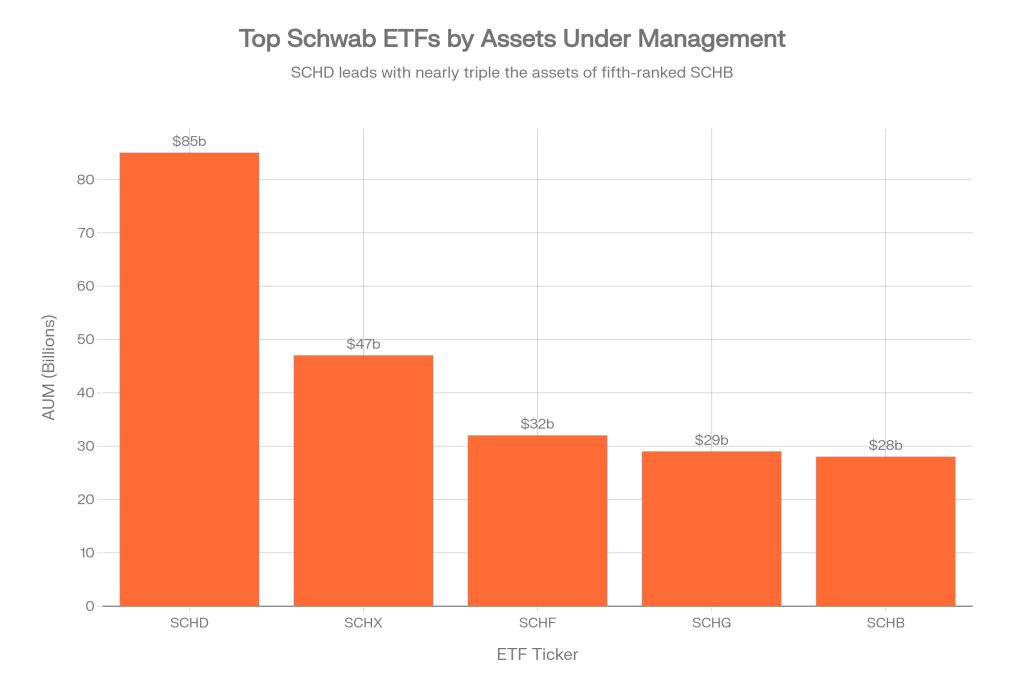
Illustrative chart: SCHD, SCHX, SCHF, SCHG and SCHB are Schwab’s largest ETFs by assets, forming the core of many investor portfolios.
For European investors, the most relevant Schwab ETFs usually fall into four groups:
- Core U.S. equity: SCHB (total market), SCHX (large-cap), SCHG/SCHV (growth/value).
- Dividend income: SCHD (U.S. Dividend Equity).
- International equity: SCHF (developed ex-U.S.), SCHE (emerging markets), SCHC (international small-cap).
- Core bonds and inflation protection: SCHZ (aggregate bond), SCHP (TIPS), SCHR/SCHO (Treasuries).
Why look at Schwab instead of UCITS ETFs?
Most European investors get perfectly served by Ireland-domiciled UCITS ETFs from Vanguard, iShares and others. However, Schwab ETFs can appeal when:
- You want ultra-low headline fees (0.03-0.06%) on U.S. and international equities.
- You prefer U.S.-domiciled ETFs for tax reasons. For instance, U.S. citizens in Europe avoid PFICs this way.
- You like Schwab’s specific index methodology. For example, SCHD applies a quality-dividend screen.
- You already manage a multi-broker, multi-currency portfolio and accept the complexity.
1. SCHD – Schwab U.S. Dividend Equity ETF
SCHD has become one of the most talked-about dividend ETFs globally. It targets high-quality U.S. companies with at least 10 years of dividend payments. The screen tests for financial strength and dividend sustainability. For a full lineup of UCITS dividend ETFs that EU retail investors can actually buy on a normal broker, see our best dividend ETFs for European investors hub.
| Metric | Value (early 2026) |
|---|---|
| Assets under management | ≈ $80+ billion |
| Total expense ratio | 0.06% |
| Number of holdings | ≈ 100 |
| Distribution yield (TTM) | around 3.3-3.8% |
| 10-year annualised return | roughly high-single digits |
SCHD’s sector mix tilts heavily toward energy, consumer staples and healthcare. Meaningful allocations also go to industrials and financials. Technology appears but does not dominate. This pattern reflects the fund’s value and dividend focus.

Illustrative chart: SCHD’s sector allocation is tilted toward energy, consumer staples and healthcare, with smaller weights in information technology and communication services.
Why SCHD appeals to Europeans:
Rates referenced here follow our EU ETF tax dataset (2026), checked against official sources.
- It provides a concentrated, quality-screened slice of the U.S. dividend universe.
- The low fee (0.06%) pairs with a long track record of strong risk-adjusted returns.
- It beats picking individual U.S. dividend stocks from abroad on simplicity.
Key risks: sector concentration, heavy U.S. dollar exposure, and potential U.S. dividend tax drag for non-U.S. residents.
Source: confirm SCHD’s current TER, holdings and distribution history on the official Schwab U.S. Dividend Equity ETF (SCHD) product page and prospectus. Cross-check on Morningstar or via the justETF US dividend ETF screener before investing. For a UCITS-domiciled comparison most EU investors can actually buy, see VYM vs SCHD, our best dividend ETFs for European investors hub, and our best non-UCITS equity ETFs notes.
2. SCHB and SCHX – Broad U.S. Market Exposure
For European investors who want a simple, low-cost anchor to the U.S. equity market, SCHB (Schwab U.S. Broad Market ETF) and SCHX (Schwab U.S. Large-Cap ETF) make compelling choices.
How we compare: fund picks here follow our published how we compare ETFs — TER, tracking difference, liquidity and domicile, in that order.
| Fund | Index Tracked | Coverage | TER |
|---|---|---|---|
| SCHB | Dow Jones U.S. Broad Stock Market | ≈ 2,500 U.S. stocks (total market) | 0.03% |
| SCHX | Dow Jones U.S. Large-Cap | ≈ 750 largest U.S. companies | 0.03% |
At 0.03% fees, these ETFs sit among the cheapest U.S. equity funds globally. SCHB suits those wanting a “one-and-done” U.S. allocation. By contrast, SCHX works well for investors who pair it with dedicated small-cap and value/growth tilts.
Illustrative chart: Schwab broad-market and international ETFs typically charge 0.03-0.07%, far below category averages around 0.25-0.45%.
Use case for Europeans: a single SCHB or SCHX position can anchor your U.S. equity core. Then UCITS ETFs cover Europe and the rest of the world if you prefer to keep some assets in Ireland-domiciled funds.
Cross-check the latest TER, index tracking error and AUM on the Schwab U.S. Large-Cap ETF (SCHX) factsheet and the Schwab U.S. Broad Market ETF (SCHB) factsheet before placing a trade.
3. SCHF and SCHE – International and Emerging Markets
To complement U.S. exposure, Schwab offers two key international equity ETFs:
- SCHF – Schwab International Equity ETF: tracks FTSE Developed ex-U.S., covering developed markets in Europe, Asia and Canada.
- SCHE – Schwab Emerging Markets Equity ETF: tracks FTSE All-World Emerging, covering EM Asia, Latin America, EMEA.
Both ETFs are passive, diversified and low-cost. SCHF historically charges around 0.03%. SCHE charges around 0.11% after Schwab’s recent fee cuts. Together, they can build a complete non-U.S. equity sleeve.
Illustrative chart: over long periods, SCHD has outperformed broad developed and emerging markets, while SCHF and SCHE provide diversified ex-U.S. exposure.
For a European investor already heavily exposed to domestic markets via job and property, SCHF + SCHE offers a simple way to diversify. This pair covers North America and emerging economies without overconcentrating in the U.S. alone.
4. SCHZ and SCHP – Core Bonds and Inflation Protection
On the fixed-income side, Schwab’s ETFs prove equally competitive. Two stand out as natural building blocks:
- SCHZ – Schwab U.S. Aggregate Bond ETF: tracks a broad U.S. investment-grade bond index (Treasuries, agencies, corporates, securitised). The fee sits around 0.03%.
- SCHP – Schwab U.S. TIPS ETF: tracks U.S. Treasury Inflation-Protected Securities, also priced near 0.03%.
These funds deliver inexpensive access to U.S. dollar fixed income and inflation hedging. For euro-based investors, they introduce currency risk. However, they also offer potential diversification versus euro interest-rate cycles.
Cost advantage vs category averages
One of Schwab’s strongest selling points is cost. Its equity and bond index ETFs typically charge between 0.03% and 0.08%. By contrast, category averages often sit between 0.20% and 0.40%.
Illustrative chart: large Schwab ETFs like SCHD, SCHX, SCHF, SCHB and SCHZ combine substantial AUM with some of the lowest expense ratios in their peer groups.
Over a 30-year horizon, the difference between paying 0.30% and 0.05% per year on a €100,000 investment compounds into tens of thousands of euros. For investors already committed to U.S.-domiciled ETFs, Schwab sits at the efficient frontier of cost and quality.
Access and execution for European investors
Because of PRIIPs, you generally cannot buy SCHD, SCHB or SCHF directly via an EU retail broker. Your realistic options are:
- Open a Charles Schwab International account if your country is eligible (e.g. some Western European countries).
- Use a non-EU broker that offers access to U.S. ETFs as a non-EU client. For example, Freedom24 sees wide use by EU residents for direct US ETF access outside the PRIIPs retail perimeter.
- For U.S. citizens in Europe, work with a U.S. broker and avoid UCITS PFIC complications.
If you prefer a broker with broad ETF coverage, multi-currency support and strong tools, you can also consider opening a trading account with a global platform such as Interactive Brokers. This works provided your jurisdiction and client category permit access to U.S.-domiciled ETFs. I cover why I default to IBKR for serious ETF investors in my why Interactive Brokers stands out for ETF investors in Europe piece. Always verify what instruments are legally available to you under your local rules.
Schwab ETF advantages
- Ultra-low expense ratios on core equity and bond exposures.
- Strong track records, especially for SCHD and SCHB.
- Simple, rules-based index methodologies.
- High AUM and liquidity in major tickers.
Considerations for Europeans
- PRIIPs limits access via EU brokers.
- U.S. withholding tax on dividends.
- Potential U.S. estate tax exposure.
- More complex tax reporting and FX management.
When Schwab ETFs make sense vs UCITS alternatives
For many European investors, Ireland-domiciled UCITS ETFs that mirror U.S. indices (e.g. VUSA, CSPX, IWDA, VWCE) prove simpler and cleaner from a regulatory and tax perspective. Schwab ETFs start to make sense when:
- You are a U.S. citizen or green card holder living in Europe and must avoid PFICs.
- You already run a U.S. brokerage account for other investments and want to consolidate into one ecosystem.
- You manage a larger portfolio where micro-optimising fees and index methodology justifies the extra complexity.
- You specifically want SCHD’s rules-based dividend and quality screen rather than a generic high-yield ETF.
For smaller portfolios (< €50,000) held entirely within the EU, the incremental benefit of Schwab versus UCITS rarely justifies the added friction. By contrast, for larger and more sophisticated setups, Schwab can play a meaningful role alongside European ETFs.
Conclusion: Schwab ETFs as a powerful, optional upgrade
Charles Schwab’s ETF range offers some of the cleanest, lowest-cost building blocks in global markets. SCHD covers dividends, SCHB anchors total U.S. equity, SCHF/SCHE handle international diversification, and SCHZ/SCHP deliver bonds and inflation protection. For European investors willing and able to operate with U.S.-domiciled funds, these ETFs can significantly reduce investment costs. Meanwhile, they maintain high diversification and strong long-term performance potential.
However, regulatory and tax realities mean Schwab ETFs are not the default choice for every European. PRIIPs limits access through EU brokers. Additionally, non-U.S. residents must accept withholding tax, estate tax exposure and foreign-account reporting. For many, high-quality UCITS ETFs remain the path of least resistance.
The Irish vs Luxembourg WHT tool estimates the annual leakage from suboptimal fund domicile.
The right answer depends on your passport, broker access, portfolio size and willingness to handle complexity. If you decide that U.S.-domiciled ETFs fit your situation, Schwab’s line-up deserves a place at the top of your research list. In that case, opening a robust multi-market brokerage account works well. For example, a global platform like Interactive Brokers in eligible jurisdictions gives you the execution tools you need. Then SCHD, SCHB, SCHF and SCHE can anchor a durable, low-cost portfolio.
Three Realistic Routes for a European Investor to Hold SCHD, SCHB or SCHF
Because PRIIPs blocks EU retail access to the Schwab line-up, you essentially pick between four legal paths. None of them are trivial. Moreover, each has a different cost-of-friction profile.
| Route | Who it fits | Typical friction |
|---|---|---|
| IBKR elective professional client | EU residents with a portfolio above €500k or significant finance background | Lose retail investor protections; must meet two of three IBKR pro criteria |
| Schwab International account | HNW investors in eligible countries; expats with US ties | Account minimum (often $25k+); not available in every EU country |
| Non-EU broker (e.g. Freedom24) | EU residents who want direct US ETF access without HNW thresholds | Non-EU/EEA regulated entity (Kazakhstan group, with CySEC-licensed EU sister) on the US-listed leg; PRIIPs retail protections do not apply; political and counterparty risk profile different from EU brokers |
| UCITS substitute on any EU broker | Most retail readers of this site | You give up SCHD’s exact methodology but keep PRIIPs/MiFID protection |
For most EU retail readers, the UCITS-substitute route makes the right call. The first three remain valid but come with real trade-offs. Importantly, the IBKR pro-client route specifically removes ESMA retail-investor protections. Those protections include negative-balance protection, leverage caps, and marketing restrictions. Moreover, you keep that classification across all your IBKR positions, not just the US ETFs. By contrast, the Freedom24 route keeps you as a retail client but outside the EU regulatory perimeter for the US-listed leg. That presents a different shape of risk. It works for some readers, not for others.
What is the Best UCITS Equivalent to SCHD?
There is no exact UCITS clone of SCHD. The Dow Jones US Dividend 100 index it tracks is not licensed to a major UCITS issuer in Ireland. However, the closest practical substitutes EU investors can actually buy on a normal broker are:
- Fidelity US Quality Income UCITS ETF (FUSD) – similar quality + dividend screen on US large caps, Ireland-domiciled, distributing.
- SPDR S&P US Dividend Aristocrats UCITS ETF (USDV / SPYD) – 25+ year dividend grower screen, narrower than SCHD but rules-based.
- VanEck Morningstar US Sustainable Wide Moat UCITS ETF (MOAT) – quality tilt rather than dividend tilt, but useful when paired with a broad income ETF.
None of these acts as a one-to-one replacement. Together with a broad US ETF (VUAA / CSPX), however, they cover most of what European readers actually want from SCHD. That means low fee, quality screen, and US large-cap exposure. The deeper comparison sits in VYM vs SCHD, our roundup of the best dividend growth ETFs for European investors (which goes beyond pure-yield screens into compounding-quality territory like SCHD), and our best non-UCITS equity ETFs notes.
US Estate Tax: The Hidden Cost Most Articles Skip
Non-US persons holding US-situs assets – including SCHD, SCHB, SCHF and any other US-domiciled ETF – face US federal estate tax above a $60,000 exemption. The headline rate climbs to 40%. A handful of countries have an estate tax treaty with the US that raises the threshold (UK, Germany, France, Netherlands and a few others). However, most EU countries – including the Baltics – do not.
In practice, this matters. For example, if a Lithuanian investor dies holding $200,000 of SCHD in a Schwab International account, the estate could face US estate tax on the portion above $60,000. By contrast, UCITS ETFs avoid this entirely because they are Ireland-domiciled, not US-domiciled. This holds true even when they hold the exact same underlying US stocks. Crucially, this single point explains why most EU retail readers should default to UCITS even when SCHD’s 0.06% TER looks attractive.
Frequently Asked Questions
Is there a UCITS version of SCHD I can buy on an EU broker?
There is no exact UCITS clone of SCHD. The reason is that the Dow Jones US Dividend 100 index is not licensed to a major UCITS issuer. However, the closest substitutes are the Fidelity US Quality Income UCITS ETF (FUSD), the SPDR S&P US Dividend Aristocrats UCITS ETF (USDV), and the VanEck Morningstar US Wide Moat UCITS ETF (MOAT). None acts as a one-to-one replacement. Together with a broad US ETF like VUAA or CSPX, however, they cover most of what European readers want from SCHD. That means low fee, quality screen, and US large-cap exposure. Crucially, this all stays within PRIIPs/MiFID retail protection.
Why does Schwab not just launch a UCITS version of SCHD?
Schwab Asset Management has historically focused on the US retail market. It has no UCITS distribution infrastructure in Europe. Launching even one UCITS ETF requires an Ireland or Luxembourg domicile, a UCITS management company, KID production in every EU language, and a sponsor on each European exchange. Unless Schwab sees a clear inflow case from EU retail, the economics do not work. For now, EU readers should treat SCHD as effectively closed and look for UCITS substitutes.
Can I buy SCHD or SCHB on Interactive Brokers if I become an elective professional client?
Yes, but with significant trade-offs. To qualify as an elective professional client at IBKR you must meet two of three criteria. The criteria include: a financial-instruments portfolio above €500,000, an average of 10+ trades of meaningful size per quarter over the past four quarters, or at least one year working in a finance-sector role that required knowledge of the transactions concerned. IBKR’s exact criteria appear in their EU PRIIPs guidance. Importantly, reclassification applies to your whole IBKR account, not just one product. Moreover, you permanently lose retail-investor protections including negative-balance protection and certain marketing safeguards.
What is the US estate tax exposure on Schwab ETFs for a non-US investor?
US-situs assets above $60,000 face US federal estate tax at rates climbing to 40% for non-US persons without a treaty. Countries with a US estate-tax treaty – UK, Germany, France, Netherlands, and a few others – get a higher threshold. However, most EU jurisdictions including the Baltics do not. By contrast, UCITS ETFs avoid this because they are Ireland-domiciled, not US-domiciled. This holds even when they contain the same underlying US stocks. For non-trivial holdings, this single point usually decides the question in favour of UCITS.
How much US dividend withholding tax do I pay on SCHD as a European investor?
Under most US tax treaties with EU countries, the withholding rate on US-source dividends paid to a non-US individual is 15% if you have filed a W-8BEN with your broker. Without the W-8BEN or for non-treaty countries, the default rate is 30%. The treaty rates and procedure appear in IRS Publication 515. By contrast, UCITS ETFs domiciled in Ireland typically capture the 15% rate at the fund level via the US-Ireland treaty. Therefore, you do not need to file forms. This is one of the structural reasons UCITS prove administratively simpler than direct US ETFs for most EU residents.
Is SCHD better than a dividend-focused UCITS ETF for long-term European investors?
On pure fund-design grounds, SCHD’s methodology is excellent and its 0.06% TER is hard to beat. However, for a European retail investor the relevant comparison is not SCHD vs a UCITS ETF in isolation. Instead, it is SCHD-via-IBKR-pro-client (or Schwab International, or a non-EU broker like Freedom24) vs a UCITS substitute on your normal broker. Once you factor in lost retail protections, US estate-tax exposure, more complex tax reporting and the friction of FX, most EU retail readers end up better served by a UCITS dividend ETF. SCHD belongs in larger or more specialised portfolios where the operational setup already exists.
Before you open any account
grab the free 12-page Starter Kit: the 7-filter fund shortcut, the 3-question broker safety matrix, and the 7 mistakes that cost beginners the most.
European UCITS/ETF investor with 11+ years building a global dividend and index portfolio, and founder of Financial Expert Class. I write every guide here from first-hand experience investing across EU brokers and tax regimes — not theory. More about me →