
Best Non-UCITS (US-Domiciled) Equity ETFs for European Investors
European investors typically benefit from UCITS ETFs domiciled in Ireland or Luxembourg. However, some sophisticated investors might consider US-domiciled ETFs for compelling reasons. These non-UCITS funds offer lower expense ratios and superior liquidity. Additionally, they provide access to unique investment strategies not available in European markets.
For the dollars-and-cents impact of an expense ratio, use the TER cost analyzer.
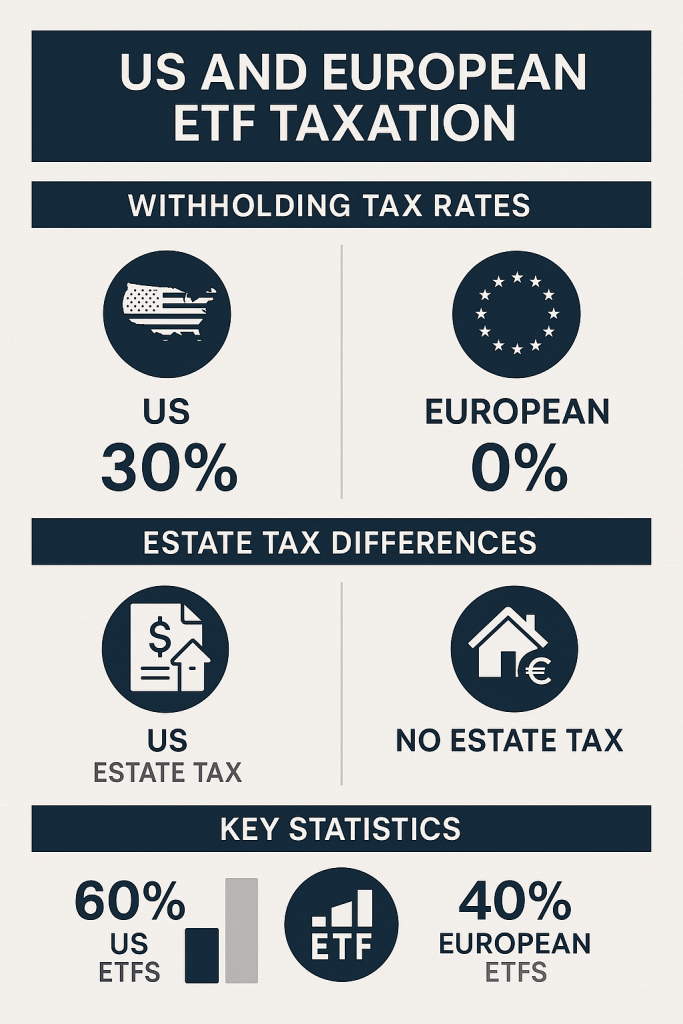
US vs European ETF taxation comparison infographic
Understanding the US ETF Landscape for Europeans
US-domiciled ETFs represent the world’s largest and most diverse ETF market. Moreover, they hold over $7 trillion in assets under management. However, European retail investors face significant regulatory hurdles when accessing these funds. The PRIIPs regulations that came into effect in 2018 caused these hurdles.
Key Challenges for European Investors
Regulatory Restrictions: Most European brokers cannot offer US ETFs to retail clients. This restriction stems from missing Key Information Documents (KIDs). Typically, only professional investors or those who qualify as elective professional clients can access these funds.
Tax Implications: US ETFs subject European investors to 30% withholding tax on dividends. Tax treaties can reduce this to 15%. Additionally, investors face potential US estate tax of up to 40% on holdings exceeding $60,000.
Estate Tax Concerns: Unlike UCITS ETFs, US-domiciled funds expose non-US investors to American estate taxes. Consequently, this creates significant inheritance planning challenges.
Top-Performing US-Domiciled ETFs
Despite these challenges, certain US ETFs offer compelling advantages for qualified European investors. Below are the best performers across different categories.

Top US domiciled ETFs performance dashboard
Broad Market Exposure
VOO (Vanguard S&P 500 ETF) stands out as the premier choice for S&P 500 exposure. Notably, it carries a 0.03% expense ratio and holds $604 billion in assets. As a result, it significantly undercuts European alternatives while providing identical market exposure.
VTI (Vanguard Total Stock Market ETF) offers comprehensive US market coverage. It includes 4,000+ holdings spanning large, mid, and small-cap stocks. Crucially, its 0.03% expense ratio makes it extremely cost-effective for total market exposure.
SPY (SPDR S&P 500 ETF Trust) launched in 1993 as the world’s first ETF. Today, it remains highly liquid despite a higher 0.09% expense ratio. Importantly, its massive $618 billion in assets ensures excellent trading conditions.
Growth-Focused Options
QQQ (Invesco QQQ Trust) provides exposure to the Nasdaq-100 with its technology-heavy weighting. Despite a 0.20% expense ratio, it has delivered impressive 17.6% annualized returns over five years.
VBK (Vanguard Small-Cap Growth ETF) targets high-growth smaller companies. Moreover, it carries a 0.07% expense ratio. Recent performance shows 35% one-year returns, though with higher volatility.
Dividend and Value Strategies
SCHD (Schwab US Dividend Equity ETF) focuses on dividend-paying stocks with strong fundamentals. Its 0.06% expense ratio remains low. Additionally, consistent dividend growth makes it attractive for income-focused investors.
VBR (Vanguard Small-Cap Value ETF) provides exposure to undervalued smaller companies. Notably, it has delivered 33.8% one-year returns with a 0.07% expense ratio. Therefore, it offers compelling value potential.
Sector-Specific Opportunities
XLK (Technology Select Sector SPDR ETF) concentrates on technology giants. Furthermore, it has produced 31.5% one-year returns. Its 0.09% expense ratio provides targeted tech exposure.
VNQ (Vanguard Real Estate ETF) offers REIT exposure with a 0.12% expense ratio. Although returns have been modest recently, it provides essential portfolio diversification.
Small-Cap Excellence
US markets offer superior small-cap ETF options compared to European alternatives:
- IJT (iShares S&P Small-Cap 600 Growth ETF): 28.4% one-year returns with 0.18% expense ratio
- AVUV (Avantis U.S. Small Cap Value ETF): 19.2% five-year annualized returns with 0.25% expense ratio
- RWJ (Invesco S&P SmallCap 600 Revenue ETF): 18.9% five-year performance with revenue-weighted methodology
Tax Considerations and Strategies
Withholding Tax Implications
European investors face 30% withholding tax on US ETF dividends. However, this may drop to 15% for countries with favorable tax treaties. In practice, some investors can offset this against local dividend taxes. Consequently, US ETFs may become competitive.
Estate Tax Planning
The $60,000 threshold for US estate tax creates significant planning challenges. However, several European countries have signed estate tax treaties that provide relief:
- Germany: Comprehensive estate tax treaty provides significant protection
- United Kingdom: Treaty limits exposure for UK domiciliaries
- Netherlands: Favorable treaty provisions for qualifying investors
- Switzerland: Estate tax treaty provides substantial benefits
Professional Investor Status
Many European investors can qualify as elective professional clients. This status grants access to US ETFs through brokers like Freedom24. This platform offers US-domiciled ETFs to qualified European investors.
Freedom24: Gateway to US Markets
Freedom24 stands out as one of the few European brokers offering direct access to US ETFs for qualified investors. The platform provides:
- Access to major US exchanges (NYSE, NASDAQ)
- Competitive trading fees for ETF transactions
- Professional-grade research tools
- Multi-currency account capabilities
However, investors should carefully evaluate their professional investor status. Crucially, they must understand the associated responsibilities before proceeding.
Risk Management and Diversification
Currency Risk
US ETFs expose European investors to USD currency risk. This risk works both ways. For example, you gain when the dollar strengthens, but you lose during dollar weakness.
Concentration Risk
Many popular US ETFs are heavily concentrated in technology stocks. By contrast, the top 10 holdings in both SPY and VOO represent over 34% of assets. Therefore, this creates concentration risk.
Liquidity Advantages
US ETFs typically offer superior liquidity compared to European alternatives. Notably, SPY trades over $20 billion daily. As a result, tight bid-ask spreads persist even during volatile markets.
Alternative Strategies
VTI/VXUS Combination
Sophisticated investors often combine VTI (US Total Market) with VXUS (International ex-US) to create global exposure. Moreover, this approach offers foreign tax credit benefits and precise allocation control.
Sector Rotation
US markets provide extensive sector ETF options unavailable in Europe:
- Healthcare: Multiple specialized options including biotech and medical devices
- Technology: Various sub-sector focuses from semiconductors to software
- Energy: Comprehensive coverage of traditional and renewable energy
ESG and Sustainable Options
US markets lead in ESG ETF innovation:
- ESGV (Vanguard ESG U.S. Stock ETF): 0.09% expense ratio with comprehensive ESG screening
- USXF (iShares ESG Advanced MSCI USA ETF): Advanced ESG methodology with strong performance
- VOTE (TCW Transform 500 ETF): Unique shareholder advocacy approach with 0.05% expense ratio
Performance Comparison Analysis
| ETF | Expense Ratio | 1-Year Return | 5-Year Return | AUM (Billions) | Focus Area |
|---|---|---|---|---|---|
| VOO | 0.03% | 24.8% | 16.1% | $604B | S&P 500 |
| VTI | 0.03% | 23.8% | 15.3% | $516B | Total Market |
| QQQ | 0.20% | 29.2% | 17.6% | $313B | Nasdaq-100 |
| SCHD | 0.06% | 13.5% | 14.2% | $65B | Dividends |
| VBK | 0.07% | 35.0% | 8.2% | $18B | Small Growth |
Making the Decision
When US ETFs Make Sense
US-domiciled ETFs may suit European investors who:
- Qualify as professional investors
- Have substantial assets warranting estate tax planning
- Seek specific exposures unavailable in UCITS format
- Can effectively manage currency and tax implications
- Prioritize ultra-low costs and maximum liquidity
When to Stick with UCITS
Most European investors should prefer UCITS ETFs due to:
- Simplified tax treatment and reporting
- No US estate tax exposure
- Regulatory protection under European law
- Easier accessibility through most brokers
- Accumulating share classes for tax efficiency
Conclusion
US-domiciled ETFs offer compelling advantages in costs, liquidity, and investment options. However, they come with significant tax and regulatory complexities for European investors. Therefore, the decision requires careful consideration of individual circumstances. Furthermore, investors must verify professional investor qualification and pursue comprehensive tax planning.
For qualified investors willing to navigate these complexities, US ETFs provide access to the world’s most sophisticated and cost-effective investment vehicles. However, the majority of European investors will find UCITS alternatives more suitable for their needs.
In short, consult with tax professionals and use specialized brokers like Freedom24. This step helps you properly evaluate whether US-domiciled ETFs align with your investment objectives and regulatory status.
Frequently asked questions
What does UCITS mean?
UCITS stands for “Undertakings for the Collective Investment in Transferable Securities” — an EU-harmonised retail fund framework. UCITS ETFs benefit from cross-border passporting, eligibility rules and KIDs/PRIIPs disclosure. See ESMA for the latest regulation.
Why does UCITS matter for European investors?
UCITS ETFs are accessible on European brokers, get standard EU retail-investor protection, and benefit from favourable tax treatment in most EU member states. Most European retail brokers cannot offer non-UCITS US-domiciled ETFs since the 2018 PRIIPs regulation.
Sources and further reading
- justETF — European UCITS ETF screener
- Morningstar UK ETF rankings
- ESMA — European Securities and Markets Authority
- Bogleheads wiki — EU investing
- ETF.com industry data
The domicile decision, priced: run your position through the free ETF withholding tax calculator to see the annual drag that treaty access removes.
Before you open any account
grab the free 12-page Starter Kit: the 7-filter fund shortcut, the 3-question broker safety matrix, and the 7 mistakes that cost beginners the most.
European UCITS/ETF investor with 11+ years building a global dividend and index portfolio, and founder of Financial Expert Class. I write every guide here from first-hand experience investing across EU brokers and tax regimes — not theory. More about me →