
Best Franklin Templeton ETFs for European Investors
To watch how this allocation drifts over time, I use how I track my portfolio.
Use the UCITS ETF analyser to test these against any other UCITS ETF on the same metrics.
Franklin Templeton stands out as a powerhouse in the European ETF market. Notably, the firm draws on over 70 years of investment expertise. Moreover, it offers compelling UCITS options for European investors who want diversification, low fees and thematic growth. With 49 UCITS ETFs on justETF’s count — 39 equity and 10 bond, up from the “more than 35” this page used to say — spanning regions and asset classes, Franklin Templeton sits alongside Vanguard, iShares, Invesco and SPDR as a serious UCITS building block. For the broader context of European ETF issuers, see our European ETF providers comparison hub. Additionally, if you’re new to UCITS investing, start with the European ETF investing beginner roadmap for 2026.
Comparing funds is step one — the Masterclass turns it into a complete plan — fund choice, broker setup, YOUR country’s taxes and the first purchase, in 55 text lessons.
Top Performing Franklin Templeton ETFs in 2025
The 2025 standout performer was the Franklin FTSE Korea UCITS ETF. Crucially, it delivered an impressive 36.52% return year-to-date. Consequently, it leads single-country emerging-market exposure. Always cross-check live performance, TER and AUM for each Franklin product. Use the issuer fact sheet plus an independent screener such as justETF or Morningstar UK before you allocate capital.
Methodology: every shortlist on this page applies our how we compare ETFs.
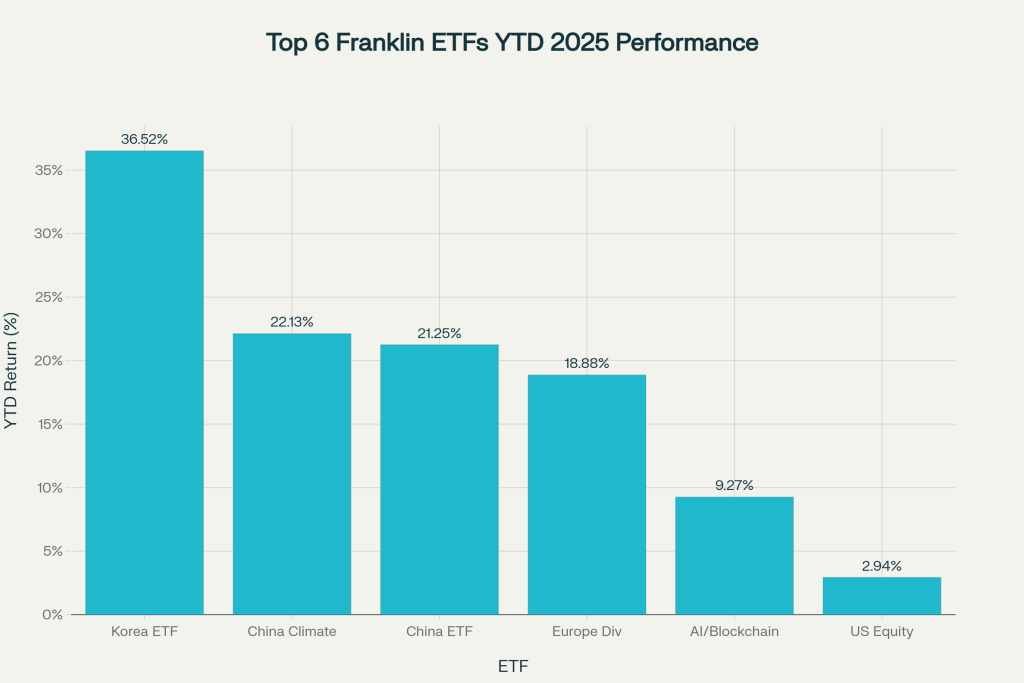
Top Performing Franklin Templeton ETFs — YTD 2025 Returns
Asian Market Leaders
The Franklin FTSE Korea UCITS ETF leads the pack with exceptional performance. Moreover, the fund tracks Korean equities and charges just 0.09% annually. Therefore, it ranks among the cheapest UCITS routes into Korean equity for European investors.
The Franklin FTSE China UCITS ETF follows closely with 21.25% YTD returns. Additionally, this broad China exposure fund offers comprehensive access to mainland and offshore Chinese markets. Notably, it charges only 0.19% annual fees.
For ESG-conscious investors, the Franklin MSCI China Paris Aligned Climate UCITS ETF provides climate-focused Chinese exposure at a TER of 0.22%, with EUR 8m under management at 28 July 2026 — the smallest fund named on this page, and a real closure risk (IE000EBPC0Z7). It returned 22.13% this year while applying Paris-aligned screens. Investors who want a wider menu of climate-tilted UCITS funds can compare the field via our best green and ESG ETFs for European investors guide.
European Focus Options
European investors should not overlook home-grown opportunities. For example, the Franklin European Quality Dividend UCITS ETF delivered 18.88% YTD returns while focusing on high-quality dividend payers.
This fund charges 0.25% annually and distributes dividends quarterly. Importantly, it holds 50 carefully selected European companies with strong dividend histories. This methodology slots in well alongside the broader UCITS dividend universe covered in our best dividend ETFs for European investors hub.

Technology and Innovation: what are Franklin’s best tech funds?
Short answer: one Franklin technology UCITS ETF exists, it is very new and very small, and this page did not previously name it at all. The Franklin S&P 500 Information Technology UCITS ETF, IE000EQGURT5 tracks the S&P 500 Capped 35/20 Information Technology index at 0.09% — Irish, accumulating, 74 holdings. But it launched on 11 May 2026 and held EUR 2m at 28 July 2026, with more than half the fund in three stocks. It is cheap and it is real; it is not yet a position you build a portfolio on.
Franklin’s actual flagship technology product is not an ETF. The Franklin Technology Fund (LU0109392836) is an actively managed Luxembourg SICAV mutual fund holding roughly USD 15.6bn — some 780 times the ETF. If you came here looking for “the Franklin tech fund”, that is almost certainly what you have heard of, and it is a different kind of product with a different cost structure and no intraday dealing.
And a correction to the fund this section used to file under technology. The Franklin AI, Metaverse and Blockchain UCITS ETF, IE000IM4K4K2 tracks a single index: Solactive Global Metaverse Innovation. There is no AI sleeve and no blockchain sleeve — the index selects companies with business operations in the metaverse ecosystem, which lands 79% in technology and 83% in US-listed names. It charges 0.30%, holds 76 positions and EUR 14m. The three-year return this page gave as 84.05% is 88.36% in EUR. Treat it as a small satellite, and know that its name promises three themes and its index buys one.
Smart Beta and Factor Investing
Franklin Templeton runs a credible smart-beta franchise. Their factor-based approach identifies quality stocks through systematic screening. Additionally, it builds on the underlying academic factor literature that platforms like ETF.com and the Bogleheads wiki on factor investing aggregate and discuss.
The Franklin U.S. Equity UCITS ETF demonstrates this approach. Specifically, it selects 250 stocks from the Russell 1000 using quality, value, momentum and low volatility — four factors, not the three this sentence used to list, which is odd given the page names all four in the next section. The fund is IE00BF2B0P08 at 0.20%, and its index moved to the Linked LibertyQ US Large Cap Equity Index-NR, so check the current methodology rather than an older factsheet.
Multi-Factor Benefits
Multi-factor investing reduces single-factor risks. Therefore, Franklin Templeton combines quality, value, momentum, and low volatility factors. This delivers more balanced exposure than any single-factor sleeve.
This approach has proven reasonably effective across market cycles. Notably, the Franklin U.S. Equity ETF delivered 31.84% over three years despite modest YTD performance. In short, investors should judge factor sleeves on multi-year horizons, not single quarters.
Bond and Fixed Income Options
European investors need fixed-income diversification. Franklin Templeton offers several bond ETF options with varying durations and credit qualities. Moreover, these sit naturally alongside the broader universe described in our European fixed-income ETFs complete guide.
The Franklin Euro Short Maturity UCITS ETF provides low-risk income. It returned 1.78% YTD with minimal duration risk. Additionally, it charges only 0.15% annual fees.
For corporate bond exposure, consider the Franklin Euro IG Corporate UCITS ETF. It focuses on investment-grade European corporate bonds and posted 2.98% YTD returns.
Green and Sustainable Bonds
ESG investing extends to fixed income. For example, the Franklin Sustainable Euro Green Bond UCITS ETF offers Europe’s first actively managed green bond ETF.
This fund selects bonds that finance environmental projects under the EU Green Bond Standard and SFDR taxonomy. It charges 0.25% annually and provides sustainable income generation.
Fee Structure and Cost Analysis
Franklin Templeton ETFs are competitively priced. Notably, annual fees range from 0.07% to 0.45%. This puts the cheapest products on par with the lowest-cost passive trackers from Vanguard or iShares. You can cross-reference these via Vanguard UK and iShares UK.
The Franklin S&P 500 Paris Aligned Climate UCITS ETF charges just 0.07% annually. Consequently, it ranks as one of the lowest-cost climate-aligned S&P 500 wrappers available to European investors.
| ETF Category | Typical Fee Range | Example |
|---|---|---|
| Broad Market | 0.07% – 0.20% | S&P 500 Paris Aligned Climate |
| Regional / Country | 0.09% – 0.25% | Korea, China ETFs |
| Dividend Focus | 0.25% – 0.30% | European Quality Dividend |
| Thematic / Innovation | 0.30% – 0.45% | AI, Metaverse & Blockchain |
Cost Comparison
Franklin Templeton’s fees compete well with industry leaders. Moreover, they often undercut larger providers while keeping quality fund management.
The 0.09% fee on the Korea ETF beats many emerging-market competitors. Additionally, the 0.07% S&P 500 climate fee rivals the cheapest broad-market index trackers in Europe.
Trading and Access Through Freedom24
European investors can access most Franklin Templeton UCITS ETFs through major brokers. Freedom24 offers comprehensive access to over 3,600 ETFs across global markets. Moreover, our best European ETF brokers hub compares it against several alternatives.
Freedom24 provides competitive pricing for ETF trading. Their Smart plan charges €2.00 per order plus €0.02 per share.
Platform Benefits
Freedom24’s platform offers several advantages:
- 15 global trading venues for optimal execution
- Currency conversion at competitive rates
- No custody fees for ETF holdings
- Research tools and market analysis
European investors can trade Franklin Templeton ETFs across major European exchanges. These include Xetra, the London Stock Exchange and Euronext.
Account Opening Process
Opening a Freedom24 account is straightforward. Notably, the process takes minutes with full regulatory protection.
Correction: Freedom24 is not BaFin-regulated and the €20,000 is not a German scheme. The operator is Freedom Finance Europe Ltd, authorised by CySEC in Cyprus under CIF licence 275/15, and the €20,000 ceiling comes from the Cypriot Investor Compensation Fund. The figure is right, the country is not — and this site’s own Fidelity page states the CySEC position correctly, so the two pages contradicted each other. Twenty thousand euros is in any case the EU-harmonised investor-compensation ceiling rather than a national floor, and it is not a deposit guarantee. For reference, BaFin supervises. Consequently, this provides a baseline of security for European investors accessing global ETF markets.
Investment Strategies and Portfolio Construction
Franklin Templeton ETFs work well in diversified portfolios. Their geographic and sector diversity reduces single-market concentration risks. For a full template of how a UCITS sleeve fits inside a global core, see our balanced ETF portfolio guide for European investors.
Core-Satellite Approach
Use broad-market ETFs as core holdings. For example, the Franklin FTSE Developed World UCITS ETF, IE000CVOSY02 provides developed-market equity exposure at 0.09% annually. Two caveats this page previously left out. It tracks FTSE Developed, so it holds no emerging markets at all and is not an all-world product — it does not compete with FTSE All-World trackers on coverage, only on price. And it holds EUR 19m at 28 July 2026, having launched on 24 June 2024, which is small for a proposed core holding. On coverage the comparison is with our VWCE vs X All-World comparison hub.
Add satellite positions in regional or thematic ETFs. The Korea and China ETFs offer emerging-market exposure. Meanwhile, the AI ETF targets innovation.
Dividend Income Strategy
European dividend investors can build income portfolios using Franklin Templeton ETFs. Specifically, the European Quality Dividend ETF forms an excellent foundation.
Combine this with the Global Quality Dividend UCITS ETF for worldwide income exposure. Importantly, both funds focus on sustainable dividend growth rather than chase the highest headline yield.
Risk Considerations and Due Diligence
All investments carry risks. Franklin Templeton ETFs face market, currency, and concentration risks depending on their focus.
Geographic Concentration
Single-country ETFs like the Korea and China funds face concentration risk. Economic or political changes can significantly impact performance. By contrast, the 36.52% YTD figure on Korea, while attractive, sits on top of meaningful single-country volatility.
Diversify across regions to reduce this risk. Therefore, combine Asian ETFs with European and US exposure for balanced global allocation.
Currency Exposure
Many Franklin Templeton ETFs are EUR-hedged for European investors. However, some retain currency exposure for additional diversification.
The China ETFs maintain USD exposure, which adds currency risk. Consequently, consider this when sizing positions in your portfolio.
Tax Efficiency and UCITS Structure
Franklin Templeton’s UCITS ETFs offer tax efficiency for European investors. Most are Irish-domiciled. Therefore, they provide favourable withholding tax treatment on US-source dividends. The European Securities and Markets Authority (ESMA) maintains the full UCITS regulatory framework governing every fund discussed here, and our complete UCITS ETF guide for European investors explains it.
Dividend Taxation
Distributing ETFs pay dividends subject to local tax rates. By contrast, accumulating versions reinvest dividends automatically and defer tax obligations.
Choose based on your tax situation and income needs. For example, German investors often prefer accumulating ETFs for tax efficiency.
Regulatory Compliance
All Franklin Templeton UCITS ETFs comply with European regulations. They publish KID documents in PRIIPs format. Moreover, they meet MiFID II distribution requirements.
Performance Attribution and Fund Management
Franklin Templeton’s active management expertise informs their ETF offerings. Notably, even passive funds benefit from sophisticated index construction via the LibertyQ index family.
Smart Beta Methodology
The proprietary LibertyQ indices use systematic factor screening to identify quality companies while keeping broad diversification. For example, the European Quality Dividend ETF exemplifies this approach. It selects dividend-paying stocks using quality screens and fundamental analysis rather than pure yield ranking.
Research and Development
Franklin Templeton invests heavily in quantitative research. Moreover, they update their factor models periodically to reflect changing market conditions. Consequently, this research advantage helps their ETFs deliver more consistent performance across market cycles. The three-year track records support this claim. However, investors should always sanity-check against an independent source like Morningstar before they make allocation decisions.
Future Outlook and New Launches
Franklin Templeton continues expanding their European ETF range. Recent launches include climate-aligned and sustainable investment options.
ESG Integration
Environmental, social, and governance factors carry growing weight. Notably, Franklin Templeton offers 17 Article 8 and 9 ETFs under SFDR classification.
The Paris Aligned Climate ETFs target a 10% carbon intensity improvement. Crucially, they keep low tracking error to parent indices.
Innovation Pipeline
Expect more thematic ETFs focusing on structural growth trends. For example, the AI and Blockchain ETF demonstrates Franklin Templeton’s innovation focus.
Future launches may target robotics, healthcare innovation, and clean energy themes for European investors.
How Franklin Templeton Compares with Other UCITS Issuers
Franklin Templeton is not the only credible UCITS option for the niches above. For example, the Korea and China single-country exposure overlaps with similar products from iShares. The dividend-quality sleeve competes with WisdomTree and iShares quality-dividend ETFs. Additionally, the AI / blockchain thematic sits against WisdomTree, Global X and Invesco offerings (some of which our best Invesco ETFs for European investors guide covers). The right decision usually comes down to three things: live TER differential, replication method (physical, sampled or synthetic), and the size and tracking history of the fund. Always cross-check these in the official KID and on justETF before allocating, rather than relying on a single article (including this one).
Getting Started with Franklin Templeton ETFs
Begin with broad-market exposure through core ETFs. For example, the FTSE Developed World or S&P 500 Franklin products provide solid foundations.
Add regional exposure through emerging-market ETFs. Notably, the strong-performing Korea and China ETFs offer growth potential at the cost of higher volatility.
Portfolio Implementation
Start small and build positions gradually. Moreover, use Freedom24’s fractional trading to access expensive ETFs affordably.
Dollar-cost (or euro-cost) averaging through regular investments reduces timing risk. In practice, this strategy works particularly well with volatile emerging-market ETFs like the China and Korea sleeves.
Monitoring and Rebalancing
Review your Franklin Templeton ETF holdings at least annually. Quarterly review is fine but rarely necessary. Rebalance when allocations drift significantly from targets. Typical thresholds are 5 percentage points absolute or 25% relative drift.
The Freedom24 platform provides portfolio analytics and performance tracking tools for effective monitoring.
Franklin Templeton ETFs offer European investors compelling opportunities across global markets. Crucially, their combination of competitive fees, strong performance, and innovative strategies makes them excellent portfolio building blocks. They sit alongside Vanguard, iShares and Invesco UCITS products.
Whether you seek Asian growth, European dividends, or technology innovation, Franklin Templeton has suitable options. Use a regulated broker like Freedom24 to access these efficiently and cost-effectively. Additionally, always verify the live KID, TER and AUM before you place the trade.
Frequently Asked Questions
What are Franklin Templeton’s best tech funds?
There is exactly one Franklin technology UCITS ETF and it is brand new: the Franklin S&P 500 Information Technology UCITS ETF (IE000EQGURT5), 0.09%, Irish, accumulating, 74 holdings — launched 11 May 2026 with EUR 2m and over half the fund in three stocks. Cheap, real, and too small to build on yet. The product most people mean when they say “Franklin tech fund” is the Franklin Technology Fund (LU0109392836), an actively managed Luxembourg SICAV holding about USD 15.6bn — a mutual fund, not an ETF. Franklin’s AI, Metaverse and Blockchain UCITS ETF is not a technology fund in the index sense: it tracks Solactive Global Metaverse Innovation, one theme rather than three.
What are Franklin Templeton’s best ETFs for a European investor?
By size and cost rather than by last year’s return: Franklin FTSE Korea (IE00BHZRR030) at 0.09% and EUR 4,210m is the range’s flagship; Franklin S&P 500 Paris Aligned Climate (IE00BMDPBZ72) at 0.07% and EUR 299m is the cheapest; Franklin European Quality Dividend (IE00BF2B0L69) at 0.25%, EUR 531m and 50 holdings is the income pick; and Franklin FTSE China (IE00BHZRR147) at 0.19% and EUR 1,490m for single-country China. Franklin’s strength in Europe is cheap single-country and factor exposure, not broad core funds.
Which Franklin Templeton ETFs are too small to buy?
Three named on this page are worth thinking twice about, because a sub-scale fund can be closed and a closure is a forced taxable disposal in most countries. At 28 July 2026: Franklin MSCI China Paris Aligned Climate EUR 8m, Franklin AI, Metaverse and Blockchain EUR 14m and Franklin FTSE Developed World EUR 19m — the last of which this page proposes as a core holding. The Information Technology fund is smaller still at EUR 2m, but it launched in May 2026, so it has not had time to gather assets.
What is the cheapest Franklin Templeton UCITS ETF?
The Franklin S&P 500 Paris Aligned Climate UCITS ETF (IE00BMDPBZ72) leads the range at 0.07%, with EUR 299m. Next at 0.09% are the FTSE Korea fund (IE00BHZRR030, EUR 4,210m — the largest in the range), the FTSE Developed World fund (IE000CVOSY02, EUR 19m) and, newly, the S&P 500 Information Technology fund (IE000EQGURT5, EUR 2m). Fund sizes matter as much as the fee here: the same 0.09% buys you a EUR 4.2bn fund or a EUR 2m one. Always confirm the live TER on the official Franklin Templeton fact sheet and a screener such as justETF before you buy. Importantly, issuer fees occasionally move.
Which Franklin Templeton ETF performed best in 2025?
Year-to-date in 2025, the Franklin FTSE Korea UCITS ETF stood out as the top performer at 36.52%. It edged out the Franklin MSCI China Paris Aligned Climate UCITS ETF at 22.13% and the Franklin FTSE China UCITS ETF at 21.25%. Notably, the European Quality Dividend UCITS ETF led European-focused products at 18.88%. Past performance does not reliably indicate future results. Consequently, single-country YTD figures should not drive long-term allocation decisions.
Are Franklin Templeton UCITS ETFs safe for European investors?
Franklin Templeton’s UCITS ETFs sit mainly in Ireland or Luxembourg. They comply with the EU UCITS framework. Specifically, ESMA supervises this framework at the EU level. Meanwhile, national regulators such as BaFin (Germany) and the Central Bank of Ireland supervise it at member-state level. UCITS rules impose strict diversification, liquidity and disclosure requirements. However, they do not protect investors against market loss. Always read the KID and prospectus before you invest.
What is the best Franklin Templeton ETF for dividend income in Europe?
For European-focused dividend income, the Franklin European Quality Dividend UCITS ETF at 0.25% TER is the natural choice within the range. Specifically, it holds approximately 50 quality dividend payers and distributes quarterly. For global dividend exposure, the Global Quality Dividend UCITS ETF is the complementary product. Notably, both prioritise dividend quality and sustainability over the highest absolute yield.
Should I choose accumulating or distributing Franklin Templeton ETFs?
That depends entirely on your tax residency and goals. For example, German, Dutch and Irish investors often favour accumulating share classes for tax deferral and simpler reinvestment. By contrast, investors who want regular cash income often prefer distributing share classes. UK and many southern European investors typically fall in this group. Tax treatment differs by country. Therefore, check the rules in your jurisdiction or consult a qualified tax advisor.
How do Franklin Templeton ETFs compare with iShares and Vanguard?
Franklin Templeton tends to be most competitive in single-country exposure (Korea, China), Paris-aligned climate trackers, and quality-dividend factor sleeves. By contrast, iShares typically has wider product breadth and higher AUM per fund. Meanwhile, Vanguard wins on the cheapest broad core (S&P 500, FTSE All-World). For most European investors, the sensible decision is to combine the cheapest global core (Vanguard or iShares) with selective Franklin satellites where they have a clear cost or factor edge.
Where can I verify Franklin Templeton ETF data before buying?
Use multiple independent sources. The official Franklin Templeton fact sheet and KID are the primary source. Additionally, cross-check with justETF for TER, AUM, replication method and tracking difference. Use Morningstar UK for performance, ratings and analyst commentary. Moreover, check ETF.com for global context. The ESMA website documents the UCITS legal framework that applies to every product discussed here.
Frequently asked questions
Run your own contribution profile through the EU broker fee tool to see where you actually pay the most.
Sources
- Franklin S&P 500 Information Technology UCITS ETF, IE000EQGURT5 — 0.09%, EUR 2m, 74 holdings, launched 11 May 2026. Read 26 August 2026
- Franklin AI, Metaverse and Blockchain UCITS ETF, IE000IM4K4K2 — 0.30%, EUR 14m, 76 holdings, Solactive Global Metaverse Innovation index
- Franklin FTSE Korea, IE00BHZRR030 — 0.09%, EUR 4,210m — and FTSE China, IE00BHZRR147 — 0.19%, EUR 1,490m
- Franklin S&P 500 Paris Aligned Climate, IE00BMDPBZ72 — 0.07%, EUR 299m, the cheapest in the range
- Franklin European Quality Dividend, IE00BF2B0L69 — 0.25%, EUR 531m, 50 holdings, quarterly, LibertyQ European Dividend index
- Franklin FTSE Developed World, IE000CVOSY02 — 0.09%, EUR 19m, developed markets only, launched 24 June 2024
- Franklin Euro Short Maturity, IE00BFWXDY69 — 0.15%, EUR 284m, distributing annually; Euro IG Corporate, IE000H0TSO96 — 0.15%, EUR 100m, semi-annual; Sustainable Euro Green Bond, IE00BHZRR253 — 0.25%, EUR 166m. All three are actively managed
- franklintempleton’s own product pages carry the KIDs and factsheets and are the right place to confirm a live TER before dealing
European UCITS/ETF investor with 11+ years building a global dividend and index portfolio, and founder of Financial Expert Class. I write every guide here from first-hand experience investing across EU brokers and tax regimes — not theory. More about me →