
ETF Due Diligence Checklist: 10 Data Points Before You Buy
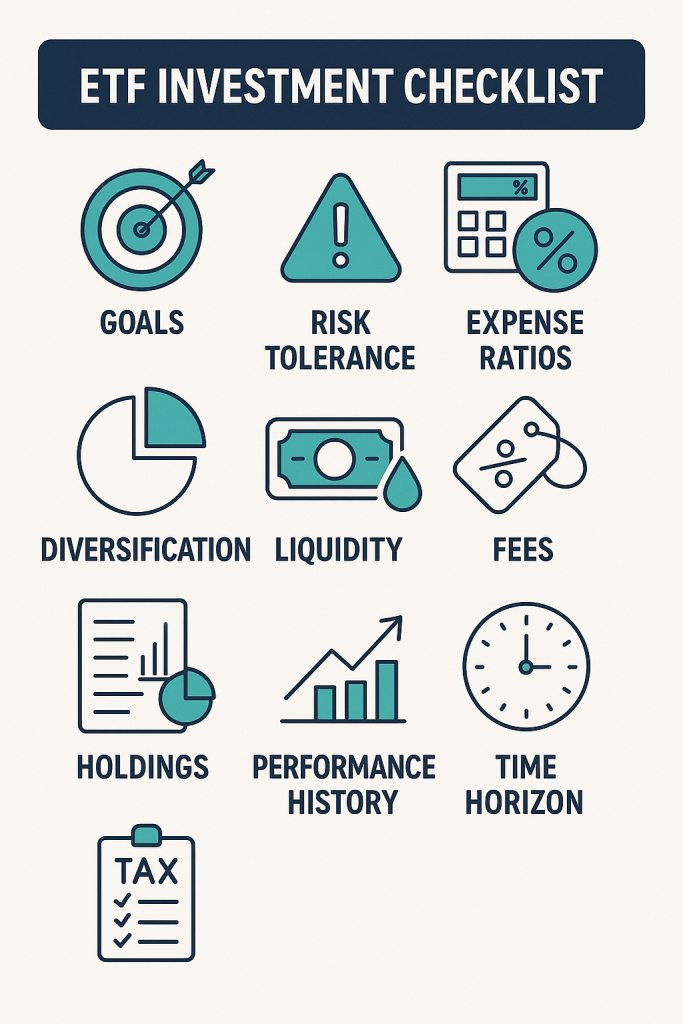
ETF Due Diligence Checklist infographic with 10 key data points
Exchange-traded funds (ETFs) have transformed investing for Europeans. Moreover, they offer low-cost access to diversified portfolios across global markets. Europe now lists over 2,500 ETFs holding more than €1.8 trillion in assets. Therefore, picking the right ETF requires careful analysis. This checklist covers 10 essential data points every European investor should review before buying an ETF.
Related reading: the mistakes this checklist exists to prevent.
1. Total Expense Ratio (TER) and Hidden Costs
The Total Expense Ratio is the annual fee you pay to own an ETF. It is shown as a percentage of your investment. European equity ETFs typically charge between 0.05% and 0.30% per year. For example, a €10,000 investment in an ETF with a 0.12% TER costs you €12 annually in management fees.
Browse the full series in our portfolio construction & FIRE hub.
See also: ETF TER fee.
However, TER does not tell the full story. Additional costs include bid-ask spreads, trading commissions, and currency conversion fees. The bid-ask spread is the gap between buying and selling prices. It ranges from 0.02% for liquid ETFs to several percentage points for niche products. Therefore, judge total cost of ownership rather than the expense ratio alone.
Key Action: Compare TER across similar ETFs and factor in trading costs. Generally, equity ETFs with TER below 0.25% count as low-cost.
2. Tracking Difference and Tracking Error
Tracking difference measures how closely an ETF follows its benchmark. It captures the performance gap between the ETF and its index over a set period. For example, a tracking difference of -0.15% means the ETF lagged its index by 0.15% annually. Fees and operational costs typically explain the gap.
Tracking error, measured as standard deviation, shows how consistent that tracking is. A lower tracking error suggests more reliable index replication. For example, an ETF with 0.50% tracking error sits within 0.50% of its average tracking difference roughly two-thirds of the time.
Key Action: Look for ETFs whose tracking differences sit close to their TER and whose tracking errors stay below 1%. Consistent underperformance beyond the TER may flag management issues.
3. Replication Method
ETFs use different strategies to track their indices. Physical replication means buying the actual securities in the index. Providers do this through full replication, which buys every security, or through sampling, which buys representative securities. Synthetic replication uses derivatives like swaps to get index exposure without owning the underlying securities.
Physical replication offers transparency and removes counterparty risk. However, it can struggle in less liquid markets. By contrast, synthetic replication can deliver precise tracking and reach difficult markets, but it adds counterparty risk.
Key Action: For core holdings, prefer physically replicated ETFs from established providers. Consider synthetic ETFs only for specialized exposures where physical replication is impractical.
4. Fund Size and Liquidity
Fund size, measured by Assets Under Management (AUM), signals stability and operational efficiency. Larger ETFs gain economies of scale. Consequently, they can cut costs and improve liquidity. ETFs with less than €100 million in AUM may face closure risk. By contrast, those above €500 million are generally considered stable.
Liquidity goes beyond daily trading volume. It depends on both secondary market trading and the liquidity of underlying assets. European ETFs typically show lower trading volumes than US peers. In practice, European markets see roughly 1% daily turnover versus 10-12% in the US.
Key Action: Focus on ETFs with at least €100 million in AUM and consistent trading activity. For core positions, prioritize funds above €500 million.
5. Index Methodology and Holdings
Understanding the underlying index is crucial for ETF selection. Check whether the index uses market capitalization weighting, equal weighting, or factor-based weighting. Review the number of holdings. More holdings usually deliver better diversification, while concentrated funds offer targeted exposure.
Additionally, check the index rebalancing frequency and inclusion criteria. Some indices rebalance quarterly, while others adjust monthly or annually. High-turnover indices can drive up trading costs inside the ETF.
Key Action: Verify that the index methodology aligns with your investment objectives. Review the top 10 holdings to understand concentration risk.
6. Fund Domicile and Tax Implications

European ETF market domicile distribution showing Ireland and Luxembourg leadership
ETF domicile shapes tax efficiency for European investors. Ireland leads European ETF domiciliation with 72% market share, followed by Luxembourg at 19%. Irish-domiciled ETFs benefit from favorable tax treaties, especially with the US. Consequently, withholding tax on US dividends drops from 30% to 15%.
For European assets, domicile matters less. However, Ireland and Luxembourg both offer UCITS regulation. This framework protects investors and allows passporting across EU markets. By contrast, German, French, and Swiss domiciles account for smaller market shares.
Key Action: For global or US-exposed ETFs, prefer Irish domicile for tax efficiency. Ensure the ETF has UCITS compliance for regulatory protection.
7. Distribution Policy
ETFs either pay dividends to investors or reinvest them automatically. Distributing ETFs pay out dividends quarterly or annually. They provide income but require manual reinvestment for growth. Accumulating ETFs reinvest dividends automatically. This simplifies wealth building, but it offers no regular income.
Tax implications vary by country. Some European jurisdictions favor accumulating ETFs for tax efficiency, while others treat both equally. Therefore, weigh your income needs and tax situation before choosing a distribution policy.
Key Action: For long-term growth, choose accumulating ETFs to benefit from automatic compounding. Select distributing ETFs only if you need regular income.
8. Securities Lending and Counterparty Risk
Many ETFs run securities lending to earn extra revenue. They lend portfolio securities to short sellers in exchange for fees. This can lift returns slightly. However, it introduces counterparty risk if borrowers default.
Physical ETFs that lend securities typically hold high-quality collateral above 100% of the lent securities value. By contrast, synthetic ETFs carry counterparty risk through their swap arrangements.
Key Action: Check if the ETF engages in securities lending and review collateral policies. For conservative investors, consider ETFs that don’t lend securities.
Related reading: Best T. Rowe Price ETFs for European Investors.
9. Provider Reputation and Experience
ETF provider quality shapes fund management, customer service, and longevity. Established providers like iShares, Vanguard, Xtrackers, and Amundi have deep experience and resources. Evaluate the provider’s total ETF assets, track record, and commitment to the European market.
Additionally, weigh operational support, including market insights, educational resources, and trading assistance. Providers with strong local presence often deliver better service to European investors.
Key Action: Prioritize established providers with significant European ETF assets and long track records. Research the provider’s commitment to your target market segments.
10. Trading Venue and Market Access
European investors can trade ETFs on multiple exchanges. These include London Stock Exchange, Xetra (Frankfurt), Euronext, and others. Different exchanges may offer varying liquidity, trading hours, and settlement procedures.
Some brokers, like Freedom24, open access to broader ETF selections. This includes US-domiciled ETFs typically unavailable to European retail investors. Freedom24 offers over 3,500 ETFs across major global exchanges, providing European investors unprecedented access to international funds.
Key Action: Choose trading venues offering competitive spreads and sufficient liquidity. Consider brokers like Freedom24 for expanded ETF access beyond traditional European offerings.
Implementation Strategy
After reviewing these 10 data points, rank ETFs by your priorities. For core portfolio holdings, prioritize low costs, reliable tracking, and established providers. For specialized exposures, accept higher costs if the ETF delivers unique access or a superior methodology.
Broker Selection for ETF Trading
When implementing your ETF strategy, consider opening an account with Freedom24. It is a regulated broker offering European investors access to over 3,500 ETFs across major global exchanges. Traditional European brokers often limit ETF selection to Europe-based funds. By contrast, Freedom24 unlocks US-domiciled ETFs and emerging market funds that retail European investors rarely reach.
Freedom24 offers competitive pricing from €1.20 per order plus €0.02 per share. Consequently, it stays cost-effective for ETF investments. The platform delivers multilingual support, educational resources, and access to 15 global trading venues. As a CySEC-regulated broker with extra oversight from BaFin in Germany, Freedom24 protects investors while widening their options.
Conclusion
ETF selection demands systematic evaluation across multiple dimensions. This 10-point checklist gives European investors a clear framework. Use it to find ETFs that match your investment objectives while keeping costs and risks low. Remember that the “best” ETF depends on your specific needs, time horizon, and risk tolerance.
Focus on understanding what you’re buying, why you’re buying it, and how it fits your overall investment strategy. With over 2,500 European ETFs on offer, thorough due diligence helps you choose funds that serve your long-term financial goals.
Importantly, by applying this checklist consistently and partnering with brokers like Freedom24 that widen your investment universe, you can build a robust ETF portfolio. Such a portfolio captures global market opportunities while preserving cost efficiency and regulatory protection.
Sources and further reading
- justETF — European UCITS ETF screener
- Morningstar UK ETF rankings
- ESMA — European Securities and Markets Authority
- Bogleheads wiki — EU investing
- ETF.com industry data
Quantify it before you choose: our free withholding tax and domicile calculator turns the Ireland-versus-Luxembourg question into a euro figure for your holding.
See also: Free EU ETF resources.
Before you open any account
grab the free 12-page Starter Kit: the 7-filter fund shortcut, the 3-question broker safety matrix, and the 7 mistakes that cost beginners the most.
See also: Best american century.
European UCITS/ETF investor with 11+ years building a global dividend and index portfolio, and founder of Financial Expert Class. I write every guide here from first-hand experience investing across EU brokers and tax regimes — not theory. More about me →