
ETF Savings Plans: Automating Wealth Building
ETF savings plans have ignited a quiet revolution across Europe. Retail investors automate monthly purchases of diversified exchange-traded funds. As a result, they turn small contributions into long-term wealth. Moreover, they sidestep high fund costs and stock-picking stress. I have run my own plans for over a decade, and in this guide I will show you how they work. Additionally, you will learn why their popularity keeps surging into 2026. Furthermore, you will see how to launch your own with brokers such as Scalable Capital, Trade Republic and Freedom24. Crucially, this guide stays compliant with EU marketing rules.
If you are choosing between the two apps, see XTB or Trade Republic.
The practical walkthrough is here: the Trade Republic savings-plan walkthrough.
Once you hold a few funds, it helps to see the whole picture — here is Snowball Analytics.
What Is an ETF Savings Plan?
An ETF savings plan is a standing order that invests a fixed amount. German-speaking markets often call it an “ETF Sparplan.” Typically, you invest €25, €100 or €500 into one or more ETFs. In practice, you pick a chosen interval, usually monthly. Brokers then batch these small orders. Next, they buy fractional ETF shares. Finally, they credit them to your account automatically.
Key traits:
- Automation: “Set & forget” investing removes emotion and market-timing temptation.
- Cost efficiency: Commission-free or low-fee plans keep drag minimal versus traditional mutual funds. If you want to see how these costs stack up across 10 brokers in real numbers, the EU broker cost comparator runs the math.
- Diversification: A single ETF such as an MSCI World tracker holds 1,300+ global stocks.
- Accessibility: Minimums from €1–€25 open markets to first-time investors.
Investing is a risk. The forecasts and past performance are not reliable indicators of future performance. It is important to do your own analysis before making any investment. This article is not financial advice.
How Big Has the Trend Become?
Continental Growth Spurt
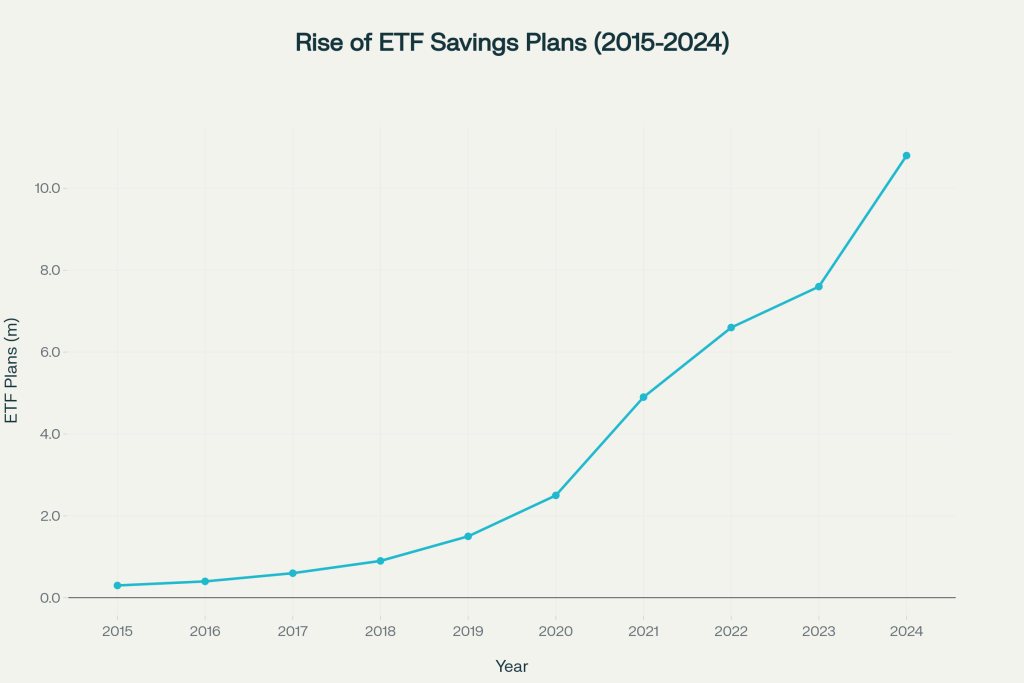
ETFs went mainstream in the late 2010s. Notably, German neobrokers introduced cheap Sparpläne. Research by extraETF shows striking growth. Indeed, plans executed each month across continental Europe ballooned from 0.3 million in 2015 to 10.8 million in 2024. Furthermore, annual savings volumes jumped to €17.6 billion that year. BlackRock projects the tally could reach 32 million plans by 2028. By mid-2026, the trend shows no sign of slowing, as brokers keep expanding into new EU markets. Verify current figures with justETF or issuer reports, because the numbers move fast.
Why Investors Love Them
| Advantage | How It Helps Investors |
|---|---|
| Low ongoing costs | Typical total expense ratio (TER) for broad market ETFs ≈0.07%–0.20%, far below many mutual funds. |
| Fractional investing | Buy into pricey funds like MSCI World with as little as €1 per month. |
| Cost averaging | Smooths out market swings by investing on a schedule, reducing timing risk. |
| Tax-efficient growth | ETFs generate fewer capital-gains distributions than mutual funds; wrappers like ISAs or the French PEA can shield gains entirely. |
Setting Up a Plan: Step-by-Step
1. Choose Your ETF
For global equity exposure, many Europeans favour the iShares Core MSCI World UCITS ETF. It carries a TER of 0.20%. Notably, it delivered a strong five-year run into early 2026 — figures are illustrative, so verify current performance on Morningstar. Additionally, sustainable or region-specific ETFs can complement a core holding. However, avoid chasing past winners. Crucially, future returns are uncertain.
2. Pick a Broker
Below is a snapshot of leading EU platforms. Fees refer to a €100 monthly plan.
| Broker | Savings-Plan Fee | Free ETFs | USP |
|---|---|---|---|
| Trade Republic | €0 | 2,000+ | Commission-free plans across the Eurozone, plus interest on cash. |
| Scalable Capital | €0 on savings plans | 2,500+ | Huge commission-free savings-plan range; FREE and PRIME+ pricing models. |
| Freedom24 | From €1.20 per order | N/A* | Wide ETF universe; ideal for lump-sum ETF purchases and IPO access. |
| DEGIRO | €1–€2 | 200+ | Low custody fees, global markets access. |
| BNP Paribas Easy | 0.99% | 300 | Full-service bank option. |
*Freedom24 currently lacks automated ETF Sparpläne. However, investors can still buy ETFs manually or with scheduled cash transfers. Notably, the broker uses a low order fee structure of €1.20 + €0.02/share. Additionally, it offers access to U.S.-domiciled ETFs. Therefore, it stays attractive for one-off or quarterly contributions. Fees change, so verify current terms.
Compliance tip: Avoid absolute marketing claims like “best broker.” Instead, phrase comparisons as “one of the leading platforms.” However, you may use stronger wording when objective awards justify it.
3. Define Amount & Interval
Compounding rewards consistency. For example, take a €150 monthly plan into a world equity ETF compounding at 7% annualised. Over 25 years, it could build a €256,000 nest egg. This assumes constant returns and excludes taxes and fees. The figures are illustrative only. Use our compound growth calculator to stress-test scenarios.
4. Automate Funding
Link your bank via SEPA standing order. Notably, some brokers let you set recurring transfers, including Freedom24. However, the buy order there still requires manual confirmation. Therefore, ensure amounts fit your budget. Crucially, never invest beyond your risk capacity.
5. Review Annually
Check that your ETF’s TER still suits your goals. Additionally, review its replication method and index exposure. Moreover, rebalancing may help if you add bond ETFs or thematic satellites.
Where to run your ETF savings plan
I get asked one question more than any other: which broker should actually execute the plan? There is no single answer. It depends on where you live, how much cash you park, and how hands-off you want to be. Here is my honest take on the three platforms I rate for automated ETF investing in 2026.
Scalable Capital offers one of the largest commission-free savings-plan ranges in Europe, with thousands of eligible ETFs. It runs two pricing models: FREE and PRIME+. The FREE tier costs nothing monthly and still executes ETF savings plans at €0. PRIME+ adds unlimited trading and other perks for a flat subscription. One honest caveat: Scalable pays no interest on cash sitting in the broker account. Interest is only available through its separate overnight-money account, which you must set up on top. Scalable serves residents of Germany, Austria, Italy, France, Spain and the Netherlands. For a full head-to-head, read my Scalable Capital vs Trade Republic comparison, or follow the step-by-step Scalable savings-plan guide to set one up in minutes.
Trade Republic keeps things radically simple. Every ETF savings plan is free, fractional shares are standard, and the app pays interest on uninvested cash directly in the main account. That last point matters if you hold a buffer between paydays. The trade-off is a leaner research toolkit than Scalable’s. For most beginners in the Eurozone, it is a very strong default.
XTB suits investors outside the German neobroker heartland. It offers commission-free EU ETF investing (fair-usage limits apply) and operates across most of the EU, including markets Scalable and Trade Republic do not fully cover. Its ETF plans are flexible, and the platform adds decent charting for those who want it.
| Feature | Scalable Capital | Trade Republic | XTB |
|---|---|---|---|
| Savings-plan cost | €0 (huge ETF range) | €0 | €0 commission on EU ETFs |
| Pricing models | FREE and PRIME+ | Single free model | Single free model |
| Interest on cash | Not in the broker account; only via its separate overnight account | Yes, in the main account | Yes, on uninvested balances |
| Fractional shares | Yes | Yes | Yes (fractional ETFs) |
| Availability | DE, AT, IT, FR, ES, NL | Most Eurozone markets | Most EU markets |
Whichever you pick, the mechanics matter less than the habit. Open the account, set the plan, and let the standing order do the heavy lifting. Verify current fees and country availability before you sign up, because terms change often.
Costs & Taxes: What to Watch
Total Cost of Ownership
- Product cost (TER): Global stock ETFs 0.07%–0.20%.
- Plan fee: 0%–1.5% per execution.
- Bid-ask spread: Narrow on large ETFs (0.02%–0.10%).
- FX fee: Buying USD-traded ETFs may add 0.15%–0.30%. Notably, Freedom24 routes to U.S. exchanges directly. As a result, it reduces synthetic swap costs.
Tax Nuances Across Europe
| Country | Capital Gains Tax on ETFs | Dividend Withholding | Notable Rules |
|---|---|---|---|
| Germany | 26.375% after €1,000 allowance | 15%–35% foreign; reclaimable | Partial tax exemption (30%) on equity ETFs. |
| France | 31.4% flat PFU; PEA wrapper free of income tax after 5 years (18.6% social charges remain) | 12.8% | PEA plan caps €150,000 contribution. |
| Spain | 19%–28% | 15% | Mutual-fund “Traspasos” switch relief does not apply to ETFs. |
| Ireland | 41% exit tax, deemed disposal after 8 years | 15% | Taxation harsher than direct stocks; reform has been debated — verify current rules. |
| Netherlands | Wealth tax on notional return (Box 3) | 15% | No CGT but annual wealth levy; Box 3 rules are in transition — verify current rates. |
Moving to zero-CGT jurisdictions can wipe out gains taxes after a residency change. For example, Belgium or Cyprus may suit certain expats. However, watch out for exit taxes at departure, and note that several countries have tightened these rules recently. Importantly, always consult a tax adviser and verify the current rules for your jurisdiction.
Risk, Return & Real Performance
Historical Snapshot: MSCI World Index
| Period | Annualised Return | Max Drawdown |
|---|---|---|
| 10 years (2015–2024) | ≈10% | -33% (COVID crash 2020) |
| 5 years to end-2025 | ≈9% | -25% |
| 2008 (worst year) | -40.7% | – |
Figures are illustrative and rounded; verify current index data on Morningstar. Past returns illustrate equity volatility. Notably, 2008 saw a drop of -40.7%. Therefore, disciplined monthly investing matters. It keeps you buying through the dips, when shares are cheapest.
Scenario Analysis
| Monthly Contribution | Years | Assumed Return | Ending Value |
|---|---|---|---|
| €50 | 20 | 6% | €22,013 |
| €150 | 25 | 7% | €256,217 |
| €500 | 30 | 5% | €417,900 |
Figures exclude taxes and fees and are illustrative only. In practice, real returns fluctuate.
Freedom24: Buying ETFs the Flexible Way
Freedom24 has not launched automated Sparpläne yet. However, it remains a leading provider of global ETFs at competitive order fees. European clients can:
- Purchase accumulating UCITS ETFs from €1.20 per trade.
- Access U.S.-domiciled ETFs—rare among EU-regulated brokers—broadening product choice.
- Earn interest on cash while waiting to invest (rates vary; check the platform for current terms).
- Set calendar reminders to place monthly orders, mimicking a plan.
Investors must weigh trading costs versus broker convenience. Moreover, they should verify whether Freedom24’s lack of savings-plan automation suits their strategy.
How Can Real Estate ETFs Be Incorporated into My ETF Savings Plan?
Real estate ETFs can enhance diversification in your savings plan. Additionally, they may boost returns. By allocating a portion of your investments to real estate ETFs, you gain exposure to property markets. Notably, you avoid the hassle of direct ownership. Ultimately, exploring real estate ETFs and trusts can be a strategic move for long-term growth.
Building a Simple 2-ETF Portfolio
| Allocation | ETF | Rationale |
|---|---|---|
| 80% | iShares Core MSCI World UCITS ETF (Acc) | Global developed stocks exposure. |
| 20% | iShares Core € Government Bond UCITS ETF | Euro-denominated bonds dampen equity swings and avoid FX risk. |
Rebalance yearly back to 80/20. Alternatively, investors seeking higher growth could swap bonds for an MSCI Emerging Markets ETF.
This analysis sits within our portfolio construction & FIRE hub.
Conclusion: Automate, Diversify, Stay Consistent
ETF savings plans empower Europeans to harness global markets. Moreover, they require minimal effort and cost. Investors fund monthly contributions in two ways. Manually, they use Freedom24. Alternatively, neobrokers like Scalable Capital and Trade Republic handle it automatically. As a result, they embed discipline and compound returns over decades. Pair smart platform selection with clear risk awareness. Therefore, you can turn small habits into sizeable wealth. Additionally, platforms like eToro can enhance your trading experience significantly. The benefits of eToro for ETF trading include user-friendly interfaces, social trading features, and a diverse array of investment options. Consequently, these features help investors make informed decisions. By leveraging these advantages, you can amplify your investment strategy. Ultimately, you foster long-term financial growth.
FAQ
Q: How much money do I need to start an ETF savings plan?
A: Very little. Most EU neobrokers accept plans from €1 to €25 per month. Scalable Capital and Trade Republic both start at €1, thanks to fractional shares. Start small, then raise the amount as your budget allows.
Q: Should I choose an accumulating or distributing ETF for my plan?
A: For hands-off compounding, accumulating ETFs usually win. They reinvest dividends automatically, so nothing sits idle. Distributing ETFs suit investors who want visible cash income. Tax treatment differs by country, so check your local rules first.
Q: Which broker is best for an ETF savings plan in 2026?
A: It depends on your country and habits. Scalable Capital offers a huge free savings-plan range in six EU markets. Trade Republic adds interest on cash in the main account. XTB covers most of the EU with commission-free ETF investing. Verify current terms before opening an account.
Q: Can I pause or change my savings plan at any time?
A: Yes. Savings plans carry no lock-in. You can pause, raise, lower or cancel the standing order free of charge at every major broker. Your existing ETF shares simply stay in the account.
Q: Is monthly investing better than a lump sum?
A: Statistically, investing a lump sum earlier tends to beat drip-feeding, because markets rise more often than they fall. However, most people invest from salary, so monthly plans match real cash flow. They also smooth out timing risk and remove emotion.
Q: How are ETF savings plans taxed in Europe?
A: Each country differs. Germany taxes gains at 26.375% after a €1,000 allowance, France offers the PEA wrapper, and Ireland applies a 41% exit tax with deemed disposal. Rules change often, so verify current rates and consult a tax adviser.
Q: What happens to my ETFs if my broker goes bust?
A: Your ETF shares are segregated client assets, held separately from the broker’s own balance sheet. Creditors cannot claim them, and they transfer to another custodian. Uninvested cash is protected by EU deposit or investor-compensation schemes, typically up to €100,000 or €20,000 depending on the account type.
Q: Do fractional ETF shares carry extra risk?
A: Not materially. Fractions are simply book-entry claims on whole shares your broker holds. You receive proportional returns and, with distributing funds, proportional dividends. The main limitation is portability: fractions usually must be sold, not transferred, if you switch brokers.
Cited sources: Morningstar and justETF. Fees and rules change — verify current terms with each broker.
See also: a worked EUR 500 monthly plan.
Before you open any account
grab the free 12-page Starter Kit: the 7-filter fund shortcut, the 3-question broker safety matrix, and the 7 mistakes that cost beginners the most.

European UCITS/ETF investor with 11+ years building a global dividend and index portfolio, and founder of Financial Expert Class. I write every guide here from first-hand experience investing across EU brokers and tax regimes — not theory. More about me →